
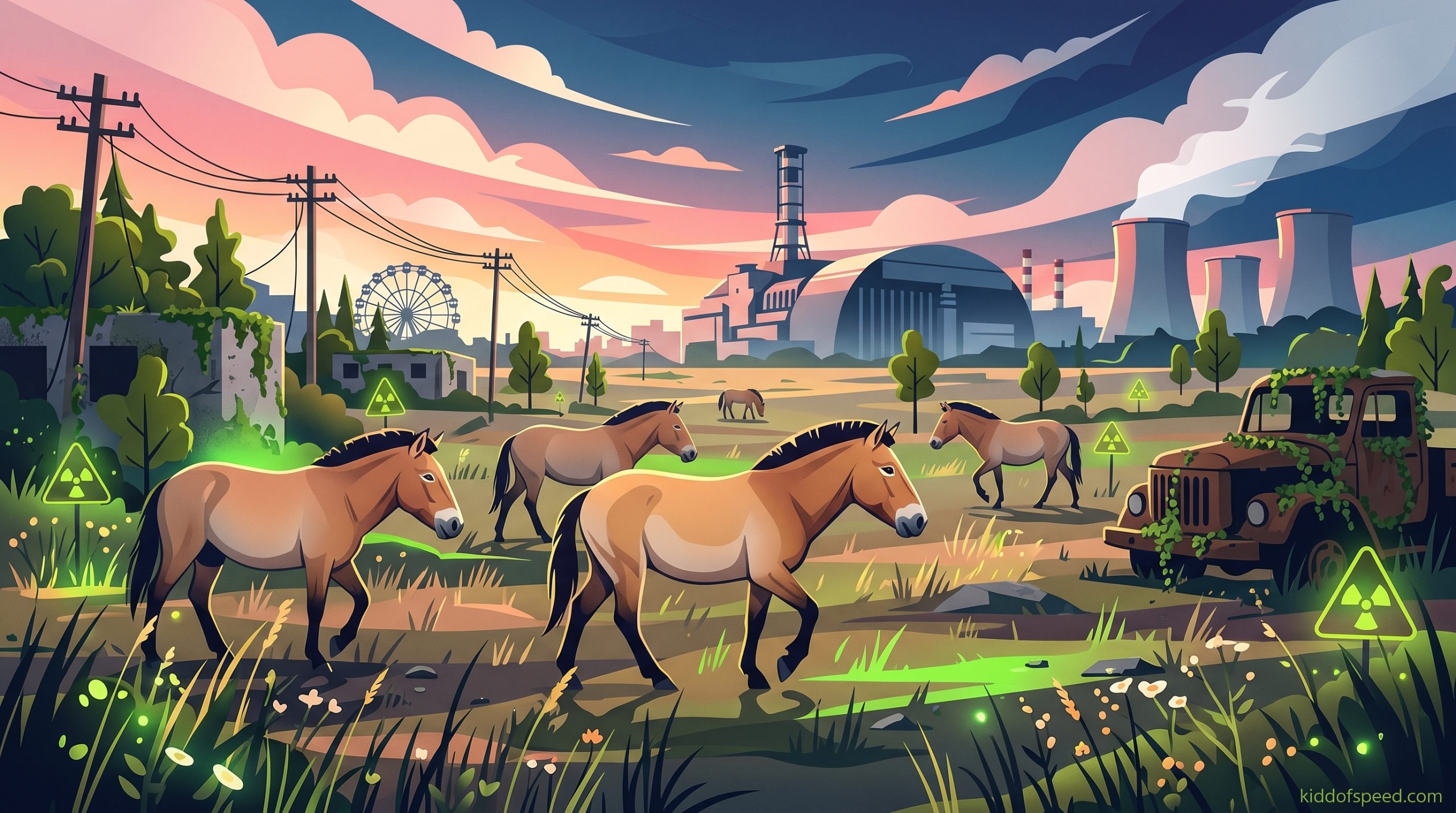
In the heart of a landscape that humans abandoned nearly four decades ago, a remarkable conservation success story continues to unfold. Przewalski horses Chernobyl have transformed the radioactive Exclusion Zone into an unlikely sanctuary, proving that nature finds a way even in the most unexpected places. These stocky, sand-colored equines now roam freely across a territory larger than Luxembourg, where radiation keeps people away but wildlife thrives.
I first became fascinated by this story when I learned that the world’s last truly wild horse species had found refuge in one of the most notorious places on Earth. Between 1998 and 2004, conservationists released 36 horses into the Chernobyl Exclusion Zone as an experiment. The population has since doubled, expanding beyond Ukraine’s borders into neighboring Belarus.
This article explores the complete story of these remarkable animals. We will examine why they were introduced, how they have adapted, what scientists have discovered through decades of research, and what this unique population means for global conservation efforts.
Table of Contents
- What Is the Chernobyl Exclusion Zone?
- The World’s Last Truly Wild Horse
- Why Przewalski Horses Were Introduced to Chernobyl
- Population Growth and Current Status
- Behavioral Observations: Life in the Zone
- The Wildlife Community of Chernobyl
- Research Challenges and the Impact of War
- How Many Przewalski Horses Are in Chernobyl Today
- Frequently Asked Questions About Przewalski Horses in Chernobyl
- The Future of Przewalski Horses in Chernobyl
What Is the Chernobyl Exclusion Zone?
The Chernobyl Exclusion Zone is a 1,000-square-mile restricted area surrounding the site of the 1986 nuclear disaster. When Reactor Number Four exploded on April 26, 1986, it released 400 times more radioactive material than the Hiroshima atomic bomb. Soviet authorities evacuated approximately 350,000 people from their homes, creating a human-free buffer that would last for generations.
In the nearly 40 years since the disaster, something unexpected happened. Without human activity, hunting, farming, or development, the zone transformed into an accidental wildlife preserve. Forests reclaimed abandoned villages, wolves returned to the landscape, and rare species found shelter in a place considered uninhabitable by human standards.
Scientists now describe this transformation as a “factory reset” for nature. The radiation, while still present, has proven less destructive to wildlife than human civilization. This accidental experiment in rewilding provided the perfect setting for one of conservation’s most ambitious projects: reintroducing the world’s last wild horse to its natural habitat.
The World’s Last Truly Wild Horse
Przewalski’s horse (Equus ferus przewalskii) represents something extraordinary in the equine world. Unlike domestic horses, which have been bred by humans for thousands of years, Przewalski’s horses evolved independently and remain genetically distinct. They carry 33 pairs of chromosomes compared to the 32 pairs found in domestic horses, making them a truly separate species.
Native to the steppes of Mongolia, these horses are known locally as “takhi,” which translates to “spirit horse” or “worthy of worship.” The name reflects the reverence Mongolian culture holds for these animals. They have never been successfully domesticated, maintaining their wild instincts and social structures despite centuries of human presence in their native range.
By the late 20th century, the species had vanished from the wild entirely. Hunting, habitat loss, and competition with domestic livestock had driven them to extinction in their natural range. Only captive populations in zoos and reserves kept the species alive. Conservationists faced a critical question: where could these horses safely return to the wild?
Physical Characteristics of Przewalski’s Horse
Przewalski’s horses possess distinctive features that set them apart from their domestic cousins. They have a stocky, compact build with a dun-colored coat that ranges from sand to reddish-brown. Their manes stand upright rather than flowing, and they typically develop a dark dorsal stripe along their backs.
These horses have a somewhat “toy-like” appearance compared to domestic breeds, with shorter legs and a more robust body structure. Their ears are proportionally larger and more mobile, helping them detect predators across the open steppe. Adult horses typically weigh between 550 and 800 pounds, with males being slightly larger than females.
Why Przewalski Horses Were Introduced to Chernobyl
The decision to introduce Przewalski horses to Chernobyl emerged from a combination of desperation and opportunity. By the late 1990s, conservationists had successfully bred captive populations, but they needed safe release sites. The Chernobyl Exclusion Zone offered vast tracts of steppe-like habitat with one crucial advantage: no human presence.
Between 1998 and 2004, conservation teams transported 36 horses from captivity to the Ukrainian side of the exclusion zone. The horses came from various European zoos and breeding programs, selected for genetic diversity to establish a healthy founding population. Researchers chose the area around the Polesie State Radioecological Reserve, where the landscape resembled their native Mongolian steppe.
The introduction served dual purposes. First, it aimed to establish a self-sustaining wild population of an endangered species. Second, it functioned as a long-term research project to study how large mammals adapt to landscapes with minimal human interference. Scientists hoped to learn valuable lessons applicable to other rewilding efforts worldwide.
Population Growth and Current Status
The Chernobyl Przewalski horse population has exceeded expectations. Within two decades, the initial 36 horses doubled their numbers, establishing a self-sustaining community that continues to expand. Camera trap studies and direct observation have documented steady population growth despite the challenging environment.
The success extended beyond Ukraine’s borders. Horses began crossing into Belarus, establishing satellite populations in the Polesie State Radioecological Reserve on the Belarusian side. This expansion demonstrated the horses’ natural dispersal behavior and their ability to thrive across the broader Chernobyl-affected region.
Genetic Diversity and Conservation Concerns
Maintaining genetic diversity remains an ongoing challenge for the Chernobyl population. A 2018 genomics study raised important questions about the long-term genetic health of reintroduced Przewalski horses worldwide. With a limited founder population, inbreeding poses risks that conservationists must monitor carefully.
Scientists track the Chernobyl population’s demographic information through camera traps, genetic sampling, and observation. This monitoring helps ensure sufficient genetic diversity persists across generations. The isolated nature of the exclusion zone, while protecting horses from human interference, also limits genetic exchange with other reintroduced populations.
Behavioral Observations: Life in the Zone
Motion-activated cameras deployed by researchers from the University of Georgia and other institutions have revealed fascinating insights into how these horses live. The footage shows Przewalski horses behaving much as they did in their native Mongolia, forming small family groups led by a single stallion with several mares and their offspring.
Perhaps the most surprising discovery involves the horses’ use of human structures. Abandoned barns, sheds, and farm buildings throughout the exclusion zone have become shelters for the horses, particularly during harsh winters. This adaptive behavior demonstrates the species’ flexibility in utilizing available resources.
Seasonal Patterns and Shelter Use
Camera trap data reveals distinct seasonal patterns in the horses’ behavior. During summer months, the horses range widely across open grasslands, grazing on the abundant vegetation that has flourished in the absence of agriculture. They form loose associations, sometimes gathering in larger groups near water sources.
Winter brings different challenges. Temperatures in the Chernobyl region regularly drop below freezing, and snow cover limits grazing opportunities. During these months, horses increasingly seek shelter in abandoned structures, sharing space with other wildlife including deer, moose, and occasionally predators like wolves.
Researchers documented horses entering barns and sheds, behavior rarely observed in their native Mongolia where such structures do not exist. This adaptation highlights the horses’ intelligence and survival instincts, allowing them to thrive in an environment vastly different from their evolutionary home.
The Wildlife Community of Chernobyl
The Przewalski horses share their radioactive refuge with an impressive array of wildlife. The exclusion zone hosts thriving populations of wolves, brown bears, lynx, moose, deer, beavers, and hundreds of bird species. This abundant mammal community has transformed Chernobyl into one of Europe’s most significant accidental nature reserves.
Denys Vyshnevskyi, the zone’s lead nature scientist, described the phenomenon as a “small miracle.” The absence of human activity proved more beneficial to wildlife than radiation was harmful. Hunting, habitat destruction, and pollution had previously devastated the region’s biodiversity. The disaster’s silver lining created space for nature to recover.
The concept of a “factory reset” resonates strongly when observing Chernobyl’s wildlife. The zone demonstrates how quickly ecosystems can rebound when human pressure disappears. Przewalski horses play a crucial role in this recovering ecosystem, functioning as large grazers that shape vegetation patterns and provide prey for predators.
Shared Shelter: A Unique Observation
University of Georgia researchers made a particularly interesting discovery regarding shared shelter use. Camera traps placed in abandoned buildings captured footage of multiple species using the same structures at different times. Horses, deer, moose, and even predators like wolves all utilized these human-made shelters.
This shared use suggests that shelter availability, rather than food competition, drives wildlife distribution during harsh weather. The abandoned structures scattered throughout the zone serve as critical refuges during winter storms, potentially reducing competition and enabling higher overall wildlife densities than would otherwise be possible.
Research Challenges and the Impact of War
Scientific study of the Chernobyl horses faced unprecedented disruption beginning in 2022. The Russian invasion of Ukraine brought military activity directly into the exclusion zone, damaging research infrastructure and forcing scientists to suspend many monitoring activities. Fires burned across the zone, and power grid damage affected automated camera systems.
The area became a military corridor during the conflict’s early phases, with troops and equipment moving through the very areas where horses had established their territory. Researchers could not access camera trap data, and some monitoring stations were destroyed or rendered inaccessible. The long-term study that had documented horse behavior since 2015 faced serious setbacks.
Despite these challenges, reports suggest the horse population survived the conflict’s initial phase. The horses’ wild nature and extensive range allowed them to avoid military concentrations. As of 2026, research activities have gradually resumed in areas where security permits, though full scientific access remains limited by ongoing conflict.
Future Research and Conservation Funding
The war has raised serious questions about long-term research continuity and conservation funding. International collaborations, including those with the University of Georgia and Arizona State University, faced disruption as Ukrainian scientists dealt with displacement and resource shortages. Grant funding for Chernobyl wildlife research has become uncertain as priorities shift.
Nevertheless, the Chernobyl Przewalski horse population remains a valuable scientific resource. When conditions permit, researchers hope to resume comprehensive studies of genetic diversity, population dynamics, and behavioral adaptation. The unique circumstances of this population offer insights applicable to rewilding projects worldwide.
How Many Przewalski Horses Are in Chernobyl Today
Determining the exact population of Przewalski horses Chernobyl hosts remains challenging due to the vast territory and research disruptions. Based on pre-war monitoring data and post-conflict observations, scientists estimate the population exceeds 70 individuals across the Ukrainian and Belarusian portions of the exclusion zone.
The population continues expanding into surrounding areas, demonstrating healthy reproduction rates and successful adaptation. Some horses have been observed up to 30 miles from their original release sites, establishing new territories and exploring the full extent of available habitat.
This growth validates the initial conservation strategy. The Chernobyl population has achieved the primary goal of establishing a self-sustaining wild community, contributing significantly to global Przewalski horse conservation efforts alongside populations in Mongolia, China, and other European reserves.
Frequently Asked Questions About Przewalski Horses in Chernobyl
What happened to the Przewalski’s horse?
Przewalski’s horse once ranged across the steppes of Central Asia but was driven to extinction in the wild by the late 20th century due to hunting, habitat loss, and competition with domestic livestock. Through dedicated captive breeding programs in zoos and reserves, the species survived in human care. Reintroduction efforts began in the 1990s, including the 1998-2004 releases into the Chernobyl Exclusion Zone. Today, wild populations exist in Mongolia, China, and the Chernobyl region, representing one of conservation’s most significant success stories.
Why are there Przewalski horses in Chernobyl?
Conservationists introduced Przewalski horses to Chernobyl between 1998 and 2004 as part of a reintroduction experiment. The 1,000-square-mile Exclusion Zone offered ideal conditions: vast steppe-like habitat with no human presence, hunting, or development. Thirty-six horses from European zoos and breeding programs were released to establish a self-sustaining wild population. The project aimed to save an endangered species while studying wildlife adaptation in a human-free environment.
Has anyone ever tamed a Przewalski horse?
No, Przewalski horses have never been successfully domesticated despite centuries of coexistence with humans in their native Mongolia. They maintain distinctly wild behavior patterns, including strong herd instincts and flight responses that make them unsuitable for domestication. Several attempts throughout history have failed, reinforcing their status as the world’s only truly wild horse species. They differ from feral horses, which are domestic horses living wild, because they evolved without human selective breeding.
Are there still mutated animals in Chernobyl?
Despite popular myths, significant animal mutations are not commonly observed in the Chernobyl Exclusion Zone. While radiation can cause genetic damage, the levels present in most of the zone do not produce the dramatic mutations often depicted in media. Wildlife populations, including Przewalski horses, appear healthy and reproducing normally. Scientific studies have not documented widespread abnormalities. The greater threat to wildlife in most regions remains human activity, which the exclusion zone successfully prevents.
The Future of Przewalski Horses in Chernobyl
The Przewalski horses Chernobyl shelters represent a living experiment with implications far beyond this single population. Their success demonstrates that rewilding can work even in compromised environments, offering hope for other endangered species facing habitat loss and human pressure elsewhere.
As we look toward the future, several questions remain. Will the population maintain sufficient genetic diversity for long-term viability? How will continued conflict in the region affect conservation efforts? Can the Chernobyl model be replicated in other human-excluded zones?
What seems certain is that these remarkable animals will continue roaming the abandoned villages and steppes of the exclusion zone for generations to come. The Chernobyl disaster, one of humanity’s greatest environmental catastrophes, has paradoxically created a sanctuary for the world’s last wild horse.
In the end, the story of Przewalski horses in Chernobyl reminds us that nature possesses remarkable resilience. Given space and protection, wildlife can recover from even the most challenging circumstances. These spirit horses of Mongolia, now at home in a radioactive landscape, embody the unexpected hope that can emerge from tragedy.