
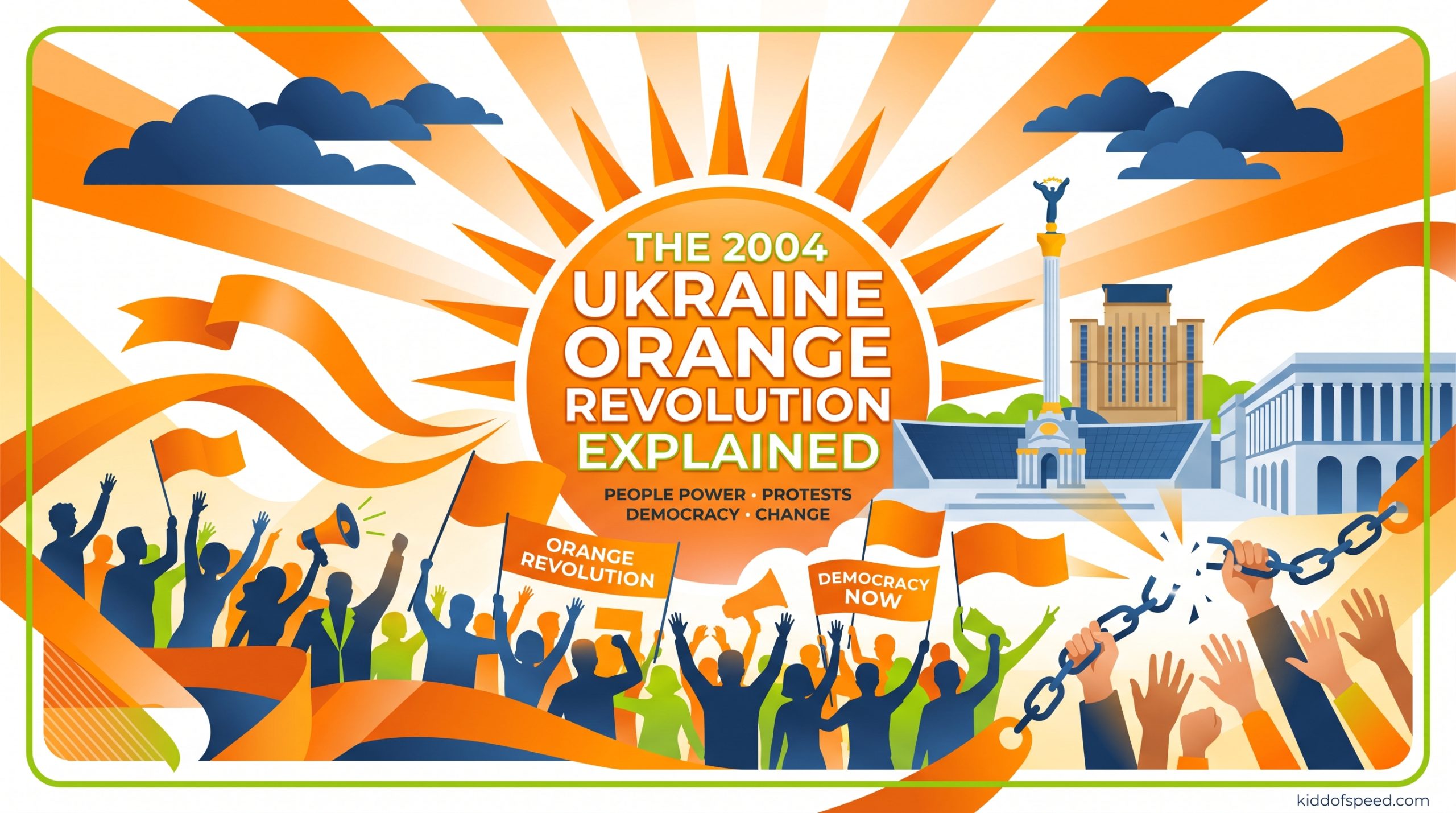
The Ukraine Orange Revolution 2004 was one of the most significant democratic movements in post-Soviet history. What strikes many historians most is how hundreds of thousands of ordinary Ukrainians peacefully took to the streets to defend their vote. The Orange Revolution transformed Ukraine’s political landscape and set in motion forces that would shape Eastern European geopolitics for decades to come.
From late November 2004 through January 2005, massive protests erupted across Ukraine following allegations of widespread fraud in the presidential election. What started as disputed election results became a nationwide movement that would become known as the Orange Revolution. This guide explains what happened, why it mattered, and how it changed Ukraine forever.
Table of Contents
- What Was the Orange Revolution?
- Historical Context: Ukraine in 2004
- Key Figures in the Orange Revolution
- The 2004 Presidential Election and Fraud Allegations
- Timeline of the Orange Revolution
- November 21, 2004: Election Day and Initial Results
- November 22, 2004: Protests Begin
- Early to Mid-November 2004: Mass Mobilization
- November 26, 2004: European Mediation
- November 29, 2004: Parliament Declares Election Invalid
- December 3, 2004: Supreme Court Rules
- December 8, 2004: Political Reform Package
- December 26, 2004: The Rerun Election
- December 28, 2004: Yushchenko Declared Winner
- January 23, 2005: Inauguration
- The Mass Protests and Civil Mobilization
- The Supreme Court Ruling
- International Reaction to the Orange Revolution
- Immediate Outcomes and the Yushchenko Presidency
- Orange Revolution vs Euromaidan: Understanding the Difference
- Long-Term Impact and Historical Significance
- Frequently Asked Questions About the Orange Revolution
- The 2004 Ukraine Orange Revolution Explained: Final Thoughts
What Was the Orange Revolution?
The Orange Revolution was a series of peaceful protests and civil disobedience actions that took place in Ukraine from November 2004 to January 2005. The movement began after the second round of the 2004 presidential election, when the Central Election Commission declared pro-Russian candidate Viktor Yanukovych the winner over reformist Viktor Yushchenko. Evidence of massive electoral fraud triggered an unprecedented popular uprising.
The movement earned its name from the orange color associated with Yushchenko’s campaign. Orange became the symbol of the democratic opposition and the people’s demand for fair elections. Protesters wore orange scarves, waved orange flags, and created an ocean of orange in Kyiv’s Independence Square that captured the world’s attention.
At its peak, approximately one million people gathered in Kyiv alone, with additional protests across the country. The revolution remained remarkably peaceful throughout, with no violent clashes or property destruction. This commitment to nonviolence became one of its defining characteristics and contributed significantly to its eventual success.
Historical Context: Ukraine in 2004
To understand the Orange Revolution, you need to understand the Ukraine that existed in 2004. Thirteen years after gaining independence from the Soviet Union, Ukraine remained divided between those who looked toward Europe and those who maintained strong ties to Russia. This division ran along geographic, linguistic, and cultural lines.
Western Ukraine, where Ukrainian language and identity remained strong, generally favored European integration and democratic reforms. Eastern Ukraine, with its Russian-speaking population and industrial ties to Russia, tended toward maintaining close relations with Moscow. President Leonid Kuchma had governed since 1994, walking a careful line between these factions while consolidating power.
By 2004, Ukraine’s economy was growing, but corruption remained rampant. Kuchma’s government faced accusations of authoritarianism and involvement in the unsolved murder of journalist Georgiy Gongadze. A new generation of Ukrainians, raised in an independent country, wanted their nation to embrace European democratic standards rather than continue the post-Soviet patterns of cronyism and corruption.
Key Figures in the Orange Revolution
Several individuals played crucial roles in the events of 2004. Understanding who they were and what they represented helps explain why the revolution unfolded as it did.
Viktor Yushchenko: The Reformist Candidate
Viktor Yushchenko emerged as the face of democratic reform in Ukraine. As Prime Minister from 1999 to 2001, he had gained popularity for economic reforms that stabilized the country after the Russian financial crisis. Yushchenko advocated for closer ties with the European Union and NATO, positioning himself as a Western-oriented alternative to the status quo.
In September 2004, Yushchenko fell seriously ill after dining with officials from Ukraine’s security service. He was diagnosed with dioxin poisoning, which left his face disfigured. Many Ukrainians believed the poisoning was politically motivated, ordered by elements within the government opposed to his candidacy. This apparent assassination attempt generated sympathy for Yushchenko and galvanized support for his campaign.
Viktor Yanukovych: The Establishment Candidate
Viktor Yanukovych represented the establishment and Russian interests. As Prime Minister under Kuchma, he promised continuity with existing policies and closer integration with Russia rather than the West. Yanukovych enjoyed the backing of Ukraine’s oligarchs and received overt support from Russian President Vladimir Putin, who visited Ukraine twice during the campaign.
Yanukovych’s base lay in eastern and southern Ukraine, where Russian language and culture predominated. His campaign portrayed him as a practical manager who would maintain stability and preserve Ukraine’s traditional ties to Russia. The fraudulent election that initially declared him winner became the catalyst for the Orange Revolution.
Yuliya Tymoshenko: The Firebrand Organizer
Yuliya Tymoshenko brought charisma and organizational skill to the opposition movement. Known for her braided hairstyle and fiery speeches, she became one of the most visible leaders of the protests. Tymoshenko had previously served as Deputy Prime Minister for energy and had built a reputation as a fierce critic of corruption.
Her ability to mobilize supporters and her uncompromising stance against the government made her a key figure during the revolution. She would later serve as Prime Minister under Yushchenko, though their alliance eventually fractured.
Leonid Kuchma and Vladimir Putin
President Leonid Kuchma sought to maintain influence by backing Yanukovych while managing the transition of power. Russian President Vladimir Putin actively intervened in Ukrainian politics, campaigning for Yanukovych and congratulating him prematurely on his “victory.” Putin’s involvement reflected Russia’s determination to keep Ukraine within its sphere of influence.
The 2004 Presidential Election and Fraud Allegations
The 2004 presidential election was supposed to mark Ukraine’s maturation as a democracy. Instead, it revealed the depths of electoral corruption in the country. The contest between Yushchenko and Yanukovych went to a runoff after neither candidate won a majority in the first round on October 31.
The runoff election on November 21, 2004, became one of the most fraudulent in modern European history. Exit polls conducted by reputable organizations showed Yushchenko winning by a margin of approximately 52 to 44 percent. However, the Central Election Commission, controlled by the government, announced results showing Yanukovych winning by nearly three percentage points.
The fraud was neither subtle nor sophisticated. Evidence emerged of multiple voting, voter intimidation, and falsified vote counts. In some regions, turnout figures exceeded 100 percent of registered voters. International observers from the Organization for Security and Co-operation in Europe (OSCE) documented widespread irregularities and declared the election fell short of democratic standards.
Perhaps most brazenly, the Russian state media reported Yanukovych’s victory before Ukrainian authorities had announced official results. Putin called to congratulate Yanukovych, a gesture that many Ukrainians interpreted as foreign interference in their sovereign affairs.
Timeline of the Orange Revolution
The Orange Revolution unfolded over approximately two months, from the disputed election in November to Yushchenko’s inauguration in January. Here is a detailed timeline of the major events.
November 21, 2004: Election Day and Initial Results
Ukrainians voted in the runoff election between Yushchenko and Yanukovych. Exit polls indicated a clear Yushchenko victory. However, as vote counting proceeded, the Central Election Commission reported results showing Yanukovych in the lead.
November 22, 2004: Protests Begin
Yushchenko called on supporters to gather in Kyiv’s Independence Square, known as Maidan Nezalezhnosti. Thousands responded, beginning what would become weeks of continuous protest. Opposition leaders declared they would not accept fraudulent results.
Early to Mid-November 2004: Mass Mobilization
The protests grew exponentially. By November 26, hundreds of thousands of people filled Maidan. Protesters established a tent city in the square, with volunteers providing food, medical care, and other necessities. Demonstrations spread to other cities, particularly in western Ukraine.
November 26, 2004: European Mediation
European Union leaders Javier Solana, Polish President Aleksander Kwasniewski, and Lithuanian President Valdas Adamkus arrived in Kyiv to mediate. Russia sent a delegation as well. Negotiations began between the opposition and government.
November 29, 2004: Parliament Declares Election Invalid
Ukraine’s parliament passed a non-binding resolution declaring the election invalid and expressing no confidence in the Central Election Commission. While not legally binding, this vote signaled growing institutional support for the protesters’ demands.
December 3, 2004: Supreme Court Rules
The Ukrainian Supreme Court ruled that the election results could not be recognized due to widespread fraud. The court ordered a new runoff election to be held on December 26. This decision represented a stunning victory for the opposition and validated the protesters’ demands.
December 8, 2004: Political Reform Package
Parliament passed constitutional reforms that would reduce presidential powers and increase the authority of the prime minister. This compromise helped convince some government supporters to accept a new election.
December 26, 2004: The Rerun Election
Ukrainians returned to the polls for a second runoff election. International observers monitored the vote closely. This time, the election proceeded with minimal irregularities. Exit polls again showed Yushchenko winning, and official results confirmed this outcome.
December 28, 2004: Yushchenko Declared Winner
The Central Election Commission certified Yushchenko as the winner with approximately 52 percent of the vote to Yanukovych’s 44 percent. Yanukovych challenged the results but ultimately conceded.
January 23, 2005: Inauguration
Viktor Yushchenko was inaugurated as President of Ukraine. Hundreds of thousands of Ukrainians who had supported the revolution celebrated in Kyiv. The Orange Revolution had achieved its immediate goal of fair elections and democratic transfer of power.
The Mass Protests and Civil Mobilization
The protests that defined the Orange Revolution were remarkable for their scale, discipline, and peaceful nature. At their height, approximately one million people gathered in Kyiv, with hundreds of thousands more participating in demonstrations across the country.
Maidan Nezalezhnosti became the symbolic and organizational heart of the revolution. Protesters established a tent city in the square that housed thousands of people around the clock. Volunteers organized food distribution, medical care, and security. The square functioned as a self-governing community, with stages for speeches and entertainment to maintain morale during the cold November and December days.
Women played a particularly significant role in organizing and sustaining the protests. They led volunteer networks, coordinated logistics, and maintained communication between different protest groups. The revolution was not simply a political event but a social mobilization that involved entire families and communities.
The protesters maintained strict nonviolence throughout the movement. When riot police were deployed, protesters responded with song and prayer rather than confrontation. This commitment to peaceful resistance denied the government any pretext for violent crackdown and maintained international sympathy for the opposition.
Orange became ubiquitous during the protests. Protesters wore orange ribbons, scarves, and hats. Buildings displayed orange banners. The color transformed from a campaign symbol to a representation of democratic aspirations. The visual impact of Kyiv’s orange-clad crowds became one of the revolution’s most enduring images.
The Supreme Court Ruling
The Ukrainian Supreme Court’s December 3 ruling was the turning point of the Orange Revolution. After reviewing extensive evidence of fraud presented by the opposition, the court declared the November 21 election results invalid.
The court found that the Central Election Commission had violated electoral law and that the election failed to express the will of the Ukrainian people. The justices ordered a new runoff election to be held by December 26, with enhanced monitoring to prevent fraud.
This ruling was significant for several reasons. It demonstrated that Ukraine’s judicial system could function independently under pressure. It provided a legal framework for resolving the crisis without resorting to extra-constitutional means. And it validated the protesters’ claims, giving them momentum to continue until a fair election could be held.
The court’s decision also made it difficult for the Yanukovych camp to maintain their claim to victory. While they initially resisted calls for a new election, the Supreme Court ruling removed their legal foundation.
International Reaction to the Orange Revolution
The Orange Revolution drew intense international attention and elicited sharply different reactions from Western democracies and Russia.
The European Union and United States strongly supported the protesters’ demands for fair elections. EU officials mediated between the opposition and government, helping negotiate a peaceful resolution. Western leaders made clear that any government resulting from fraudulent elections would not be recognized as legitimate.
Russia took the opposite position. President Putin openly supported Yanukovych and characterized the protests as Western-backed destabilization. Russian state media portrayed the revolution as a coup orchestrated by the United States and European powers. This narrative would become standard in Russian discourse regarding the event.
The divergent reactions reflected broader geopolitical competition for influence in post-Soviet space. For the West, the Orange Revolution represented a hopeful example of democratic transition. For Russia, it signaled dangerous encroachment on its traditional sphere of influence and a potential precedent for similar movements within Russia itself.
International election observers from the OSCE played an important role in documenting fraud and validating the rerun election. Their presence helped deter additional manipulation and provided credibility to the final results.
Immediate Outcomes and the Yushchenko Presidency
The Orange Revolution achieved its immediate goal of overturning fraudulent election results and installing Yushchenko as president. However, the promise of revolutionary change gave way to the messy realities of Ukrainian politics.
Yushchenko took office on January 23, 2005, amid widespread optimism. He appointed Yuliya Tymoshenko as Prime Minister, creating a powerful alliance between the revolution’s two most prominent leaders. The government promised to root out corruption, pursue European integration, and reform Ukraine’s economy.
Yet the Yushchenko presidency disappointed many who had supported the revolution. Infighting between the president and prime minister paralyzed the government. Tymoshenko was dismissed as prime minister in September 2005, marking the collapse of the revolutionary alliance. Corruption continued, economic reforms stalled, and Ukraine’s trajectory toward Europe remained uncertain.
By 2010, Ukrainians elected Viktor Yanukovych president in an election judged free and fair by international observers. The revolution’s standard-bearer had been defeated by the man the revolution had originally opposed. This outcome led many observers to question whether the Orange Revolution had achieved lasting change.
Despite these disappointments, the Orange Revolution established that Ukrainians could peacefully defend their democratic rights. The precedent of mass mobilization against electoral fraud would prove significant in the years to come.
Orange Revolution vs Euromaidan: Understanding the Difference
Comparing the Orange Revolution of 2004 to the Euromaidan protests of 2014 helps illuminate both movements and Ukraine’s political evolution over the decade between them.
Both movements began with disputed political decisions backed by Russia. In 2004, it was electoral fraud in the presidential election. In 2013-2014, it was President Yanukovych’s sudden refusal to sign an association agreement with the European Union. Both movements centered on Maidan Nezalezhnosti and drew support from Ukrainians seeking closer ties to Europe.
However, the differences are striking. The Orange Revolution remained peaceful throughout, while Euromaidan involved violent clashes with security forces that left over 100 protesters dead. The Orange Revolution concluded with legal resolution through the Supreme Court, whereas Euromaidan resulted in Yanukovych fleeing the country and a change of government outside constitutional procedures.
The geopolitical context had also shifted. By 2014, Russia was no longer content with diplomatic opposition to Ukrainian Western integration. Putin’s government responded to Euromaidan by annexing Crimea and supporting separatist movements in eastern Ukraine, launching a conflict that continues today.
The Orange Revolution failed to consolidate its gains, and many of its leaders disappointed their supporters. Ukrainians who participated in Euromaidan were aware of this history, yet they returned to the streets anyway. This suggests that the desire for democratic governance and European integration remained strong despite the Orange Revolution’s failures.
Long-Term Impact and Historical Significance
The Orange Revolution’s influence extends far beyond Ukraine’s borders and continues to shape Eastern European politics today. Understanding its legacy requires examining its effects on Ukraine, Russia, and the broader region.
For Ukraine, the revolution represented a national awakening. It demonstrated that Ukrainians could unite across regional and linguistic lines to defend their rights. The revolution accelerated the development of Ukrainian civil society and independent media. Even though its immediate political achievements proved temporary, the Orange Revolution established a baseline of democratic expectation that subsequent governments could not entirely ignore.
For Russia, the Orange Revolution triggered a fundamental shift in policy. The Kremlin interpreted the revolution as Western interference and a potential template for similar movements in Russia itself. Putin’s government responded by cracking down on domestic opposition, establishing control over media, and developing the information warfare capabilities that would later be deployed against Ukraine and other targets.
The Orange Revolution was the first in a wave of “color revolutions” in post-Soviet states, followed by similar movements in Georgia, Kyrgyzstan, and elsewhere. These revolutions became a central concern of Russian foreign policy and contributed to the deterioration of Russia’s relations with the West.
The revolution’s legacy also includes its connection to the 2022 full-scale Russian invasion. Putin’s determination to prevent Ukraine from pursuing a Western-oriented path, which he saw confirmed by the Orange Revolution and Euromaidan, contributed to his decision to launch the largest European military conflict since World War II. The Orange Revolution thus stands as a pivotal moment in the chain of events that led to the current crisis.
Frequently Asked Questions About the Orange Revolution
Why is it called the Orange Revolution?
The movement is called the Orange Revolution because orange was the campaign color of Viktor Yushchenko. Protesters adopted orange scarves, flags, and ribbons as symbols of their support for democratic reform. The color became so ubiquitous during the protests that media worldwide used it to describe the movement.
Was the Orange Revolution peaceful?
Yes, the Orange Revolution was remarkably peaceful. Despite involving hundreds of thousands of protesters over several weeks, there were no violent clashes with police or property destruction. Protesters maintained strict nonviolence throughout, responding to potential confrontation with song and prayer rather than aggression.
Who was involved in the Orange Revolution?
Key figures included Viktor Yushchenko, the reformist candidate who became president; Yuliya Tymoshenko, the charismatic opposition leader; Viktor Yanukovych, the establishment candidate backed by Russia; Leonid Kuchma, the outgoing president; and Vladimir Putin, the Russian president who supported Yanukovych. Most importantly, hundreds of thousands of ordinary Ukrainians participated in the protests.
What caused the Orange Revolution?
The immediate cause was widespread fraud in the November 21, 2004 presidential runoff election. The Central Election Commission declared Yanukovych the winner despite exit polls showing Yushchenko ahead. Underlying causes included frustration with corruption, desire for European integration, regional tensions between pro-European West and pro-Russian East, and the poisoning of Yushchenko which generated sympathy for his candidacy.
Was the Orange Revolution successful?
The Orange Revolution achieved its immediate goal: overturning fraudulent election results and installing Yushchenko as president through a fair rerun election. However, it failed to deliver lasting democratic transformation. Yushchenko’s presidency was plagued by infighting and corruption, and Yanukovych won the presidency in 2010. The revolution established precedents for peaceful protest and democratic mobilization that would prove significant later.
The 2004 Ukraine Orange Revolution Explained: Final Thoughts
The 2004 Ukraine Orange Revolution stands as a defining moment in post-Soviet history. Hundreds of thousands of Ukrainians demonstrated that peaceful protest could overturn electoral fraud and install a government through democratic means. The revolution established Ukraine’s democratic credentials on the world stage and set the country on a path toward European integration.
Yet the Orange Revolution also illustrates the difficulty of consolidating democratic gains. The Yushchenko presidency disappointed many supporters, and the man the revolution opposed returned to power through constitutional means just six years later. The revolution did not resolve Ukraine’s fundamental divisions or end Russian interference in its politics.
Understanding the Orange Revolution remains essential for anyone seeking to understand Ukraine today. The movement’s legacy shaped the Euromaidan protests a decade later, influenced Russia’s policy toward its neighbor, and contributed to the geopolitical tensions that exploded in 2022. The Orange Revolution was not merely a historical event but the beginning of a process that continues to unfold.