
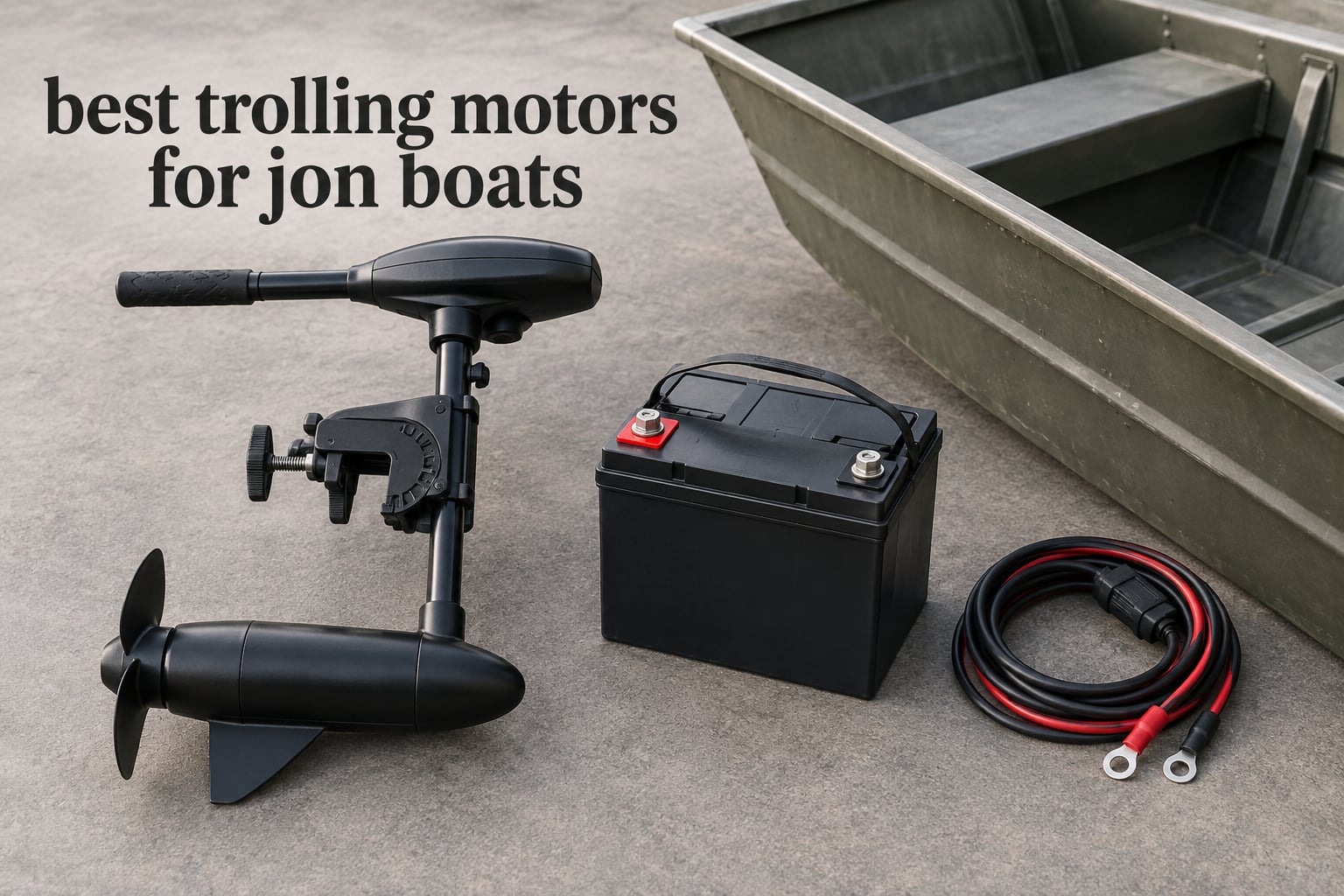
The best trolling motors for jon boats are 12-volt transom mounts in the 30 to 55 lb thrust range, sized so the motor can hold a spot on a light aluminum hull without overpowering it. On a 10-12 ft jon boat, a 30 to 35 lb unit is plenty. On a 14-16 ft jon boat carrying two anglers, a cooler, and a livewell, step up to 55 lb of thrust on 12 volts.
That is the short version. Jon boats are a genuinely different case from the fiberglass and pontoon hulls most trolling motor guides assume. The aluminum hull is light, the sides are low, the freeboard is minimal, and the whole boat sits nearly motionless in a crosswind. A motor that feels ample on a 20 ft bass boat can feel anemic on a 14 ft jon boat in October, because the jon boat has almost no mass to resist being pushed around.
Everything in this guide is built around that reality. We compared eight transom-mounted motors that make sense on an aluminum jon hull, looking closely at thrust class, shaft length, speed control type, salt and freshwater rating, and the failure patterns owners actually report. We also leaned on long-run owner accounts from Tin Boats and Ultimate Bass, because three years of use on one hull teaches you more than any spec sheet.
If your boat is smaller than a jon boat, our trolling motors for kayaks guide covers the 10 to 20 lb class, and the canoe guide goes smaller still. If your jon boat runs in brackish water or tidal marsh, read the saltwater fishing guide as well, because corrosion decides how long a motor lasts there.
Table of Contents
- Top 3 Picks: Trolling Motor Picks for Jon Boats (October 2026)
- All 8 Best Trolling Motors for Jon Boats in 2026
- How We Chose These Motors
- 1. Minn Kota Endura C2 30 – Quiet, Simple Choice for a 10-14 Foot Jon Boat
- 2. Newport NV-Series 55 – Best All-Rounder for Lakes and Creeks
- 3. PEXMOR 55 lb 8-Speed – Budget Pick with a Spare Prop
- 4. Minn Kota Endura Max 55 – Digital Power Management for Long Slow Days
- 5. AQUOS Haswing 65 Brushless – Most Thrust for a Loaded Hull
- 6. Goplus 55 lb 8-Speed – Mid-Range Shaft in a Composite Head
- 7. VEVOR 55 lb 8-Speed – Weed-Cutting Power in a Sealed Head
- 8. Minn Kota Traxxis 55 – Longest Shaft in the Group
- How Much Thrust Does Your Jon Boat Need?
- How Fast Will a Jon Boat Actually Go on a Trolling Motor?
- Transom Mount vs Bow Mount on a Jon Boat
- Shaft Length, Freeboard, and Shallow Stumpy Water
- Battery Placement, Voltage, and All-Day Runtime
- Freshwater vs Saltwater, Warranty Length, and Known Failure Modes
- Frequently Asked Questions
- What is the best motor for a jon boat?
- What size trolling motor do I need for a jon boat?
- How fast will a jon boat go with a trolling motor?
- Should a jon boat use a transom mount or a bow mount trolling motor?
- How do I know what size shaft I need for my boat?
- Where should the battery go on a jon boat?
- Is Spot-Lock worth it on a jon boat?
- Who makes the most reliable trolling motors?
- Final Verdict: Which Jon Boat Trolling Motor Should You Buy?
Top 3 Picks: Trolling Motor Picks for Jon Boats (October 2026)

Minn Kota Endura C2 30
- 30 lb thrust
- 12V
- 30 in composite shaft
- 15 lb motor weight
- 5 forward and 3 reverse speeds

Minn Kota Endura Max 55
- 55 lb thrust
- 12V
- 36 in shaft
- Digital Maximizer runtime
- push-to-test battery meter
The Endura C2 30 is the default answer for a small jon boat because a 15 lb motor at 30 lb of thrust is the rare combination that is genuinely easy to carry, genuinely quiet, and genuinely proven on this hull type. The Newport NV-Series 55 is the pick if you need more thrust and the aluminum build matters to you. The Endura Max 55 is the one to buy if you intend to run a single battery all day.
All 8 Best Trolling Motors for Jon Boats in 2026
| Product | Specifications | Action |
|---|---|---|
| Minn Kota Endura C2 30 |
|
Check Latest Price |
| Newport NV-Series 55 |
|
Check Latest Price |
 PEXMOR 55 lb 8-Speed PEXMOR 55 lb 8-Speed |
|
Check Latest Price |
| Minn Kota Endura Max 55 |
|
Check Latest Price |
 AQUOS Haswing 65 Brushless AQUOS Haswing 65 Brushless |
|
Check Latest Price |
 Goplus 55 lb 8-Speed Goplus 55 lb 8-Speed |
|
Check Latest Price |
 VEVOR 55 lb 8-Speed VEVOR 55 lb 8-Speed |
|
Check Latest Price |
 Minn Kota Traxxis 55 Minn Kota Traxxis 55 |
|
Check Latest Price |
How We Chose These Motors
We did not run instrumented thrust tests on a dynamometer. Nobody publishing a jon boat roundup does, and any that claims otherwise is making it up. What we did was work from published specifications, the volume of owner reviews behind each model, and the patterns that show up repeatedly across those reviews.
We weighted four things. Thrust class against loaded hull weight came first. Shaft length against the boat’s freeboard came second. Then we looked at whether the motor is rated for the water you actually fish, and finally at durability, which on a jon boat means shaft and lower-unit survival in rocks, gravel, and submerged timber.
Owner history is a real signal here, not a soft one. A motor with a few hundred reviews and a long, consistent ownership story tells you more about a 12 ft jon boat than a model with a large but thin review count. We also read the one-star reviews closely, because early failures cluster there.
We may earn a commission when you buy through the links on this page, at no extra cost to you. That does not change the order of the picks.
1. Minn Kota Endura C2 30 – Quiet, Simple Choice for a 10-14 Foot Jon Boat
Minn Kota Endura C2 30 Freshwater Transom Mounted Trolling Motor (30″ Shaft)
30 lb thrust on 12V
30 in composite shaft
15 lb motor weight
5 forward and 3 reverse speeds
Pros
- Quiet enough not to spook fish on clear water
- Light enough for one person to lift onto a small transom
- Proven on 10-16 ft jon boats over years of owner use
- Power Prop pushes through heavy vegetation
Cons
- Reverse is weak and froths the water
- Short foot leaves little room for a transducer mount
- Battery connection is bolt-on rather than plug style
Here is the motor I keep coming back to for a small jon boat. The 30 lb of thrust is not a headline number, but on a 10 to 12 ft aluminum hull with one angler in it, 30 lb is exactly the muscle you need to hold a spot, walk a shoreline, and back out of a tight pocket. The motor itself weighs 15 lb, which sounds unremarkable until you are lifting it onto a low transom by yourself at a launch ramp.
Reviews on this model are unusually long-lived. Owners talk about 500 hours and a decade of service on the same hull, which tells you something about the composite shaft and the gear set. The 10-position lever lock bracket is reinforced composite, and it does not flex or warp the way an aluminum bracket on a light hull can.
Speed control is five forward and three reverse, which is more than enough to troll a slow presentation. The telescoping tiller is six inches, and the one-hand tilt lets you get the prop out of the water without wrestling with a release lever every time you reach a bank.
The shaft is 30 inches of composite, and the prop is a Power Prop sized for motors with a 3-1/4 in diameter head. The prop kit includes the prop pin, nut, and washer, which is one less errand after a long day on the water.
What the Endura C2 30 does well on a jon boat
Weight is the quiet advantage. At 15 lb, this is a motor one adult can lift into a jon boat without a second pair of hands, and that matters more on a jon boat than on a decked boat because the transom is low and awkward to work over.
Runtime is strong for a fixed-speed resistor design because there is no electronics drawing idle current. If your day is repositioning and casting rather than long slow presentations, the five-speed setup costs you nothing and gives you a simpler motor with fewer failure points.
Where it will disappoint you
Reverse is the honest weakness. Owners report frothing the water without much push, and the common workaround is to turn the tiller around and use forward thrust to back up. It works, but it is not the same as a real reverse gear.
Second, the bracket foot is short, so fitting a transducer mount means shimming. On a boat set up for fish finding, plan for that before the motor arrives. And several owners note that 30 lb is the floor for a jon boat with two people aboard, not a comfortable margin.
2. Newport NV-Series 55 – Best All-Rounder for Lakes and Creeks
Newport NV-Series 55lb Thrust Saltwater Transom Mounted Trolling Electric Trolling Motor w/ LED Battery Indicator & 30″ Shaft (23M1000203)
55 lb thrust on 12V
30 in shaft
Saltwater rated aluminum
5-LED battery meter
Pros
- Tops the trolling motor sales rank with a large review base
- 55 lb of thrust from a 3-blade prop for low-end push
- Aluminum build rated for salt water
- Adjustable and lockable mount angle height and direction
Cons
- Heaviest motor in the group at 23.2 lb
- Needs a deep cycle battery and benefits from the breaker
- Battery not included so full runtime depends on your pack
If one motor had to cover a jon boat used on a lake in July and a tidal creek in October, this is the one. It is a 12-volt 55 lb transom mount built on an aluminum body and rated for salt water, with a 30 inch shaft and a three-blade propeller. That combination puts it in the middle of this roundup on thrust and at the top on versatility.
The review base is the largest here, more than 3,300 ratings, and the sales rank sits at the top of the trolling motor category. That matters for a jon boat buyer because it means parts, advice, and troubleshooting knowledge are easy to find when something goes wrong.
Runtime is the quiet strength. Owners report all-day running on a single deep cycle battery, and the five-LED battery meter on the head removes the guesswork about when to head back to the ramp. The spec sheet lists roughly 4 mph as the top speed depending on hull and conditions, with a maximum amp draw of 52A.
The mount is adjustable in angle, height, and direction, and each adjustment locks. On a jon boat where you may be switching between trolling in the bow and repositioning at the stern, being able to lock a setting and leave it is worth more than it sounds.
It needs one 12V lead-acid or lithium deep cycle battery, with 50 amp hours recommended. A 50 amp circuit breaker is included, which is one thing you do not have to source separately. A tilt handle and a six inch telescoping tiller round out the control set.
Why this one works in more places than the others
The saltwater rating is the deciding spec for anyone moving between fresh and brackish water. A freshwater-only motor in a tidal creek is a motor you are slowly destroying, and the corrosion shows up in the shaft, the head, and the terminals rather than as one clean failure.
For river and backwater work, 55 lb of thrust with a three-blade prop is the amount of low-end torque that lets you hold a position against running current rather than merely drift. The three-blade design also pushes through heavy vegetation better than a two-blade, which matters in backwater and weedy lakes.
What to watch out for
At 23.2 lb, this is the heaviest motor in the group, and owners on small boats flag that as a real inconvenience. Loading it into a 10 ft jon boat is a two-person job in many cases, which undercuts the convenience of a transom mount in the first place.
A minority of reviews reports motors that shudder, trip a breaker, or lose their seal within a few uses. That is a small but real cluster, and it is the main reason this motor sits at second rather than first. The reverse gear is more useful than the Endura C2 30’s, but it is still a resistor-controlled three-speed reverse, not a heavy-duty backup.
3. PEXMOR 55 lb 8-Speed – Budget Pick with a Spare Prop
PEXMOR 8 Speed Electric Trolling Motor, Electric Outboard Boat Motor w/Adjustable Handle & LED Indicator, Transom Mounted for Saltwater, Kayak, Fishing Boat (Grey, 55 LBS)
55 lb thrust on 12V
Spare prop included
Adjustable shaft depth and angle
1-10 LED battery indicator
Pros
- Serious thrust for its tier
- Runs all day on a 100Ah lithium battery
- Spare propeller included for fouled blades
- Knob and button shaft depth and angle adjustment
Cons
- Plastic transom mount and tilt hardware feel cheap
- No battery terminal clamps included
- Small review base of 52 ratings
- One owner reported failure within two months
This is the pick if your jon boat is small, your runs are short, and you are outfitting the whole boat on a budget. It is a 12-volt 55 lb transom mount with a three-blade prop, eight speeds, and a spare prop in the box. For a 10 to 12 ft boat with one or two people, that is more thrust than the hull needs.
The review base is thin at 52 ratings, so treat the star figure as directional rather than proven. Within that base, owners generally describe good value and note that the motor runs all day on a 100Ah lithium battery. Several say the feel is comparable to a Minn Kota at a fraction of the outlay.
Adjustment is where this motor earns its keep. Shaft depth is set with a knob and shaft angle with a button, so you can dial in the trim for a shallow creek on one trip and a deeper lake on the next without tools. The handle is a six inch telescoping adjustable unit, and the LED indicator runs 1 to 10 rather than 3 or 5 levels.
Note that the same product family is offered at 26, 36, 46, 55, and 86 lb. This listing is the 55 lb black variant, so check which variant you are actually looking at before you commit, because the thrust class and the prop both change.
When this budget motor makes sense
If your boat is a 10 ft jon, you fish lakes rather than salt water, and you would rather spend the difference on a good battery and a proper seat, this motor makes the math work. Fifty-five pounds of thrust on a hull that weighs a couple of hundred pounds is not a subtle upgrade over a 30 lb motor. It is a different capability class.
The included spare prop is a genuinely useful detail. Fouled blades are the most common reason a motor leaves the water mid-trip, and having a second blade means you are not paddling home.
Where the cost savings come from
The transom mount and tilt hardware are plastic, and owners notice the difference next to a metal-bracketed motor. That is where the money was saved, and on a hull that bumps docks and stumps, a flexing bracket is not a trivial compromise.
No battery terminal clamps are included, so you may need to source your own. One owner reported a failure inside two months, and with a 52-rating review base that is noise rather than a trend. It is still exactly the kind of risk a one-year warranty does not cushion.
4. Minn Kota Endura Max 55 – Digital Power Management for Long Slow Days
Minn Kota Endura Max Transom-Mount Electric Trolling Motor – 55 Lb. Thrust, 36 In. Shaft, Freshwater
55 lb thrust
36 in composite shaft
Digital Maximizer power management
Push-to-test meter
Pros
- Digital Maximizer extends runtime on a single battery
- 55 lb covers two anglers and gear
- Composite shaft resists flexing and impact
- Ten-position lever lock bracket
Cons
- Freshwater labeling only so not ideal for brackish water
- Heavier and costlier than 30 lb class motors
- Composite lower unit is lighter but less rigid than metal
The Endura Max is the step up from the 30 lb Endura, and the step that matters most is not thrust. It is the Digital Maximizer power management system, which pulses only the current each speed setting needs rather than feeding the motor everything on the dial. On a jon boat running off one deep cycle battery, that is the difference between a full day and a long morning.
At 55 lb of thrust on 12 volts with a 36 inch composite shaft, this is the configuration most 14 to 16 ft jon boats want. Two anglers, a cooler, a tackle box, and enough thrust to hold a spot in a crosswind.
The push-to-test battery meter reads state of charge with a button press instead of leaving you to guess, and the 10-position lever lock bracket uses the same reinforced composite as the smaller Endura, so it resists the flexing and UV damage a light aluminum hull amplifies.
Why runtime is the deciding factor here
Forum users make the point repeatedly: if you reposition and cast rather than making long slow presentations, a fixed-speed motor is fine and cheaper. The digital premium only pays off for slow all-day work, and on a jon boat that means fishing a shoreline, working a creek, or presenting a lure for hours.
If that is your use, the extended runtime is the single most valuable feature in this roundup. If it is not, the Endura C2 30 already does the job.
What the extra money does not buy
The Endura Max is labeled for fresh water. That is a real limitation if your boat touches brackish bays, tidal creeks, or estuary backwater, and it is the main reason this motor does not take the top spot for a boat that splits its season between lakes and salt.
The lower unit is composite rather than aluminum, which is lighter and resists flexing but is less rigid than a metal alternative when it meets a rock at speed. And at 55 lb with a 36 inch shaft, this is more motor than a 10 to 12 ft jon boat needs. On a small hull, more motor is not always better.
5. AQUOS Haswing 65 Brushless – Most Thrust for a Loaded Hull
AQUOS Haswing 12V 65lbs 35.5in Brushless Transom Trolling Motor
65 lb brushless thrust on 12V
Step-less forward and reverse
35.5 in shaft
Two-year warranty
Pros
- Highest thrust rating in this roundup
- Brushless motor roughly doubles runtime versus a brushed 55 lb
- Light for its thrust class at about 19.8 lb
- Step-less control gives very fine trolling speeds
Cons
- Causes EM and RF interference with some fish finders
- Audible whine and vibration at the lowest settings
- No circuit breaker included
- Tilt handle and head feel less durable than metal-bodied rivals
Look at this motor if your jon boat is 16 ft or longer, loaded with gear, and you fish where wind and current both push back. At 65 lb of thrust it is the highest number in this roundup, and unlike bigger multi-battery models it still runs on a single 12V system.
What separates it from everything else here is the brushless motor. Owners report a full-throttle draw of roughly 40 amps and 20 to 26 amps at cruising throttle, with around 40 percent of the battery capacity unused after a ten-hour day. Against a brushed 55 lb motor, that is the difference that matters on a boat with one battery box.
Control is step-less in both directions rather than a fixed gear selector, so you can dial a trolling speed between settings instead of hunting for the nearest notch. The tilt system locks into ten positions, the battery indicator has three levels, and the lower end is compact enough to clear a transom-mounted outboard.
Warranty is two years on the entire motor, and it is rated for both fresh and salt water. Shaft length is listed at 24.6 inches in the specifications and 35.5 inches overall in the listing title, so measure your freeboard before ordering.
When a brushless motor earns its place
Run one battery and want to be out all day, and brushless efficiency is worth more to you than a heavier build. A brushed motor at this thrust class would weigh far more to carry and draw much harder on a single deep cycle pack. This one weighs about 19.8 lb.
The step-less control also solves a specific trolling problem. On a resistor-controlled motor you are limited to discrete speeds, and the slowest one may still be too fast for a shallow creek presentation. A stepless dial gives you the speed you actually want.
What owners complain about
The most serious documented drawback is electromagnetic and radio frequency interference. Multiple owners report it disrupting their fish finders, including when the motor runs on a separate power supply. On a jon boat where space forces the motor wiring and the transducer wiring into the same cable run, this is not a hypothetical problem.
There is also an audible whine and some vibration at the lowest speed settings, which can matter in clear water. No circuit breaker is included, so add one. Several owners also find the tilt handle and head unit less durable than a metal-bodied motor, so handle the tiller gently.
6. Goplus 55 lb 8-Speed – Mid-Range Shaft in a Composite Head
Goplus Electric Trolling Motor 8 Speed, 55 Lbs Thrust Boat Fishing Motor w/Telescoping Handle, Two-bladed Propeller, LED Battery Indicator and 36″ Shaft for Freshwater Saltwater Use (55LBS)
55 lb thrust on 12V
36 in composite shaft
Die-cast aluminum head
8 speeds with LED indicator
Pros
- Longer 36 in shaft helps reduce cavitation in chop
- Quiet at full speed with smooth handle control
- Composite shaft and reinforced materials resist salt water
- LED gauge helps plan when to add a battery
Cons
- Several motors reported dead within months
- Two-blade prop struggles in heavy vegetation
- Weak warranty support relative to coverage advertised
- Less power separation between forward speeds
The case for this motor is shaft length. At 36 inches it is longer than most of the transom motors here, and a longer shaft is the simplest way to keep the propeller buried in the water in a chop, where a short shaft lets the prop break the surface and cavitate. If your jon boat gets pushed around in open water, that is worth paying attention to.
Construction is glass fiber composite rods with a die-cast aluminum head, listed for both fresh and salt water use. Speed control is eight settings, five forward and three reverse, on a dial at the top of the telescoping handle, with an LED battery level indicator. A fuse is wired to trip before the motor burns out in heavy weeds.
When it works, buyers report real power. Owners describe pushing a 15 ft flat-bottom boat with two people into a head wind, which is a heavier test than most jon boats ever face.
Why the shaft length matters in chop
Shaft length is not just about reaching deeper water. It is about how much of the shaft is in the water when the boat is moving. A short shaft on a low-freeboard jon boat comes out of the water in waves, and a propeller that comes out of the water loses thrust and eventually cavitates, which sounds like a rattling growl under load.
Longer also costs you clearance. A longer shaft and lower unit are more likely to find a stump, a rock, or a log on the bottom. Which matters more depends entirely on where you fish.
The reliability picture is the concern
This motor has the lowest rating in the roundup at 4.0, with 12 percent one-star and 9 percent two-star reviews. The dominant complaint theme is early failure: motors arriving dead, stopping after two or three uses, or losing gears inside two years with poor warranty resolution.
The two-blade prop is also less able to cut heavy vegetation than a three-blade, which is the opposite of what you want in a weedy backwater. Owners also note less change between forward speeds, so the speed control is less useful than the number of settings suggests. Buy it knowing the early-failure rate, and keep the receipt.
7. VEVOR 55 lb 8-Speed – Weed-Cutting Power in a Sealed Head
VEVOR Electric Trolling Motor, Transom Mounted Outboard Boat Motors 12V 55lbs Thrust, 8-Speed Electric Boat Engine w/Battery Indicator, for Kayaks, Fishing Boats on Freshwater/Saltwater, 30-In Shaft
55 lb thrust on 12V
30 in aluminum alloy shaft
Sealed aluminum motor head
Three-blade prop
Pros
- Three-blade prop tuned for low-speed torque and reduced tangling
- High-strength aluminum shaft and sealed head for corrosion resistance
- Telescoping handle adjustable from 6.3 to 10.6 in
- Adjustable shaft height and transom bracket
Cons
- Only one propeller included
- Build inconsistency shows in the one-star share
- Speed varies noticeably with load and wind
- Manual unit with no GPS option at this level
For a jon boat fishing weedy lakes, hydrilla beds, or a backwater with a lot of submerged growth, the propeller is the deciding part. This motor comes with a three-blade prop explicitly tuned for low-speed torque and reduced tangling, which is a different design goal from the high-speed thrust most of these motors are optimized for.
The build detail that matters is the shaft and head. It uses a high-strength aluminum alloy shaft with a sealed waterproof aluminum motor head, rated for corrosion resistance, and the whole motor is listed at 20.3 lb. On a hull that will bump bottom in a shallow creek, an aluminum shaft is a stiffer, more repairable platform than a composite one.
Control is eight speeds, five forward and three reverse, with a telescoping handle that adjusts from 6.3 to 10.6 inches so it works whether you steer standing or seated. Shaft height and the transom bracket are both adjustable. At 30 inches, the shaft sits in the middle of the pack for a jon boat.
The listing also covers 24V 86 lb and GPS-equipped 12V 55 lb variants at 36 and 54 inches. This is the manual 12V 55 lb with a 30 inch shaft, so verify the variant when the box arrives.
Where the aluminum build earns its keep
Composite shafts are light and they flex, which is good, until you hit something. A Tin Boats owner who ran a composite-shaft motor for three years in rivers with real current described repeated contact with logs, rocks, gravel, sand, and dirt, and concluded that shaft durability mattered more to him than the lowest price.
That experience is the argument for this motor and for the Traxxis below. If your jon boat fishes structure and current rather than open water, shaft strength is not a detail you can ignore.
What to be careful about
Only one propeller is included, and there is no spare in the box. If a blade fouls in heavy vegetation, you are either swapping a part or paddling.
The rating of 4.1 comes with a 12 percent one-star share, the kind of number that usually points to build inconsistency at a given tier rather than one isolated fault. Owners also note that actual speed varies noticeably with boat weight, wind, and water conditions, so do not judge the motor by a single run. On a loaded 16 ft hull, 55 lb of thrust is a working number rather than a comfortable one.
8. Minn Kota Traxxis 55 – Longest Shaft in the Group
Minn Kota Traxxis Transom-Mount Electric Trolling Motor – 55 Lb. Thrust, 42 in. Shaft, Freshwater
55 lb thrust on 12V
42 in shaft
One-hand stow
Quick-Cam depth system
Pros
- 42 in shaft gives the deepest reach in this roundup
- One-hand stow and thumb-release deployment into ten positions
- Adjustable steering tension collar for feel
- Digital Maximizer runtime with a push-to-test meter
Cons
- Most expensive motor in the roundup
- 42 in shaft is more motor than a small jon boat needs
- Mixed 3-star and 1-star share for the outlay
At 42 inches, the Traxxis has the longest shaft of any motor in this roundup, and shaft length is the feature that separates it. On a jon boat working a steep drop-off, a channel edge, or a deep backwater pool, the extra reach is the difference between holding a spot over the fish and fishing above them.
It is also a 55 lb 12V motor at about 17.6 lb, which is a reasonable weight for that thrust. The tiller tilts up to 45 degrees and extends up to six inches, and the Quick-Cam depth system locks in your trim depth once you set it, so the motor does not creep upward as the battery drains over a long day.
Stowing is genuinely good. You pull the tiller up and forward and the motor collapses with no buttons or release levers, and a thumb release deploys it into one of ten positions. On a jon boat with a low transom, where you are lifting the prop over the back of the hull constantly, that convenience is real.
The steering tension collar above the mount lets you dial in the feel you want, which matters because tiller steering on a light hull is either too stiff or too loose out of the box. Digital Maximizer and the push-to-test battery meter round out an otherwise well-considered package, backed by a two-year warranty.
When a 42 inch shaft is the right call
Measure your freeboard at the bow before you order. A 42 inch shaft on a boat with low freeboard means a lot of shaft above the transom, which eats angler space and can feel unwieldy on a small hull. If your boat routinely works water deeper than about 6 feet, the extra reach pays for itself immediately.
It is also the shaft to consider if your boat sees current. A deeper shaft holds the prop in a cleaner column of water when a river pushes you, which helps the motor bite rather than just churn.
Where the money goes further than it needs to
This is the most expensive motor in the roundup, and for a 10 to 16 ft jon boat the honest question is whether you need 42 inches of shaft and one-hand stow. Owners buying it for smaller boats frequently describe it as more motor than the hull requires, which means more weight at the transom and more trim sensitivity on a light hull.
Its 3-star share is elevated for the outlay, which is the same pattern buyers report on other premium motors in this category: satisfaction is high, but the value calculation is not automatic. Our bass boat trolling motor guide covers the cases where a long shaft and digital controls start to make more sense.
How Much Thrust Does Your Jon Boat Need?
The rule of thumb is 2 lb of thrust for every 100 lb of loaded boat weight, and on an aluminum hull the formula alone will undersize you. A jon boat’s listed weight is hull only, so add two anglers, a cooler, tackle, and a livewell before you read anything into the number.
Do not take a 10 ft jon boat with one angler and a tackle box and order 8 lb of thrust. The formula produces a number that is technically correct and practically useless, because a hull with almost no momentum needs real authority simply to fight a crosswind. The practical floor on any jon boat is 30 lb.
Jon boat length to thrust and voltage, the framework to keep in your head:
10 to 12 ft jon boat, one angler: 30 to 35 lb of thrust on 12 volts. This is the Endura C2 30 class, and it is genuinely enough.
14 to 16 ft jon boat, two anglers and gear: 55 lb of thrust on 12 volts. This is the sweet spot and the most common answer in this roundup.
16 to 18 ft loaded jon boat, wind and current: 65 lb or more, and if you can accept the weight, a 24V system. The 65 lb brushless motor is the single-battery version of that answer.
River current deserves its own note, because flat-water thrust ratings do not describe it. A Tin Boats owner ran a 45 lb 12V composite-shaft motor on a heavy 15 ft jon boat in rivers for three years and reported that power was adequate for holding spots and drifting slowly upstream, but could not power quickly against strong current.
He would choose 12V at 45 to 55 lb again, and said more power would have been welcome. Plan on at least the middle of the range if you fish moving water.
How Fast Will a Jon Boat Actually Go on a Trolling Motor?
Fast enough to get somewhere before the fish notice, and slower than most buyers expect. The manufacturer’s stated top speed for a 55 lb transom motor is around 4 mph under favorable conditions. A 30 lb motor on a small jon boat will manage less.
Use these as planning numbers rather than specifications, because hull weight, load, wind, and current all move them:
10 ft jon boat, 30 lb motor, one angler: roughly 3 to 3.5 mph
14 ft jon boat, 55 lb motor, two anglers: roughly 3.5 to 4 mph
16 ft loaded jon boat, 55 to 65 lb motor: roughly 3 to 3.5 mph into wind, a little more running downwind
Trolling speed is the number that matters for presentations, and it is much lower than top speed. The lowest one or two speed settings on a 30 lb motor are the ones to use for a slow lure. Step-less control on a brushless motor gives you more usable slow speed than a five-speed resistor setup, which is why it is worth something on a clear-water boat.
Transom Mount vs Bow Mount on a Jon Boat
A transom mount is the correct default for a jon boat, not a budget compromise. It costs less, weighs less, installs in minutes without drilling, stores in the same space as the battery, and can be moved between boats. On a low-freeboard hull with limited deck, that combination of simplicity and weight distribution wins.
A bow mount pulls the boat straight, which matters more on a long, light hull, and offers far better steering precision because the thrust applies ahead of the pivot point. An Ultimate Bass poster running a 36 lb bow mount on a jon boat reports that it moves the boat well, while noting the tiller is less convenient in tight quarters. Bow mounts also add installation work, a second battery, longer cable runs, and fore-aft trim changes.
None of the eight motors in this roundup is a bow mount. If you want that steering precision, you are starting a different search, and you should budget for a second battery and longer cable runs before you commit.
If you are still comparing hull classes, our inflatable boat motor guide covers the lightweight end of the market.
Shaft Length, Freeboard, and Shallow Stumpy Water
Measure freeboard at the bow, from the top of the hull to the waterline, then add 16 to 20 inches. That total is a reasonable shaft length. On a jon boat, that formula often lands shorter than the shaft that comes in the box, which is normal. A 30 inch shaft is the everyday answer, 24 to 25 inches is for shallow work, and 36 to 42 inches is for open water, chop, and depth.
The tradeoff runs both ways. Too short and the prop cavitates in chop as it breaks the surface. Too long and the lower unit drags through stumps, rocks, and gravel, which on a river is not a hypothetical risk. One owner described his motor regularly hitting logs, rocks, gravel, sand, and dirt in river use, and used that experience to justify buying for shaft durability over price.
For shallow water, prop choice matters as much as shaft length. A three-blade weedless prop is built to cut through vegetation without losing thrust, and it is the better choice in hydrilla and heavy weed. On truly stumpy water, no prop saves you, and a shallow water anchor is often the more sensible tool.
Adjustable shaft depth, offered on the PEXMOR, the VEVOR, and the Traxxis, lets you change trim without changing motors. On a boat that alternates between a shallow creek and a deep lake, that is worth more than a fixed choice made in the driveway.
Battery Placement, Voltage, and All-Day Runtime
A jon boat’s trim is unusually sensitive to weight because the sides are low and the freeboard is small. A battery hung off the stern or set off-center will visibly squat the hull, and a low-sided hull that is sitting down in the water handles badly in a crosswind. Put the battery low and centered, ideally forward of the motor, and check the boat’s attitude with the battery in before you add anything else.
Ring terminals with wing nuts beat battery clips. Forum users who have had connection failures point to clipped terminals and corrosion as the cause, and the fix costs almost nothing. Recharge wet-cell lead acid within 12 to 24 hours; forum users consistently identify not recharging in time as the leading cause of early battery death, which is a battery problem masquerading as a motor problem.
On voltage, a 24V system means two batteries and considerably more weight on a hull that was never wired to carry it. That is why every motor in this roundup runs on 12 volts. If you need more than 65 lb of thrust, a brushless 12V motor is a better answer for a jon boat than doubling your battery weight.
River fishers who only reposition and cast rather than making long slow presentations can run a fixed-speed motor and a smaller battery. The digital premium is for full-day slow work.
Freshwater vs Saltwater, Warranty Length, and Known Failure Modes
Do you need a saltwater-rated motor for a freshwater jon boat? No. Do you need one if your boat ever touches brackish water, a tidal creek, or an estuary? Yes, and the cost of getting that wrong is a corroded shaft and a ruined head. Most corrosion failures are gradual and then sudden. A fresh rinse after every saltwater trip matters more than the label on the box.
Warranty length is a usable quality signal because it reflects how confident a brand is in the electronics and lower unit. Two-year coverage on the Minn Kota, Newport, and AQUOS motors here is a meaningful difference from the one-year term on the PEXMOR and the weak support owners report on the Goplus, where advertised coverage and actual resolution diverge.
Reliability patterns are consistent across owner reports. In one MotorGuide account on Tin Boats, a 45 lb composite-shaft motor ran three years in rivers with adequate power, but the motor head repeatedly worked loose, let water in, and destroyed the control board. The head and shaft repairs together cost close to a replacement motor, so the owner bought a new motor instead and ruled out that brand. No MotorGuide appears in this roundup, but the failure mode is worth recognizing in any brand: a head that separates from the shaft will let water in and kill the board behind it.
The other recurring failures are simpler. Budget motors in the 4.0 to 4.1 rating range show early failures: motors arriving dead, losing gears, or quitting within a few months. Weak reverse is common on entry-level transom motors. A brushless motor can also interfere with your fish finder, which on a jon boat is a wiring problem before it is an electronics problem.
Check where your transducer cable and motor cable run before you drill a single hole, and keep the motor’s power lead away from the electronics bundle. On a low-sided jon boat that is a five-minute job that prevents a frustrating day.
Frequently Asked Questions
What is the best motor for a jon boat?
A 12-volt transom mount is the right answer for almost every jon boat. For a 10 to 12 ft hull with one angler, 30 to 35 lb of thrust is enough. For a 14 to 16 ft boat carrying two anglers, a cooler, and a livewell, use 55 lb of thrust on 12 volts. The Minn Kota Endura C2 30 is the pick for small hulls and the Endura Max 55 for loaded boats that need all-day runtime.
What size trolling motor do I need for a jon boat?
Use 2 lb of thrust per 100 lb of loaded weight as a starting point, then add for wind and current because a light aluminum hull has no momentum to resist being pushed. In practice, 10 to 12 ft jon boats want 30 to 35 lb, 14 to 16 ft boats want 55 lb, and a loaded 16 to 18 ft boat in wind or current wants 65 lb or more.
How fast will a jon boat go with a trolling motor?
Plan on roughly 3 to 4 mph. A 55 lb transom motor is rated at around 4 mph under favorable conditions, and a 30 lb motor on a small jon boat will manage closer to 3 mph. Wind, load, and current all reduce that, and it is slow by design. Trolling speeds for presentations are much lower than top speed, so use the lowest one or two settings.
Should a jon boat use a transom mount or a bow mount trolling motor?
Use a transom mount unless you have a long, decked-out hull. A transom mount is lighter, costs less, installs without drilling, and stores with the battery, which suits a low-freeboard jon boat. A bow mount pulls the boat straight and steers with far more precision, but needs a second battery, longer cable runs, and more installation work. None of the eight motors reviewed here is a bow mount.
How do I know what size shaft I need for my boat?
Measure freeboard at the bow from the top of the hull to the waterline, then add 16 to 20 inches for your shaft length. A 30 inch shaft is the everyday choice for a jon boat, 24 to 25 inches suits shallow stumpy water, and 36 to 42 inches is for chop, open water, and depth. Too short cavitates in waves, too long drags through stumps and rocks.
Where should the battery go on a jon boat?
Low and centered, forward of the transom motor, so the hull does not squat. Low freeboard makes trim very sensitive, and a battery hung off the stern or set off-center visibly changes how the boat sits and handles in a crosswind. Use ring terminals with wing nuts rather than clips, and recharge wet-cell lead acid within 12 to 24 hours to avoid killing the battery.
Is Spot-Lock worth it on a jon boat?
It depends on how much you reposition. Spot-Lock holds a position so you can cast without holding the tiller, which is worth a lot on a light hull that blows sideways in wind. If you mainly reposition and cast instead of holding a spot, a fixed-speed motor is enough. None of the eight motors in this roundup includes a GPS anchor, so this is an upgrade considered separately from thrust.
Who makes the most reliable trolling motors?
Warranty length is a usable proxy, and the two-year terms on the Minn Kota, Newport, and AQUOS motors here reflect more confidence than a one-year term. Long review histories matter too: the Endura C2 30 and Newport NV-Series have thousands of ratings spanning years, while lower-rated budget motors here show recurring early failures within months. Shaft durability matters as much as electronics on a river boat.
Final Verdict: Which Jon Boat Trolling Motor Should You Buy?
For most jon boats, the Minn Kota Endura C2 30 is the right starting point. It is light, quiet, proven over years on this hull type, and 30 lb of thrust is genuinely enough for a 10 to 12 ft boat with one angler in it. If you carry two people, gear, and a livewell, go to 55 lb on 12 volts instead, and pick the Newport NV-Series for a boat that touches salt water or the Endura Max 55 for all-day slow work on a single battery.
Add the AQUOS 65 brushless when your boat is loaded and you want maximum thrust without doubling your battery weight, and the Traxxis 55 when you need real shaft reach in deeper water. The budget-tier motors in this roundup work, but they carry higher early-failure rates and shorter warranties, which is a poor trade on a hull that works in rocks and current. Measure your freeboard, weigh your loaded boat, and match the shaft to the water before you order.