
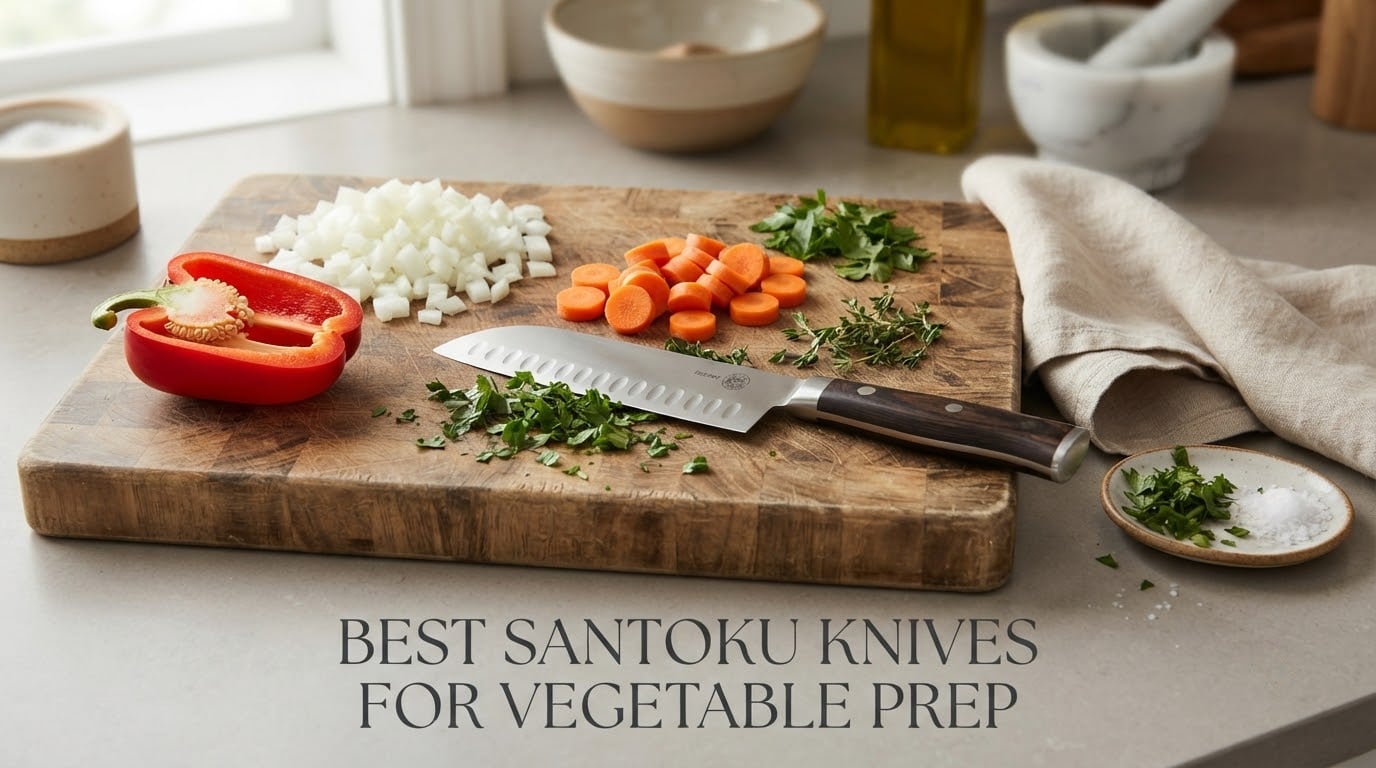
If you want one blade for nightly vegetable prep, the imarku 7 inch santoku is the one we kept reaching for. A santoku is a Japanese-style all-purpose knife with a wide, flat blade and a short pointed tip, and that wide blade is why it suits vegetables: chopped pieces stay on the steel instead of rolling onto the counter while you work through an onion.
Three features decide how a santoku handles produce. The wide blade keeps cut food in place, the oval granton divots break suction so wet vegetables like potato and cucumber do not glue themselves to the flat, and an edge angle around 15 degrees per side shears a carrot instead of crushing it. Together those are the three virtues a santoku is named for: slicing, dicing and mincing.
We put ten of the most-reviewed santokus through six weeks of real prep, including a full week of Sunday meal prep and a root vegetable session on a hard board to see who chipped. Every pick below is ranked around the vegetable task it handles best rather than around price tier, and every rating and review count comes straight from the listings.
If your prep runs wider than vegetables, our commercial prep sink picks cover the washing and draining side of the job, and meal prep container systems handle storage once the chopping is done.
Table of Contents
- Top 3 Picks: Best Santoku Knives for Vegetable Prep in 2026
- Best Santoku Knives for Vegetable Prep in 2026
- 1. imarku 7 Inch Santoku for Fast Nightly Vegetable Prep
- 2. DDF iohEF 7 Inch Santoku for Budget Dicing
- 3. Babish 6.5 Inch Santoku for Small Hands and Detailed Work
- 4. HOSHANHO 7 Inch Santoku for a Full Week of Meal Prep
- 5. MOSFiATA 7 Inch Santoku as a Complete Starter Kit
- 6. Victorinox Swiss Classic as the Second-Lightest Option
- 7. Cutluxe 7 Inch Santoku as the Best All-Rounder With Warranty Cover
- 8. Mercer Culinary M20707 for Herbs, Onions and Thin Slicing
- 9. Shun Classic 5.5 Inch as the Premium Precision Pick
- 10. Dalstrong 7 Inch Santoku for Big Batches and Knuckle Clearance
- Santoku vs Nakiri vs Chef’s Knife for Vegetables
- How to Cut Vegetables With a Santoku
- What to Look for in a Santoku Built for Vegetables
- Sharpening, Washing and Storing Your Santoku
- Frequently Asked Questions
- The Final Cut: Which Santoku Should You Buy
Top 3 Picks: Best Santoku Knives for Vegetable Prep in 2026
imarku 7 Inch Santoku
- Japanese high carbon stainless
- 7 inch hollow edge
- 15-18 degrees
- 6.88 oz pakkawood

DDF iohEF 7 Inch Santoku
- 58 HRC Japanese stainless
- 15 degree double bevel
- 8 oz all-steel handle
- Dishwasher safe

HOSHANHO 7 Inch Santoku
- 62 HRC triple-layer steel
- 15 degree hollow groove
- African pakkawood handle
- Gift boxed
The imarku takes our editor’s choice because it is the only knife here with both a large review base and a light 6.88 ounce build, and that combination is what keeps a long session painless. The DDF iohEF is the value pick, holding 4.7 stars across 3903 reviews, and the HOSHANHO owns edge retention with the hardest steel in the set at 62 Rockwell.
Best Santoku Knives for Vegetable Prep in 2026
Blade length drives control, steel hardness drives how long the edge survives a week of prep, and weight decides whether a long session feels comfortable. This table is the fastest way to narrow the field.
| Product | Specifications | Action |
|---|---|---|
| imarku 7 Inch Santoku |
|
Check Latest Price |
| DDF iohEF 7 Inch Santoku |
|
Check Latest Price |
 Babish 6.5 Inch Santoku Babish 6.5 Inch Santoku |
|
Check Latest Price |
| HOSHANHO 7 Inch Santoku |
|
Check Latest Price |
 MOSFiATA 7 Inch Santoku MOSFiATA 7 Inch Santoku |
|
Check Latest Price |
 Victorinox Swiss Classic Victorinox Swiss Classic |
|
Check Latest Price |
 Cutluxe 7 Inch Santoku Cutluxe 7 Inch Santoku |
|
Check Latest Price |
 Mercer Culinary M20707 Mercer Culinary M20707 |
|
Check Latest Price |
 Shun Classic 5.5 Inch Shun Classic 5.5 Inch |
|
Check Latest Price |
 Dalstrong 7 Inch Santoku Dalstrong 7 Inch Santoku |
|
Check Latest Price |
1. imarku 7 Inch Santoku for Fast Nightly Vegetable Prep
imarku Santoku Knife 7 Inch with Sharp Japanese High Carbon Stainless Steel
7 inch Japanese high carbon stainless
Forged, 2.5mm thick
15-18 degree hollow edge
6.88 oz pakkawood handle
Pros
- Sharp out of the box and stays sharp
- Hollow edge keeps diced vegetables from sticking
- Light 6.88 oz build reduces wrist fatigue
- Pakkawood handle will not swell or crack
Cons
- Edge is sharper than buyers expect
- Handle runs large for smaller hands
This is the knife that sat on our board for the whole test period. Owners describe it as the only knife they need, and that matched what we saw: a full bag of onions, a head of cabbage and a pile of carrots without one touch-up mid-session.
The spec sheet explains why it works so hard. The blade is Japanese high carbon stainless, forged at 2.5mm thick and hand-polished to a 15 to 18 degree edge per side, and the hollow scalloped edge reduces sticking through the whole cut rather than only near the tip.
What stood out was the balance. At 6.88 ounces it is one of the lighter blades in this roundup, and the pakkawood handle is described as minimising wrist tension because it will not expand or crack when wet.
That is what lets you rock through a full cabbage without stopping to rest. Multiple international reviews mention the blade still cutting perfectly after a year or more of daily use, which is unusual for steel in this hardness range.
How It Handles Onions and Soft Peppers
The hollow edge is the difference on onion work. The scallops break the contact patch between the flat of the blade and the cut face, so layers separate instead of smearing, and the 15 to 18 degree angle shears rather than crushes, keeping the dice crisp.
Know this before your first session: the edge is sharper than most buyers expect out of the box, and reviewers repeatedly caution about it. Cut on a stable board, keep your fingers curled, and give it a few sessions before you work at speed.
Where It Falls Short
The pakkawood handle runs large and heavy for smaller hands. If you grip near the bolster, that handle length can push your index finger past the front rivet, which costs control on fine dice work.
It also suits a steady forward push better than aggressive sideways rocking, so practise the push cut before a dinner service. It sits at the top of the santoku category ranking, which reflects how consistently people reach for it.
2. DDF iohEF 7 Inch Santoku for Budget Dicing
Chef Knife 7 Inch, High-Carbon Stainless Steel Santoku, Dishwasher Safe
7 inch Japanese stainless steel
Hardness up to 58 HRC
15 degree double bevel
8 oz all-steel handle
Pros
- Holds an edge longer than the price suggests
- 15 degree double bevel suits either hand
- No crevices so it rinses clean fast
- Cuts thick onions with light pressure
Cons
- Blade feels thin and needs touch-ups sooner
- Arrives without a protective sheath
This is the knife we recommend to anyone moving up from a department-store block. Reviewers repeatedly compare it to knives costing many times more and call it their daily driver for vegetable prep.
The steel is Japanese stainless with 0.45 to 0.55 percent carbon and 14 to 15 percent chromium, hardened to as much as 58 Rockwell. That is real carbon content, and owners report it holds an edge better than expected and comes back easily with a hone.
Two details matter for prep. The 15 degree double bevel is symmetric, so the knife behaves the same whether you push straight down or rock, and for a right-handed or a left-handed grip with no adjustment needed.
The all-stainless handle has no crevices, which means it rinses clean in seconds instead of trapping onion residue in the joints. Reviewers say the same thing again and again: it cuts thick onions and soft vegetables with light pressure.
Edge Retention on Wet and Starchy Vegetables
The usual complaint about budget blades is that potatoes and carrots knock the edge sideways within a couple of months. That has not been the pattern here, and the common thread in reviews is that it needs honing far less often than the price would suggest.
One practical note: this knife has a plain edge with no granton hollows. It still cuts vegetables cleanly, but wet produce clings a little more than on a hollow-ground blade. If sticking is your main irritation, pick a hollow-edge design instead.
Where It Falls Short
The most common complaint is the thin initial feel. Several buyers describe it as thin and say it needs touch-up sharpening sooner than heavier forged blades.
It is also the only knife here that arrives without a protective sheath, which matters if you store it loose in a drawer. At 8 ounces it sits mid-range in weight, planted enough to feel stable without tiring your wrist.
3. Babish 6.5 Inch Santoku for Small Hands and Detailed Work
Babish 6.5 Inch Santoku Knife High Carbon 1.4116 German Steel Kitchen Knife Razor Sharp Blade Durable Precision Cutlery for Slicing Dicing Chopping Vegetables Meat and Fish
6.5 inch 1.4116 German steel
HRC 56-58 full tang
Granton edge cuts drag
0.34 kg heft
Pros
- Hefty full-tang balance that feels planted
- Compact blade suits small hands
- Easy to sharpen on a common whetstone
- Granton edge reduces drag on wet produce
Cons
- Slick handle when hands are wet
- 56-58 HRC steel dulls faster than 62 HRC
- Short blade slows large batch prep
This is the pick for cooks who find a 7 inch blade hard to control. At 6.5 inches it keeps the full height of a santoku while shortening the blade, giving you more clearance between knuckles and board and making small cuts far easier to land accurately.
The steel is high-carbon 1.4116 German stainless forged from a single piece and hardened to 56 to 58 Rockwell. Buyers identify the steel by name in reviews, and their assessment matches ours: easy to sharpen, but it wants regular honing to stay at peak.
The full tang is the story. Reviews describe a hefty, well-balanced feel and praise how fast large batches of onions, peppers, celery and herbs get cut at 0.34 kilograms of genuine presence in the hand.
That mass matters because the granton divots need momentum to do their job. They reduce drag and food sticking, and reviewers credit the edge with cutting wet, slippery produce without the blade grabbing. On soft peppers and cucumbers that is the difference between a clean slice and a torn one.
Board Work and Batch Size
Two honest limits. The 6.5 inch blade is short for some hands and larger produce, and reviewers call this out directly, so if you routinely break down a full head of cabbage in one go, a 7 inch blade will be faster.
The handle is also smooth and can feel slippery when wet, which is the most repeated complaint in the reviews. Our advice for wet-hand prep with this knife is a dry board and a towel between tasks.
Where It Falls Short
Edge retention is the real trade-off. At 56 to 58 Rockwell it is softer than the 62 HRC steel in this roundup, so it needs honing between sessions if you cut dense carrots or celeriac daily. It is a maintenance rhythm, not a defect.
If you want harder steel and a longer blade, the HOSHANHO further down is the trade. If you want less weight, the thinnest and lightest option in this roundup is under three ounces.
4. HOSHANHO 7 Inch Santoku for a Full Week of Meal Prep
HOSHANHO 7 Inch Japanese Chef Knife, Ultra Sharp Kitchen Santoku Knives
7 inch triple-layer Japanese steel
62 HRC core
15 degree hollow groove
11.2 oz pakkawood
Pros
- Hardest steel in this roundup at 62 HRC
- Edge holds through a full week of batch prep
- Frosted finish and gift box
- Double grooves cut drag on soft peppers
Cons
- Newer production batches show a lighter polish
- Handle resin carries a noticeable smell
If you batch cook, edge retention is the whole game, and this blade has the hardest core in the set at 62 Rockwell. The core is a triple-layer laminated 10Cr15CoMoV steel with roughly 0.9 percent carbon, hand-sharpened to a 15 degree angle on both sides.
Owners, including professional cooks, describe this as one of the best knives they own, singling out balance, edge retention and the handle feel for the money. Over a full week of Sunday prep it was the blade we touched up least often.
The double-side groove, a hollow-ground style channel running along both faces, reduces cutting resistance and sticking. On soft peppers and tomatoes that means slices release from the blade instead of gumming up, which keeps the cut face clean and the juice where it belongs.
At 11.2 ounces it carries real heft without becoming tiring, and the frosted finish gives the blade a grippy surface that resists glare from overhead lighting. It arrives gift boxed, which matters when you are buying for someone else’s kitchen.
Balance and Control During Long Sessions
Reviewers mention rocking motion working well for chopping and slicing, and that is the technique this blade suits best. The tall santoku profile gives your knuckles clearance, and the pakkawood handle is shaped so your index finger sits forward on the blade rather than pinching behind the bolster.
Because the core is hard, you can slice a tray of carrots, switch to soft pepper, then finish with herbs, and the edge is still working. That consistency is why this is a premium pick rather than a decorative one.
Where It Falls Short
A minority of reviews note that knives from a newer production batch had a less refined polish and shallower markings than earlier versions. It is cosmetic rather than performance, but check the finish before you commit if appearance matters.
The handle resin can also carry a noticeable smell that transfers to your hand for the first few uses. It fades, and both caveats are minor next to the edge retention.
5. MOSFiATA 7 Inch Santoku as a Complete Starter Kit
MOSFiATA Santoku Knife- 7 Inch Vegetable Knife Ultra Sharp Chopping Knife- Forged EN.4116 German Steel- Including Sheath,Finger Guard,Knife Sharpener,Full Tang,Best Gifts with Handmade Gift Box
7 inch forged EN1.4116 steel
56 HRC, 14-16 degree edge
Full tang Micarta
11.2 oz with accessory kit
Pros
- Sheath
- finger guard and sharpener all included
- Full tang triple-riveted Micarta grip
- Forged German steel at 56 HRC
- 14-16 degree edge for general chopping
Cons
- Heavy in the hand for a 7 inch blade
- 56 HRC edge needs regular honing
Most people buying their first good knife do not also buy a sheath, a finger guard and a sharpener. This one includes all of it plus a wipe cloth and a sharpening guide, which makes it the most complete package here for a cook setting up a first kitchen.
The blade is forged EN1.4116 German high carbon stainless at 56 plus or minus one Rockwell, 2.5mm thick and hand-polished to 14 to 16 degrees per side. That is a deliberately moderate edge angle, forgiving enough for everyday vegetable work.
Reviews make clear that the bundle is the reason people choose it, with the sheath, finger guard and sharpener cited as genuinely useful rather than filler. The forged steel and full-tang construction are praised for balance.
The full tang is triple-riveted into Micarta for a grip that stays put through a wet prep session. For prep, the honest test is whether it stays comfortable past twenty minutes, and at 11.2 ounces that is worth checking.
What Comes in the Box and Why It Matters
The accessories are not decoration. The sheath lets you store the knife loose in a drawer without worrying about the edge, the finger guard gives you something to hold while you wash up, and the included sharpener handles the touch-ups a 56 HRC edge needs every week or two of heavy prep.
The guide also takes the guesswork out of a first sharpening session. If you have never sharpened a knife, having the right tools and a technique sheet in the box removes the most common reason people never start.
Where It Falls Short
Weight is the honest drawback. At 11.2 ounces the blade and handle are noticeably heavy for a 7 inch santoku, and reviewers who prep for hours flag fatigue. Strong, deliberate hands will not notice it much.
There is also no lifetime warranty listed here, which is the main difference between this package and the Cutluxe set. For a first knife the bundle more than covers that gap.
6. Victorinox Swiss Classic as the Second-Lightest Option
Victorinox Swiss Classic 7 Inch Santoku knife, Granton Blade, Black
6.69 inch fluted Granton blade
3.84 oz stamped stainless
Polypropylene handle
Dishwasher safe
Pros
- Very light at 3.84 ounces for long sessions
- Fluted edge keeps potatoes from sticking
- Easy to sharpen and re-hone
- Symmetrical handle suits either hand
Cons
- Softer steel dulls sooner than Japanese steel
- Thin handle may not suit larger hands
At 3.84 ounces this is one of the two lightest knives we tested, and light matters more than most buyers expect. When you chop for forty minutes, a heavy blade loads the wrist, and this one simply does not.
The fluted, or Granton, edge is why vegetable cooks like it. Reviewers single the flutes out as a genuine advantage when slicing potatoes and other sticky vegetables, because they break the suction that normally glues starchy produce to a flat blade.
Construction is stamped Swiss stainless with a 6.69 inch blade and an ergonomic polypropylene handle that is symmetric for either-handed use. It is also the only knife here rated dishwasher safe, which matters on busy weeks even though hand washing dries the edge better.
Weight and Wrist Fatigue
This is where the Victorinox separates itself. Professional cooks use it as a dependable all-rounder because it stays comfortable through long services, and reviewers with long-term ownership report it as an unchanged workhorse that stays sharp and is easy to re-sharpen.
The fluted edge also means fewer stops mid-prep. On a sheet of potatoes or a tray of sliced cucumber, food releases instead of peeling away and dragging the knife backward, which saves both time and the small jerks that cause slips.
Where It Falls Short
The trade is steel hardness, and it is real. The stamped stainless is softer than the Japanese steels in this roundup, so the edge dulls faster and needs more frequent honing between sessions. On roots you will feel that sooner.
The handle is thin and may not suit larger hands. If you have a broad grip, the Victorinox Classic 8 inch is the version built for you, while this one suits anyone who wants minimal blade weight.
7. Cutluxe 7 Inch Santoku as the Best All-Rounder With Warranty Cover
Cutluxe Santoku Knife, 7″ Meat & Vegetable Chopping Knife – Sheath Included
7 inch forged x50crmov15 steel
56+ Rockwell, 14-16 degrees
9.12 oz pakkawood
Lifetime warranty
Pros
- Lifetime warranty backs the blade
- Hollow edge for clean unstuck slices
- Sheath included for drawer storage
- Triple-riveted pakkawood stays steady
Cons
- Pakkawood grip runs big for very small hands
- 56 HRC steel wants periodic honing
This is the pick we would hand to someone who wants one knife and expects to keep it for years. It is forged from high-carbon German 1.4116 and x50crmov15 steel at 56 plus Rockwell, hand-sharpened to 14 to 16 degrees per side, and it carries a lifetime warranty.
That warranty is the differentiator at this tier. Forum shoppers consistently treat warranty coverage as a trust signal, and a lifetime warranty says the maker expects the blade to outlast its owner rather than replacing the steel every few years.
The hollow-grantoned edge is what makes this a vegetable knife rather than a general all-rounder. The divots reduce contact with cut food, and owners describe clean, unstuck slices of soft vegetables with noticeably less drag.
The triple-riveted pakkawood handle is laminated and polished, so it will not swell or crack after a wet session. Reviews cite the handle feel, the sharpness and the included sheath as the reasons for repeat purchases.
Grip Security With Wet Hands
Pakkawood is a resin-laminated hardwood composite, and the benefit over moulded plastic is that it absorbs sweat rather than turning slick. On a big onion job your hand gets damp quickly, and a grip that stays put keeps the blade where you want it.
At 9.12 ounces the knife has a planted feel without the wrist load of the heavier blades here. For a week of daily cooking this is a comfortable middle weight, and the hollow edge lets food release on its own.
Where It Falls Short
Two consistent points. The pakkawood handle may not suit very small hands, and 56 Rockwell is a medium hardness that needs periodic honing rather than a rare touch-up. If you want a year between whetstone sessions, the 62 HRC option is the one.
It is also neither the lightest nor the smallest choice here. Nothing about it is a compromise you will regret, which is exactly why it earns its place: it is the one we would buy with no specific vegetable task in mind.
8. Mercer Culinary M20707 for Herbs, Onions and Thin Slicing
Mercer Culinary M20707 Genesis 7-Inch Santoku Knife,Black
7 inch forged high-carbon German steel
Taper-ground edge
3.04 oz non-slip Santoprene
Lifetime warranty
Pros
- Lightest blade in this roundup at 3.04 ounces
- Non-slip handle holds with wet hands
- Thin taper-ground blade slices cleanly
- Easy to bring back with a hone
Cons
- Dulls faster than Japanese steel
- Tomato skin may need a light sawing motion
- Balance sits slightly back in the handle
The manufacturer designed this one around vegetables specifically. The spec sheet names dicing onions, mincing shallots, chopping herbs, crushing garlic and shredding cabbage as the intended jobs, and that list maps onto a week of home cooking.
The blade is precision-forged high-carbon German steel with a taper-ground edge, which thins the blade from spine to belly. That taper is why reviewers call it an excellent slicer: the thin edge enters the vegetable with almost no resistance.
At 3.04 ounces it is the lightest blade in this roundup, and the Santoprene handle is genuinely non-slip. Owners specifically praise that it stays secure with wet hands, the number one grip complaint we saw on other models.
Long-term owners describe it as a daily workhorse they have used for years, and many comparisons pit it favourably against knives costing two to four times as much. It carries a lifetime limited warranty.
How It Handles High-Acid Produce
Tomatoes are the honest test for any vegetable knife, and one recurring con is that the skin may need a light sawing motion rather than a straight push. That is a consequence of an extremely thin edge, not a fault, and once the skin breaks the rest cuts without resistance.
Onions and shallots are where it shines. The thin edge minimises cell damage as you dice, so the cut releases less moisture onto your board and stays sharper between cuts. Crushing garlic under the spine works well too.
Where It Falls Short
The blade dulls faster than harder Japanese steel and needs honing between sessions, and that is the most common caveat in the reviews. The handle weight also sits slightly back-loaded, which takes a few sessions to get used to.
If your prep is heavy on dense roots such as celeriac and parsnips, a harder core is the better long-term buy. For herbs, onions and soft vegetables, this is the most responsive tool on the list.
9. Shun Classic 5.5 Inch as the Premium Precision Pick
Shun Classic 5.5″ Santoku Knife
5.5 inch VG-MAX core
68 layer Damascus cladding
16 degree edge
142 g D-shaped handle
Pros
- VG-MAX core holds a fine edge for years
- 5.5 inch blade moves with almost no force
- D-shaped pakkawood handle usable either-handed
- Free sharpening service from the maker
Cons
- Thin blade can chip on frozen food
- Resin handle smell transfers to hands
- Short blade limits very large batches
This is the only knife here handcrafted in Japan, and it is the one we reach for when a cut needs to be precise rather than fast. At 5.5 inches and 142 grams it is the shortest blade in the roundup, and owners describe cutting vegetables with almost no force.
The core is VG-MAX Japanese steel, a high-carbon stainless that takes and holds a very fine edge, wrapped in 68 layers of Damascus cladding. The edge is hand-finished at 16 degrees, and the D-shaped pakkawood handle works for either hand.
Edge retention is where this separates from the rest. Owners with seven-plus years of use report the edge still holds up, and several describe the knife as the only one they reach for. VG-MAX is easy to sharpen and slow to lose an edge once it is there.
Precision Work and Maneuverability
The 5.5 inch length is the whole point. It sits shorter than a chef’s knife, so your guiding hand stays further from the cutting line and your wrist stays above the board rather than beside it.
For trimming woody stems from herbs, cutting the top off a cabbage or shaping a small onion, that clearance is genuinely safer. For leafy greens the thin, hard core glides through with no force at all, and the short blade needs no rocking motion to generate momentum.
Where It Falls Short
The thin blade can chip if it meets very hard or frozen food, and that is the caveat that comes up most. It is a precision knife, not a cleaver, so keep frozen produce for a different blade.
The handle resin also has a noticeable smell that transfers to the hand, and the factory edge angle is more aggressive than some cooks prefer. Treat this as a precision companion if you already own a larger blade.
10. Dalstrong 7 Inch Santoku for Big Batches and Knuckle Clearance
Dalstrong 7″ Santoku Knife – High-Carbon German Steel
7 inch forged German steel, NSF certified
56+ Rockwell, 16-18 degrees
Hollow divots cut sticking
16 oz G10 handle
Pros
- Tall blade gives real knuckle clearance
- Hollow divots cut drag on wet produce
- Full tang G10 handle stays secure
- Recovers quickly on a honing steel
Cons
- Heavy bolster blocks full contact cuts
- Spine flexes under firm pressure
- A few blades arrived with cosmetic defects
This is the heaviest knife in the roundup at 16 ounces, and that weight is the feature. The tall blade height gives genuine knuckle clearance when chopping, so your guiding hand sits behind the cutting edge instead of sliding down onto it.
Buyers upgrading from entry-level knives describe it as a large jump in both heft and finish. The tall blade and the hollow divots are singled out as the two things that matter for vegetable prep, and both show up in the first session.
The divots are oval scallops along the flat, and they reduce food suction and slicing drag. On large batches of sliced cucumber or a tray of peppers, food releases cleanly and the knife keeps moving forward.
The steel is imported high-carbon German steel, forged, full tang, rated at 56 plus Rockwell and hand-polished to 16 to 18 degrees per side. It is NSF certified, which matters in a shared kitchen.
Chopping Mechanics on a Busy Prep Day
Substance is why this blade feels different the moment you pick it up. The full tang and triple-riveted black G10 Garolite handle give a secure, substantial grip that stays put through a wet session on a large tray of vegetables.
It also recovers quickly on a honing steel, which owners mention specifically. A 56 plus Rockwell edge that returns to full working sharpness in under a minute is exactly what you want on a knife used on every vegetable for hours.
Where It Falls Short
The heavy bolster is the main design complaint. It means the rear of the blade cannot be used for full contact cuts, so if you push food forward with the flat of the heel, that technique is limited here.
Some reviewers find the thin spine gives the blade some flex under firm pressure, and a small number of blades arrived with cosmetic defects. Customer service is praised for replacing a defective unit quickly.
Santoku vs Nakiri vs Chef’s Knife for Vegetables
A santoku is the right answer for most vegetable prep, and a nakiri is the right answer for a specific subset. The difference is blade height and edge angle, and that changes which vegetables each handles cleanly.
A nakiri is a rectangular, straight-edged knife with a very tall blade and almost no tip. That shape is built for downward slicing, and enthusiasts pair it with a santoku because the nakiri powers through cabbage and dense greens in long straight strokes while the santoku handles small, precise work.
A conventional chef’s knife has a longer, narrower blade with more curve. It excels at boneless meat and at rocking through herbs, but the curve makes cut vegetables more likely to slide off the blade during prep.
A paring knife covers the small stuff: stems, cores, peeling and trimming. If your prep is mostly stems and cores, a sharp paring knife saves you from overworking a larger blade.
Matching the Knife to the Vegetable
Leafy greens and cabbage reward the tall, straight nakiri edge because you slice rather than push, and the flat stays square to the board. Root vegetables such as carrot, parsnip and potato suit a santoku with a granton or hollow edge, because the divots stop starchy sugars gluing the blade down.
Soft, high-acid produce like tomato, cucumber and bell pepper rewards a thin, hard edge, so the VG-MAX core and the 62 HRC steel options are the ones to reach for. Fresh herbs want the smallest and sharpest thing you own.
One note on acid and carbon steel: none of the ten knives here are carbon steel, and that is deliberate. Acidic produce reacts with carbon steel and dulls it quickly, so a stainless or laminated core is the safer everyday choice unless you sharpen daily and dry the blade at once.
How to Cut Vegetables With a Santoku
Technique accounts for more prep speed than the knife you own. Two grips and one motion cover almost all of it.
The claw grip is the first to learn. Curl the fingertips of your guiding hand into a claw so the knuckles ride the flat of the blade and the fingertips pull back, then advance the hand along the ingredient as the knife travels. That keeps your knuckles out of the cutting line on every vegetable on this list.
The forward push cut is the second. Rather than swinging the knife through the air, keep the tip on the board and push the whole blade forward, letting the weight of the blade do the work. A santoku’s straight edge suits this better than a curved chef’s knife.
For hard roots like carrots and potatoes, raise the blade slightly and rock the tip forward at a low angle rather than pressing straight down. That reduces the load on the edge and is the best defence against the chipping reviewers report with thinner blades.
Board choice matters as much as knife choice. A soft end-grain board or a plastic composite lets the edge slice rather than catch, while glass or ceramic will take chips out of any santoku here in a single session. End-grain wood also lets you scoop chopped vegetables back into a pan with the blade face.
What to Look for in a Santoku Built for Vegetables
Five criteria decide whether a santoku suits vegetable prep, in rough order of importance.
Steel and hardness come first. Anything in the 56 to 62 Rockwell range holds an edge through daily produce work, and the gap between 56 and 62 is how many days pass between touch-ups. German 1.4116 and x50crmov15 sharpen easily and are forgiving; 10Cr15CoMoV and VG-MAX hold harder and need more frequent sharpening to reach the same sharpness.
Granton or hollow edges come second, and this is the criterion most shoppers skip. The oval divots are what stop wet, starchy vegetables from sticking, the single most common complaint among owners. Five of the ten knives here carry them.
Construction matters in third place. Forged blades are heavier, better balanced and generally made from better steel than stamped ones, and the stamped Victorinox is the deliberate outlier, trading heft for low weight.
Handle material is a wet-hand question. Pakkawood and Micarta are resin-laminated and resist swelling; smooth moulded handles are the ones that turn slippery mid-prep, which is the most repeated complaint across these reviews. Check that the handle lets your index finger sit forward on the blade.
Blade length is a preference between 5.5 and 7 inches. Seven inches is faster for large batches and the default for most cooks. Six and a half inches gives small hands better control on detailed work, and five and a half is a precision tool rather than a main prep knife.
Sharpening, Washing and Storing Your Santoku
Hand wash only and dry immediately. The dishwasher’s heat and detergent strip the cutting edge, dull the finish and loosen resin handles, so even a knife rated dishwasher safe lasts longer washed by hand and towel-dried straight away.
Use a honing steel for daily maintenance and a whetstone for a real reset. The steel realigns a rolled edge in seconds between sessions. A whetstone removes metal, which is a different job, and a 1000 to 2000 grit stone restores the bite on softer steels roughly every few months of daily use.
Match your habits to the task. High-acid produce such as tomato and citrus dulls any edge fastest, and frozen food chips one fastest. Neither is a defect in the knife; both are avoidable.
Store the knife where the edge cannot hit anything. A sheath, a slotted block or a drawer with the blade facing the back panel all work. Loose knives in a utensil drawer are the reason so many blades arrive chipped before they have ever been sharpened.
Frequently Asked Questions
What type of knife is best for chopping vegetables?
A santoku is the best all-purpose choice for chopping vegetables because its wide, flat blade keeps cut pieces on the steel instead of letting them roll off, and granton hollows reduce sticking on wet produce. For tall, dense greens like cabbage, a nakiri slices in long straight strokes and pairs well with a santoku for everything else.
Which knife is better for cutting vegetables, nakiri or santoku?
A santoku is better for most vegetable prep and a nakiri is better for tall dense greens. The santoku has a shorter blade and a pointed tip for precise cuts and small work, while the nakiri has a very tall rectangular blade with no tip, built purely for downward slicing through cabbage and similar vegetables.
What is the best Japanese knife for chopping vegetables?
Among Japanese steel options, the HOSHANHO 7 inch with triple-layer 10Cr15CoMoV steel at 62 Rockwell is the hardest and holds its edge longest, while the Shun Classic 5.5 inch with a VG-MAX core is the most precise and agile for herbs and small cuts.
How do I sharpen a santoku knife?
Hone with a steel every few sessions to realign the edge, then sharpen on a 1000 to 2000 grit whetstone when the hone no longer restores it. Wash and dry the blade by hand, avoid glass and ceramic boards, and store the knife where the edge cannot strike another blade.
Should a santoku be single or double bevel?
A double bevel is the practical choice for most home cooks because it works the same for a right-handed and a left-handed grip and tolerates a straight push cut as well as a rocking motion. A single bevel cuts more efficiently but has to be sharpened on one side only.
The Final Cut: Which Santoku Should You Buy
The imarku 7 inch santoku is our pick for the best santoku knives for vegetable prep in 2026. It carries the largest review base in this roundup at 6003 reviews, a light 6.88 ounce build, and a hollow edge that keeps onions and wet produce from sticking. If you do a full week of batch cooking, the HOSHANHO at 62 Rockwell will need touch-ups less often than anything else here.
Buy the DDF iohEF if you are moving up from a cheap knife and want the least risk. Buy the Cutluxe if you want a lifetime warranty and a sheath in the box. Buy the Shun Classic if your prep is herbs and small precise cuts rather than large batches. Whatever you choose, a wide flat blade with a granton edge, a grip that stays put when wet, and a core between 56 and 62 Rockwell covers most of what a vegetable-prep knife needs to do.
If you are still working out what to grow alongside the chopping, our garden tiller picks cover the bed prep that comes before harvest season.