

The short answer: a small, thin-bladed paring knife with a plain edge and a handle that stays put when your hands are wet. For most home cooks, the Victorinox Swiss Classic 3.25 inch spear point is the one to buy, because it peels a potato in a single continuous ribbon and costs less than a takeout order. If you want a knife built purely for peeling, the RADA R102 is the dedicated specialist. Everything below is our ranking of the best paring knives for peeling, tested against the same jobs: apples, potatoes, citrus supremes and a pile of shrimp to devein.
Most paring knives are not designed for peeling. They are shrunk-down chef’s knives, with a tall, stiff blade and a centred edge that wants to dive straight down instead of following the curve of a fruit. That is the single insight that separates a good parer from a good peeler, and it is why we scored every knife here on peel behaviour before anything else. The enthusiast forums agree: enthusiasts on Kitchen Knife Forums point out that a fine paring knife is often a poor peeler, because peeling wants an edge set off-centre so the blade can be rotated mid-turn.
We spent weeks putting these ten blades through potato peelings, apple spirals, zesting and a long evening of deveining. We also weighed what owners report after months of use rather than the marketing copy, since a knife that arrives razor sharp and dulls in a month is a different purchase from one that keeps its edge. For readers who want the wider picture, our picks for everyday carry knives and field dressing knives cover the other end of the blade spectrum.
Table of Contents
- Top 3 Picks for Best Paring Knives for Peeling (October 2026)
- Best Paring Knives for Peeling in October
- 1. Victorinox Swiss Classic 3.25 inch Paring Knife
- 2. imarku 3.5 Inch Japanese High Carbon Paring Knife
- 3. linoroso 3.5 Inch Full Tang Paring Knife
- 4. Mercer Culinary Millennia 3.5 Inch Paring Knife
- 5. Cuisinart Triple Rivet 3.5 Inch Paring Knife
- 6. RADA R102 Peeling Paring Knife
- 7. Henckels Solution 4 Inch Paring Knife
- 8. WUESTHOF Classic 3.5 Inch Paring Knife
- 9. Mercer Culinary Genesis 3.5 Inch Paring Knife
- 10. VITUER 4 Piece Paring Knife Set with Sheaths
- Why Blade Shape Matters More Than Brand for Peeling
- How to Choose a Paring Knife for Peeling
- Frequently Asked Questions
- Our Final Verdict on the Best Paring Knives for Peeling
Top 3 Picks for Best Paring Knives for Peeling (October 2026)

Victorinox Swiss Classic 3.25 inch
- 3.25 inch spear point blade
- Textured non-slip polypropylene handle
- Dishwasher safe and NSF approved

imarku 3.5 inch High Carbon
- Forged Japanese high-carbon steel at 58 HRC
- 9 to 15 degree hand-polished edge per side
- FSC-certified pakkawood handle
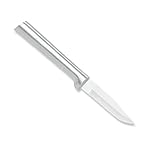
RADA R102 Peeling Paring Knife
- 2.5 inch hollow-ground T420 blade
- Built specifically for peeling produce
- Cast aluminum handle
- made in the USA
The Victorinox is the default answer because it does everything a paring knife should and nothing it should not. The imarku is the sharper, more substantial option if you want a knife that feels like a real tool in the hand. The RADA is the only one here with a blade drawn and ground purely for peeling, which is why it wins the specific job this article is about.
Best Paring Knives for Peeling in October
| Product | Specifications | Action |
|---|---|---|
| Victorinox Swiss Classic 3.25 inch Paring Knife |
|
Check Latest Price |
| imarku 3.5 inch Japanese High Carbon Paring Knife |
|
Check Latest Price |
 linoroso 3.5 inch Full Tang Paring Knife linoroso 3.5 inch Full Tang Paring Knife |
|
Check Latest Price |
 Mercer Culinary Millennia 3.5 Inch Paring Knife Mercer Culinary Millennia 3.5 Inch Paring Knife |
|
Check Latest Price |
 Cuisinart Triple Rivet 3.5 Inch Paring Knife Cuisinart Triple Rivet 3.5 Inch Paring Knife |
|
Check Latest Price |
| RADA R102 Peeling Paring Knife |
|
Check Latest Price |
 Henckels Solution 4 Inch Paring Knife Henckels Solution 4 Inch Paring Knife |
|
Check Latest Price |
 WUESTHOF Classic 3.5 Inch Paring Knife WUESTHOF Classic 3.5 Inch Paring Knife |
|
Check Latest Price |
 Mercer Culinary Genesis 3.5 Inch Paring Knife Mercer Culinary Genesis 3.5 Inch Paring Knife |
|
Check Latest Price |
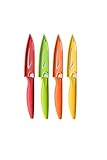 VITUER 4 Piece Paring Knife Set with Sheaths VITUER 4 Piece Paring Knife Set with Sheaths |
|
Check Latest Price |
Grouped by role, the list reads like a menu. Victorinox, Cuisinart, Henckels and VITUER are the cheap workhorses. imarku, linoroso and the two Mercer models are the mid-range sweet spot. WUESTHOF is the premium benchmark. RADA sits on its own as the dedicated peeling tool. Whichever you choose, a paring knife is the one tool that benefits most from being small, light and sharp in the hand rather than heavy and strong on the counter.
1. Victorinox Swiss Classic 3.25 inch Paring Knife
Victorinox Swiss Classic 3.25″ Paring Knife, Straight Edge Spear Point
3.25 inch stamped stainless blade
Polypropylene textured handle
18.14 g
Dishwasher safe
Pros
- Sharp out of the box and responds well to a sharpening stone
- Textured non-slip grip that still works with wet hands
- Light at 18.14 g so the blade tracks the curve of the fruit
- Best-selling paring knife on the market
Cons
- Factory sharpness varies between examples
- Handle is slim and light during a long prep session
This is the knife I hand to anyone who asks what to buy. At 3.25 inches the blade is short enough to move in a tight arc around a potato without the tip skating off the curve, and thin enough at the edge that the first pass takes the skin off in one unbroken spiral. The spear point gives you a usable tip for piercing the skin at the start, which a rounded peeling knife cannot do.
Owners are unusually consistent about the handle. The moulded polypropylene has a fine texture that stays put on a wet hand, and the whole knife weighs 18.14 grams, so your wrist does not load up during a session of trimming brussels sprouts. That is a genuine advantage over heavier all-metal designs, and it is why this blade suits small hands and anyone with limited grip strength.
Technically it is nothing exotic: a stamped stainless blade, a plain edge, no hollow grind and no distal taper. That is precisely why it works. The geometry is unremarkable and predictable, which means the edge is easy to restore on a 1000-grit stone at home and forgiving of a slightly clumsy pass through a potato.
The main complaint in reviews is that factory sharpness varies, so a few examples arrive needing a quick touch-up before the first use. Owners also mention the handle feels thin during long sessions, which is a fair trade for the weight. Dishwasher safe and NSF approved, it is the easiest of the ten to live with.
Why it handles wet fruit so well
Peeling means wet hands, and wet hands plus a slick handle is how people drop knives into a sink. The moulded texture on this handle is the reason the Victorinox keeps turning up as a consensus recommendation in owner discussions, where cooks who use expensive knives still keep one as a beater. It also suits anyone who finds a slim metal handle uncomfortable.
Because the blade is short, you can hold produce in one hand and peel single-handed without bracing against a countertop, which is faster and safer than most peeler-and-board setups.
Where it falls short
It will not win any argument about steel or grind, and it does not try. If you enjoy sharpening and want a knife that rewards a whetstone, look at the imarku or WUESTHOF instead. If you want a knife built specifically for peeling curves rather than general paring, the RADA is the more interesting tool.
The slim handle also means it is not the first choice for a long, high-volume prep service. For home peeling, though, that is not a real limitation.
2. imarku 3.5 Inch Japanese High Carbon Paring Knife
imarku Paring Knife 3.5 Inch, Japanese High Carbon Stainless Steel
3.5 inch forged Japanese steel
58 HRC
9 to 15 degree edge per side
Pakkawood handle
Pros
- Forged Japanese high-carbon steel sharpened to a 9 to 15 degree angle per side
- Pakkawood handle reduces fatigue over long sessions
- Satisfying heft improves control on curved surfaces
- Handles in multiple colours
Cons
- Pakkawood handle should be hand washed
- Wood grip can feel slick when repeatedly wet
This is the most-reviewed paring knife in our group, and the reason is the steel. Forged from imported Japanese high-carbon stainless hardened to 58 on the Rockwell scale, then hand polished to a 9 to 15 degree angle per side, it produces an edge fine enough to lift a potato skin without dragging. Owners repeatedly describe it as arriving sharper than anything else at this level.
The 3.5 inch blade is a touch longer than the Victorinox, and the extra length is useful when you want to slice a firm apple in half rather than just peel it. The pakkawood handle is the most comfortable thing in the test for a long session, and it noticeably reduces the finger numbness that cheap handles cause.
There is real heft here, at 2.88 ounces, and that matters when the blade is thin. A feather-light thin blade can skate over a wet potato skin; a little weight lets the edge bite and travel. The taper-ground design adds stability near the heel, which is why the edge stays consistent down the blade rather than only near the tip.
The trade-off is care. Pakkawood is a composite wood and resin handle, and the maker is clear that it should not go in the dishwasher. Repeated wetting can also leave the surface feeling slick, which is worth knowing before you buy it for heavy produce work.
Best for people who sharpen at home
A 9 to 15 degree edge per side is a fine factory angle, and fine edges are easy to restore on a whetstone but easy to damage on a hard cutting board. Used on a wood board for fruit and vegetables, this knife rewards that care. Used on glass or stone, the tip will chip sooner than the Victorinox would.
It is also the pick for large hands. The handle is fuller and longer than most, which reviewers who prefer slim European parers may find too substantial.
Where it falls short
The 58 HRC steel is harder than most entry-level stainless, so it needs more deliberate sharpening and more attention to storage. If you want something you can drop in a sink and forget, the Victorinox or the VITUER set is a calmer choice.
The pakkawood handle is also the weakest link in wet conditions, which is the single most repeated complaint about wooden handles on paring knives in general.
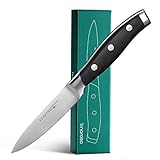
3. linoroso 3.5 Inch Full Tang Paring Knife
linoroso 3.5 Inch Paring Knife, Sharp Forged German Stainless Steel Kitchen Knife, Full Tang Small Fruit Knife with Ergonomic Handle, Premium Classic Series with Elegant Gift Box
3.5 inch forged ThyssenKrupp steel
56+ HRC
11 to 12 degree edge
Full tang
Pros
- Genuinely forged ThyssenKrupp German steel heat treated to 56+ HRC
- Full tang gives excellent balance and no flex at the handle
- Handle fits smaller hands comfortably
- Arrives in a gift box
Cons
- Edge needs refreshing after roughly a year of use
- Blade is slightly thicker than ultra-thin Japanese parers
Forged from ThyssenKrupp steel and heat treated to 56+ HRC, this knife has the most traditional European construction in the group, and at 3.5 inches the blade is a sensible all-round size. The 11 to 12 degree hand-ground edge is slightly less acute than the imarku, which makes it a touch more forgiving day to day.
Full tang construction is the reason it feels solid. There is no hidden tang to flex under pressure, and reviewers note the balance point sits right at the bolster so the blade rotates easily between a peeling grip and a tip-down cutting grip. It is also one of the few here that reviewers single out as fitting small hands well.
Cleaning is straightforward: the polished blade surface resists food residue, so a warm wash and a dry towel is enough. No dishwasher cycle, no oiling routine, no stone required for months at a time. That combination of forged steel and low maintenance is rare at this level.
The common note across reviews is that the edge dulls with use and wants a touch-up about a year in. The second is that the blade is a little thicker than ultra-thin Japanese paring knives, so it is less nimble for very intricate work such as a fine supremes cut on a tight-skinned lemon.
A good gift for a home cook
It arrives in a gift box, which matters if you are buying for someone whose kitchen you do not know. The full tang and forged construction read as premium on the counter, and owners report that it holds its edge well enough that a beginner will not feel the need to maintain it to keep it useful.
It is also available in matching boning and chef knife sizes, so someone who likes the handle can build a small set from the same line.
Where it falls short
Nothing here is a genuine weakness, but the blade thickness is a real trade. Thin blades peel; thick blades are tougher. If your peeling is delicate work on soft-skinned fruit and citrus, go thinner. If you also want to trim small bones and scrape a pomegranate, the extra spine is a benefit.
The handle is smooth metal, so with thoroughly wet hands it offers less purchase than a textured or moulded grip. Wipe the handle before peeling and this is a non-issue.
4. Mercer Culinary Millennia 3.5 Inch Paring Knife
Mercer Culinary M22003 Millennia Black Handle, 3.5-Inch, Paring Knife
3.5 inch one-piece Japanese steel
Santoprene handle
1.6 ounces
Hand wash
Pros
- One-piece high-carbon Japanese steel is easy to keep an edge on
- Textured Santoprene handle gives a secure grip
- Sturdy blade handles tougher jobs than thin parers
- Popular as a gift and as a kitchen backup
Cons
- Factory edge is sharp but not fully razor sharp
- Manufacturer recommends hand washing only
The Millennia is the beefy option. At 1.6 ounces with a thick Santoprene handle carrying textured finger points, it is built for people who want a small knife that will not flinch when the job turns from peeling into coring, seeding or deveining. Reviewers call out the handle as the most substantial in the group.
The blade is one-piece high-carbon Japanese steel, a material that is unusually good value because the whole billet comes from one piece rather than a sandwich of soft steel between steel skins. That is why the edge holds better than a comparable stamped blade without any exotic steel in the recipe.
Where it loses points is factory sharpness. Owners describe the edge as sharp but not quite razor sharp, so most of them give it a pass on a stone before the first use. Once it is sharpened, it stays sharp longer than most knives in this bracket, and resharpening is straightforward.
Care is the second limitation. The maker asks for hand washing with warm water and mild soap, then a full dry. Skip that and both the handle and the blade suffer. It is an easy rule to follow and worth respecting if the knife is a gift.
Why the handle shape is the selling point
Those textured finger points are not decoration. They sit in the places where a wet hand slides first, and they are the reason this knife feels safe on a soapy sink-bound vegetable. For cooks with larger hands, or anyone who prefers a short, wide grip, the shape is genuinely comfortable.
The thicker spine also lets you apply real pressure without the blade flexing, which is useful on a dense sweet potato or a head of celery where a thin parer would buckle.
Where it falls short
It is not a nimble tool. Fine decorative work, a tight supremes cut, or peeling a soft heirloom tomato needs a thinner blade and a lighter handle, which is exactly what the imarku offers. This one is a workhorse, not a pastry tool.
Also expect to sharpen it once before first use. That is a five-minute job on a 1000-grit stone and it is the difference between a knife that feels special and one that feels merely adequate.
5. Cuisinart Triple Rivet 3.5 Inch Paring Knife
Cuisinart C77TR-3PR Triple Rivet Collection 3.5″ Paring Knife, Black
3.5 inch high-carbon stainless
Forged full tang
Wide safety bolster
3.52 ounces
Pros
- Full-tang all-metal build with an extra-wide safety bolster
- Sharp enough from the factory for coring tomatoes and peeling
- Substantial but balanced in the hand
- Includes a protective blade guard
Cons
- Stainless loses its edge faster than harder steels
- Heavier than most paring knives of this size
- Some examples arrive dull
This is the knife you buy when the blade will live in a tackle box, a rental or a shared kitchen. Everything is metal: a forged high-carbon stainless blade, a full tang secured with triple stainless rivets, and an extra-wide safety bolster that makes the transition from blade to handle a firm stop rather than a weak hinge.
At 3.5 inches it is sharp enough out of the box for coring tomatoes, peeling apples and working through shallots. The included blade guard means it can sit in a drawer next to the rest of the cutlery without a sheath or a conversation about loose blades.
The trade-off is edge retention. Reviewers are clear that plain stainless of this type loses its edge sooner than a harder Japanese or German high-carbon steel, so it wants regular honing. Several buyers also note that some examples arrive dull from the factory, which is the one quality-control wobble worth knowing about.
At 3.52 ounces it is heavier than nearly every other paring knife here. That weight is fine for a cook who wants a knife that stays put and feels robust, and less fine for precise one-handed peeling where a light blade tracks the fruit more easily.
Where the bolster earns its keep
A wide bolster is a structural feature on a full tang, but here it also acts as a guard. Your ring finger cannot slide forward onto the edge when you are pushing hard into a dense vegetable, which is a real safety gain over slim-handled rivals.
It is also the easiest knife here to clean. Dishwasher safe, no oiling, no seal to strip. For a first knife for a teenager learning to cook, that low maintenance profile is worth more than a fancier steel.
Where it falls short
For pure peeling, edge retention matters more than durability, and this blade concedes ground to a harder steel on that measure. If you peel every day and never hone, choose the imarku or the WUESTHOF instead and sharpen when you feel the edge drag.
The weight also means it is not the pick for small hands, or for anyone whose grip strength is limited.
6. RADA R102 Peeling Paring Knife
RADA Cutlery Peeling Paring Knife (R102), Silver
2.5 inch hollow-ground T420 steel
Cast aluminum handle
1.44 ounces
Hand wash
Pros
- Hollow grind on T420 high-carbon steel produces an unusually sharp
- peel-friendly edge
- Blade length is sized for a full turn around a potato or apple
- Hand wash only and permanently cast handle
- Manufactured in the United States
Cons
- Short blade is limited for larger cutting tasks
- Handle feels cold compared with wood or plastic
This is the only knife here designed for the specific job in the title. The RADA R102 has a 2.5 inch hollow-ground blade, and a hollow grind removes far more metal from the face of the blade than a flat grind, leaving a wedge of steel thin enough to slice rather than push. Owners describe the edge as gliding through fruit and vegetables with very little resistance.
At 1.44 ounces and 6.13 inches overall, it is the smallest and lightest option in the roundup. That means the whole knife rotates under the fingertips, which is precisely what a single continuous peel needs: a rotation of the wrist while the knife stays largely in place.
Manufactured in the United States from raw materials through construction, it comes with a lifetime guarantee. The handle is permanently cast brushed aluminum with a satin finish, so there is no scale, no loose fastener and no glue joint to fail. The plain non-serrated edge is the right edge for skin, not for slicing bread.
Because the grind is thin, the practical rule is simple: use it on a wood or plastic board. Hollow-ground edges chip faster than flat-ground ones when they hit a hard surface, and this blade has less steel to give than most.
Why a shorter blade peels better
Blade length is the variable most shoppers ignore, and here it works in your favour. A 2.5 inch blade has a tip-to-heel distance short enough to follow a 3 inch potato or a small apple without your hand having to reset mid-turn. Longer blades tend to dig in at the end of the stroke and gouge the fruit.
It is also the safest of the ten for a beginner, because the short point is much harder to accidentally drive into a knuckle than a 4 inch tip.
Where it falls short
Anything beyond peeling and trimming is outside its remit. It will not halve an onion, core a large cabbage or slice a baguette, and the thin hollow grind offers no spine to push against. If you want one knife for all small jobs, look at the Victorinox or the WUESTHOF instead.
The cast aluminum handle is also hand wash only and feels noticeably colder than wood or Santoprene in the hand, which matters less over a two-minute peel than over a two-hour service.
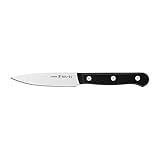
7. Henckels Solution 4 Inch Paring Knife
Henckels Solution 4 Inch Paring Knife, Razor-Sharp, German Engineered
4 inch stamped stainless blade
Full tang
Three rivets
2.88 ounces
Pros
- Arrives genuinely razor sharp from the factory
- Full tang with tight flush rivets
- Longer 4 inch blade handles coring and slicing as well as peeling
- Dishwasher safe and rust-free
Cons
- Tall stiff blade frustrates fine turning cuts
- Some owners report light edge rust
- Heavier and more utility knife than a true parer
The 4 inch Henckels is the most capable blade in the group if you want one small knife that covers coring, slicing and peeling as well as a paring knife. It arrives genuinely razor sharp, which owners single out as the standout feature, and the satin-finished stamped stainless is rated rust-free and dishwasher safe.
Construction is solid: a single-piece precision-stamped blade with a full tang and three rivets. At 2.88 ounces it has enough weight to push through a tomato core or the tough skin on a mango, and the longer blade gives you a flat side to lay against a cucumber for clean slice coins.
The dividing issue is geometry, and it is a real one. The blade is tall with a thick spine, which makes it stiff. Peeling an apple in a continuous spiral needs a blade that will turn and follow the curve; this one prefers straight, committed cuts. For fine decorative work, a thin blade is simply better.
A small number of owners also report edge rust after light use even with hand washing, and rivet corrosion over years of dishwasher cycles. Neither is universal, but both are reasons to rinse and dry this knife rather than assume it is maintenance-free.
When a longer blade actually helps
There are peeling jobs where a short blade loses. Peeling a long butternut squash, lifting the skin off a pineapple side, or slicing a firm apple in half to core it, all reward a longer blade and a stiffer spine. That is exactly the range this knife covers.
It is also a good first knife for someone learning, because the extra length and rigidity makes mistakes less likely than a thin blade would.
Where it falls short
For a spiral peel on a potato, it will frustrate you. The spine does not want to change direction, and the tall blade resists the shallow angle you need to keep the peel thin.
Be aware that it behaves more like a compact utility knife than a true paring knife. If your priority is elegant, controlled peeling, the RADA or the Victorinox is the better instrument.
8. WUESTHOF Classic 3.5 Inch Paring Knife
WÜSTHOF Classic 3.5″ Paring Knife, Black
3.5 inch forged high carbon steel
Full tang
Triple riveted
1.6 ounces
Pros
- Best-rated knife in the group with a 91 percent five-star share
- Forged full-tang blade with a fine tapering point
- Triple-riveted handle is exceptionally solid and balanced
- Excellent for garlic
- herbs and small produce
Cons
- Premium pricing sits far above every other option here
- Short 3.5 inch blade limits it to small produce
Rated 4.8 stars with a 91 percent five-star share, the WUESTHOF Classic is the benchmark that most other knives on this list are measured against, and the reason is consistency of feel. The forged high carbon stainless blade is full tang with a triple-riveted handle, and at 1.6 ounces the weight sits right under the middle of the blade where your thumb rests.
The blade tapers to a fine point, which is what makes it good for the fiddliest peeling work: separating a garlic clove from its skin, trimming the stalk of a herb without tearing it, and cutting a tight supremes on a lemon. Owners describe the edge as staying keen across long sessions of fine detail work.
The Classic series has been WUESTHOF’s best-selling line for generations, and that matters for one practical reason: a full-tang forged blade with a riveted handle is repairable and predictable. It also means the balance does not change as the knife ages, which is a complaint that eventually catches stiff-handled knives.
Feedback on this model centres on one thing rather than on quality. The narrow 3.5 inch blade is confined to small produce and garnish work, so it will not replace a knife for a large melon or a full onion.
Who it suits and who it does not
It suits a cook who wants exactly one small knife and expects it to last. If you sharpen regularly, the fine point stays useful for years, and the full-tang build means nothing rattles or flexes when the work gets firm.
It does not suit someone who peels large quantities of winter squash, or who wants a blade that can double as a small utility knife. Neither of those is a quality problem, they are scope problems.
Where it falls short
The only real answer is the price. WUESTHOF costs several times what the Victorinox, the RADA and the VITUER set do, and the measurable performance difference between this and a well-made mid-range blade is smaller than that gap suggests.
Buy it for the balance, the finish and the point, not for the steel. If you already own a good WUESTHOF chef’s knife, this paring knife will feel completely familiar in the hand.
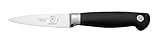
9. Mercer Culinary Genesis 3.5 Inch Paring Knife
Mercer Culinary M20003 Genesis 3.5-Inch Paring Knife,Black
3.5 inch forged German steel
Taper-ground edge
Santoprene handle
3.17 ounces
Pros
- Precision-forged high-carbon German steel with a taper-ground edge
- Handle stays non-slip even with wet hands
- Owners report it outlasting knives costing several times more
- Easy to resharpen on a whetstone
Cons
- Handle is thicker and heavier than slim European parers
- Blade is slightly deeper than a true paring knife
The Genesis is the knife we would buy if a single mid-range pick had to cover every scenario. It is precision forged from high-carbon German steel with a taper-ground edge, and that combination of a real taper and a real grind is what gives it an edge that holds a long time and is still easy to restore at home.
At 3.17 ounces it is the second-heaviest knife here, and the Santoprene handle is the widest. What that weight buys is stability: the edge bites into a firm potato skin instead of skating, and the taper keeps the blade tracking as it moves through the fruit.
Owners who also own premium German and Japanese knives report that it holds an edge longer than knives costing far more, and that it is easy to bring back on a whetstone or a diamond stone. The handle is explicitly designed to stay non-slip with wet hands, which is the complaint we hear most often about all-metal paring knives.
The two trade-offs are honest ones. The handle is thicker and heavier than the slim European designs, which will not suit very small hands. And the blade is slightly deeper than a true paring knife, so it reads a little more like a small utility knife in the hand.
The wet-hand grip question
Grip with wet hands is the deal breaker that most buyers do not think about until they drop a knife. The moulded Santoprene on this handle is textured and slightly tacky, and owners with wet hands report it does not move. That is the same advantage the Victorinox and the Mercer Millennia offer, in a knife with a far better edge.
It is the one to choose if you prep in volume, work in a warm kitchen, or simply have a heavy-handed cutting style.
Where it falls short
Size. The blade is a touch deep and the handle a touch full, so it will not disappear into a pinch grip the way a 3 inch parer does. Fine pastry work and delicate supremes are slightly less precise on this blade than on a thinner one.
Care is hand wash only, as with the rest of the Mercer line. Follow that and the edge will outlast knives that cost double.
10. VITUER 4 Piece Paring Knife Set with Sheaths
VITUER Paring knife, 4PCS Paring knives (4 Knives and 4 Knife cover), 4 Inch Peeling Fruit and Vegetable Knife, Ultra Sharp Kitchen Knives, German Steel, PP Plastic Handle
Four knives and four sheaths
3Cr13MoV steel at 56 HRC
4 inch blades
Soft PP handles
Pros
- Four colour-coded knives cover a whole household's prep needs
- German 3Cr13MoV stainless steel at 56 HRC
- Includes matching sheaths for drawer storage
- Comfortable soft-touch handles
Cons
- Thin steel needs extra pressure on hard produce
- Handles can loosen after many wash cycles
- Surface rust if left wet
Most of this roundup assumes one cook and one knife. The VITUER set solves a different problem: a household where everyone peels, a holiday kitchen that needs four working blades, or a cook who wants a backup that can live in a drawer or a gym bag without chipping. Four knives, four sheaths, 4 inch blades.
The steel is German 3Cr13MoV stainless at 56 plus or minus 2 HRC, which is a mainstream forging alloy rather than a premium one. In practice it means a sharp, serviceable edge that needs more pressure on hard produce and will not hold a razor edge for months the way the imarku or WUESTHOF does.
What you notice first is the colour coding. Four soft-touch polypropylene handles in different colours let you assign a knife to a person or a task, and owners like that it makes a shared kitchen less chaotic. The knives and sheaths are BPA-free and lead-free, and hand washing is recommended.
The recurring gripes are honest ones for the tier. Thin, lightweight steel needs more force on a dense carrot. Blades can develop surface rust if they are not dried immediately. And after many wash cycles, handles can begin to loosen.
Where a set beats a single knife
A set wins on availability. If you are prepping for a group, one knife is a bottleneck, and four thin blades in parallel is faster than queueing at a single edge. The sheaths also make it practical to keep them in a drawer, a box or a bag without a sharp-edge problem.
It is also the smart gift for someone who is just learning, because a dropped or dulled knife is not a loss.
Where it falls short
Do not expect these to be your only good kitchen knife. The edge is short-lived, the steel is thin, and once a few of them dull at different rates you have four knives of varying usefulness rather than one excellent tool.
They are best treated as high-volume peelers and prep knives, with one of the sharper blades in this roundup reserved for the work that needs a fine edge.
Why Blade Shape Matters More Than Brand for Peeling
Most published paring knife roundups stop at brand names. That misses the point, because the difference between a knife that peels and a knife that merely looks like a small chef’s knife is a few degrees of blade geometry. Here is what actually governs how a peel behaves.
Where the edge sits. On a standard knife, the edge runs down the middle of the blade. For one-handed peeling you want it set toward the side away from your thumb, so the blade can be rotated into the curve of the fruit without your hand getting in the way. This is the single most under-explained thing about peeling, and it is why enthusiasts who use top-end knives still buy dedicated peelers for grapefruit and mango.
How thin the blade is. A thin blade starts a peel cleanly and takes less force. A thick blade wants to push rather than slice, which is how you end up with a gouge on the first potato. Hollow grinds, which remove far more metal from the blade face, produce the thinnest edges of anything here. That is the RADA’s advantage.
Tip shape. Spear point tips are precision tools: they start the peel at the stem and pick out a stem well. Turnip and carrot blades are curved for a reason, and they follow a sphere better than a straight edge does. Bird’s beak tips curl under for reaching between segments and removing a pomegranate aril, and they are not a general peeling shape.
Blade length. Under 3 inches and you lose leverage on a hard potato skin. Over 4 inches and the blade no longer wants to turn in a tight arc. Between 2.5 and 3.5 inches is where peeling feels effortless, which is why seven of the ten knives here fall in that range.
There is a useful trick worth knowing. A paring knife that has been sharpened for years can be ground into a shallow curve at the edge, effectively turning it into a hookbill peeler, and cooks report that an old knife worn this way becomes their favourite peeling tool. Our roundup of tactical folding knives covers the opposite end of the spectrum for comparison, where edge geometry is about piercing rather than slicing.
How to Choose a Paring Knife for Peeling
Before you buy, run through these five checks. They will narrow ten options down to two in about a minute.
1. Pick the blade length for your produce. 2.5 to 3.25 inches is the sweet spot for round fruit and vegetables. 3.5 inches handles firmer items like potatoes and apples. 4 inches is for people who want one small knife that also cores and slices, and who accept that peeling will feel less fluid.
2. Choose stainless over carbon for daily peeling. Fruit juice is acidic and it will stain and pit a carbon steel blade within a session. Carbon steel takes a keener edge and is a joy to sharpen, but it needs washing and drying immediately. If you will peel and walk away, stainless is the right answer. If peeling is a hobby rather than a chore, carbon is more rewarding.
3. Test the grip, not the price. This is the number one complaint in owner discussions: handles that get slick when wet. Moulded textured polypropylene and Santoprene grips perform well. Cast aluminum and smooth wood are the weakest when your hands are soapy. A knife you can hold with a wet hand is worth more than a knife with marginally better steel.
4. Check the construction. A full tang means the steel runs the length of the handle, which gives balance and stops the blade flexing. Hidden tang designs are lighter and cheaper. Neither is wrong, but full tang is a useful upgrade if the handle is metal.
5. Think about who sharpens it. Every paring knife dulls. A 1000-grit whetstone will bring back a 56 HRC stainless edge in a few minutes and is the cheapest insurance in a kitchen. A fine 9 to 15 degree edge like the imarku’s takes more care to maintain but cuts cleaner. Buy the edge your habits can support.
There is one more test, and you can do it in a shop. Hold the knife in a pinch grip the way you would hold a pencil, then roll it through a slow circle. If the tip tracks smoothly and the handle does not rotate in your fingers, it will peel well. Our broader bushcraft and survival knife picks use the same logic in a different environment, where grip and steel matter for the same reasons.
Frequently Asked Questions
What knife is best for peeling?
For most home cooks the Victorinox Swiss Classic 3.25 inch is the best all-round peeling knife: a thin spear point blade that starts a peel at the stem and follows the curve of a potato or apple in one continuous turn, with a textured handle that stays secure with wet hands. If peeling is the only job you will give it, the RADA R102 is built specifically for that, with a hollow-ground 2.5 inch blade that is thinner than anything else in the range.
What is the best knife for peeling fruit?
Soft-skinned fruit rewards a thin, short blade and a tip you can steer. Our fruit picks are the RADA R102 for round fruit, the Victorinox Swiss Classic for general work and the WUESTHOF Classic 3.5 inch for the finest detail work such as citrus supremes and trimming herbs. For long spirals on a firm apple or pear, reach for a 3.25 to 3.5 inch blade rather than a very short one.
What is the best knife for peeling apples?
Apples are firm and slightly wet after washing, so you want a blade with some bite and a handle with texture. The Mercer Culinary Genesis 3.5 inch pairs a taper-ground forged German edge with a non-slip Santoprene handle, which owners report stays put with wet hands. For a thinner, lighter peel in long ribbons, the Victorinox Swiss Classic 3.25 inch is our overall pick.
Is a paring knife better than a vegetable peeler?
They suit different jobs. A Y-peeler is fast on firm vegetables and cheap to replace, but it cannot start at a stem, follow a curve or make a thin supremes cut. A paring knife is slower on a big batch of carrots but far more precise, works on soft-skinned fruit that a peeler would tear, and can do coring, deveining and garnishing. Many cooks keep both and use the knife for anything round or soft.
Why does my paring knife slip or glide when peeling?
A knife that glides sideways across a wet potato is usually gliding because the edge is dull, not because the blade is too short. A sharp edge bites and pulls the skin off; a dull one has to be pushed, and pushing is what makes the knife wander. Second, check the handle: smooth cast aluminum and wet wood grips are the most commonly reported slip problems. Dry your hands and the handle, and sharpen on a 1000-grit stone.
Our Final Verdict on the Best Paring Knives for Peeling
The Victorinox Swiss Classic 3.25 inch is our pick for the best paring knives for peeling, because a short, thin spear point blade and a grip that survives wet hands solve the actual problem and leave nothing important out. Buy the RADA R102 instead if peeling is the only job, the Mercer Culinary Genesis if you want a heavier, better-steeled blade that holds its edge, and the WUESTHOF Classic if you want one premium knife that will last decades.
Whatever you pick, give it five minutes on a 1000-grit stone before the first apple. That single habit is the difference between a paring knife you use every day and one that sits in the drawer.