
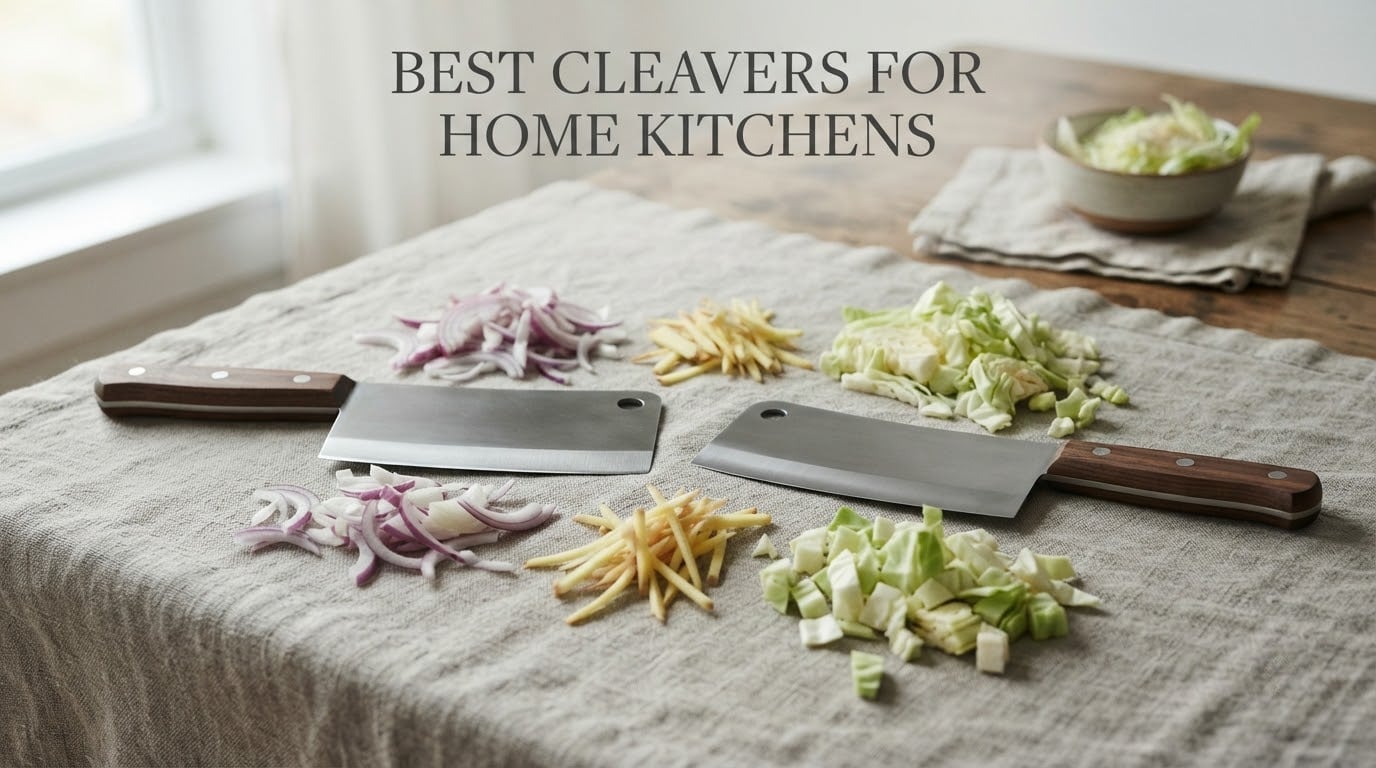
A cleaver is a broad, rectangular-bladed kitchen knife that comes in two distinct forms: a thin Chinese vegetable cleaver, often called a caidao, used for slicing, chopping and scooping, and a thick, heavy meat cleaver used for splitting bone and joints. They are not interchangeable, and confusing them is the single most common mistake buyers make.
That confusion drives most of the bad buying decisions we see. Plenty of home cooks order a two-pound bone chopper because it looks impressive in the drawer, then discover it is clumsy for the one job they actually do every day, which is cutting onions. Our advice for 2026: if you prep vegetables most days, buy a Chinese vegetable cleaver and treat the bone cleaver as a second thought.
We compared twelve cleavers for this guide, weighing the published specifications against the recurring themes in thousands of owner reviews. We looked hard at blade length, weight in ounces and grams, steel type, spine thickness, edge angle, handle material and how each knife arrived in the box. What we found is that the differences between these twelve are not about brand prestige. They are about weight, steel hardness and whether you need to touch bone at all.
Before the list, here is the rule that decides most purchases. A Chinese caidao replaces a chef’s knife, a paring knife and a bench scraper for the majority of home cooks. A nakiri is a shorter, more precise Japanese vegetable blade that slices beautifully but will never split a joint. A thick meat cleaver only earns its drawer space if you break down whole poultry, ribs or large bone-in cuts regularly. If you are still unsure, the large deep fryer guide covers the other large piece of equipment most home vegetable cooks end up buying.
Table of Contents
- Top 3 Picks: The Best Cleavers for Home Kitchens in 2026
- Best Cleavers for Home Kitchens in October
- 1. Utopia Kitchen 7 Inch Meat Cleaver — Best Overall for a Home Kitchen
- 2. ENOKING 7.5 Inch Hand Forged Cleaver — Best for Forged Value and Rib Work
- 3. Juvale 8 Inch Meat Cleaver — Best for Serious Bone Breakdown
- 4. PAUDIN 7 Inch Nakiri — Best for Precise Vegetable Slicing
- 5. imarku 7 Inch Cleaver — Top Rated for a Thin Multi-Purpose Blade
- 6. Winco KC-301 8 Inch Cleaver — Budget Pick That Never Chips
- 7. TUO 7 Inch Vegetable Cleaver — Best Everyday Value with a Curved Profile
- 8. Mueller 7 Inch Meat Cleaver — Best When the Dishwasher Runs Your Life
- 9. ROCOCO Viking 6.2 Inch Cleaver — Best for Gifting and Outdoor Use
- 10. SHI BA ZI ZUO 8 Inch Professional Cleaver — Best for High-Volume Vegetable Prep
- 11. Dalstrong 7 Inch Damascus Cleaver — Best Premium Steel and Longest Edge Life
- 12. Victorinox Fibrox 7.1 Inch Chinese Cleaver — Best for Compact Drawers
- How to Choose a Cleaver: Weight, Steel, Handle and Edge
- Sharpening and Caring for Your Cleaver
- Frequently Asked Questions
- Conclusion: The Best Cleavers for Home Kitchens in 2026
Top 3 Picks: The Best Cleavers for Home Kitchens in 2026


Best Cleavers for Home Kitchens in October
| Product | Specifications | Action |
|---|---|---|
| Utopia Kitchen 7 Inch Meat Cleaver |
|
Check Latest Price |
 ENOKING 7.5 Inch Hand Forged Cleaver ENOKING 7.5 Inch Hand Forged Cleaver |
|
Check Latest Price |
| Juvale 8 Inch Meat Cleaver |
|
Check Latest Price |
 PAUDIN 7 Inch Nakiri PAUDIN 7 Inch Nakiri |
|
Check Latest Price |
 imarku 7 Inch Cleaver imarku 7 Inch Cleaver |
|
Check Latest Price |
 Winco KC-301 8 Inch Cleaver Winco KC-301 8 Inch Cleaver |
|
Check Latest Price |
 TUO 7 Inch Vegetable Cleaver TUO 7 Inch Vegetable Cleaver |
|
Check Latest Price |
 Mueller 7 Inch Meat Cleaver Mueller 7 Inch Meat Cleaver |
|
Check Latest Price |
 ROCOCO Viking 6.2 Inch Cleaver ROCOCO Viking 6.2 Inch Cleaver |
|
Check Latest Price |
| SHI BA ZI ZUO 8 Inch Cleaver |
|
Check Latest Price |
 Dalstrong 7 Inch Damascus Cleaver Dalstrong 7 Inch Damascus Cleaver |
|
Check Latest Price |
 Victorinox Fibrox 7.1 Inch Cleaver Victorinox Fibrox 7.1 Inch Cleaver |
|
Check Latest Price |
1. Utopia Kitchen 7 Inch Meat Cleaver — Best Overall for a Home Kitchen
Utopia Kitchen Meat Cleaver Knife 7 Inch Bone Chopper Stainless Steel
Stamped stainless steel
Full tang construction
14.08 ounces
7 inch blade
Pros
- Arrives very sharp and holds its edge with occasional sharpening
- Full tang with durable ABS grip
- Good heft for poultry and bone
- Stainless shows no rust over years of use
Cons
- Not dishwasher safe
- Heavy for smaller hands
- No sheath included
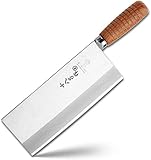
This is the one we keep coming back to. The Utopia Kitchen cleaver is stamped stainless steel with a full tang, it weighs 14.08 ounces, and its owner reviews describe a knife still going strong after six-plus years and hundreds of birds.
Fourteen ounces sits in a useful place. It is heavy enough that a straight down-chop through a chicken thigh or a bundle of celery carries real momentum, and light enough that you can still use the tip for slicing shallots without loading your wrist. The stamped construction is a simpler, tougher build than a forged blade, and the steel is forgiving enough that it resists the chipping thin high-carbon edges suffer.
The wide flat face is the part people underestimate. Once you have diced a pan of peppers, you slide the blade sideways, lift and dump the whole board into the wok in one motion. It also flattens a smashed garlic clove or a rough piece of ginger in a single press, which is a genuine time saver over a chef’s knife.
Balance sits close to the pinch grip rather than at the tip, so the knife tracks where your thumb and index finger tell it to. That is what makes the push-cut technique feel controlled on the first session instead of the tenth.
What to check before you commit
Handle sizing matters more than any other factor here. The ABS moulded grip is chunky, and owners with smaller hands report that a long prep session on a whole chicken leaves the wrist tired. If your hands are small, hold it in a shop or compare the grip diameter against a knife you already own.
It is not dishwasher safe, so plan on hand washing and a proper dry. That is a small habit, but it is the difference between a blade that looks clean in five years and one with freckles near the spine.
Where it falls short
A handful of owners report needing to sharpen again after only a few uses, which is normal for a stamped stainless edge that is deliberately a little softer and more forgiving than a Japanese high-carbon core. Expect to work a honing rod into your routine rather than treating it as a once-a-year task.
No sheath is included, so a bare edge goes straight into a drawer or a knife block slot. Given how sharp this arrives, we would rather it lived on a board or in a sheath than loose in a drawer with the forks.
2. ENOKING 7.5 Inch Hand Forged Cleaver — Best for Forged Value and Rib Work
ENOKING 7.5″ Cleaver Knife, Chef’s Knives – Hand Forged
Hand forged high carbon stainless
16 degrees per side
1.4 pounds
Triple-riveted full tang
Pros
- Sharp low-grind V edge
- Balanced weight for rib and poultry bones
- Triple-riveted handle resists breakage
- Includes a sheath and gift box
Cons
- Steel can surface-rust if the blade stays wet
- Handle finish quality varies between batches
- Too heavy for fine dicing
The ENOKING cleaver is the value pick for anyone who wants a forged blade and does not need Japanese steel. At 1.4 pounds with a 7.5 inch blade and a hand-polished 16 degree edge per side, it is noticeably more aggressive than the stamped options at a similar weight class.
Reviewers consistently describe it as capable of breaking through rib bones and dense root vegetables without the blade wandering. The V-shaped grind means the edge meets food at a shallow angle and cuts with less wrist force than a straight hollow grind, which is why the rocking motion through onions feels easy on this one.
Two practical warnings come up again and again in the reviews. First, owners report that this steel behaves more like carbon steel than the listing suggests, and surface rust appears quickly if the blade is not dried and wiped down immediately after washing. A light coat of food-grade oil solves it entirely.
Second, the handle finish varies between batches. Some owners love the wood grip for long sessions, others report it becoming unpleasant against sweaty skin after an hour of prep. If you cook with wet hands often, this is worth thinking about before you commit.
How it performs on a whole chicken
At 1.4 pounds the spine carries enough mass to split a chicken in half through the breastbone with one controlled swing, and the full tang means the handle will not develop play over time. The triple rivets hold even after repeated heavy washing, which is more than can be said for pin-fastened wood handles.
The edge is sharp on arrival and takes a fine correction on a whetstone in minutes. Buyers report the blade sharpening easily and holding that edge through months of use before a touch-up is needed.
Where the weight becomes a problem
Fine dicing is the weak spot. One and a half pounds of momentum in a 7.5 inch blade is a lot of knife for 3mm brunoise, and the handle finish issue compounds fatigue over a long session. If your prep is mostly herbs and fine dice, look at a lighter caidao instead.
It is also not strong enough for very large or frozen beef bones. Several owners report the edge deflecting on frozen sections, which is a fair limit to expect at this weight class.
3. Juvale 8 Inch Meat Cleaver — Best for Serious Bone Breakdown
Juvale Meat Cleaver – 8-Inch Stainless Steel Blade, Wood Handle – Heavy-Duty Butcher Knife & Bone Cleaver for Beef Brisket, Meat Cutting & Chopping – Chopping Knife
Forged stainless steel
2.1 pounds
8 inch blade
Integrated hanging hole
Pros
- Very thick blade for chicken turkey lamb and pork bones
- Wood handle grips well with greasy hands
- Sharp on arrival and takes a fine edge
- Hanging hole for storage
Cons
- 2.1 pounds tires smaller hands
- Large bulky handle
- Screw heads can trap food
Of the twelve, this is the most honest meat cleaver. It is 2.1 pounds of forged stainless steel with an 8 inch blade, and it is designed for one job: putting force through bone. Buyers routinely report it moving through chicken, turkey, lamb and pork without hesitation.
That mass is also the reason it is not a vegetable knife. Two pounds does not respond to a gentle push-cut, and the weight is concentrated toward the front of the blade. If you only need a bone chopper twice a year, this is overkill and a lighter option will serve you better every other day.
The wood handle is pinned with three fasteners and gives a genuinely secure grip on greasy hands, which matters when the blade is slick with fat. The handle is large, and owners with smaller palms describe it as bulky, so this is another knife where hand size should decide.
Two factory details are worth knowing. The blade arrives coated in protective lubricant, and machine grease frequently cakes into the hanging hole and around the screw heads, so wash the whole knife thoroughly before the first use. Food can lodge in those screw heads if you skip that step.
What it is genuinely good at
Breaking a whole bird down into eight pieces, splitting a rack of ribs and jointing a pork shoulder are all inside this knife’s comfort zone. The thick spine means the edge has a solid backing, so instead of flexing and deflecting it transmits your swing straight into the joint.
Even so, one reviewer reports it could not cut a frozen brisket bone. Treat that as the honest upper limit: this is a home bone cleaver, not a freezer-bone or saw tool.
Where it will disappoint you
Fatigue is the recurring theme. Two pounds is more knife than most home cooks can swing for a full weekend breakdown without the wrist and forearm complaining, and the handle bulk compounds it for small hands.
Some units also arrive with blue protective plastic wrap still visible under the handle edge. It is cosmetic, but it is the kind of finish detail that tells you the quality control pass was quick.
4. PAUDIN 7 Inch Nakiri — Best for Precise Vegetable Slicing
PAUDIN Nakiri Knife – 7″ Razor Sharp Meat Cleaver and Vegetable Kitchen Knife, High Carbon Stainless Steel, Multipurpose Asian Chef Knife for Home and Kitchen with Ergonomic Handle
5Cr15Mov stainless
56+ Rockwell
225g
7 inch nakiri blade
Pros
- Razor sharp 5Cr15Mov edge with good retention
- Thin flexible profile for slicing and dicing
- Pakkawood handle balanced at the pinch point
- Waved finish reduces food friction
Cons
- Not built for bone or cartilage
- Light at 225g for forceful work
- Waved finish is decorative not Damascus
The PAUDIN nakiri is the answer for cooks who want the cleaver silhouette with Japanese slicing behaviour. It is the lightest knife here, and the thin 7 inch blade moves through a head of cabbage with almost no resistance.
The steel is 5Cr15Mov high carbon stainless rated at 56+ Rockwell. That is a mid-range hardness: harder than the soft forgiving steels that dull in a week, softer than the 62+ cores that need a whetstone to maintain. For a home cook it is a sensible middle, and owners report the edge is simple to restore on a stone.
The pakkawood handle is compressed resin rather than natural timber, so it will not crack, swell or split when a wet blade lives in the handle overnight. That matters more than it sounds, because a wood handle that harbours moisture in a cleaver’s long tang gap is how mould and cracks start.
Balance sits right at the pinch point, which makes the knife pivot easily for mincing. The waved surface pattern is a functional finish as well as a decorative one: it reduces the contact area so wet onion and starch slide off instead of gluing to the face.
Where the nakiri shape genuinely wins
Flat-push cutting is where a nakiri is untouchable. Lay the blade down, push forward, lift, push again. Because the entire edge lies flat on the board, you get straight vertical cuts through onion, ginger and daikon with no rocking and no angle control to think about.
It is also the easiest of the twelve to maintain. A thin double-bevel edge sharpens quickly on a whetstone and is forgiving of imperfect angles while you learn.
What you give up for that precision
Bone and cartilage are out of scope entirely. The full 225 gram weight is still a limitation for forceful bone work, and there is no mass behind the cut to protect it. Owner reviews are consistent on this point.
Also expect a short adjustment period. Cooks trained on a Western chef’s knife tend to rock first out of habit, and a nakiri punishes that habit by not lifting food as cleanly on the upstroke.
5. imarku 7 Inch Cleaver — Top Rated for a Thin Multi-Purpose Blade
imarku Cleaver Knife 7 Inch, Japanese High Carbon Stainless Steel Chopper
Japanese high carbon stainless
57+1 HRC
15 degree double bevel
2.4mm spine
Pros
- Excellent edge retention from harder steel
- Slender 2.4mm spine stays rigid
- FSC pakkawood handle resists corrosion
- Symmetrical handle suits either dominant hand
Cons
- Lightweight so no bone capability
- Costs more than budget cleavers
- Needs a grip adjustment
The imarku cleaver is the best balance of slicing precision and durability in this group. It is forged Japanese high carbon stainless at 57+1 HRC, hand sharpened to a 15 degree double bevel, with a 2.4mm spine. That combination is the reason it earns a top rating here.
At 15 degrees per side the edge is noticeably finer than the 18 to 20 degree edges on most of the European-styled picks. A fine edge cuts with less force and stays sharp longer, and the harder steel means it holds that geometry through months of use rather than weeks.
The 2.4mm spine is the number to understand here. It is thin enough that the blade flexes almost imperceptibly through a potato, but thick enough at the back that owners report no wobble when pushing through dense cabbage or a thick wedge of melon. That is a well-judged compromise between a nakiri and a full meat cleaver.
The handle is FSC-certified pakkawood, which resists moisture better than ordinary timber and will not grey or crack with frequent washing. It is also rated for either dominant hand, which is uncommon in this category and useful if you happen to be left-dominant.
How it handles a week of stir-fry prep
Owners describe using this for chopping, mincing, slicing, boning, fruit and large vegetables with equal confidence, and the wide profile keeps your knuckles a safe distance from the cutting surface during a push-cut. That extra blade height is the safety argument for a rectangular knife in general, and it shows up most clearly on a big head of cabbage.
It is also easy to re-sharpen. A 15 degree double bevel is a straightforward geometry to restore on a 1000 grit stone, and the fine starting angle means less material has to come off to get back to biting.
Where the thin design stops
It is a vegetable and boneless meat cleaver, not a bone chopper, and at 11.84 ounces there is not enough mass for forceful bone work. Owners report it simply lacks momentum when a chicken carcass gets in the way.
You will also notice the price sits above most of the budget picks, and the wide blade takes a few sessions to get used to if your muscle memory is built around a chef’s knife. Both are one-time costs for a knife that stays sharp noticeably longer.
6. Winco KC-301 8 Inch Cleaver — Budget Pick That Never Chips
Winco 8″ Blade Chinese Stainless Steel Cleaver
Forged stainless steel
1 pound
8 by 3.5 inch blade
Dishwasher safe
Pros
- Very low cost and widely praised value
- Forgiving steel that does not chip
- Easy to re-sharpen in seconds
- Dishwasher safe with no rust over months
Cons
- Soft steel dulls quickly without honing
- Gaps at the handle can trap food
- Uneven factory edge on some units
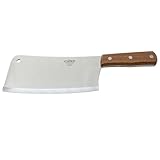
The Winco KC-301 is the sacrificial knife of this group, and that is a compliment. Professional cooks describe it as the value option for hard work: an 8 inch by 3.5 inch forged stainless blade at 1 pound, with an edge that gives up quickly but never chips.
Soft steel has a real upside. When it loses its edge you restore it in seconds on a rod or a stone, and when it does meet something it should not, it deforms rather than chipping out a hole in the cutting line. For butternut squash, pineapple and frozen root vegetables, that is the behaviour you want in a tool you do not mind working on.
The one-pound weight still gives enough momentum for bulk chopping, and the 3.5 inch blade height is substantial for a nakiri-style profile. It handles the classic Chinese technique well, including the flat-side garlic crush, and owners report it running true through months of use without any surface rust.
Dishwasher safe is a genuine advantage in a busy home. Two picks in this guide cannot go through a machine, and if you do not have the habit of drying a blade the moment you rinse it, that trait alone removes a whole category of risk.
When this is the right knife
Reach for the Winco when you are doing volume prep of hard vegetables, or you want a second cleaver that lives in a communal kitchen and does not matter if it gets marked. The 5 inch wood handle gives a long grip that suits two-handed control on big cuts.
It is also the honest entry point if you have never sharpened a blade before. A forgiving edge that reshapes in seconds means you can learn the technique without a whetstone mistake costing you money.
What to watch out for
Edge retention is the trade, and it is a real one. Owners report the blade dulling quickly if it is not honed regularly, so build the rod into your wash-up routine from day one rather than waiting until the knife starts slipping.
Two factory complaints recur: gaps between the wooden grips and the tang that can trap food and moisture, and loose rivets on some examples that let the tang move inside the handle. Check the handle is solid before you commit, and keep it out of the dishwasher if you want the rivets to stay tight.
7. TUO 7 Inch Vegetable Cleaver — Best Everyday Value with a Curved Profile
TUO Vegetable Cleaver Knife, Chinese Chef Knife 7 inch Meat Cleaver with Pakkawood Handle, Stainless Steel Butcher Chopper for Home Kitchen – Fiery Phoenix Series
German X50CrMoV15 steel
HRC 56
18 degrees per side
10.4 ounces
Pros
- Curved profile works as tip slicer and flat scraper
- Balance point right at the pinch grip
- Waterproof pakkawood handle
- Backed by a lifetime manufacturer guarantee
Cons
- Needs honing every couple of weeks with daily use
- Greater blade depth than a nakiri
- No sheath included
The TUO Fiery Phoenix is the pick that most often displaces an expensive knife from someone’s block. It is a 7 inch forged cleaver in German X50CrMoV15 stainless, vacuum heat treated to HRC 56, hand sharpened to 18 degrees per side, and it weighs 10.4 ounces.
The curved blade profile is the detail worth calling out. The front is fine enough to make a pointed tip for trimming spring onions, the middle section is flat and wide for smashing garlic, and the bottom edge near the handle is built for mincing. One blade, three working zones, and no need to swap tools mid-recipe.
Owners who already own good Japanese and German knives report this became their daily driver anyway. The fit and finish is tight, and the balance point sits exactly at the pinch grip so the blade rotates under your thumb rather than swinging out past your hand.
The pakkawood handle is waterproof and resists the warping and splitting that ruin natural wood in a wet prep environment. The full tang runs the length of the handle with a polished bolster at the front, which is a stronger construction than the pin-fastened wood handles used on cheaper cleavers.
What the curved profile changes in practice
A curved belly means the blade rocks through dense food instead of needing a straight lift-and-push cycle, so mincing garlic, ginger and herbs becomes a smooth continuous motion. Owners also report it slicing parsley and delicate herbs without bruising them, which a blunt chopping motion would crush.
It also arrives in a gift box and is backed by a lifetime manufacturer guarantee against defects, which is unusual coverage at this level and worth something if you are buying for someone starting out.
Where it needs an adjustment
HRC 56 is a moderate hardness, and owners report needing to hone every couple of weeks with daily use. That is a real difference from the harder Japanese steel in the imarku and Dalstrong picks, where the interval stretches to months.
The blade is also deeper than a nakiri, so cooks moving from a Japanese vegetable knife will need a few sessions to stop treating it like one. And there is no sheath, so plan where it lives before the first use.
8. Mueller 7 Inch Meat Cleaver — Best When the Dishwasher Runs Your Life
Mueller 7-Inch Meat Cleaver Butcher Knife, German High Carbon Steel
High carbon German stainless
18 degree double bevel
1.1 pounds
Seamless full tang
Pros
- Laser-tested edge sharp enough for fine boning
- Seamless stainless handle survives the dishwasher
- Balanced for poultry joints and roasts
- Blade doubles as a bench scraper
Cons
- 7 inch blade is small for large cuts
- Very sharp on arrival
- Not for heavy large-bone work
The Mueller cleaver solves a specific problem: kitchens where the dishwasher is not optional. The handle is seamless stainless steel, so there are no seams, no wood and no rivet heads to trap food, and the whole knife is built to be washed in a machine without damage.
At 1.1 pounds with a 7 inch blade, it is heavier and more front-loaded than the vegetable cleavers here, and owners report it handling poultry joints and roasts with good control. The balance is what makes that possible: weight distributed forward enough to chop, not so much that it drags.
The edge is laser-tested high carbon German stainless hand sharpened to an 18 degree double bevel on both sides. Owners describe it as sharp enough for fine scoring and boning, not just bulk chopping, and as holding its edge for months of regular use. Hand washing still preserves that edge longer, but the knife tolerates a machine cycle without harm to the handle or finish.
Like the other wide-blade picks, the flat face works as a bench scraper for moving prepped food off the board in one pass, which quietly speeds up a busy prep session more than most cooks expect.
What works well here
This is the knife to buy if a wooden handle is a deal-breaker for you. Wood is comfortable when dry and unhygienic in a shared kitchen, and the seamless stainless alternative removes that compromise entirely without giving up much in balance or control.
It also covers more jobs than a specialist. Owners use it for garlic, onions, roasts and steaks alike, so a single knife can handle a whole dinner rather than one task.
Where it falls short
Seven inches is on the smaller side, and buyers who prefer larger knives report it feeling cramped on big slabs of meat or a full head of cabbage. The wide rectangular shape also offers no rocking motion, so mincing is less fluid than on a curved European-style edge.
It is also not a large-bone tool. If you break down frozen or very thick beef bones, a purpose-built bone cleaver or a saw is the right instrument for the job.
9. ROCOCO Viking 6.2 Inch Cleaver — Best for Gifting and Outdoor Use
ROCOCO Viking Cleaver Knife Birthday – Kitchen Axe & Sheath Father Gift Men
High carbon steel
0.43 kg
6.2 inch blade
Walnut handle with sheath
Pros
- Curved edge gives an effortless rocking motion
- High carbon steel sharpens quickly
- Carved walnut handle with raised texture
- Includes a stitched leather sheath
Cons
- Smaller and lighter than the styling suggests
- Awkward for large cuts of meat
- Sheath has no belt loop
The ROCOCO Viking axe carries the highest average rating in this group at 4.8, and it earns that in a way the others do not. Most of its reviewers bought it as a gift, and most of them keep using it.
The curved edge is the functional part. It is designed for a fast rocking slicing motion, and owners report using it to mince meat, fish, chicken and vegetables with an effortless back-and-forth rhythm. At 0.43 kg and 6.2 inches it is light enough to work all evening without fatigue.
The walnut handle is carved with raised texture, which is a genuine grip feature rather than decoration, and the high carbon steel blade sharpens quickly whenever it needs it. Each knife is inspected and lightly oiled before it leaves the factory, which is why owners report no rust problems straight out of the packaging.
It comes with a genuine stitched leather sheath with a snap closure, a detail that sits oddly against a kitchen-drawer cleaver. That sheath is what makes this the natural choice for a camping, BBQ or fishing gift.
Where it performs
Treating it as a compact all-purpose knife is where it works best. Skinning, boning, general chopping, slicing and mincing are all comfortably inside its range, and several owners describe it as well balanced and surprisingly comfortable despite the axe styling.
The decorative detailing, including the dragon head motif, is what makes it a present. If you are buying for someone who will actually cook, the design is a bonus rather than the reason it works.
Where the styling misleads
The axe look suggests something large and heavy, and buyers report being surprised in the other direction: it is smaller and lighter than expected. Several users find the blade and overall size awkward for large cuts of meat, so measure your typical roast before ordering.
The sheath also lacks a belt loop and fits loosely enough that the blade tip can show, and high carbon steel needs to be stored dry to keep its sharpness. It is a skinning and boning knife rather than a heavy bone chopper, whatever the styling implies.
10. SHI BA ZI ZUO 8 Inch Professional Cleaver — Best for High-Volume Vegetable Prep
SHI BA ZI ZUO 8-inch Professional Cleaver – Stainless Steel Meat & Vegetable Knife with Non-stick Finish and Anti-slip Wooden Handle
Three-layer 80Cr13 clad steel
2mm spine
329g
Non-stick finish
Pros
- Extremely sharp on arrival with months between sharpenings
- Stiff 2mm spine with no blade flex
- Flat blade works as an efficient scraper
- Rosewood beehive handle is non-slip in a pinch grip
Cons
- Not for thick or large bones
- Sharp choil edge can dig into the middle finger
- Some examples use a wire tang
The SHI BA ZI ZUO is the one experienced cooks name most often when a home cook asks which Chinese cleaver to buy first. It is an 8 inch forged cleaver with a three-layer 80Cr13 high carbon core, a 2mm spine, and a total weight of 329g.
That layered construction is the interesting part. A hard 80Cr13 core gives edge retention and hardness, while softer low carbon outer layers give the blade toughness so it flexes rather than snapping. The result is a stiff spine with no visible wobble, which owners consistently praise for a blade at this weight.
Reviewers repeatedly report the blade arriving extremely sharp and staying that way for months without sharpening. The 12 to 15 degree double bevel with a tapered spine is a fine edge, and the vacuum heat treatment plus non-stick coating both contribute to how long it holds its geometry.
At 329g the weight sits in a sweet spot: heavy enough that a down-chop through a dense cabbage moves the blade on its own, light enough to keep mincing for a full prep session. Collectors who own far costlier knives regularly report this one displacing them from the block.
What makes it good for volume work
The wide flat blade covers a full board of diced vegetables, then lifts and dumps them into the pan in one motion. Owners also use the flat face to press garlic and ginger flat, which saves a step and releases the flavour faster.
The rosewood beehive handle is the shape most Asian cleaver users prefer because it locks into a pinch grip, and it is described as genuinely non-slip even with wet hands. The large blade surface also gives your support hand plenty of room to set a safe claw grip.
Where it stops working
It is a vegetable and boneless meat cleaver. Chicken bones are fine, but owners are clear that thick or large beef bones will damage it, and the thin edge has no mass to protect it.
Two handle details deserve a mention. The choil has a sharp vertical edge that can dig into the middle finger during a pinch grip until you build a callus, and some examples have a wire tang rather than a full one, with a bend visible at the end. The non-stick coating is also a consumable that will eventually need replacing under heavy long-term use.
11. Dalstrong 7 Inch Damascus Cleaver — Best Premium Steel and Longest Edge Life
Dalstrong 7″ Meat Cleaver Knife – Japanese Super Steel Damascus
Japanese AUS-10V core at 62+ Rockwell
8-12 degrees per side
364g
66 Damascus layers
Pros
- 62+ Rockwell core holds an edge for years
- Honbazuke 8-12 degree edge stays sharp with rod maintenance only
- Hammered finish reduces cutting friction
- Full tang triple-riveted G-10 handle
Cons
- By far the highest price in this group
- Not built for thick bone work
- Hand wash only
The Dalstrong is the outlier in this lineup, and it earns the place. It is the only pick with a 62+ Rockwell Japanese super steel core, a 66 layer Damascus build and a hand-finished 8 to 12 degree Honbazuke edge, and the review theme across owners is remarkably consistent: the edge stays sharp for years on ceramic rod maintenance alone.
At 8 to 12 degrees per side this is the finest edge in the group by a wide margin. Fine edges cut with almost no downward force, which is why owners describe it as effortless on boneless meat, fish, vegetables and leafy greens. The precisely tapered blade and hammered finish reduce food contact so nothing sticks.
Nitrogen cooling during heat treatment is what lets the maker claim hardness, flexibility and corrosion resistance together. The result is a 364g cleaver that owners describe as sturdy in the hand without feeling like a bar of metal, and heavy enough to break down a chicken comfortably.
The handle is a full tang, triple riveted, military-grade G-10. There is a sheath and a presentation box, and the wide blade makes scooping prepped food onto it fast. This is a knife you would keep for decades rather than replace.
What you get for the money
Edge retention is the real premium feature. A 56 to 57 Rockwell steel needs honing every couple of weeks under daily use; a 62+ core holds its geometry for months or years, and a fine 8 to 12 degree bevel is far more expensive to produce than a 20 degree stamped edge.
Owners also value the finish and the gift presentation. If you are buying one knife and keeping it, the difference in feel and edge life is genuinely noticeable day to day.
Where it falls short
It is a medium-duty Chinese style cleaver, not a bone cleaver. Owners wanting to hack through thick bone are consistently directed to a different steel, and the consensus across reviews is that using this one on bone would be a mistake.
There is also a quality control thread worth knowing: some examples arrived with a blade grind wider than advertised, and a few buyers received worn or damaged presentation boxes. Customer service corrected the grind issue when it was raised. Hand wash only, since dishwasher detergent damages the blade over time.
12. Victorinox Fibrox 7.1 Inch Chinese Cleaver — Best for Compact Drawers
Victorinox Fibrox 7 in Chinese Cleaver – Swiss Made Butcher Chef Knife
Swiss stamped stainless
7.1 inch blade
8 cm width
Fibrox non-slip handle
Pros
- Ergonomic non-slip handle grips when wet or greasy
- Dishwasher safe Swiss stainless construction
- Compact dimensions for a tight workspace
- Straight edge is easy to maintain
Cons
- Stamped steel holds an edge less well than forged blades
- Smaller blade limits bulk prep and bone work
- Straight edge gives no rocking motion
The Victorinox Fibrox is the most compact rectangular option here by width, at 8 cm overall, with a 7.1 inch blade. It suits cooks with a narrow prep area, a small sink or a knife drawer that has run out of room.
The Fibrox handle is the reason to consider it. The textured thermoplastic rubber gives a secure grip in wet or greasy conditions, which is the single most common complaint about cheaper cleavers. Swiss-made stamped stainless construction is dishwasher safe and durable, and the straight edge is simple to maintain.
It works as a general utility knife for chopping, cutting and dicing, and at 4.7 stars from 701 owner ratings the satisfaction rate is high. Written owner reviews were not available for this listing, so the observations here lean on the stated features and the rating distribution.
Compared with the 8 inch Chinese cleavers in this guide, the difference shows up on volume work. A smaller rectangular blade simply has less surface area to gather diced vegetables and less length to travel through a large cabbage wedge.
Why compactness is a real feature
Knife storage is a genuine constraint in a home kitchen. A full-width cleaver needs its own slot or board, and eight inch blades push everything else out of alignment. If your drawer is already crowded, a 7.1 inch blade changes how the whole block fits.
The non-slip handle also makes this a safe pick for a first cleaver. Wet hands plus a slippery wooden handle is a common route to a cut finger, and the Fibrox texture is designed specifically to prevent that.
Where it is the wrong pick
Stamped construction means less edge retention than the forged and Damascus alternatives here, so the edge will need more regular attention. The 7.1 inch blade also limits bulk prep and rules out bone work entirely.
The straight edge gives no rocking motion, making it less efficient for mincing herbs and garlic than the curved picks in this list. If your prep is heavy on mince rather than dice, choose a curved edge instead.
How to Choose a Cleaver: Weight, Steel, Handle and Edge
Weight is the first thing to check, and it is the number that decides whether a knife earns its place in a home kitchen. Anything under about 12 ounces is a slicing tool. Between 12 ounces and 1.5 pounds is a general-purpose cleaver. Over 1.5 pounds is a bone cleaver, and using it on vegetables is like using a hammer to hang a picture.
Balance matters more than total weight. A well-balanced cleaver pivots at the pinch grip between your thumb and index finger, so you can change direction mid-cut without fighting the knife. This is why owners argue about grams and ounces rather than adjectives like heavy-duty. The two-pound Juvale and the 10.4 ounce TUO feel completely different in the hand, and the difference is where the mass sits, not how much of it there is.
Blade material splits into three practical groups. Soft stainless, like the Winco, forgives mistakes, sharpens in seconds and never chips, but it dulls fast. Mid-range high carbon stainless between 56 and 58 Rockwell, used by the PAUDIN, TUO and imarku, is the sensible home-kitchen middle. Very hard Japanese cores at 62+ Rockwell, like the Dalstrong, hold an edge for years and demand more care in return.
Handle material decides how the knife feels after forty minutes with wet hands. Pakkawood is compressed resin and shrugs off water. Stainless handles are the most hygienic and the easiest to clean, but they transfer cold and heat. Natural wood is comfortable when dry and a mould risk when it stays wet, and a handle seam that traps food is the deal-breaker that shows up most often in complaints.
Edge geometry explains the feel. A 15 degree double bevel, like the imarku’s, cuts with less force and lasts longer. An 18 degree edge, like the TUO and Mueller, is more forgiving and faster to maintain. A single bevel, found on traditional nakiri, cuts beautifully but needs a specialist angle to sharpen.
Check the blade on arrival before you cut anything with it. Reviewers consistently report new cleavers turning up dull or with small nicks, and the fix is simple: run a few passes on a fine stone or a ceramic rod before the first use, and if the edge has a genuine chip, use the seller’s return window rather than trying to grind it out yourself. Misrepresented Damascus steel is a recurring complaint in this category, so treat the stated steel and hardness figures as the useful part of a listing and the pattern counts as decoration.
Hold the knife with a pinch grip on the handle and a claw grip on the food. Curl the fingers of your non-cutting hand back so the knuckles ride the flat of the blade, and let the flat rather than the edge do the moving. The wide rectangular blade gives you far more room to get this right than a chef’s knife does, which is one of the strongest safety arguments for owning a cleaver at all.
And do not use a thin Chinese cleaver on bone. That single rule prevents nearly every damaged edge discussed in owner reviews. If you need to break down poultry or ribs, the Juvale or the ENOKING are the right instruments, and everything under 12 ounces in this guide is the wrong one.
For the rest of your setup, our commercial panini press guide covers another common home-kitchen upgrade, and the vinyl plank flooring guide is worth a look if you are planning a kitchen refresh around a better prep area.
As for the three knives every kitchen needs: a chef’s knife for precision work, a thin Chinese caidao for volume vegetable prep and a thick meat cleaver for bone, in that order of how often you will reach for them. Most home kitchens get the middle one right and the first one last.
Sharpening and Caring for Your Cleaver
Cleavers need far less frequent sharpening than chef’s knives, and the reason is the amount of steel behind the edge. A cleaver spine is a solid slab rather than a tapering wedge, so it does not lose its geometry the way a thin blade does, and a monthly check is usually enough to keep it working.
Start with a honing rod after almost every prep session. Steel honing realigns a dull edge without removing metal, and a ceramic rod does the same job without the small amount of steel a steel rod takes away. You should only reach for a whetstone when the rod stops producing a burr-free bite, which for most home cooks is a few times a year.
Wash by hand and dry immediately for anything above 56 Rockwell or anything with a non-stick or Damascus finish. The picks in this guide that cannot go through a dishwasher are the ones where skipping that habit actually costs you. Then wipe a thin film of food-grade oil over carbon steel blades before storage, and keep them somewhere dry.
Store it on a magnetic strip, in a sheath or in a knife block slot with the edge covered. A bare 8 to 12 degree edge resting against other cutlery in a drawer is the most common way a good cleaver gets chipped before it is ever used.
Frequently Asked Questions
What is a cleaver used for in a kitchen?
A cleaver is used for two broad jobs. A thin Chinese vegetable cleaver, or caidao, slices, chops, minces and scoops vegetables, boneless meat and fish, and its flat side crushes garlic or tenderizes meat. A thick meat cleaver splits bone, joints and poultry carcasses. Chinese kitchens use the caidao for almost all daily prep because the wide blade is fast and versatile.
What is the best cleaver for a home kitchen?
The best cleaver for most home kitchens is a Chinese vegetable cleaver weighing 12 to 16 ounces with a full tang and a pakkawood or stainless handle. Our top pick, the Utopia Kitchen 7 Inch Meat Cleaver, weighs 14.08 ounces, arrives sharp and is rated 4.6 stars across 7641 owner reviews. Only add a heavy bone cleaver if you break down poultry or ribs monthly.
Why do Chinese chefs use cleavers?
Chinese professional kitchens run on a thin caidao because it is fast, versatile and safe with wet hands. The wide rectangular blade covers a full board in one push-cut, scoops diced ingredients straight into a wok, and gives knuckle clearance that a chef’s knife does not. Bone work is handled with a separate heavy tool at a separate station, because a thin Chinese edge chips on bone.
Can a cleaver cut through bone?
Only a thick, heavy meat cleaver can, and only reliably on chicken, turkey and pork. A thin Chinese vegetable cleaver or a nakiri will chip if it meets bone, because there is not enough mass behind the edge to protect the cutting line. For frozen or very large beef bones, use a saw. Keep the bone cleaver separate from your vegetable knife.
How often should I sharpen a cleaver?
Hone with a steel or ceramic rod after most prep sessions, which realigns the edge without removing metal, and expect to need a whetstone only a few times a year. Softer steels around 56 Rockwell dull faster and may need rod work every couple of weeks under daily use, while 62+ Rockwell cores can hold an edge for months or years. Wash by hand, dry fully and oil carbon steel before storage.
Is a nakiri the same as a cleaver?
No. A nakiri is a Japanese vegetable knife with a shorter, thinner blade built for straight down push-cuts through cabbage, onions and daikon. A Chinese caidao is taller, heavier and slightly curved. Both slice; neither is meant for bone. The practical difference is weight and spine thickness, and the nakiri will chip far sooner if it meets anything hard.
Conclusion: The Best Cleavers for Home Kitchens in 2026
After working through twelve options, the best cleavers for home kitchens come down to weight and steel, not brand. If you want one knife that does what a chef’s knife does and then some, the Utopia Kitchen 7 Inch Meat Cleaver is the one we would buy first: 14.08 ounces, full tang, stamped stainless that reviewers report staying chip-free and rust-free over years.
Cooks doing heavy vegetable prep should look at the SHI BA ZI ZUO 8 Inch, with its three-layer 80Cr13 core and 2mm spine, or the lighter imarku if edge retention matters most. Anyone breaking down whole birds and ribs monthly should add the Juvale 8 Inch, and should keep it away from the onion board.
Whatever you pick, run it over a fine stone before the first cut, dry it by hand the moment you rinse it, and keep the edge covered in a drawer. Those three habits do more for a cleaver than any amount of shopping.
1 thought on “12 Best Cleavers for Home Kitchens (October 2026) Reviews”