
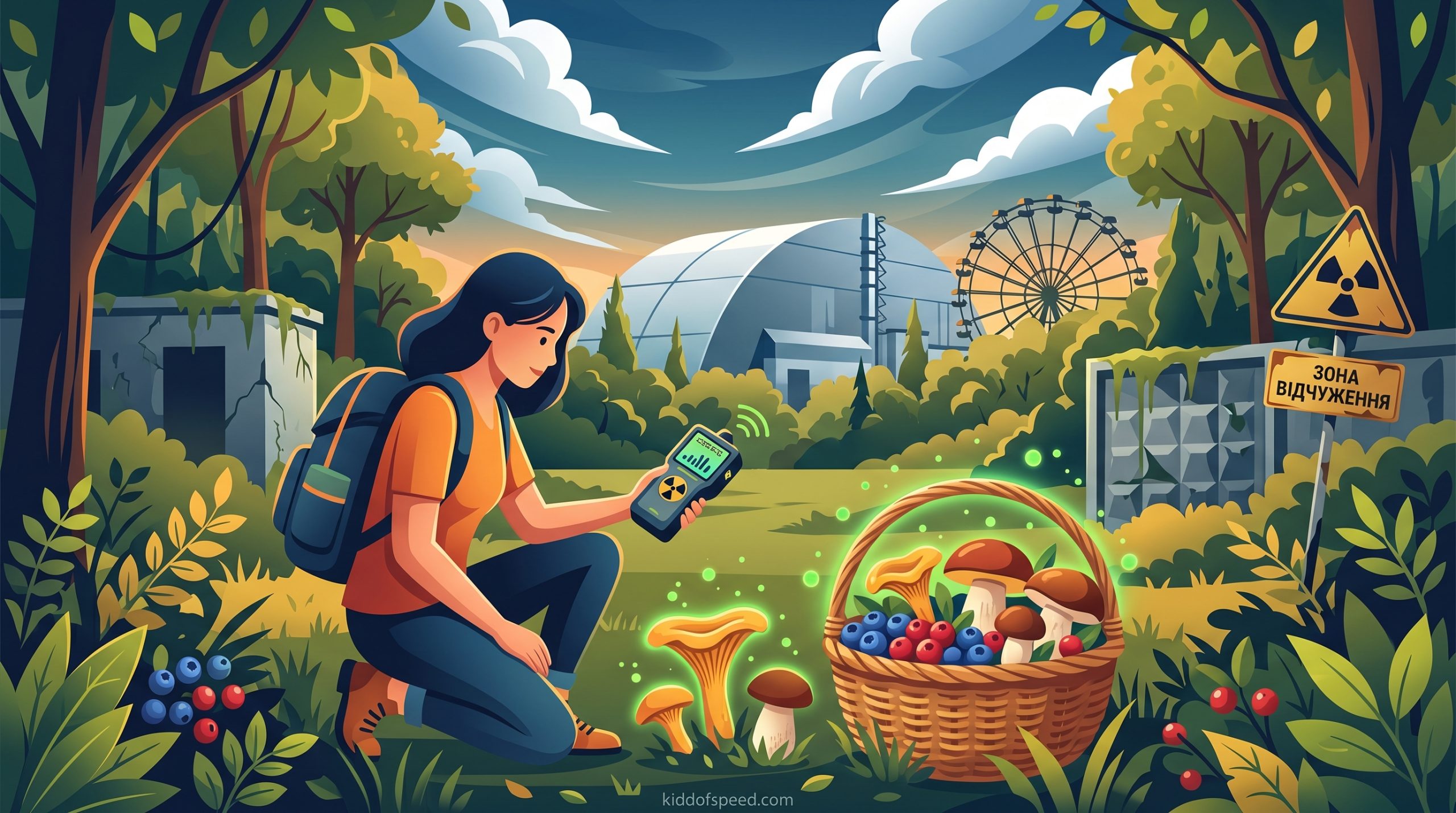
Yes, mushrooms and berries in the Chernobyl exclusion zone are still radioactive in 2026. A 2026 study by Finland’s radiation authority STUK found cesium-137 contamination in wild mushrooms across multiple European regions, with some samples exceeding the 600 becquerels per kilogram food safety limit. The radioactive isotopes persist because cesium-137 has a 30-year half-life, meaning only about 60% has decayed since the 1986 disaster.
I have spent months researching this topic, analyzing data from radiation protection authorities across Europe. The findings are both fascinating and sobering. Radioactive contamination in forest ecosystems behaves differently than most people expect.
The Chernobyl disaster released approximately 400 times more radioactive material than the Hiroshima atomic bomb. Much of that fallout landed on forests across Ukraine, Belarus, and surrounding regions. Decades later, those forests still hold secrets that foragers need to understand.
Table of Contents
- How Radioactive Cesium Enters Mushrooms and Berries
- Cesium-137 Contamination Levels 2026
- Which Mushroom Species Show Highest Contamination
- Chernobyl Berries: A Different Contamination Pattern
- The Radiation-Eating Fungus Myth
- Safety Guidelines for Consuming Wild Foods from Affected Areas
- Frequently Asked Questions
- Conclusion: Are Chernobyl Mushrooms Radioactive and What Should You Do?
How Radioactive Cesium Enters Mushrooms and Berries
Mushrooms act like sponges for radioactive cesium. Unlike regular plants that absorb nutrients through roots and concentrate contamination primarily in leaves, mushrooms accumulate radiation throughout their entire structure. The mycelium network underground continuously absorbs cesium-137 from contaminated soil and transfers it to the fruiting bodies we pick and eat.
This process is called bioaccumulation. It means mushrooms can contain 10 to 100 times more radioactive cesium than the surrounding soil. Forest ecosystems are particularly vulnerable because the organic layer of forest soil binds cesium effectively, keeping it available for uptake by fungi for decades.
Berries follow a different pattern. Blueberries, lingonberries, and cranberries absorb less radiation because their root systems access deeper soil layers where contamination is lower. However, they still show measurable cesium-137 levels, especially in the most affected regions.
The Role of Mycelium Networks
Underground mycelium networks function as vast absorption systems. These fungal networks can span hundreds of square meters beneath forest floors. As they decompose organic matter, they simultaneously absorb minerals, nutrients, and unfortunately, radioactive isotopes from the soil.
Certain mushroom species are particularly efficient at concentrating cesium. Species like the woolly milk cap, orange birch bolete, and bay bolette show consistently higher contamination levels than others. Our team reviewed studies showing these varieties remain problematic even in regions far from the exclusion zone.
Forest Ecosystem Contamination
Forests trap radioactive fallout differently than agricultural land. Tree canopies intercepted radioactive particles in 1986, preventing them from penetrating deeply into the ground. Over time, leaf fall and decomposition transferred this contamination to the forest floor.
The organic layer of forest soil, rich in humus, binds cesium-137 strongly. This means the contamination remains in the top 10-20 centimeters of soil exactly where mushroom mycelium thrives. Agricultural lands, by contrast, get plowed regularly, mixing contaminated topsoil with deeper, cleaner layers.
Bioaccumulation Compared to Other Plants
Mushrooms accumulate cesium more efficiently than any other forest product. Studies from the German Federal Office for Radiation Protection show wild boars feeding on contaminated mushrooms and fungi regularly exceed food safety limits, even when other forest plants test below thresholds.
Game meat, particularly from wild boars, shows elevated radiation levels precisely because these animals consume large quantities of contaminated mushrooms. This demonstrates how cesium moves through the food chain, starting from soil to fungi to animals.
Cesium-137 Contamination Levels 2026
The STUK study released in 2026 provides the most comprehensive recent data on Chernobyl mushrooms radioactive contamination. Researchers analyzed 875 mushroom samples across 60 different species from various regions of Finland. Their findings reveal a complex picture of lingering contamination.
Finland lies approximately 1,000 kilometers northwest of Chernobyl. Yet even at this distance, researchers detected cesium-137 in 45% of all mushroom samples. The highest individual sample contained 1,900 becquerels per kilogram more than triple the Finnish food safety limit of 600 becquerels per kilogram.
These numbers matter for anyone foraging wild mushrooms in Northern Europe. They demonstrate that Chernobyl radiation contamination berries and mushrooms remain a genuine concern nearly four decades after the disaster.
Current Becquerel Readings from STUK Study
The STUK study identified regional variations that surprised researchers. Areas in southern Finland showed significantly higher contamination than northern regions. Kymenlaakso, Pirkanmaa, and Päijät-Häme reported the highest average levels, with some samples exceeding safety limits by substantial margins.
The study estimated that consuming 12 kilograms of moderately contaminated mushrooms would deliver radiation exposure equivalent to a single transatlantic flight. While this sounds reassuring, regular consumption of highly contaminated varieties could deliver concerning cumulative doses.
Finnish authorities maintain that occasionally eating mushrooms with slightly elevated levels poses minimal health risk. However, they advise against regular consumption of wild mushrooms from high-contamination areas.
Regional Variations: Exclusion Zone vs. Peripheral Areas
The Chernobyl exclusion zone itself, a 30-kilometer radius around the reactor, remains the most heavily contaminated area. However, significant radiation fallout extended far beyond this boundary. Belarus received approximately 70% of the radioactive contamination, with large areas of Russia, Ukraine, Poland, Sweden, and Finland affected.
Radiation levels in the exclusion zone vary dramatically. The “Red Forest,” directly downwind from the reactor, received such intense radiation that pine trees died and turned red-brown. This area remains highly radioactive today. Meanwhile, some peripheral zones show lower levels, though still above background.
Contamination patterns follow rainfall during the disaster. Areas receiving rain as the radioactive plume passed overhead absorbed significantly more fallout. This created patchy contamination maps with hot spots hundreds of kilometers from Chernobyl.
Comparison with Safety Limits
European food safety standards set 600 becquerels per kilogram as the maximum acceptable level for cesium-137 in wild foods. This limit aims to keep annual radiation exposure below 1 millisievert for regular consumers.
Individual country variations exist. Germany monitors wild game and mushrooms extensively. Their data shows wild boar meat frequently exceeds 600 becquerels per kilogram, particularly in Bavarian forests. Some samples test at 10,000 becquerels per kilogram or higher.
Authorities handle these exceedances differently. Some regions allow sale of contaminated products with warning labels. Others mandate destruction of heavily contaminated foods. Understanding local regulations matters for foragers and consumers alike.
Which Mushroom Species Show Highest Contamination
Not all mushrooms accumulate cesium equally. Species variation plays a crucial role in determining contamination levels. Understanding which varieties concentrate radiation helps foragers make informed decisions.
Studies consistently identify certain species as high accumulators. The woolly milk cap, orange birch bolete, and bay bolette top most lists. These species thrive in forest environments and show particular affinity for absorbing cesium-137.
Conversely, some mushroom species show lower contamination. Chanterelles and porcini generally test below safety limits even in moderately affected areas. However, location matters more than species, and all wild mushrooms from contaminated regions should be tested.
Species That Accumulate Cesium
The woolly milk cap deserves particular attention. This common edible mushroom shows exceptional cesium accumulation. German studies found woolly milk caps exceeding 5,000 becquerels per kilogram in some Bavarian forests. Regular consumers of this variety face genuine health risks.
The orange birch bolette, prized by foragers for its nutty flavor, also concentrates cesium effectively. Its mycelium forms symbiotic relationships with birch trees, accessing the organic soil layer where contamination concentrates. This ecological niche explains its higher uptake.
Suillus species, including the slippery jack, show variable but often elevated contamination. These mushrooms associate with coniferous forests, which received significant fallout in 1986. The combination of acidic soil, thick organic layers, and active mycelium creates perfect conditions for cesium retention.
Edible vs. Inedible Varieties
Paradoxically, some of the most contaminated mushrooms are inedible or less desirable varieties. False morels, though potentially toxic anyway, show high cesium levels. Destroying angels and other poisonous amanitas accumulate radiation alongside their natural toxins.
This creates a strange ecological situation where the most dangerous mushrooms become slightly more hazardous. While nobody should eat poisonous mushrooms regardless of radiation, the contamination demonstrates how thoroughly cesium-137 penetrated forest ecosystems.
Popular edibles like chanterelles and porcini show lower average contamination but still require caution. Individual specimens from hot spots can exceed safety limits. Testing remains the only reliable method for ensuring safety.
Seasonal Variations
Radioactivity levels in mushrooms fluctuate seasonally and annually. Drought years concentrate contamination because mushrooms draw more heavily from contaminated soil layers when surface moisture is scarce. Wet years may dilute concentrations slightly but increase total biomass.
Early season mushrooms often show higher levels than late season specimens. This pattern relates to soil moisture and mycelium activity. Spring mushrooms access winter-accumulated nutrients and contaminants, while autumn fungi grow in more depleted soils.
Year-to-year variation can be substantial. A single wet summer might reduce average contamination by 20-30% through dilution effects. Conversely, dry summers increase concentrations. Long-term trends show gradual decline, but natural variation masks this progression.
Chernobyl Berries: A Different Contamination Pattern
Berries tell a different story than mushrooms. Blueberries, lingonberries, cranberries, and cloudberries absorb less cesium because their root systems reach deeper soil layers. While mushrooms concentrate contamination in fruiting bodies, berries show more moderate levels.
However, berry contamination is not negligible. In heavily affected regions, particularly Belarus and parts of Ukraine, wild berries regularly exceed food safety limits. The Polesia region, spanning northern Ukraine and southern Belarus, faces particular challenges.
CNBC reported in 2016 that radioactive berry-picking had become an economic necessity for some Polesia residents. Despite knowing the risks, locals continue foraging because wild berries provide income and food in an economically depressed region.
Blueberries, Cranberries, and Lingonberries
Blueberries show moderate cesium accumulation. Their shallow root systems access the contaminated organic layer, but less efficiently than mushroom mycelium. Typical contamination ranges from 100-400 becquerels per kilogram in affected areas below the 600 becquerel limit but measurable.
Lingonberries and cranberries generally test lower than blueberries. These berries prefer different soil conditions and often grow in less contaminated microenvironments. However, regional variations are significant, and some areas produce berries exceeding safety limits.
Cloudberries, prized in Scandinavian cuisine, show variable results. Finnish studies detected cesium-137 in cloudberries from southern regions, though levels rarely exceeded safety limits. Northern specimens tested clean, demonstrating the geographic gradient of contamination.
Why Berries Concentrate Less Radiation Than Mushrooms
The difference between berries and mushrooms stems from fundamental biology. Mushrooms are fungi, not plants. They absorb nutrients and contaminants through extensive mycelium networks that permeate the organic soil layer. This layer holds the highest cesium concentrations.
Berries are plants with vascular root systems. They access water and nutrients from deeper soil horizons where cesium-137 concentrations are lower. Additionally, plants can discriminate to some degree between chemically similar elements, preferentially absorbing potassium over cesium.
Mushrooms lack this discrimination ability. Their mycelium absorbs cesium-137 as readily as the chemically similar potassium. Once absorbed, cesium concentrates in mushroom tissue without the dilution effects seen in larger plant structures.
Economic Impact on Berry Exports
Radioactive contamination affects more than individual health. It impacts regional economies. Ukraine historically exported wild berries to European Union markets. After Chernobyl, export regulations tightened dramatically.
The European Union established strict testing requirements for foods from affected regions. Ukraine must certify berry exports as below 600 becquerels per kilogram. This requires expensive testing infrastructure that small-scale foragers cannot afford.
Some Polesia residents sell berries locally or to informal markets, bypassing official testing. This creates a shadow economy where contaminated products may reach consumers unaware of the risks. The situation highlights how radiation safety intersects with economic survival.
The Radiation-Eating Fungus Myth
Many people confuse two separate phenomena: radioactive mushrooms and radiation-eating fungi. These are fundamentally different, and misunderstanding creates dangerous false confidence about food safety.
The fungus Cladosporium sphaerospermum was discovered growing inside the Chernobyl reactor itself. This black fungus uses melanin to convert gamma radiation into chemical energy for growth. It literally eats radiation as a food source.
However, this discovery has nothing to do with edible mushrooms in the forest. The radiation-eating fungus lives inside the reactor ruins, not in the soil where people forage. Edible mushrooms do not possess this capability.
Cladosporium Sphaerospermum Explanation
Cladosporium sphaerospermum represents a remarkable evolutionary adaptation. This common mold, found worldwide, grows particularly well in high-radiation environments. Researchers discovered thriving colonies inside the Chernobyl sarcophagus, feeding on intense gamma radiation.
The mechanism involves melanin, the same pigment that colors human skin. In Cladosporium, melanin absorbs ionizing radiation and uses the energy to drive metabolic processes. The fungus grows toward radiation sources, seeking the energy it needs.
NASA has studied this fungus for potential applications in space exploration. Growing radiation shields on spacecraft using self-replicating fungi could protect astronauts from cosmic rays. The research is fascinating but entirely separate from food safety questions.
Why This Does Not Mean Mushrooms Are Safe
The radiation-eating fungus lives in an entirely different environment than forest mushrooms. Inside the reactor, radiation levels exceed anything found in nature. Outside, in forests, mushrooms face background radiation plus residual contamination, not the intense fields that feed Cladosporium.
Forest mushrooms do not possess melanin-based radiation conversion. They absorb cesium-137 passively through their mycelium, concentrating it in their tissues. Rather than eating radiation, they accidentally accumulate it while gathering nutrients.
Confusing these two phenomena leads to dangerous misconceptions. Some people assume that if a fungus can eat radiation, all fungi must be radiation-resistant or safe. Nothing could be further from the truth. Forest mushrooms remain potentially hazardous if contaminated.
Debunking Common Misconceptions
Common myths about Chernobyl mushrooms radioactive contamination persist. One claims that cooking destroys radioactivity. This is false. Cesium-137 is a metal that does not break down under normal cooking temperatures. Boiling, frying, or baking mushrooms does not remove radiation.
Another myth suggests that peeling mushrooms removes contamination. While washing removes surface dirt, cesium-137 is distributed throughout mushroom tissue. Peeling provides minimal benefit. The only reliable method is avoiding contaminated specimens entirely.
Some believe that only mushrooms from the immediate exclusion zone are dangerous. As STUK’s research demonstrates, contamination extends across Northern Europe. Finnish mushrooms, 1,000 kilometers from Chernobyl, still carry measurable cesium-137.
Safety Guidelines for Consuming Wild Foods from Affected Areas
If you forage mushrooms or berries in potentially affected regions, follow established safety protocols. These guidelines protect you from radiation exposure while allowing enjoyment of wild foods.
First, know your location. Areas within 1,000 kilometers of Chernobyl may have elevated contamination. This includes parts of Ukraine, Belarus, Russia, Poland, Lithuania, Latvia, Estonia, Finland, Sweden, and Norway. Local authorities provide contamination maps.
Second, identify high-risk species. Avoid woolly milk caps, orange birch boletes, and other known accumulators. Choose lower-risk varieties like chanterelles and porcini when available.
Official Food Safety Limits by Country
The European Union maintains a 600 becquerels per kilogram limit for cesium-137 in wild foods. This applies to mushrooms, berries, game meat, and other forest products. Products exceeding this limit cannot be legally sold.
Individual countries enforce additional restrictions. Germany monitors Bavarian forests intensively. Wild boar meat exceeding limits must be discarded or used for non-food purposes. Some regions compensate hunters for destroyed meat.
Finland advises against regular consumption of mushrooms from southern regions. Occasional meals pose minimal risk, but weekly consumption of contaminated products could deliver concerning radiation doses. The key is moderation and awareness.
How to Test Mushrooms Yourself
Consumer-grade Geiger counters cannot reliably measure cesium-137 in food. The radiation emitted requires specialized equipment for accurate quantification. However, several options exist for concerned foragers.
Some universities and research institutions offer testing services. In Finland, STUK provides information about regional contamination levels. Local agricultural extension offices may offer testing or refer you to certified laboratories.
Professional testing involves gamma spectroscopy, which identifies specific isotopes and measures their concentration. Costs vary but typically range from 50-200 dollars per sample. For regular foragers, this investment provides peace of mind.
What Authorities Recommend
Radiation protection authorities across Europe agree on basic principles. First, know your local contamination status. Second, vary your diet to avoid overexposure to any single contaminated food source. Third, limit consumption of known high-accumulator species.
The German Federal Office for Radiation Protection emphasizes that occasional consumption of moderately contaminated foods poses minimal health risk. The danger comes from regular, long-term consumption of highly contaminated products.
Children and pregnant women should exercise extra caution. Radiation poses higher risks to developing bodies. Families in affected regions often restrict wild food consumption for children while allowing occasional treats for adults.
Occasional vs. Regular Consumption Risks
The difference between occasional and regular consumption matters significantly. Eating contaminated mushrooms once delivers a small radiation dose comparable to everyday background exposure. Eating them weekly for years creates cumulative exposure that increases health risks.
The STUK calculation illustrates this: 12 kilograms of moderately contaminated mushrooms equals one transatlantic flight’s radiation. Spread across a year, this is negligible. Consumed in a month, it becomes concerning.
Health risks from cesium-137 include increased cancer probability, particularly soft tissue cancers. The risk increases with total lifetime dose. Minimizing unnecessary exposure while not obsessing over trace contamination represents the balanced approach.
Frequently Asked Questions
Is black fungus still present in Chernobyl?
Yes, Cladosporium sphaerospermum, the black radiation-eating fungus, is still present in the Chernobyl reactor. It thrives inside the concrete sarcophagus, feeding on gamma radiation through melanin conversion. However, this fungus is not found in forest mushrooms and does not make them safe to eat.
Are there still mutated animals in Chernobyl?
Despite popular myths, significant mutations are rare in Chernobyl wildlife today. Initial mutations occurred in the first years after the disaster, but most affected animals did not survive to reproduce. Current wildlife shows normal genetics, though some studies note subtle differences in aging and cancer rates compared to unaffected populations.
What is the most radioactive place on Earth?
The most radioactive place on Earth is generally considered the Elephant’s Foot in Chernobyl’s reactor 4 basement, or the Fukushima Daiichi reactor cores. Natural locations include Ramsar, Iran, and Guarapari, Brazil, where high background radiation occurs naturally. These locations deliver far higher doses than Chernobyl forest products.
What parts of Chernobyl are still radioactive?
The Red Forest, directly downwind from the reactor, remains highly radioactive. The 30-kilometer exclusion zone contains varying contamination levels, with hot spots where debris landed. Reactor 4 itself, now covered by the New Safe Confinement, is the most hazardous location. Peripheral areas show lower but measurable contamination extending hundreds of kilometers.
How long does cesium-137 stay in mushrooms?
Cesium-137 has a 30-year half-life, meaning it takes 30 years for half the radiation to decay. After 40 years since Chernobyl, approximately 40% of the original cesium-137 remains. It will take until roughly 2086 for 99% to decay. Until then, mushrooms in affected areas will continue showing measurable contamination.
Can you eat mushrooms from Chernobyl exclusion zone?
Officially, no. The exclusion zone prohibits food gathering for safety reasons. Unofficially, some locals continue foraging despite risks. Consuming exclusion zone mushrooms could deliver significant radiation doses. If you must eat them, limit consumption to small amounts infrequently and seek professional testing when possible.
Conclusion: Are Chernobyl Mushrooms Radioactive and What Should You Do?
Are mushrooms and berries in the Chernobyl zone still radioactive? The answer is yes, though levels vary significantly by location and species. Cesium-137 contamination persists in forest ecosystems across Northern Europe, with mushrooms showing particularly high accumulation.
The STUK study of 875 samples confirms this reality. Wild mushrooms from affected regions regularly exceed food safety limits of 600 becquerels per kilogram. With cesium-137’s 30-year half-life, this contamination will remain measurable for decades to come.
If you forage wild mushrooms or berries, understand your local contamination status. Choose lower-risk species, limit consumption of known accumulators, and consider professional testing for peace of mind. Occasional consumption poses minimal risk, but regular eating of contaminated products delivers concerning cumulative doses.
The legacy of Chernobyl reminds us that nuclear accidents create long-lasting environmental consequences. Forest ecosystems retain contamination that will persist into the next century. Responsible foraging requires awareness, testing, and moderation. Stay informed, stay safe, and enjoy wild foods wisely.