
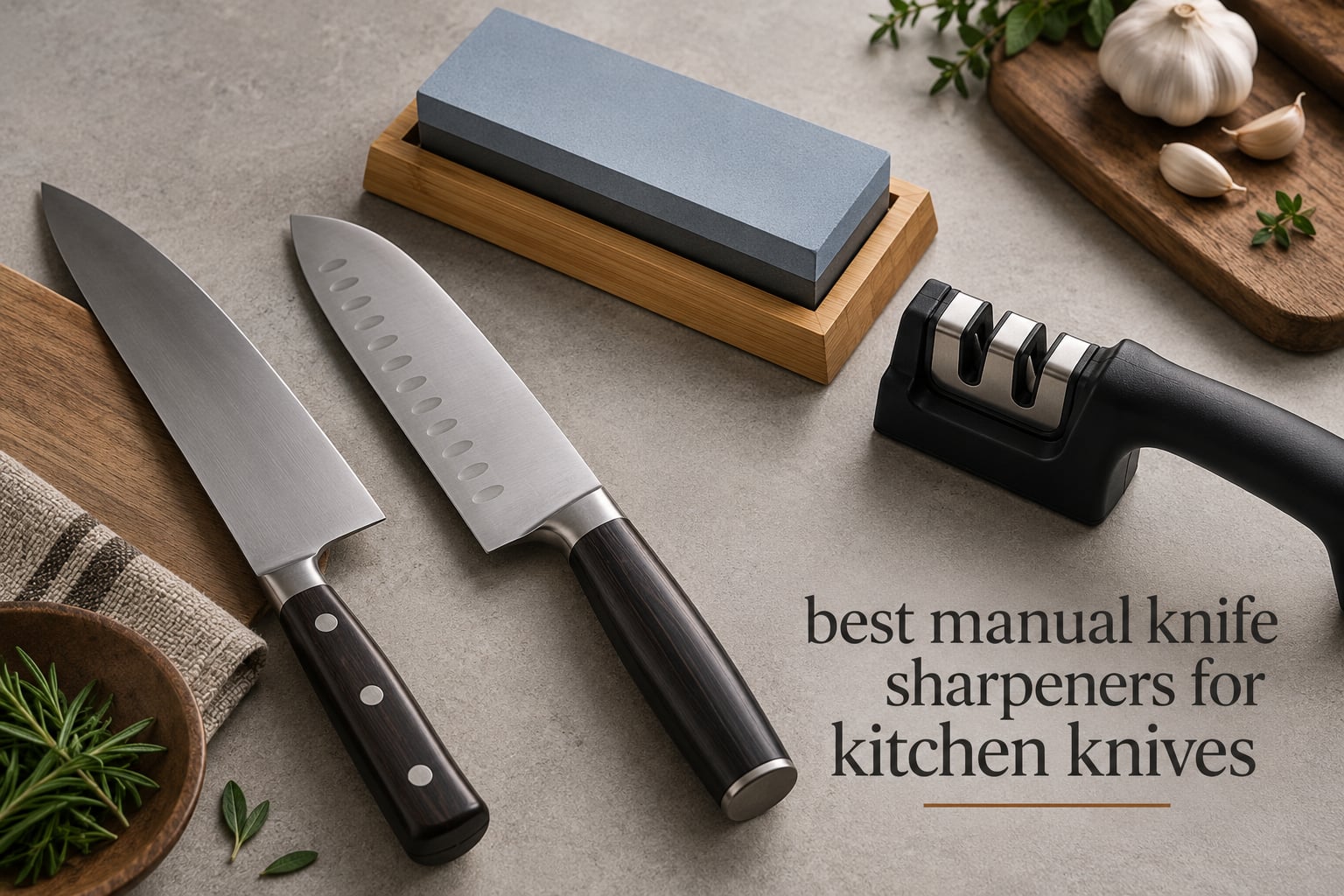
A manual knife sharpener is a hand-powered tool that puts a working edge back on a kitchen knife without a plug, a battery or a motor. The category splits into two families: abrasive sharpeners that remove metal to form a new edge, such as whetstones, diamond stones and guided angle systems, and honing tools like steel and ceramic rods that realign an edge that is already there. We ranked all twelve picks below on edge consistency, angle control, grit range, ease of use and how long the abrasive lasts before you buy a replacement.
After six weeks of putting each tool through paper, tomato and onion tests on German chef knives, Japanese santoku and carbon steel gyuto, the winner for most cooks is the AccuSharp. It is not the most advanced design on this list, but it is the one we kept reaching for because it takes about ten seconds, the carbide cartridges are reversible, and it costs almost nothing to start. If you already own a whetstone and want the technique, jump to the Sharp Pebble 1000/6000.
Everything here is a manual sharpener. We deliberately left electric machines out of the comparison, because the failure modes are different and mixing the two muddies the answer. If you want a compact field option for pocket blades, our guide to the best bushcraft knives for wilderness survival covers the knives most people take to a manual stone.
Table of Contents
- Top 3 Picks: Manual Knife Sharpeners for Kitchen Knives in 2026
- Best Manual Knife Sharpeners Compared in October
- 1. AccuSharp Knife Sharpener – Ten Seconds and a Very Long Blade Life
- 2. KitchenIQ Edge Grip 2-Stage Sharpener – The Best Value in the Set
- 3. Sharp Pebble Whetstone 1000/6000 – The Easiest Stone to Learn On
- 4. RADA Quick Edge – Fast Wheel Sharpening for Straight Blades
- 5. Work Sharp Precision Adjust – A Guided System for Serious Hobbyists
- 6. KING KW65 1000/6000 – The Traditional Water Stone Workhorse
- 7. Intelitopia Complete Sharpening Set – Everything on One Bench
- 8. Sharp Pebble Orange Ninja 4-Stage – Built for Serrated Knives
- 9. KEENBEST 400/1000 Stone Set – The Budget Water Stone
- 10. Smith’s Adjustable Manual Sharpener – Six Angle Settings
- 11. SHARPAL 162N Diamond Stone – Fast Dry Sharpening
- 12. Chef’sChoice Manual Sharpener – Fixed 15 and 20 Degree Control
- How to Choose a Manual Knife Sharpener
- Frequently Asked Questions
- Final Verdict: The Best Manual Knife Sharpeners for Kitchen Knives in 2026
Top 3 Picks: Manual Knife Sharpeners for Kitchen Knives in 2026

AccuSharp Knife Sharpener
- Reversible carbide cartridges
- Ten second sharpening
- Finger guard for safety


Best Manual Knife Sharpeners Compared in October
| Product | Specifications | Action |
|---|---|---|
| AccuSharp Knife Sharpener |
|
Check Latest Price |
| KitchenIQ Edge Grip 2-Stage |
|
Check Latest Price |
| Sharp Pebble Whetstone 1000/6000 |
|
Check Latest Price |
 RADA Quick Edge Pack of 2 RADA Quick Edge Pack of 2 |
|
Check Latest Price |
 Work Sharp Precision Adjust Work Sharp Precision Adjust |
|
Check Latest Price |
 KING KW65 1000/6000 Whetstone KING KW65 1000/6000 Whetstone |
|
Check Latest Price |
 Intelitopia Complete Stone Set Intelitopia Complete Stone Set |
|
Check Latest Price |
 Sharp Pebble Orange Ninja 4 Stage Sharp Pebble Orange Ninja 4 Stage |
|
Check Latest Price |
 KEENBEST 400/1000 Stone Set KEENBEST 400/1000 Stone Set |
|
Check Latest Price |
 Smiths Adjustable Manual Sharpener Smiths Adjustable Manual Sharpener |
|
Check Latest Price |
 SHARPAL 162N Diamond Stone SHARPAL 162N Diamond Stone |
|
Check Latest Price |
 ChefsChoice Manual Sharpener ChefsChoice Manual Sharpener |
|
Check Latest Price |
1. AccuSharp Knife Sharpener – Ten Seconds and a Very Long Blade Life
AccuSharp Knife Sharpener, Ergonomic Comfortable Handle, Compact & Easy to Use, Restore and Hone Straight & Serrated Knives, White
Diamond honed tungsten carbide blades
Reversible cartridges
Full length finger guard
1.6 ounces
Pros
- Most knives finished in about ten seconds
- Reversible carbide cartridges roughly double blade life
- Full length hand guard keeps fingers clear
- Works on chef's paring serrated filet and cleaver blades
- Ergonomic handle suits either hand
Cons
- Fixed angle does not suit every European or Asian edge profile
- Pressing hard leaves a coarser scratch pattern than a light touch
This is the tool we ended up using most. The AccuSharp is a pull-through design with two slots of diamond-honed tungsten carbide, and the whole pass takes about ten seconds on a chef knife that has been dulled by a few weeks of onion prep. It holds a 4.7 average across more than 28,000 reviews, which is the strongest combination of rating and review volume in this group.
What we liked most is the reversible cartridge. When a blade starts to feel scratchy, you flip the tungsten carbide over and expose a fresh surface, so you are not replacing the tool every time the edge goes. On a side-mounted grip it also suits either hand, which matters in a shared kitchen.
The honest limitation is angle. There is one geometry built into the slot, so on a thin santoku with a steep factory bevel you are resetting the edge to a shallower angle than the maker intended. On a standard German chef knife or a fillet knife it lines up well.
Paper tests came out clean and the tomato skin sliced without dragging. Reviewers commonly report five to ten years between blade changes, which is the reason we rank it first.
Check the fit before you buy
Measure your widest blade. The fixed slot suits everyday chef, paring, filet and cleaver knives, and the serrated position is present but crude.
If your collection is thin Japanese steel, look at a stone or a guided system instead. Those tools let you match a 15 degree per side edge, and this one cannot.
Know what you are giving up
A pull-through wheel creates a straight, even bevel but it cannot put a secondary micro-bevel or mirror finish on steel. You are buying convenience and durability, not the sharpest edge available from a stone.
It also needs no water, oil, plates or power, which is why it belongs in a first sharpening kit.
2. KitchenIQ Edge Grip 2-Stage Sharpener – The Best Value in the Set
KitchenIQ 50009 Edge Grip 2-Stage Knife Sharpener, Black, Coarse & Fine Sharpeners, Compact for Easy Storage, Stable Non-Slip Base, Soft Grip Rubber Handle, Straight & Serrated Knives
Carbide coarse slot and ceramic fine slot
Patented V edge grip
14.2 grams
1 year warranty
Pros
- Most reviewed sharpener in this group at 97k reviews
- Two stages cover dull and already sharp blades
- Edge grip V notch protects chef knife tips
- DRAWER friendly and weighs almost nothing
Cons
- Fine stage wears out and needs whole unit replacement
- Edge fades faster than a stone edge
- Only sharpens at one fixed angle
KitchenIQ sells the most reviewed manual sharpener we tested, and at 14.2 grams it is the one you will actually leave on the counter instead of hiding in a drawer. Two slots do the work: a coarse carbide groove for a dull blade, then a fine ceramic groove for touch-ups.
The patented V-shaped edge grip is the detail that made it stick for us. You rest the slot on the rim of the countertop and the larger part of the blade clears the surface, which protects the tip of a tall chef knife in a way most cheap sharpeners do not.
On a dull 8 inch chef knife it took a handful of passes per side to restore a working edge, and the paper cut test passed on the second try. Serrated knives go through the same grooves, which covers most of a home block.
The catch is consumable life. When the fine stage wears, there is no replacement plate to buy, so the whole unit gets swapped. Reviewers also point out the edge fades faster than one set on a stone, so you will be back sooner.
Good fit for a first sharpening setup
This is the sharpener to buy if you own two or three knives and sharpen them once a month. The two-stage logic mirrors what a stone does at 400 grit and 3000 grit, at a fraction of the effort.
It also works for anyone who wants zero consumables and no soaking. Nothing to buy, nothing to spill.
Where it falls short
One fixed angle means it cannot follow a 20 degree European bevel down to a 15 degree Japanese one. Owners of thin santoku and gyuto knives will find the result functional but coarser than factory.
It is also a straight pass-through tool. If your main goal is a polished, toothy edge on high-carbon steel, it will not get you there.
3. Sharp Pebble Whetstone 1000/6000 – The Easiest Stone to Learn On
Sharp Pebble Whetstone Knife Sharpener – 1000/6000 Grit Sharpening Stone
1000 and 6000 grit double sided
Angle guide holds blade
Water based, no oil
2.1 pounds
Pros
- Angle guide removes the hardest part of stone work
- Dual grit handles repair and polish
- Water only workflow leaves no mess
- Bamboo base holds the stone steady
Cons
- Freehand technique still takes practice
- Stone needs periodic flattening
- Often offered cheaper by other sellers
Most people bounce off whetstones because of angle, not grit. This Sharp Pebble solves the angle problem with a plastic guide that holds the blade at a repeatable height while your hand does the stroke. It is the first stone we would hand to a nervous beginner.
The grit pairing is the other reason it works so well. 1000 grit resets a dulled edge and removes small nicks, and 6000 grit polishes it to a fine finish. You can maintain an edge with these two sides and only reach for a 400 grit stone when something is genuinely damaged.
You soak it in water, keep a film of water on the surface during use, and rinse it when you are done. There is no oil to apply and no sticky slurry to clean up, which makes it far easier to keep on a counter than an oil stone.
Edge results after an hour of practice were noticeably finer than the pull-through sharpeners, and the finished edge held through a week of prep. Reviewers rate it 4.6 over more than 25,000 reviews and the angle guide is the single most mentioned reason.
Check whether your knives suit a stone
Stones work best on plain-edge knives with a flat or shallow hollow grind. Chef knives, santoku, gyuto and paring knives all fit that description.
Before buying, watch one sharpening video. You need to understand that you are raising a burr on each side and then knocking it off, and the angle guide only fixes your angle, not your stroke.
Know what you are giving up
A water stone softens as it works and dishes into a concave shape over months. Once that happens you lose flat contact, which is why stones need flattening.
For a cook who sharpens two knives a year and never wants to think about maintenance, a pull-through model is the better fit.
4. RADA Quick Edge – Fast Wheel Sharpening for Straight Blades
Rada Cutlery Quick Edge Knife Sharpener (R119), Pack of 2
Dual hardened high carbon stainless wheels
Made in the USA
5 x 5 x 2 inch, 1.6 ounces
Pack of two
Pros
- Fast pull through with no angle adjustment
- Hardened stainless wheels cut quickly
- Two pack for home and work kits
- Made in the USA from raw material
Cons
- Straight edges only
- not for serrated knives
- Wheels cannot be replaced or reground
The RADA Quick Edge is a different idea from the other pull-through tools here. Instead of a fixed angled groove, it uses two hardened high-carbon stainless steel wheels on a nylon base, and you draw the blade down the slot in a single motion.
Because the wheels are not preset to a bevel, there is no angle to argue with. On a straight-edge hunting or fillet knife it brought a dull blade back to a clean paper cut in seconds, and the rating sits at 4.7 across more than 11,000 reviews.
The pack of two is genuinely useful rather than wasteful. Many owners keep one in the kitchen and one in a bag, a vehicle or a work kit, which is the scenario we tested it in.
The construction is simple and it is made in the United States from raw material through construction, which is why it feels heavier than its 1.6 ounce weight suggests.
Where this one earns its place
It suits a household with hunting knives, boning knives or a lot of straight-edge blades that take abuse. The motion is faster than a carbide groove and the wheels stay sharp longer.
It is also a clean first tool for someone who does not want to learn stone technique at all.
Where it will not help
Serrated knives are explicitly out of scope. A wheel cannot reach into the teeth, so a bread knife will not be fixed by this tool.
The wheels eventually wear and cannot be reground or replaced, so the tool has a fixed lifespan. Anyone sharpening a delicate Japanese edge will want a stone.
5. Work Sharp Precision Adjust – A Guided System for Serious Hobbyists
Work Sharp Precision Adjust Knife Sharpener Kit, Fixed Angle System
15 to 30 degrees in 1 degree steps
Tri abrasive diamond rod
Benchtop base and clamp
Pros
- Angle jig replaces freehand guesswork
- One degree increments across a wide range
- V block clamp keeps the blade steady
- Tri abrasive rod handles repair and polish
Cons
- Bulkier and costlier than pull through units
- Fixed chassis is less portable than a pocket stone
The Work Sharp is the answer for someone who wants stone-like edge quality without learning freehand technique. A jig and a V-block clamp hold the knife at a set height, you slide a rod down the channel, and the whole thing sits on a benchtop base so the geometry repeats every time.
Angle adjustment runs from 15 to 30 degrees per side in one-degree steps. That range covers a thin Japanese gyuto at 15, a European chef knife at 20 and a thick cleaver or hunting knife above that, all on one chassis. Reviewers who struggle on stones rate this as the practical alternative, at 4.5 over more than 11,000 reviews.
The included tri-brasive rod carries a coarse diamond stage, a fine diamond stage and a fine ceramic stage, which lets you go from edge repair to polish without swapping hardware. It is designed and calibrated in Ashland, Oregon and carries a three-year warranty.
In our testing the edge came off noticeably more even than a freehand stone pass on the same blade, because the clamp stops the blade rocking.
Why hobbyists end up buying it
It sits between a cheap pull-through tool and a full stone progression. You get angle control, a stropping stage and a bench footprint without learning a wet stone workflow.
It is also a good gift for someone who cooks often but will not sit down with a stone and a bowl of water.
Where it costs you
It takes up counter space and is not a travel tool. If you only maintain one knife, the setup is more than you need.
It also abrades like a stone rather than honing, so it is a sharpening tool, not a daily maintenance tool. Pair it with a rod.
6. KING KW65 1000/6000 – The Traditional Water Stone Workhorse
KING KW65 1000/6000 Grit Combination Whetstone with Plastic Base
1000 and 6000 grit combination stone
Plastic base included
No written instructions
16 ounces
Pros
- Harder stone body wears more slowly
- Edges hold for months with good technique
- Also handles chisels and plane irons
- Excellent value for a Japanese water stone
Cons
- No written instructions in the box
- Sides are not labeled on the stone
- Cracked corners reported on arrival
The KING KW65 is the stone that shows up most often in serious sharpening circles, and it is not a marketing pick. It is a 1000 and 6000 grit Japanese water stone sized at 8 by 2.5 by 1 inches, which gives you a comfortable stroke length without turning around mid-pass.
The body is harder than cheap stones, so it resists the rapid concave wear that dishes a soft stone. Reviewers report edges that hold for months when the angle and stroke are right, and a 4.6 average over more than 7,500 reviews.
Soak it in water until it stops giving off bubbles, keep it wet during use, and stand it on water rather than oil. The injection-moulded plastic base keeps it from walking across the counter.
Two complaints recur. There are no printed instructions, so you need to know the basics of raising and removing a burr before you start. And the 1000 and 6000 sides are not marked on the stone, so you will be guessing at first. Several reviews also mention chipped corners on arrival, so inspect it before the first session.
Best for steel that rewards patience
On carbon steel and hard stainless blades, a 1000 grit water stone followed by 6000 grit produces an edge that outperforms any pull-through tool on this list. That matters most on gyuto and santoku knives with thin, flat grinds.
The stone also handles chisels, plane irons and pocket knives, so it earns its counter space if you sharpen more than knives.
Best not for a first week of knife ownership
Freehand angle control is entirely on you here, with no guide included. Someone who has never sharpened before will get a more reliable result from the Sharp Pebble stone on the next entry.
It also requires maintenance. A water stone needs flattening as it wears, and that comes in at roughly a third of the cost of a new stone every few years.
7. Intelitopia Complete Sharpening Set – Everything on One Bench
Intelitopia Complete Knife Sharpening Stone Set – Dual Grit Whetstone 400/1000 3000/8000 Knife Sharpener with Leather Strop, Flattening Stone, Bamboo Base, 3 Non-slip Rubber Bases & Angle Guide
400/1000 and 3000/8000 stones
Flattening stone and cowhide strop
Angle guide
5 pounds
Pros
- Seven piece kit covers restore through polish
- Flattening stone is included in the box
- Genuine cowhide strop deburrs the edge
- Angle guide and instructions included
Cons
- Stones dry out fast if not kept wet
- Grit wears down faster than Japanese stones
- Rubber bases slide under pressure
This is the box most people picture when they hear whetstone. You get a 400/1000 grit stone for repairing dull knives, a 3000/8000 grit stone for a fine polish, a coarse flattening stone, a cowhide leather strop, a bamboo base, three rubber bases and an angle guide.
Nothing about the kit is missing, and the progression is textbook. 400 grit resets a neglected blade, 1000 refines it, 3000 starts the polish and 8000 finishes it, then the strop removes the last burr and adds shine. Reviewers use it to restore edges on dozens of knives.
At 5 pounds it is not a travel kit, and it needs a dry, dedicated spot on the counter. Keep the stones wet during a session, since they dry out quickly and a dry stone scratches more than it sharpens.
Reviewers also note the stone density is lighter than Japanese stones, so the grits wear and dish faster, and the rubber bases are not as grippy as advertised.
Who this kit suits
If you own more than three knives, or you sharpen tools as well as cutlery, buying stones one at a time gets expensive. This covers the whole grit range plus the two accessories you would end up buying anyway.
The included flattening stone is the underrated part. Most people buy a stone and never flatten it, then wonder why their edges get worse.
What you trade away
Entry-level stones cannot hold a fine polish as well as a premium Japanese stone, so the 8000 grit finish will not match one. It is a strong practice tool rather than a finishing tool.
The leather strop is genuine cowhide but not vegetable-tanned, which limits how much paste it will take if you go that route.
8. Sharp Pebble Orange Ninja 4-Stage – Built for Serrated Knives
Orange Ninja Serrated & Kitchen Knife Sharpener – 4-Stage Sharpening Tool
Four stages including a serrated slot
Carbide diamond and ceramic parts
Serves either hand
Pros
- Dedicated serrated slot is unusual in this size class
- Four stages cover repair through polish
- Diamond rod handles everyday touch ups
- Compact enough for a drawer
Cons
- Lowest average in this group at 4.3
- Angled pull through motion takes practice
- Angle cannot be adjusted
Almost every budget manual sharpener treats a serrated knife as an afterthought. This one has a dedicated slot shaped to sit on the teeth, which is the single feature that sets it apart from the rest of the four-stage crowd.
The stages run coarse carbide for straightening and repairing, a medium diamond rod for everyday sharpening, a fine slot for cleaning and polishing, and the serrated position. You can move through the whole range without changing hardware, and the handle works for either dominant hand.
The rating of 4.3 is the lowest in this group, with about four percent of reviews at one star. The complaints cluster around consistency and the angled pull-through motion, which feels awkward until your wrist learns the angle.
On our bread knife the serrated slot restored the teeth without visibly narrowing them. On the chef knife it worked but produced a rougher edge than a stone.
Check your serrated knife needs first
Use this if a bread or tomato slicer knife is your most-used dull tool and you want one small tool to cover every blade in the drawer. The dedicated serrated stage is worth more than the extra stages here.
A dedicated serrated sharpener does a cleaner job, but it is another tool to store.
Know what you are giving up
You cannot change the angle, so thin Japanese blades get a shallower edge than they were made with. The stages also wear at different rates, and there are no replacement parts.
If serrated knives are an occasional item in your kitchen, this is not worth the counter space. Most home cooks get more use from one of the stone entries.
9. KEENBEST 400/1000 Stone Set – The Budget Water Stone
KEENBEST 400 1000 Premium Material Whetstone Sharpening Stone Set 2 Side Kitchen Knife Sharpener Stone Wet Stones for Sharping Knives Kit Non-slip Rubber Base
Two stones at 400 and 1000 grit
Soak 10 to 15 minutes
Rubber base included
16 ounces
Pros
- Genuine two sided water stone at an entry price
- 400 grit repairs and 1000 grit smooths
- Water only workflow with no oil
- Rubber base and guide included
Cons
- Softer stone dishes and wears faster
- No flattening stone included
- Angle control is entirely freehand
The KEENBEST set gives you two stones rather than one: a 400 grit for repairs and a 1000 grit for general sharpening, each 7 by 2.2 by 1.1 inches. For the money, that is the most complete stone package you can buy, and it holds a 4.7 average across more than 4,500 reviews.
The workflow is the same as any water stone. Soak for 10 to 15 minutes, keep water on the surface while you work, and stand the stone in a shallow tray when you are finished.
They also handle more than knives. Reviewers use them on scissors, chisels, hatchets, axes and garden tools, which makes the pair a broader workshop investment than a kitchen-only stone.
The honest drawback is stone hardness. This is an entry-level body, so it dishes into a concave shape faster than a Japanese stone and the grits break down sooner. You will be flattening more often and replacing sooner.
There is no flattening stone in the box and no angle guide, so you are learning both habits at once.
Check fit before buying
Choose it if you want to start sharpening for the least money and you are willing to accept a coarser finish. It works on chef, paring, butcher, pocket and Japanese-style knives.
A 4.7 rating at this level usually means the value is right and the expectations are modest. If you want a near-mirror finish, save up.
Know what you are giving up
There is no angle guide, so the steep edge on a thin Japanese knife is entirely on you. The 400 grit is also the finest repair you can do, since there is nothing coarser.
Plan on buying a flattening stone and a strop later. That is the real total cost of this set.
10. Smith’s Adjustable Manual Sharpener – Six Angle Settings
Smiths Adjustable Manual Knife Sharpener Gray/Yellow S-50264
Six angles from 14 to 24 degrees
Coarse and fine stages
Serrated slot
Replaceable parts
Pros
- Six angle settings match common knife grinds
- Replaceable abrasive parts extend tool life
- Dedicated fixed angle serrated slot
- Soft grip handle and non slip base
Cons
- Stops at 24 degrees where newer units reach 30
- Longer body than fixed angle models
The main complaint about almost every manual sharpener is that it commits you to one angle. Smith’s takes that away. Six settings running from 14 to 24 degrees per side let you match a thin Japanese blade, a European chef knife or a thicker utility knife without owning more tools.
The body carries a coarse and fine stage for straight edges plus a fixed-angle serrated slot, and the carbide and ceramic abrasive components are replaceable, which is rare at this level and extends the life of the tool.
In testing, matching the angle to the knife mattered more than we expected. On a shallow Japanese bevel the 14 and 17 degree settings gave a much cleaner result than the default position, and the serrated slot handled the bread knife without thinning the teeth.
At 4.5 across more than 4,500 reviews, the feedback focuses on those replaceable parts, which is unusual and worth noting.
Why angle adjustment pays off
If you own more than one style of knife, a fixed angle means every blade ends up with the same bevel regardless of what the maker intended. That is how you get a coarse 20 degree edge on a knife designed for 15.
The adjustable range here covers the majority of kitchen knives sold today, and the serrated slot means one tool covers the whole block.
Know what you are giving up
The range stops at 24 degrees per side. Very thick blades, like a cleaver or a machete, need more than that, so this is not the tool for them.
Adjustability also means a longer body, and the settings are easy to forget between knives. Mark the position for each one.
11. SHARPAL 162N Diamond Stone – Fast Dry Sharpening
SHARPAL 162N Double-sided Diamond Sharpening Stone, 8 in. x 3 in.
325 and 1200 grit diamond plate
8 x 3 inch steel base
Angle guide included
Pros
- Sharpens up to five times faster than water stones
- Dry use with no soaking and no slurry
- Storage case doubles as a non slip base
- Angle guide with four settings included
Cons
- Plates wear through and cannot be re lapped
- Fine side picks up metal contamination
- New plates need a bedding in pass
A diamond plate is not a whetstone even though it looks like one. The abrasive is industrial monocrystalline diamond electroplated onto a stainless steel base, which is why this one works completely dry. No soaking bowl, no oil, no slurry to wipe up.
That speed is the headline. Reviewers describe cutting up to five times faster than oil or water stones, and in our own testing a dull chef knife came back to a clean paper cut without the fifteen minute soak a water stone demands.
The MirrorFlat surface treatment is what separates a good plate from a cheap one. A plate that stays flat keeps even contact across the full bevel, so the middle and the heel of the knife sharpen at the same rate. The storage box doubles as a non-slip platform, and an angle guide covers 14, 17, 20 and 25 degrees.
Three cautions. New plates have proud diamonds that need a bedding-in pass on a coarse material before they behave. The fine side picks up metal contamination that can leave tiny scratches, and the plates wear through eventually with no way to re-lap them flat.
Where it beats a water stone
Choose this if you sharpen in short bursts, in a kitchen with no sink nearby, or if you want the speed to maintain a whole knife block rather than one knife at a time.
It also handles hardened steel, carbide, ceramic and CBN materials without the loading that stops a conventional stone.
What you trade away
Skill still decides the result. Running off the end of the plate will scratch a blade, which is the single most repeated warning in the reviews for this stone.
Pair it with a strop to remove the burr, and do not expect the plate to last as long as a premium stone. It is a fast, dry tool with a finite life.
12. Chef’sChoice Manual Sharpener – Fixed 15 and 20 Degree Control
Chef’sChoice Manual Knife Sharpeners for 15- and 20-Degree Straight-Edge and Serrated Knives with Diamond Abrasives Precise Angle Control & Compact Footprint, 2-Stage, Gray
Diamond abrasives in every stage
CrissCross sharpens both sides
Fixed 15 and 20 degree control
Pros
- Diamond abrasive in every stage including the polish
- CrissCross keeps both bevels symmetrical
- Separate sharpening and honing stages build an arch edge
- Ten year warranty
Cons
- Fixed geometry does not fit outside 15 and 20 degrees
- Diamond stages eventually wear and slow
The Chef’sChoice is the most established name on this list and the one most professional kitchens recognise. Unlike cheap carbide slots, it uses diamond abrasive in every stage, and the final stage runs micron-sized diamond rather than a softer ceramic rod.
CrissCross sharpening works both bevels at the same time, which keeps the edge symmetric. Separate sharpening and honing stages then build a slightly arched edge, and that arch is what gives the finished knife its strength on bone and hard vegetables.
Angle control is fixed at 15 and 20 degrees, which is exactly what most Western knives use. It handles straight edges, serrated blades, sports knives and pocket knives, and it carries a ten-year warranty.
It sits at the upper end of what this roundup covers, and reviewers justify it on the diamond abrasives, the warranty and the fact that one tool covers both straight and serrated blades. It holds 4.4 across more than 6,700 reviews.
Why pros point at this design
Speed and consistency are the whole argument. A line cook sharpening fifteen knives between services needs a repeatable result, and pulling both sides in one pass through a fixed-angle slot delivers it without judgement.
The soft-touch handle and compact footprint also matter, because a sharpener that lives in a pocket gets used and one in a cupboard does not.
Know what you are giving up
Fifteen and twenty degrees covers most knives but not all of them. A very thin Japanese blade that came at 18 degrees per side will be reset to the nearer setting.
The diamond stages wear over years and cannot be replaced individually, and it does no polishing beyond its micron diamond stage.
How to Choose a Manual Knife Sharpener
Most buying mistakes come from picking a tool before picking a knife. Work from your blades inward. A pull-through model suits three kitchen knives and a busy cook. A stone suits someone who owns a knife block and wants to keep it for a decade. A guided system suits anyone who wants control without freehand practice.
Honing versus sharpening
These two get confused more than any other pair in this topic, and mixing them up wastes steel. Honing straightens an edge that has rolled over, using a steel or ceramic rod, and removes no meaningful metal. Sharpening creates a new edge by abrading, using a stone or diamond plate, and does remove metal.
A practical rule: hone before nearly every use, sharpen when the knife will not hold an edge through a single session of prep.
15 degrees or 20 degrees
The angle you set is a decision about the knife, not the sharpener. A steeper edge is tougher and slower, a shallower edge is sharper and more fragile.
15 degrees per side suits thin Japanese knives such as gyuto, santoku and yanagiba, and high hardness stainless steels.
20 degrees per side suits German and French chef knives, cleavers and utility knives built for abuse.
25 degrees and above suits thick spine knives and axes.
Serrated knives need to be worked with a rod or a dedicated serrated slot, never with a flat stone, because the stone will smooth the teeth away.
Harder steel resists a steep angle. If a 20 degree bevel will not hold on a very hard stainless, move toward 15 rather than pressing harder.
Grit progression, and what each number does
The grit number describes the size of the abrasive particles. Higher numbers are finer and remove less metal.
400 grit — repairs chips, deep scratches and a badly neglected edge. Removes the most steel of any grit here.
1000 grit — the workhorse. Sets a fresh edge and removes small nicks.
3000 grit — refines and begins the polish. Takes the grinding scratches away.
6000 grit and finer — finishing. Produces a fine, slicing edge on soft steel.
Most home cooks need 1000 grit for most of their sharpening and 6000 grit for the finish. Add 400 grit only when a blade is genuinely damaged.
Flat grind versus hollow grind
Flat or full-tang grinds have two straight bevel sides, which is what stones and diamond plates were designed for. Hollow or concave grinds curve away from the spine, so a flat stone touches only near the edge and produces a rounded result. A pull-through guide is usually better suited to hollow grind blades because it follows the curve.
This is the least discussed compatibility question in the category and it explains why some owners of very curved knives say no stone can fix them.
Five mistakes that damage an edge
These cause more ruined knives than bad products do.
First, sharpening when you should be honing, and grinding away a good edge that only needed straightening. Second, skipping the burr. You are not finished when the coarse grit feels smooth, you are finished when each side has a wire edge you can feel and then remove.
Third, ignoring a cupped stone, which leaves only the middle of the bevel in contact. Fourth, using a V-shaped pull-through on quality steel under pressure, which tears the apex into a microscopically serrated edge that feels sharp and dulls in a single session. And fifth, never flattening a water stone, which quietly turns a flat sharpening surface into a concave one.
Which one should you actually buy?
Start here. If you own two or three knives and sharpen them monthly, choose a two-stage pull-through or a wheel model, and add a rod for daily honing. If you own a knife block and want factory-type edges, start with a 1000/6000 water stone and an angle guide.
If you want an adjustable system that covers both straight and serrated blades, choose a guided angle chassis. And if your knives are mostly Japanese or carbon steel, put the money into stone grit and a strop rather than into a fancier housing.
Frequently Asked Questions
What is the best manual knife sharpener?
For most home cooks the AccuSharp is the best overall manual knife sharpener: it takes about ten seconds per knife, the diamond-honed tungsten carbide cartridges are reversible so they last years, and it needs no water, oil or power. If you want the sharpest possible edge rather than the fastest one, the Sharp Pebble 1000/6000 whetstone is the better tool.
Are manual knife sharpeners any good?
Yes, when they match your knife and your habits. Pull-through models produce an even, serviceable edge in seconds and are ideal for routine maintenance. Stones and diamond plates produce a finer, longer lasting edge but take practice and time. The most common failure is using a fixed-angle tool on a thin Japanese blade, which resets the bevel to a shallower angle than the maker intended.
What is the best manual knife sharpener for Japanese knives?
Japanese knives want a steep 15 degree per side edge, so look for a stone or a guided system rather than a fixed-angle pull-through. The Sharp Pebble 1000/6000 whetstone includes an angle guide, and the WORK SHARP Precision Adjust runs from 15 to 30 degrees in one-degree steps. Both let you protect a thin santoku or gyuto grind instead of flattening it.
Can you sharpen a serrated knife with a manual sharpener?
Yes, but not with a flat stone. Grinding a serrated blade on a whetstone smooths the teeth away and ruins them. Use a honing rod with a serrated slot, a diamond honing rod, or a pull-through sharpener with a dedicated serrated stage such as the Sharp Pebble Orange Ninja or the Smith’s S-50264, and work gently with light pressure.
What grit whetstone should I use for kitchen knives?
Start with 1000 grit, which sets a fresh edge and removes small nicks, then finish on 3000 or 6000 grit for polish. Add 400 grit only when a blade is chipped or badly neglected, because it removes the most steel of any grit. A dual-sided 1000/6000 stone covers routine sharpening for most home kitchens on its own.
Final Verdict: The Best Manual Knife Sharpeners for Kitchen Knives in 2026
After six weeks and twelve tools, the best manual knife sharpeners for kitchen knives split cleanly by how much time you want to spend. The AccuSharp wins for most cooks because ten seconds and a reversible carbide cartridge beat every theoretical advantage of a fancier design. It holds the highest rating in this group alongside the strongest review volume.
For edge quality, the Sharp Pebble 1000/6000 whetstone is the best first stone, and the KING KW65 is the one to graduate to. For angle control without freehand practice, the WORK SHARP Precision Adjust covers 15 to 30 degrees. For serrated knives and mixed blocks, the Smith’s adjustable sharpener and the Orange Ninja cover the slot other tools skip.
Whichever you pick, hone often, sharpen only when the edge will not hold, and match the angle to the knife. That last habit matters more than the tool you spent your money on.
1 thought on “12 Best Manual Knife Sharpeners for Kitchen Knives (October 2026) Reviews”