
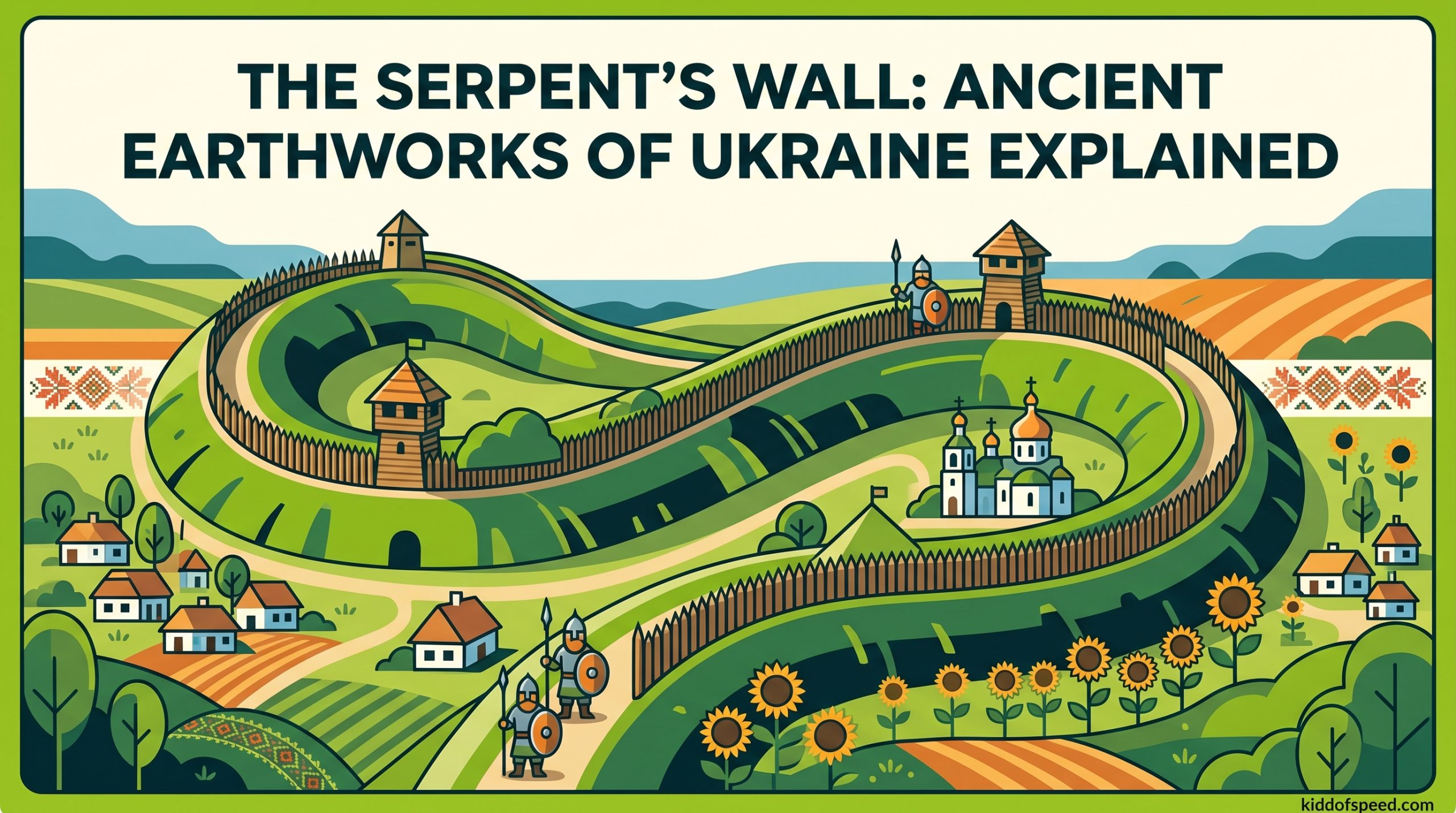
The Serpent’s Wall (Ukrainian: Змієві вали, Zmiievi valy) stands as one of the most mysterious and impressive ancient fortification systems in Eastern Europe. Stretching approximately 1,000 km across middle Dnieper Ukraine, primarily through Kyiv Oblast, these ancient earthworks have puzzled historians and archaeologists for generations. I first encountered mention of these massive fortifications while researching medieval European defense systems, and I was immediately struck by both their scale and the lingering questions surrounding their origins.
Built between the 2nd century BC and 7th century AD, the Serpent’s Wall represents a remarkable feat of ancient engineering. Multiple lines of earth and timber fortifications snake across the Ukrainian landscape, creating what some scholars consider the longest ancient defensive system in Europe. Yet despite extensive archaeological research, fundamental questions remain about who built these walls and why.
In this comprehensive guide, I’ll explain everything we know about the Serpent’s Wall. We’ll explore its geographic extent, examine the competing theories about its builders, delve into the fascinating legends that gave it its name, and look at what modern research has revealed about this ancient marvel.
Table of Contents
- What is the Serpent’s Wall?
- Where is the Serpent’s Wall Located?
- The Legend Behind the Serpent’s Wall
- Who Built the Serpent’s Wall?
- How Was the Serpent’s Wall Constructed?
- What Was the Defensive Purpose of the Serpent’s Wall?
- Archaeological Research on the Serpent’s Wall
- The Serpent’s Wall Today: Preservation and Challenges
- Frequently Asked Questions
- What is the Serpent’s Wall in Ukraine?
- How long is the Serpent’s Wall?
- When was the Serpent’s Wall built?
- Who built the Serpent’s Wall?
- What is Zmiievi valy?
- What defense purpose did the Serpent’s Wall serve?
- Is the Serpent’s Wall still visible today?
- How does the Serpent’s Wall compare to other ancient fortifications?
- Conclusion: The Enduring Mystery of the Serpent’s Wall
What is the Serpent’s Wall?
The Serpent’s Wall is an ancient system of earthworks known as valla located in middle Dnieper Ukraine. These linear fortifications stretch across primarily Kyiv Oblast, creating a defensive barrier that protected settled agricultural communities from nomadic incursions sweeping north from the steppes.
The Ukrainian name Zmiievi valy translates roughly to “serpent ramparts” or “snake walls,” reflecting both the winding nature of the earthworks and the rich folklore surrounding their creation. Some sources also refer to them as “Dragon Walls,” emphasizing the mythological connections that have captured imaginations for centuries.
Archaeologists have identified multiple parallel lines of fortifications, suggesting that the defensive system was built and rebuilt over several centuries by different peoples facing similar threats. The earthworks typically consist of earthen banks reinforced with timber, though construction techniques vary along different sections of the wall.
Where is the Serpent’s Wall Located?
The Serpent’s Wall stretches across the forest-steppe zone of Ukraine, following a roughly east-west alignment through Kyiv Oblast and extending toward Podolia in the west. The fortifications begin near the town of Zmiiv in the east and extend approximately 1,000 km westward, though exact measurements vary depending on which sections are included.
Multiple distinct lines of earthworks have been documented, with some researchers identifying up to three or four parallel defensive lines in certain areas. These parallel walls suggest either successive building phases or a coordinated defensive strategy involving multiple fallback positions.
The earthworks themselves vary in size and construction. Typical sections feature banks several meters high with accompanying ditches, though height and width vary considerably depending on local topography and available building materials. In some areas, the walls remain visible as raised ridges cutting across agricultural fields, while in other sections, centuries of farming have reduced them to subtle elevation changes barely perceptible to untrained eyes.
Modern observers can still trace the path of the Serpent’s Wall through satellite imagery, where the linear features appear as distinct patterns across the Ukrainian countryside. Archaeological surveys have mapped the most prominent sections, though the full extent of the original system likely exceeds what remains visible today.
The Legend Behind the Serpent’s Wall
Every ancient monument carries stories, and the Serpent’s Wall is no exception. The name itself derives from a folk tale first recorded in the 19th century, though the story likely circulated orally for centuries before being written down.
According to the legend, the walls were built by the giant Kozmodemian to contain the monstrous three-headed dragon Gornych. In some versions of the tale, the serpent or dragon burrowed through the earth, creating the ridges that became the defensive walls. Other variations suggest that Kozmodemian piled up the earthworks to imprison the beast, explaining both the winding, serpentine pattern and the name Zmiievi valy.
These folk traditions connect the Serpent’s Wall to deeper themes in Ukrainian and Slavic mythology. Snakes and dragons appear frequently in Slavic folklore, often representing the chaotic forces of nature that must be tamed or contained by human effort. The earth itself becomes a protective barrier, literally rising up to defend communities against destruction.
Beyond this specific legend, the serpent symbolism connects to broader patterns of ancient worship in the region. Archaeological sites throughout Ukraine, including the famous Kamyana Mohyla, contain evidence of serpent veneration stretching back to the Mesolithic period. Some researchers have suggested that the defensive walls may have incorporated or replaced earlier sacred sites, though this theory remains speculative.
The legend of Kozmodemian and Gornych continues to capture local imagination, with the Serpent’s Wall featuring in regional tourism materials and cultural heritage programs. Whether viewed as historical fact or charming fiction, these stories add a layer of mystique to an already fascinating archaeological monument.
Who Built the Serpent’s Wall?
The question of who built the Serpent’s Wall has sparked considerable academic debate. Radiocarbon dating and archaeological evidence suggest three main possibilities, with some researchers arguing for multiple building phases involving different cultures over several centuries.
Theory 1: The Sarmatians (2nd Century BC – 3rd Century AD)
The earliest possible builders were the Sarmatians, Iranian-speaking nomadic peoples who dominated the Pontic steppe during the late centuries BC and early centuries AD. Archaeological evidence suggests that some sections of the Serpent’s Wall date to this period, with radiocarbon samples indicating construction around the 2nd century BC.
The Sarmatians were themselves semi-nomadic, which raises interesting questions about why they would build such extensive fortifications. Some scholars suggest that settled Sarmatian groups or allied peoples may have constructed the walls to protect agricultural communities from other nomadic raiders. Alternatively, the fortifications might represent attempts by external powers to control Sarmatian movements.
Theory 2: The Goths (3rd-5th Centuries)
The second major theory attributes the Serpent’s Wall to the Goths, Germanic peoples who migrated into the region during the early centuries AD. The Chernyakhov culture, associated with Gothic settlement in Ukraine, left substantial archaeological remains including fortified settlements that show similar construction techniques to the Serpent’s Wall.
Support for this theory comes from dendrochronological studies of timber remains found in the earthworks. Some samples have been dated to the 4th-5th centuries, squarely within the Gothic period. The Goths had both the organizational capacity and the incentive to build defensive works, as they faced pressure from Hunnic expansion from the east.
Archaeologist Florin Curta and others have argued that the scale and sophistication of the earthworks suggest a society with considerable resources and centralized coordination, characteristics that fit the Gothic kingdoms of the period.
Theory 3: The Early East Slavs (7th-10th Centuries)
The third theory points to Early East Slavic peoples, ancestors of modern Ukrainians, Russians, and Belarusians, who expanded into the region during the 7th-10th centuries. Radiocarbon dates from some wall sections cluster around the 7th century, suggesting at least partial construction during this later period.
This theory connects the Serpent’s Wall to the emerging Kievan Rus’ state and its defensive needs. The 10th-century Byzantine emperor Constantine VII Porphyrogenitus mentioned fortifications in the region, though scholars debate whether these refer specifically to the Serpent’s Wall. The earthworks may have protected the early state of Kyiv from nomadic raids by Pechenegs, Cumans, and other steppe peoples.
The Multiple-Phase Hypothesis
Many modern archaeologists favor a compromise position: the Serpent’s Wall represents multiple building phases spanning several centuries, with different cultures contributing to the defensive system as threats evolved. The earliest sections may date to Sarmatian times, with major reconstructions during the Gothic period and further additions by Early East Slavs.
This interpretation makes sense given the strategic geography of the region. The forest-steppe zone where the Serpent’s Wall runs represents a natural boundary between agricultural lands to the north and the open steppe to the south. Successive societies would have faced similar defensive challenges and likely built upon or repaired existing fortifications rather than starting from scratch.
How Was the Serpent’s Wall Constructed?
The Serpent’s Wall represents a classic example of valla construction, a technique used throughout the ancient world for creating linear defensive earthworks. Understanding how these massive structures were built helps explain both their durability and their vulnerability to modern development.
The basic construction method involved digging a ditch and piling the excavated earth to form a bank or rampart. This simple technique created an effective obstacle for cavalry and slowed infantry advance, particularly when combined with timber reinforcements. The ditch provided an additional barrier while the bank offered elevated positions for defenders.
Archaeological excavations have revealed that timber played a crucial role in stabilizing the earthworks. Wooden frameworks, posts, and facing materials helped prevent erosion and maintain the structural integrity of the banks. In some sections, log construction techniques similar to those used in West Slavic fortifications have been identified.
The scale of the Serpent’s Wall required enormous labor investment. Estimates suggest that building just one kilometer of earthwork would have required hundreds of workers laboring for weeks. The full 1,000-kilometer system represents a staggering investment of human effort, indicating both the seriousness of the threat and the organizational capabilities of the builders.
Multiple parallel lines suggest sophisticated defensive planning. If invaders breached the outer wall, defenders could fall back to secondary positions. This layered defense strategy appears in other ancient fortification systems, including Roman limes and Chinese wall constructions, suggesting that the builders of the Serpent’s Wall understood contemporary military engineering principles.
What Was the Defensive Purpose of the Serpent’s Wall?
The Serpent’s Wall served as a crucial defensive line protecting settled agricultural communities from nomadic incursions. Throughout antiquity and the early medieval period, the Ukrainian forest-steppe marked a contested frontier between farming societies to the north and pastoral nomads sweeping across the Eurasian steppe.
The threats facing the builders of the Serpent’s Wall evolved over centuries. During the earliest phase, Sarmatian and Scythian groups posed the primary danger. Later, Hunnic expansion terrorized the region in the 4th-5th centuries. By the medieval period, Pechenegs, Cumans, and other Turkic peoples regularly raided northward, prompting the continued maintenance and expansion of defensive works.
The strategic placement of the Serpent’s Wall reflects careful consideration of military geography. The fortifications run along the edge of the forest-steppe zone, where dense woodlands to the north could provide refuge for defenders while open steppe to the south allowed nomadic cavalry to maneuver. Controlling this transition zone was essential for protecting the emerging urban centers of Kyiv and other early East Slavic settlements.
Comparisons to similar fortifications help contextualize the Serpent’s Wall within broader patterns of ancient defense. Trajan’s Wall in modern Romania served similar purposes against Dacian and later nomadic threats. The Roman limes along the Rhine and Danube represented comparable attempts to control frontier zones. Like these other systems, the Serpent’s Wall probably functioned less as an impenetrable barrier and more as a deterrent and delay mechanism, slowing raiders while defenders mobilized.
The walls likely worked in combination with other defensive measures, including mobile patrols, fortified settlements, and early warning systems. Archaeological evidence suggests that settlements along the wall line featured their own defensive works, creating a network of mutually supporting strongpoints.
Archaeological Research on the Serpent’s Wall
Scientific study of the Serpent’s Wall began in earnest during the Soviet period, with major excavations conducted in the 1970s and 1980s. These investigations transformed understanding of the earthworks, though they also generated new controversies about dating and attribution.
The 1970s excavations led by Ukrainian archaeologists revealed the complex timber construction techniques used in the walls. Dendrochronological analysis of preserved wood samples provided crucial dating evidence, though results varied considerably depending on which sections were tested. Some samples dated to the 4th-5th centuries, supporting the Gothic theory, while others clustered around the 7th century, suggesting Early East Slavic construction.
Radiocarbon dating has complicated rather than resolved questions about the Serpent’s Wall chronology. Different laboratories have produced varying results from samples taken along different sections of the wall. Some readings push construction back to the 2nd century BC, while others suggest 9th-10th century dates. This chronological spread supports the multiple-phase hypothesis, though debate continues about exactly how many building phases occurred.
International collaboration has enriched research on the Serpent’s Wall. Scholars including Florin Curta have brought comparative perspectives from Balkan and Byzantine studies, while Ukrainian archaeologists have documented regional variations in construction techniques. Academic conferences and publications have provided forums for debating competing interpretations.
Recent research has focused on understanding the Serpent’s Wall as a dynamic system that evolved over time rather than a single construction project. Geophysical surveys have identified previously unknown sections, while paleoenvironmental studies have reconstructed the landscape context in which the walls were built. This holistic approach promises to yield new insights into how the defensive system functioned and why it was eventually abandoned.
The Serpent’s Wall Today: Preservation and Challenges
The Serpent’s Wall faces significant preservation challenges in the 21st century. Agricultural development has destroyed or obscured many sections, while urban expansion around Kyiv and other cities has eliminated portions of the earthworks entirely. What remains requires active protection to survive for future generations.
The most visible sections today appear as raised linear features crossing farmland, often marked by slight color variations in crops growing over the buried remains. Aerial photography and satellite imagery have proven invaluable for identifying and mapping these subtle remnants. Some sections have been designated as archaeological monuments and receive legal protection, though enforcement varies.
The war that began in 2022 has added new threats to Ukraine’s archaeological heritage, including the Serpent’s Wall. Military activity, trenching, and development associated with defensive positions have damaged or destroyed portions of the earthworks. The full extent of this impact will only become clear when comprehensive surveys can be conducted.
Preservation efforts face the challenge of balancing agricultural productivity with heritage protection. Many sections of the Serpent’s Wall cross active farmland, and farmers understandably prioritize crop cultivation over archaeological preservation. Innovative approaches, including precision agriculture techniques that avoid deep plowing over known wall sections, offer potential solutions.
For visitors interested in seeing the Serpent’s Wall, several accessible locations exist near Kyiv. The village of Lebedyn in Boryspil Raion features well-preserved sections that have been marked with informational signs. Similar monuments exist near Obukhiv and other towns along the historical wall line. These sites offer tangible connections to Ukraine’s ancient past and the peoples who built these remarkable fortifications.
Frequently Asked Questions
What is the Serpent’s Wall in Ukraine?
The Serpent’s Wall is an ancient system of earthworks (valla) located in middle Dnieper Ukraine, primarily in Kyiv Oblast. Stretching approximately 1,000 km, these fortifications were built between the 2nd century BC and 7th century AD to protect settled communities from nomadic incursions.
How long is the Serpent’s Wall?
The Serpent’s Wall stretches approximately 1,000 km (about 620 miles) across Ukraine, running from Zmiiv in the east toward Podolia in the west. Multiple parallel lines of fortifications exist in some areas, bringing the total constructed length to significantly more than 1,000 km.
When was the Serpent’s Wall built?
Archaeological evidence suggests the Serpent’s Wall was built between the 2nd century BC and 7th century AD. Radiocarbon dating indicates multiple construction phases, with some sections dating to Sarmatian times, others to the Gothic period (3rd-5th centuries), and later additions by Early East Slavs.
Who built the Serpent’s Wall?
Three main theories exist: (1) Sarmatians in the 2nd century BC – 3rd century AD, (2) Goths during the 3rd-5th centuries, or (3) Early East Slavs in the 7th-10th centuries. Many archaeologists believe multiple cultures contributed to the defensive system over several centuries.
What is Zmiievi valy?
Zmiievi valy (Змієві вали) is the Ukrainian name for the Serpent’s Wall, meaning ‘serpent ramparts’ or ‘snake walls.’ The name derives from folk legends about a giant and dragon, and reflects the winding, serpentine pattern of the earthworks across the landscape.
What defense purpose did the Serpent’s Wall serve?
The Serpent’s Wall protected agricultural communities from nomadic raids by Scythians, Sarmatians, Huns, Pechenegs, Cumans, and other steppe peoples. It formed a defensive line along the forest-steppe boundary, protecting early settlements including the emerging state of Kyiv.
Is the Serpent’s Wall still visible today?
Yes, portions of the Serpent’s Wall remain visible as raised linear features crossing farmland, particularly in Kyiv Oblast. The most accessible sections for visitors are located near the village of Lebedyn in Boryspil Raion and near Obukhiv. However, agricultural development and urban expansion have destroyed or obscured many sections.
How does the Serpent’s Wall compare to other ancient fortifications?
The Serpent’s Wall rivals Trajan’s Wall in Romania and other major ancient defensive systems in scale and sophistication. Like the Roman limes, it served as a frontier defense against nomadic threats. At approximately 1,000 km, it represents one of the largest ancient earthwork fortifications in Europe.
Conclusion: The Enduring Mystery of the Serpent’s Wall
The Serpent’s Wall stands as a testament to the ingenuity and determination of ancient peoples facing existential threats. Stretching 1,000 km across the Ukrainian landscape, these earthworks represent one of the most ambitious defensive projects in European history. Yet despite decades of archaeological research, fundamental questions about their origins remain unanswered.
Whether built by Sarmatians, Goths, Early East Slavs, or some combination of these cultures, the Serpent’s Wall tells a story of human communities organizing to protect themselves against the chaos of nomadic invasion. The multiple phases of construction, the sophisticated use of timber reinforcement, and the strategic placement along the forest-steppe boundary all demonstrate that the builders understood their environment and their enemies.
The legend of Kozmodemian and Gornych reminds us that monuments acquire meanings beyond their original purposes. What began as practical military engineering became woven into folklore, transformed into mythic landscape features that connected communities to their past. Today, the Serpent’s Wall continues to serve as a symbol of Ukrainian heritage and resilience.
As Ukraine faces new challenges in 2026, the preservation of ancient monuments like the Serpent’s Wall takes on renewed importance. These earthworks connect modern Ukrainians to the countless generations who lived, worked, and defended this land over two millennia. Protecting the Serpent’s Wall means honoring that legacy and ensuring that future generations can continue to wonder at this remarkable achievement of ancient engineering.
I hope this exploration of the Serpent’s Wall has illuminated both what we know and what remains to be discovered about these fascinating fortifications. The ancient earthworks of Ukraine still hold secrets waiting to be uncovered by future researchers willing to dig deeper into this remarkable chapter of European history.