
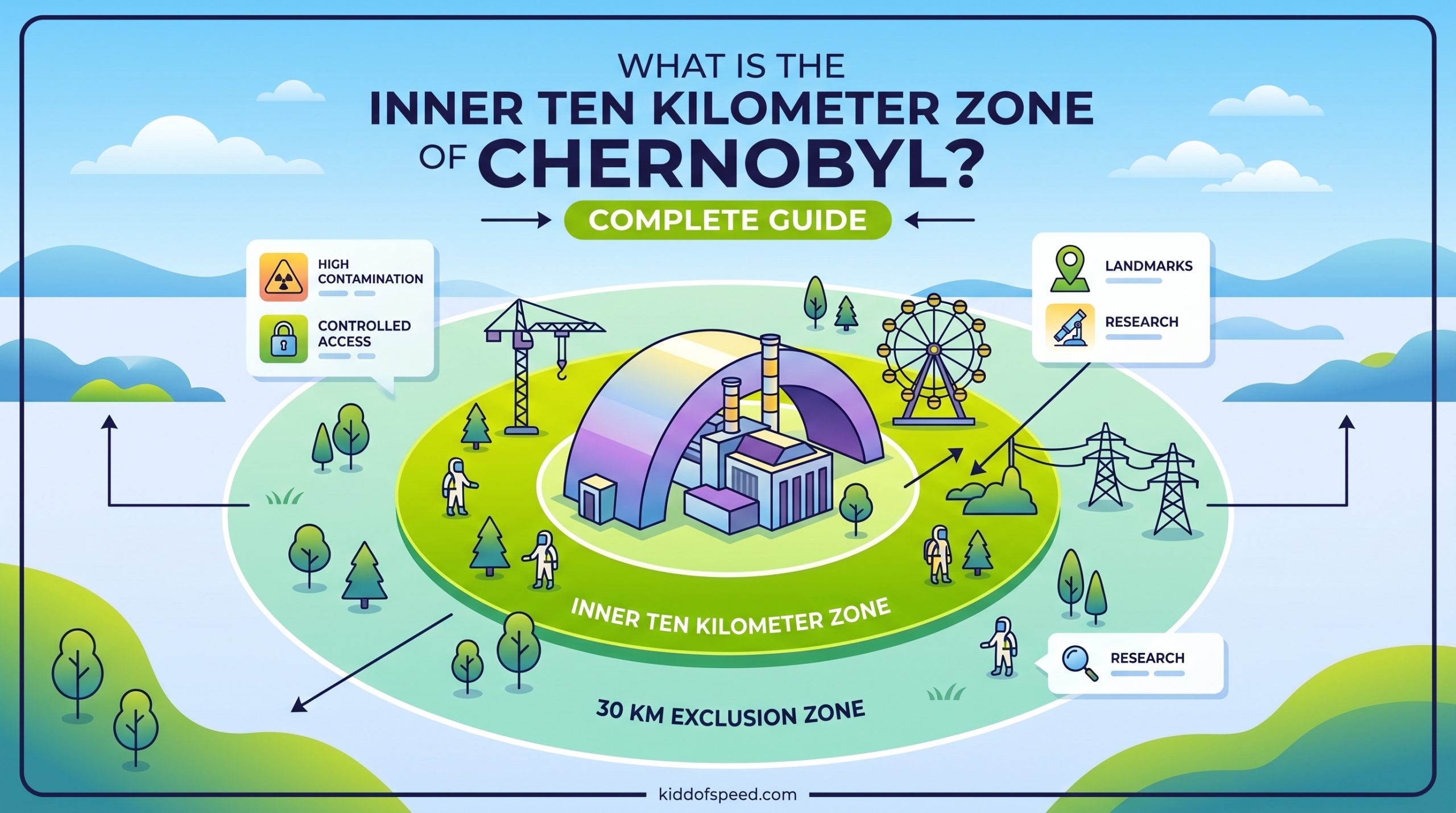
The Inner Ten Kilometer Zone of Chernobyl represents the most restricted and heavily contaminated area surrounding the site of the 1986 nuclear disaster. This circular boundary, known locally as the desyatka (meaning “ten” in Ukrainian), encloses the epicenter of the explosion and contains the highest concentrations of radioactive isotopes anywhere in the exclusion zone.
I first became fascinated with this zone while researching my Chernobyl revisited journey several years ago. The contrast between the 10km inner zone and the broader 30km exclusion zone confuses many visitors planning trips to Ukraine. Understanding these distinctions matters for safety, legal compliance, and grasping the full scope of the disaster’s impact.
Table of Contents
What Is the Inner Ten Kilometer Zone of Chernobyl?
The Inner Ten Kilometer Zone of Chernobyl is the highly restricted core area immediately surrounding the Chernobyl Nuclear Power Plant and its destroyed Reactor 4. Ukrainian authorities established this boundary within days of the April 26, 1986 explosion to isolate the most dangerous radioactive contamination.
Locals call this area the desyatka, a straightforward reference to its 10-kilometer radius from the reactor. The term reflects how people living near the exclusion zone actually talk about these places, not the bureaucratic language of government agencies.
This inner zone functions as the dead center of the Zone of Alienation. Within its boundaries sit the destroyed reactor, the infamous Red Forest, abandoned military installations, and ghost towns that remain frozen in time. Unlike the outer 30km zone where limited resettlement and regular tourist access occurs, the 10km zone maintains the strictest controls.
The State Agency of Ukraine on Exclusion Zone Management oversees all access to the desyatka. They classify this area as requiring maximum radiation protection protocols. Workers entering must follow specific dosimetry monitoring, wear protective equipment in certain areas, and observe strict time limits for exposure.
Understanding the Two-Zone System: 10km vs 30km
The Chernobyl Exclusion Zone operates on a two-tier restriction system that confuses many first-time visitors. The 30km outer zone serves as a buffer, while the 10km inner zone functions as the hazardous core requiring special clearance beyond standard tourist permits.
Most organized tours take visitors through the 30km checkpoint at Dytyatky and into areas like the city of Chernobyl itself and Pripyat. These trips expose tourists to minimal radiation risk while providing the iconic imagery people associate with the disaster. The 10km zone demands additional authorization that standard tourists rarely receive.
| Feature | 10km Inner Zone (Desyatka) | 30km Outer Zone |
|---|---|---|
| Radiation Level | 0.5-300+ microsieverts/hour | 0.2-5 microsieverts/hour |
| Access Type | Special permits only | Tourist permits available |
| Overnight Stays | Workers only (rotation schedule) | Available at Chernobyl town hotel |
| Key Locations | Reactor 4, Red Forest, Duga Radar | Pripyat, Chernobyl town, abandoned villages |
| Residency | No permanent residents | Samosely (self-settlers) present |
| Primary Activity | Decommissioning, scientific research | Tourism, limited administration |
The radiation differential between these zones is substantial. Background radiation in the 10km zone can spike to hundreds of microsieverts per hour at specific hotspots. The Red Forest area regularly measures 20-100 microsieverts per hour depending on weather conditions and ground disturbance.
By comparison, the 30km zone outer areas typically show readings comparable to higher natural background radiation locations worldwide. Visitors receive roughly 5-7 microsieverts during a standard two-day tour, equivalent to a chest X-ray or a transatlantic flight. This difference in safety profiles explains why access policies vary so dramatically between the zones.
Key Locations Within the 10km Zone
Several critical sites lie within the desyatka that define both the historical tragedy and ongoing management challenges. Understanding what exists inside this restricted perimeter helps clarify why access remains so tightly controlled nearly four decades after the initial disaster.
Reactor 4 and the New Safe Confinement
The destroyed Reactor 4 sits at the absolute center of the 10km zone. The original concrete sarcophagus, built in months following the explosion, contained the worst contamination but deteriorated over time. In 2026, engineers completed the New Safe Confinement (NSC), an enormous steel arch that now covers the old shelter.
The NSC allows workers to eventually dismantle the unstable original structure and extract the melted nuclear fuel still buried inside. This decommissioning project will continue for decades. Radiation levels immediately adjacent to the reactor structure remain the highest anywhere in the exclusion zone, with some areas exceeding 300 microsieverts per hour.
The Red Forest
Perhaps the most dangerous natural area within the desyatka, the Red Forest earned its name when pine trees turned red-brown and died after absorbing massive radiation doses in 1986. Workers bulldozed the dead trees and buried them in trenches, but the soil remains heavily contaminated with cesium-137 and strontium-90.
Today the Red Forest has regenerated with birch trees and wildlife, creating an eerie green landscape hiding radioactive soil beneath. Radiation readings here fluctuate dramatically based on rainfall, which pushes contamination closer to the surface. Even brief stops in this area require careful dosimetry monitoring.
Pripyat
The abandoned city of Pripyat sits approximately 3 kilometers from Reactor 4. Built as a model Soviet city for power plant workers and their families, its 50,000 residents evacuated within 36 hours of the explosion. The city remains one of the most photographed locations within the 10km zone.
Tourists sometimes access Pripyat on extended tours, though it technically lies within the inner zone boundary. The amusement park ferris wheel, swimming pool, and decaying apartment buildings have become iconic symbols of the disaster’s human cost. Radiation levels in Pripyat vary by location but generally range between 0.5-2 microsieverts per hour on paved surfaces.
Duga Radar
The Duga Radar, a massive Soviet over-the-horizon radar array, stands within the 10km zone near the Chernobyl town area. This Cold War relic, nicknamed the “Russian Woodpecker” for its radio interference, now serves as a popular photography destination for authorized visitors. Its towering steel structures create surreal imagery against the surrounding forest.
How to Access the 10km Zone: Permits and Checkpoints
Entry into the desyatka requires navigating Ukraine’s complex exclusion zone permit system. The 30km checkpoint at Dytyatky serves as the primary gateway for all zone access, but additional documentation proves necessary for entering the inner 10km boundary.
The Dytyatky Checkpoint
All legal entry into the Chernobyl Exclusion Zone begins at the Dytyatky checkpoint, located approximately 30 kilometers from the reactor. Guards verify permits, check passenger documentation, and inspect vehicles before allowing passage. The process takes 15-30 minutes for organized tours with proper paperwork.
Radiation monitoring begins here. Every person passing through receives a dosimeter that tracks cumulative exposure throughout their visit. Vehicles undergo contamination scanning upon exit to ensure nothing radioactive leaves the zone accidentally.
10km Zone Permit Requirements
Standard tourist permits cover only the 30km outer zone and specific locations like Pripyat. Accessing the inner 10km zone for purposes other than these designated tourist routes requires special authorization from the State Agency of Ukraine on Exclusion Zone Management.
Researchers, journalists, and workers connected to the decommissioning project receive the majority of 10km zone permits. These applications require detailed itineraries, professional credentials, and extended processing times. Tourism companies occasionally secure limited 10km access for specialized photography or extended tours, though this remains uncommon.
Exit Procedures
Leaving the 10km zone involves more rigorous screening than exit from the 30km zone alone. Multiple radiation checkpoints scan individuals and vehicles for contamination. Personal items, shoes, and clothing may trigger alarms if they absorbed radioactive particles from soil contact.
Visitors must pass through full-body scanners that detect surface contamination. Those showing elevated readings undergo additional screening and decontamination if necessary. The State Agency maintains records of all personnel movements and radiation exposure data for health monitoring purposes.
Radiation Levels and Safety in the 10km Zone
Radiation safety concerns dominate discussions about the Chernobyl 10km zone, often generating more fear than facts permit. Understanding actual measurements, safety protocols, and comparative risks helps separate legitimate concerns from myths perpetuated by media dramatization.
Current Radiation Measurements
Radiation levels throughout the 10km zone vary enormously based on location, weather conditions, and surface type. Asphalt and concrete surfaces typically show readings between 0.5-5 microsieverts per hour, comparable to some naturally high-background radiation areas globally.
Soil, vegetation, and disturbed earth in the same areas may register 10-50 times higher readings. Hotspots near reactor debris, buried radioactive waste, or disturbed Red Forest soil can spike to 100-300+ microsieverts per hour. These extreme readings remain localized rather than zone-wide.
The 3.6 Roentgen Myth Explained
The famous “3.6 roentgen” reading from the HBO Chernobyl miniseries reflects actual events but requires context. Plant management initially reported this figure based on dosimeters maxed out at that measurement. In reality, radiation levels near the reactor immediately after the explosion reached 15,000 roentgen per hour or higher.
A 15,000 roentgen dose causes immediate radiation sickness and death within hours. Workers receiving these levels during the initial disaster died within days or weeks. Current radiation in the 10km zone has decreased dramatically through radioactive decay, though long-lived isotopes like cesium-137 (30-year half-life) and strontium-90 (28-year half-life) will maintain elevated levels for generations.
Safety Protocols for Visitors
Workers and authorized visitors follow strict protocols within the 10km zone. Staying on paved surfaces minimizes exposure since asphalt blocks most ground radiation. Avoiding moss, puddles, and drainage areas prevents contact with concentrated contamination.
Workers in high-radiation areas follow 15-days-in, 15-days-out rotation schedules to limit cumulative exposure. They wear dosimeters continuously and receive regular health screenings. These protocols have proven effective, as no radiation-related deaths among zone workers have occurred since the immediate post-disaster period.
Who Works in the 10km Zone Today?
Despite the radiation risks and isolation, thousands of people work within the desyatka daily. Understanding who these workers are and what they accomplish provides perspective on the zone’s continuing importance beyond its historical tragedy.
Decommissioning Personnel
The largest workforce inside the 10km zone handles decommissioning of the Chernobyl Nuclear Power Plant. Teams work on stabilizing the New Safe Confinement, planning fuel extraction from Reactor 4, and managing radioactive waste storage facilities. This project will continue for decades, requiring ongoing human presence.
Scientific Researchers
The 10km zone serves as an unparalleled scientific laboratory for studying long-term radiation effects. Biologists monitor wildlife populations showing remarkable adaptation to radioactive environments. Environmental scientists track isotope migration through soil and groundwater. Medical researchers study exposed populations to better understand radiation health effects.
Security and Administration
Ukrainian security forces maintain checkpoints and patrol the 10km zone perimeter to prevent illegal entry. The State Agency maintains administrative offices within the zone to oversee all permitted activities. These personnel work regular shifts but live outside the zone.
Impact of the 2022 Russian Invasion
Russian forces occupied the Chernobyl Exclusion Zone during February-April 2022, marking the first foreign military presence in the area since the 1986 disaster. The occupation disrupted normal zone operations and raised serious safety concerns when Russian troops reportedly dug trenches in highly contaminated Red Forest soil.
After Ukrainian forces regained control, radiation monitoring showed elevated readings in disturbed areas. The incident highlighted ongoing vulnerabilities in securing one of the world’s most contaminated locations during wartime. Operations have since normalized, though security concerns remain elevated.
Frequently Asked Questions
How far is the safe zone from Chernobyl?
The officially designated safe zones are the 10km inner exclusion zone and 30km outer exclusion zone, both established after the 1986 disaster. However, many areas within these zones are now safe for limited visits with proper permits and guidance. The 30km checkpoint at Dytyatky serves as the entry point for authorized visitors. Tourists receive approximately 5-7 microsieverts of radiation during a two-day visit, comparable to a chest X-ray. True safety depends on following protocols, staying on paved surfaces, and avoiding high-radiation hotspots like the Red Forest.
Is 3.6 Roentgen Chernobyl real?
The 3.6 roentgen reading was real but represented a measurement limitation rather than the actual radiation level. Plant officials initially reported 3.6 roentgen because that was the maximum reading their available dosimeters could display. In reality, radiation near the destroyed reactor immediately after the explosion reached 15,000 roentgen per hour or higher. The true levels were so extreme that specialized equipment capable of measuring them did not exist at the plant. This underestimation contributed to delayed evacuation of nearby populations and inadequate protection for first responders.
What would 15,000 Roentgen do?
A dose of 15,000 roentgen would cause immediate, fatal radiation poisoning. Exposure at these levels destroys bone marrow, damages internal organs, and causes cellular breakdown within hours. Death would occur within days even with intensive medical treatment. For comparison, normal background radiation provides about 0.000001 roentgen per hour. Workers near the destroyed reactor in 1986 received doses between 400-1,000 roentgen, and many died within weeks. The 15,000 roentgen figure represents one of the highest radiation levels ever recorded in a civilian nuclear accident.
What is the exclusion zone in Ukraine for Chernobyl?
The Chernobyl Exclusion Zone covers approximately 2,600 square kilometers surrounding the Chernobyl Nuclear Power Plant. It consists of two main areas: the 10km inner zone (desyatka) containing the reactor and most contaminated areas, and the 30km outer zone serving as a buffer. Ukrainian authorities established these boundaries in 1986 following the April 26 reactor explosion. The zone remains restricted to permanent residence, though limited tourism and authorized work activities occur under strict government permits. Radioactive isotopes like cesium-137 and strontium-90 will keep portions of the zone hazardous for centuries.
Conclusion
The Inner Ten Kilometer Zone of Chernobyl represents both humanity’s worst nuclear disaster and our capacity for ongoing management of its consequences. This desyatka, established in the desperate days following April 26, 1986, continues serving critical functions in decommissioning, scientific research, and radiation safety education.
Understanding what the 10km zone actually contains, how it differs from the broader 30km exclusion zone, and what safety protocols protect workers helps demystify one of the world’s most restricted areas. The zone will remain hazardous for generations due to long-lived isotopes like cesium-137 and strontium-90.
If you’re planning your own exploration of this historic site, I recommend starting with my earlier Chernobyl revisited journey for additional context. Whether viewed as a disaster monument, scientific laboratory, or warning for future generations, the Inner Ten Kilometer Zone of Chernobyl demands both respect and understanding from anyone seeking to comprehend nuclear power’s dual nature.