
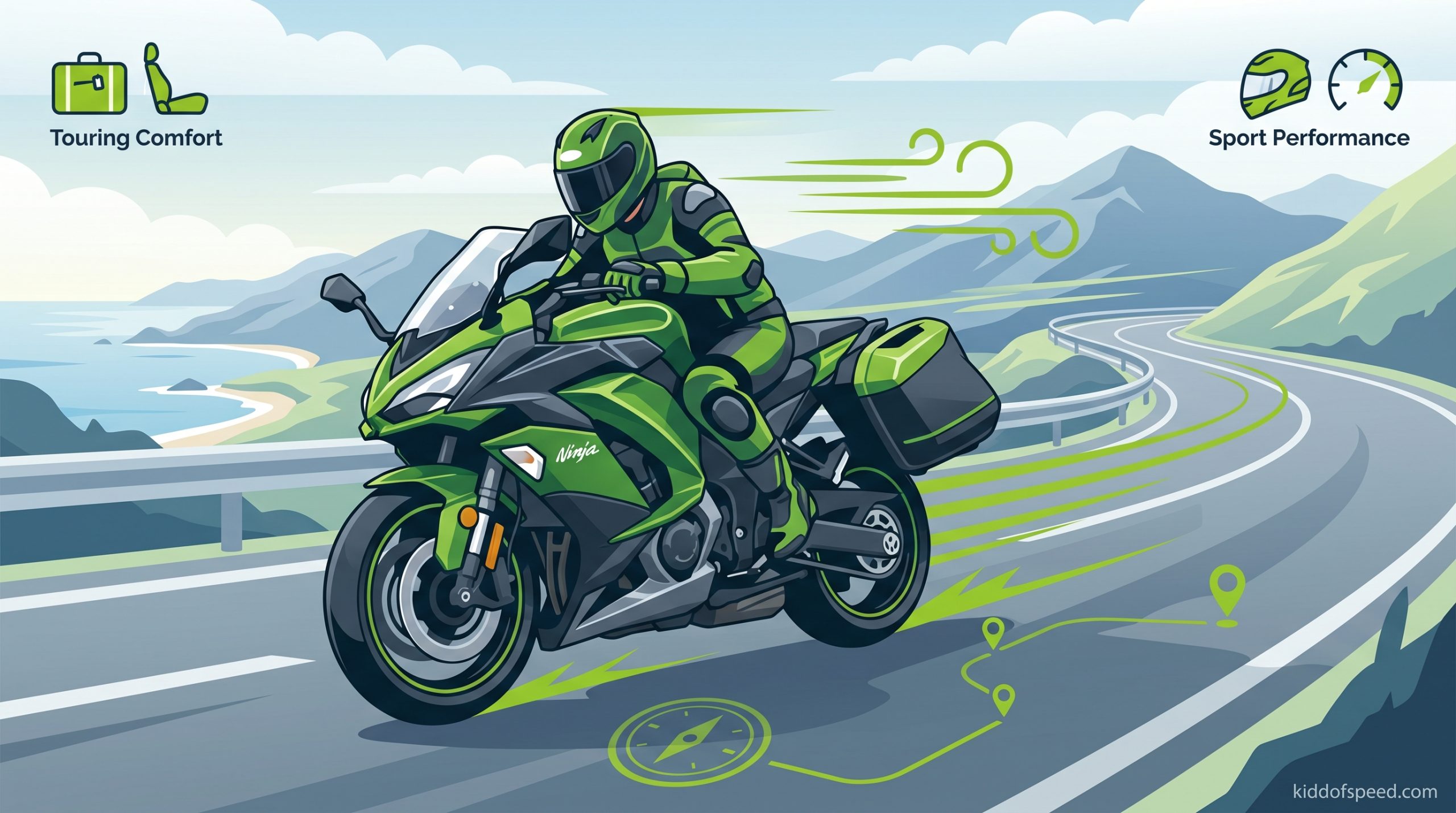
The Kawasaki Ninja became an icon of sport touring by proving that blistering performance and genuine comfort could coexist on two wheels. Since its dramatic entrance in 1984, the Ninja line has redefined what riders expect from a sport bike – demolishing the false choice between track-day thrills and cross-country capability. Forty years later, it remains the benchmark that competitors chase.
In this article, I will trace the Ninja’s journey from the revolutionary GPZ900R to 2026‘s diverse lineup. You will discover why the name “Ninja” was marketing genius, how a Tom Cruise film cemented its legendary status, and what makes these bikes surprisingly capable for long-distance touring despite their aggressive reputation.
Table of Contents
- How the 1984 GPZ900R Redefined Motorcycling
- Why Top Gun Made the Ninja a Cultural Phenomenon
- From 1984 to 2026: The Ninja Evolution Timeline
- What Makes the Kawasaki Ninja a Versatile Sports Tourer
- WSBK Championships and Racing Pedigree
- A Ninja for Every Rider: From 125cc to H2R
- Real Owner Stories: Longevity and Real-World Touring
- Frequently Asked Questions
- Why the Kawasaki Ninja Became an Icon of Sport Touring
How the 1984 GPZ900R Redefined Motorcycling
The story begins in 1984 when Kawasaki unleashed the GPZ900R – the motorcycle that would change everything. At the time, sport bikes were compromises: fast but uncomfortable, powerful but unreliable, quick but unstable. Kawasaki engineers threw out the rulebook and built something unprecedented.
The GPZ900R featured a liquid-cooled inline-four engine with 16 valves – technology borrowed from Formula 1 racing. This powerplant produced 115 horsepower and pushed the bike to a claimed top speed of 151 mph. That made it the fastest production motorcycle on the planet, stealing the crown from Suzuki’s GSX-R750.
What truly set the Ninja apart was its aluminium monocoque frame. This was aerospace technology applied to motorcycles – incredibly rigid yet remarkably light. The result was a bike weighing just 507 pounds wet, giving it a power-to-weight ratio that embarrassed competitors.
The aerodynamic fairing was equally revolutionary. Unlike the crude wind deflectors of the era, the Ninja’s full bodywork was shaped in a wind tunnel. Riders could actually tuck in and escape the wind blast, making high-speed riding manageable for mere mortals. This wind-cheating design gave the bike its distinctive sharp-edged appearance that persists to this day.
Cycle World magazine declared it “Motorcycle of the Year” in 1984. The GPZ900R did not just win awards – it established the template for every sport bike that followed. The combination of a compact inline-four, full fairing, and lightweight chassis became the industry standard within five years.
Why Top Gun Made the Ninja a Cultural Phenomenon
Technical excellence alone does not create an icon. The Kawasaki Ninja needed something bigger to cement its place in popular culture. That moment arrived in 1986 with the release of Top Gun.
Tom Cruise, playing naval aviator Pete “Maverick” Mitchell, rode a red GPZ900R in the film’s most memorable non-flight scenes. The motorcycle became an extension of Maverick’s rebellious, high-speed personality. Suddenly, the Ninja was not just a fast bike – it was the bike for fighter pilots and risk-takers.
The marketing brilliance of the “Ninja” name cannot be overstated. In 1984, ninja culture was exploding in Western consciousness. Teenage Mutant Ninja Turtles were about to dominate cartoons. American fascination with Japanese martial arts was at its peak. Kawasaki’s marketing team recognized this cultural moment and attached their motorcycle to it permanently.
The name suggested stealth, precision, and lethal capability. It was the perfect descriptor for a motorcycle that could outrun anything on the road while looking impossibly cool doing it. Competitors stuck with alphanumeric soup – GSX-R, CBR, YZF – but Kawasaki had something memorable.
By 2026, the Top Gun connection remains powerful. The 2022 sequel Top Gun: Maverick featured updated Kawasaki motorcycles, acknowledging the enduring relationship. For many riders, owning a Ninja connects them to that cinematic fantasy of speed and freedom.
From 1984 to 2026: The Ninja Evolution Timeline
The Ninja line has evolved dramatically across four decades, always pushing performance boundaries while expanding its appeal. Understanding this progression explains why the name still commands respect.
The 1990s brought the ZX-11, which reclaimed the “world’s fastest” title with a top speed approaching 175 mph. Its 1,052cc engine introduced ram-air induction – forcing more air into the engine as speed increased. This technology would become standard across the industry.
In the 2000s, Kawasaki introduced the ZX-12R, the first production motorcycle capable of exceeding 200 mph straight from the factory. This sparked a voluntary speed limitation agreement among Japanese manufacturers, capping top speeds at 186 mph (300 km/h) to avoid regulatory crackdowns.
The ZX-14R debuted in 2006, offering 1,441cc of displacement and effortless acceleration that made it the drag strip king. Despite its massive engine, clever ergonomics and a comfortable riding position made it surprisingly practical for touring riders who wanted maximum performance.
Perhaps the most significant evolution came with the Ninja H2 and H2 SX models. These bikes introduced centrifugal supercharging to mass production motorcycles. The H2 SX specifically targeted sport-touring riders, delivering 200 horsepower with the refinement and luggage capacity needed for cross-country journeys.
In 2026, the Ninja range spans from the learner-friendly 125cc models to the track-focused ZX-10R and the supercharged H2 variants. This diversity ensures there is literally a Ninja for every type of rider, from absolute beginners to professional racers.
What Makes the Kawasaki Ninja a Versatile Sports Tourer
The Kawasaki Ninja’s reputation as a sport-touring icon rests primarily on one model: the Ninja 1000 SX. This bike shatters the stereotype that sport bikes cannot tour comfortably. I have spoken with owners who regularly complete 500-mile days and finish refreshed rather than broken.
The Ninja 1000 SX features an adjustable windscreen that can redirect airflow depending on rider height and preference. Unlike fixed fairings on pure sport bikes, this adaptability means the bike works for riders from 5’4″ to 6’4″ without expensive aftermarket modifications.
The ergonomics defy the “crotch rocket” label that unfairly follows all Ninjas. The riding position is upright enough for all-day comfort but still aggressive enough for spirited canyon carving. Handlebars sit higher than pure race replicas, and foot pegs are positioned to allow leg extension during highway stretches.
Power delivery from the 1,043cc inline-four is refined rather than vicious. Kawasaki’s electronic throttle control provides smooth response at low RPMs – exactly what you want when navigating traffic or cruising at legal speeds. Yet open the throttle and 138 horsepower reminds you this is still a Ninja.
Modern electronics enhance the touring experience significantly. Traction control, multiple riding modes, cruise control, and cornering ABS come standard. These features make the bike accessible to intermediate riders while providing safety margins that inspire confidence on wet roads or unfamiliar routes.
Hard luggage integration sets the 1000 SX apart from converted sport bikes. Kawasaki designed the mounting points into the motorcycle from inception, not as afterthoughts. The side cases and optional top case provide genuine touring capacity without ruining the bike’s aesthetics when removed.
WSBK Championships and Racing Pedigree
The Ninja’s credibility as a performance machine comes from more than magazine test numbers. Kawasaki has dominated World Superbike racing with the ZX-10R, earning multiple manufacturer and rider championships throughout the 2010s and early 2020s.
Jonathan Rea’s five consecutive WSBK titles on Kawasaki machinery from 2015 to 2019 demonstrated the platform’s superiority. The technology developed for racing directly benefits street riders. Balance-free front forks, advanced traction control algorithms, and quick shifters all originated on the track.
This racing success creates a virtuous cycle. Street sales fund development, racing proves the engineering, and victories drive more sales. When a potential buyer learns their Ninja 1000 SX shares DNA with championship-winning superbikes, the premium price suddenly seems justified.
The ZX-10R specifically embodies this track-to-street philosophy. Its 998cc engine produces over 200 horsepower in race trim, yet the same basic architecture powers the milder street versions. The Showa suspension components, Brembo brakes, and electronics package all represent top-tier technology made accessible.
A Ninja for Every Rider: From 125cc to H2R
One reason the Ninja remains relevant after four decades is Kawasaki’s commitment to offering models across the entire performance spectrum. Unlike competitors who focus only on the high end, Kawasaki understands that today’s 125cc rider becomes tomorrow’s 1000cc customer.
The Ninja 125 and 400 models serve entry-level riders in markets with graduated licensing. These bikes offer genuine Ninja styling and handling characteristics in packages that respect legal restrictions and insurance realities. The 399cc parallel-twin in the Ninja 400 produces 49 horsepower – enough to be exciting without being intimidating.
For 2026, Kawasaki replaced the Ninja 400 with the Ninja 500 in many markets. This updated beginner bike offers refined ergonomics, improved wind protection, and the same approachable character that made the 400 a global bestseller. New riders can develop skills on a motorcycle that forgives mistakes while building confidence.
The mid-range is served by the Ninja 650, which uses a 649cc parallel-twin rather than the inline-four of larger models. This engine configuration provides torque-rich power delivery that works brilliantly for commuting and touring. Forum discussions consistently praise the 650 as an underrated sport-touring option despite its “entry-level sport bike” marketing.
At the top sits the H2 SX SE, a supercharged sport-tourer that produces 200 horsepower while coddling riders with heated grips, electronically adjustable suspension, and integrated luggage. It represents the ultimate expression of Kawasaki’s philosophy: brutal performance delivered with surprising refinement.
Real Owner Stories: Longevity and Real-World Touring
Forum discussions reveal what professional reviews often miss: how Ninjas actually perform over years of ownership and thousands of miles. The consensus among long-term owners is clear – these machines last with proper maintenance.
A Ninja 1000 SX owner from the Kawasaki forums reported crossing 45,000 miles with only routine service and tire changes. The engine remained strong, the transmission shifted smoothly, and the electronics functioned flawlessly. This durability transforms the purchase from an expense into an investment.
Multiple Ninja 650 owners describe their bikes as “perfect” for weekend touring despite skepticism from riding groups on larger machines. One rider detailed a 2,500-mile trip through the Pacific Northwest, praising the stock seat comfort and fuel range. These real experiences contradict the assumption that only 1000cc+ bikes can tour effectively.
Maintenance costs remain reasonable compared to European competitors. Valve adjustment intervals stretch to 15,000 miles on many models, and consumable parts like brake pads and chains are widely available. This practicality matters when you are planning a cross-country ride rather than just a Sunday coffee run.
The community aspect deserves mention. Ninja riders share information generously online, from suspension tuning tips to touring route recommendations. This culture of helpfulness makes ownership more enjoyable and reduces the intimidation factor for newcomers to the brand.
Frequently Asked Questions
What makes the Kawasaki Ninja a versatile sports tourer?
The Kawasaki Ninja excels as a sport tourer through models like the Ninja 1000 SX, which combines 138 horsepower with adjustable ergonomics, an adjustable windscreen, and integrated luggage capacity. Unlike pure sport bikes, the 1000 SX features an upright riding position comfortable for 500-mile days while maintaining the handling and acceleration expected from the Ninja name.
Which motorcycle is called the widowmaker?
The Kawasaki Ninja ZX-14R earned the nickname ‘widowmaker’ due to its massive 1,441cc engine and explosive acceleration capabilities. Earlier models like the original 1984 GPZ900R and the ZX-12R also carried this label informally. The term reflects the respect these high-horsepower machines demand from riders.
Why is Kawasaki so popular?
Kawasaki’s popularity stems from delivering exceptional performance at competitive prices, building reliable machines that last decades with proper maintenance, and offering the iconic Ninja lineup that spans from beginner-friendly 125cc models to the supercharged H2R. The brand’s WSBK racing success and Top Gun cultural connection further cement its reputation.
How long do Kawasaki Ninjas last?
With proper maintenance, Kawasaki Ninjas commonly exceed 50,000 miles and often reach 100,000 miles or more. The inline-four engines are particularly durable, with many owners reporting original engines running strong after 15+ years. Regular oil changes, valve adjustments, and chain maintenance are key to longevity.
Is Kawasaki more reliable than Harley?
Both brands have different reliability profiles. Kawasaki Ninjas typically require less frequent maintenance than Harley-Davidson motorcycles, with longer service intervals for valve adjustments and fluid changes. Harley’s air-cooled V-twins demand more regular attention but have extensive dealer networks. Kawasaki’s liquid-cooled inline-four engines generally prove more durable for high-mileage touring use.
How comfortable are Kawasaki touring bikes?
Kawasaki sport-touring models like the Ninja 1000 SX and Versys series offer excellent comfort for long-distance riding. The Ninja 1000 SX specifically features an adjustable windscreen, upright ergonomics, a comfortable stock seat rated highly by owners, and cruise control. Most riders report completing 500-mile days without significant discomfort.
Why the Kawasaki Ninja Became an Icon of Sport Touring
The Kawasaki Ninja earned its iconic status through a rare combination of genuine performance innovation, cultural timing, and consistent execution across four decades. The 1984 GPZ900R proved that a motorcycle could be both thrilling and practical. Top Gun transformed that engineering achievement into a cultural touchstone. The “Ninja” name created a brand identity that competitors still struggle to match.
What truly separates the Ninja from other sport bikes is its accessibility. Whether you are a new rider choosing a Ninja 500 as your first motorcycle, or an experienced tourer upgrading to the supercharged H2 SX, the same DNA runs through every model. You are not just buying a motorcycle – you are joining a legacy that began when Tom Cruise rode onto the screen nearly forty years ago.
In 2026, the Ninja remains the definitive answer for riders who refuse to compromise. It delivers the adrenaline of a pure sport bike with the comfort needed for serious touring. That is why it became an icon, and that is why it will remain one for decades to come.