
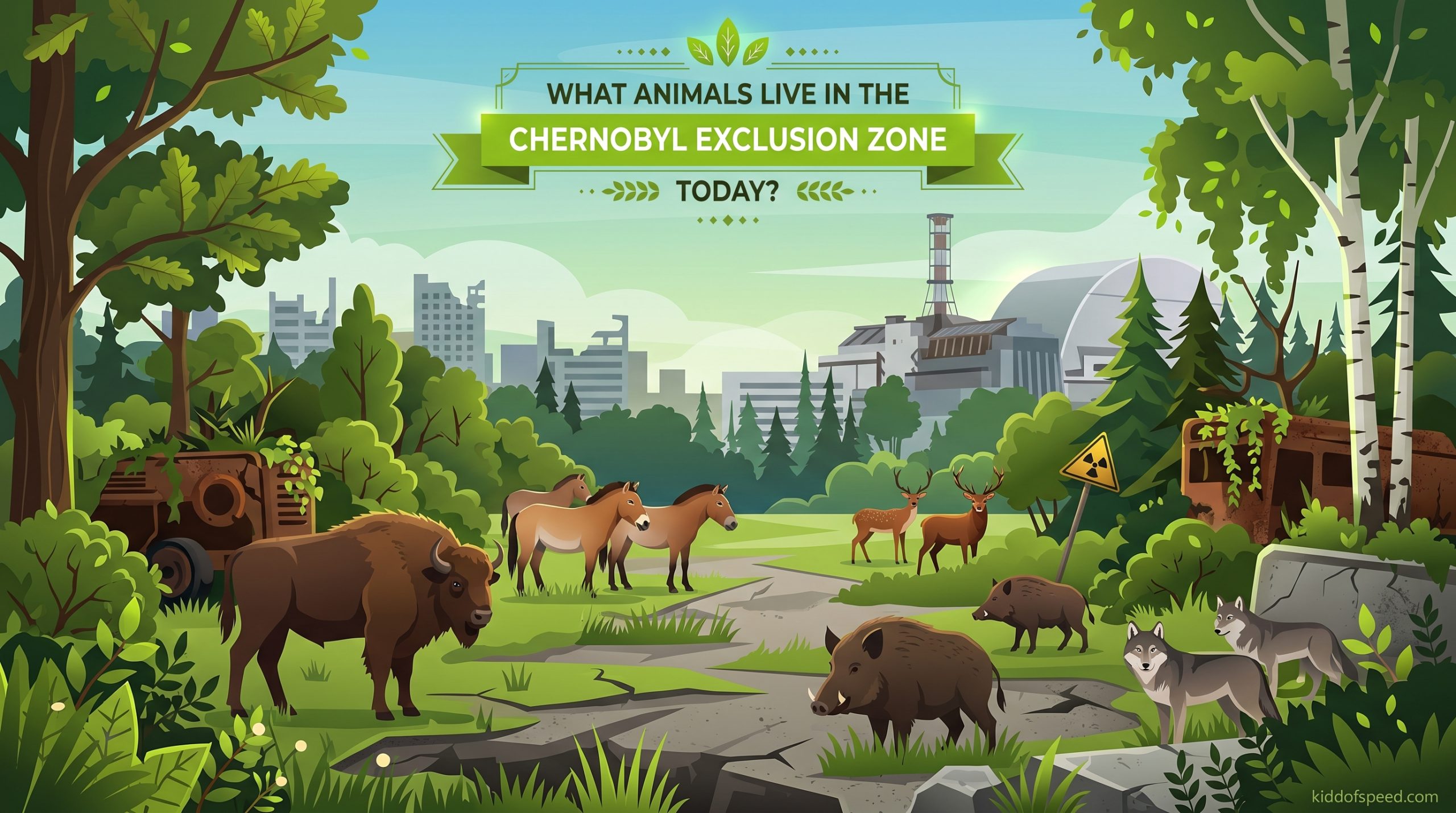
Forty years after the worst nuclear disaster in history, a remarkable transformation has taken place in northern Ukraine. The Chernobyl Exclusion Zone, a 1,000-square-mile radioactive no-man’s-land abandoned by humans, has become one of Europe’s most vibrant wildlife sanctuaries.
Gray wolves hunt through overgrown forests where radiation levels remain dangerously high. Brown bears have returned after a century-long absence. Przewalski’s horses roam freely across contaminated plains. This is the story of what animals live in the Chernobyl Exclusion Zone today, and why they thrive where we cannot.
Table of Contents
- The Surprising Truth: Why Wildlife Thrives in Radioactive Lands
- Mammals of the Chernobyl Exclusion Zone
- Birds and Other Wildlife
- Are There Mutated Animals in Chernobyl?
- Scientific Research and Camera Trap Discoveries
- New Threats: War and Climate Change
- What Animals Live in the Chernobyl Exclusion Zone Today: The Complete List
- Conclusion: What Animals Live in the Chernobyl Exclusion Zone Today
The Surprising Truth: Why Wildlife Thrives in Radioactive Lands
Here is the paradox that fascinates scientists and visitors alike: the very radiation that drove humans away has created space for animals to flourish. When researchers from the University of South Carolina began placing camera traps throughout the exclusion zone in 2026, they expected to find devastated populations. Instead, they discovered thriving ecosystems.
The key factor is not radiation tolerance. It is human absence. For four decades, no logging, hunting, farming, or urban development has disturbed this landscape. Animals face the risks of ionizing radiation and DNA damage, but they no longer face bullets, habitat destruction, or vehicle collisions.
Wildlife biologists have documented wolf populations seven times higher in Chernobyl than in surrounding nature reserves. That statistic alone tells the story: the absence of human pressure outweighs the presence of radioactive contamination for most species.
Why Shorter Lifespans Matter
Animals experience radiation differently than humans because of their biology. A wolf lives 6-8 years in the wild. A human can live 80 years or more. This shorter lifespan means less cumulative exposure to radiation over a lifetime. Animals also reproduce earlier and more frequently, allowing populations to recover even if individual animals suffer genetic damage.
Cancer takes years or decades to develop. For animals with brief lives, radiation-induced DNA damage rarely has time to manifest as fatal illness. They live, reproduce, and die of other causes before radiation can claim them.
Mammals of the Chernobyl Exclusion Zone
The exclusion zone supports robust populations of large mammals that disappeared from most of Europe centuries ago. Camera traps and field observations have confirmed at least 60 mammal species living within the radioactive boundaries.
Gray Wolves: The Top Predators
Wolves represent the most dramatic success story. Before 1986, wolves were rare in this region due to hunting and habitat loss. Today, the Chernobyl Exclusion Zone hosts one of Europe’s densest wolf populations.
Research published in 2026 confirms what camera trap data suggested for years: wolf numbers here are approximately seven times higher than in comparable uncontaminated nature reserves. These apex predators hunt wild boar, deer, and smaller prey through forests that have reclaimed abandoned villages.
The wolves show no obvious physical mutations, though scientists continue studying their genetics. They appear healthy, well-fed, and behaviorally normal compared to wolf populations elsewhere in Eastern Europe.
Brown Bears Return After 100 Years
In 2018, camera traps captured images that stunned researchers: a brown bear, the first confirmed in the region in over a century. By 2026, multiple bear sightings confirmed that these large predators have reestablished territory within the exclusion zone.
Bears require vast territories with minimal human disturbance. The 1,000 square miles of the exclusion zone provide exactly that. They feed on berries, roots, fish from contaminated rivers, and occasional carrion. Their return signals that the ecosystem has recovered enough to support large omnivores at the top of the food chain.
Przewalski’s Horses: A Conservation Triumph
In 1998, conservationists released 31 Przewalski’s horses into the Chernobyl Exclusion Zone. These stocky, tan-colored equines are the last truly wild horses on Earth, native to the steppes of Mongolia and once hunted nearly to extinction.
Today, more than 100 horses roam the zone. They have adapted to the radioactive environment, drinking from contaminated watering holes and grazing on vegetation that absorbs radionuclides from the soil. Population surveys conducted in 2026 showed stable numbers with natural reproduction succeeding despite radiation exposure.
The horses serve as ambassadors for Chernobyl’s unexpected conservation success. A species that disappeared from the wild in the 1960s now flourishes in one of the world’s most contaminated landscapes.
Eurasian Lynx: Ghosts of the Forest
Camera traps regularly capture images of Eurasian lynx, the elusive spotted cats that hunt through Chernobyl’s overgrown forests. These solitary predators require large territories with abundant prey and minimal human presence. The exclusion zone provides ideal conditions.
Lynx populations appear stable and healthy. Individual animals show no obvious radiation-related health problems. Their presence indicates a functioning ecosystem with sufficient prey species to support mid-sized carnivores.
Deer, Moose, and Wild Boar
The ungulates of Chernobyl tell their own success story. Red deer, roe deer, and moose populations have rebounded dramatically since 1986. These herbivores browse through abandoned gardens, orchards, and forest clearings where radiation levels vary wildly from spot to spot.
Wild boar present a special case. Hunters outside the exclusion zone prize boar meat, keeping populations artificially low. Inside the zone, boar face no hunting pressure. They root through contaminated soil, consuming fungi and roots that concentrate radioactive cesium. Studies show elevated radiation levels in boar tissue, yet the animals appear healthy and reproduce normally.
Some boar exported from the zone for consumption have exceeded European Union radiation safety limits, creating ongoing management challenges for Ukrainian authorities.
The Feral Dogs of Chernobyl
Perhaps the most poignant residents are the dogs. When 350,000 people evacuated in 1986, many left pets behind. Some dogs survived, forming feral packs that still roam the exclusion zone today.
These animals are not wildlife in the traditional sense. They are descendants of domestic pets: German shepherds, huskies, collies, and mixed breeds. They live around abandoned settlements, begging food from the few workers and tourists who enter the zone.
Genetic studies of Chernobyl’s feral dogs have revealed fascinating adaptations. Researchers from the University of South Carolina and other institutions have identified genetic markers suggesting rapid evolution in response to radiation exposure. These dogs have become subjects of intense scientific interest as models for understanding how mammals adapt to environmental stressors.
Nonprofit organizations work to spay, neuter, and care for these animals, providing veterinary treatment and food at checkpoints where the dogs congregate.
Birds and Other Wildlife
Birds present a more complex picture than mammals. Over 200 bird species have been recorded in the exclusion zone, from common sparrows to rare raptors. However, bird populations show more evidence of radiation effects than mammals.
Golden Eagles and Raptors
Golden eagles, white-tailed eagles, and other birds of prey have established territories within the exclusion zone. These top avian predators benefit from abundant prey and zero persecution. Their presence indicates healthy populations of small mammals and fish.
Camera traps have captured stunning images of eagles perched atop abandoned apartment buildings or Soviet-era monuments, scanning for movement below.
The Barn Swallow Studies
Barn swallows provided some of the first evidence that wildlife responds to Chernobyl’s radiation. Researchers documented higher rates of albinism, cataracts, and other abnormalities in swallows from high-radiation areas compared to control populations.
These findings initially suggested devastating impacts. However, long-term studies revealed a more nuanced picture. Swallow populations have persisted and even grown in some areas. The abnormalities, while real, have not prevented population survival.
Scientists now view barn swallows as indicator species, providing early warnings about environmental changes that might affect other wildlife.
Aquatic Life
The Pripyat River and its tributaries flow through the exclusion zone, carrying radioactive contamination toward the Dnieper River and eventually the Black Sea. Fish live in these waters, though studies show reduced populations and increased mutation rates in some species.
Catfish in the Chernobyl cooling pond grew enormous due to lack of fishing pressure and abundant food. These giant fish became famous in photographs, though they are not mutated, simply uncaught and well-fed.
Are There Mutated Animals in Chernobyl?
This question dominates public fascination with Chernobyl wildlife. The short answer: genetic changes exist, but Hollywood-style mutations do not.
The Mutation vs Adaptation Debate
Radiation causes DNA damage, which can lead to mutations in offspring. Scientists have documented increased mutation rates in Chernobyl animals compared to control populations. However, these mutations are typically subtle, not dramatic physical deformities.
The vast majority of mutations are harmful and reduce survival. Animals with severe mutations usually die before birth or early in life. This natural selection filters out the most extreme genetic changes. What researchers observe are small, population-level shifts rather than individual monstrous creatures.
The Dark Frog Discovery
One of the most significant recent findings came from a study of tree frogs published in 2026. Researchers discovered that frogs in high-radiation areas had dramatically darker skin pigmentation than frogs from cleaner zones.
Melanin, the pigment that darkens skin, also absorbs and neutralizes ionizing radiation. These frogs appear to be evolving increased melanin production as protection against their radioactive environment. This represents genuine adaptation, not mutation. The frogs are changing to survive, and the change appears beneficial.
What the Science Actually Shows
After four decades of research, scientists have found no evidence of giant mutated animals, two-headed wolves, or other creatures from science fiction. Radiation effects are real but subtle: slightly higher rates of certain abnormalities, reduced lifespans in some species, changes in population structures.
The animals of Chernobyl look like animals elsewhere. They run, hunt, breed, and die like normal wildlife. The miracle is not that they mutated. It is that they survived and thrived despite contamination that would kill an unprotected human within hours in the hottest zones.
Scientific Research and Camera Trap Discoveries
Our understanding of Chernobyl wildlife comes largely from camera traps, automated devices that photograph animals when they trigger motion sensors. These unblinking electronic eyes have revealed secrets that human observers could never witness directly.
The University of South Carolina Project
Biologists from the University of South Carolina have maintained one of the longest-running research projects in the exclusion zone. Their camera trap network, established in the early 2000s, has collected millions of images documenting wildlife recovery.
Their data shows that animal activity is highest in the most contaminated areas, directly contradicting early assumptions that radiation would suppress wildlife. The researchers concluded that human activity is a far greater deterrent to wildlife than radiation.
Radioecological Reserve Status
Ukraine designated much of the exclusion zone as a radioecological reserve, formally protecting it as a research site and wildlife sanctuary. This status prohibits most development while allowing scientific access.
The reserve has become a unique laboratory for studying long-term radiation effects, ecosystem recovery, and wildlife adaptation. No other site on Earth offers comparable opportunities to observe nature reclaiming a post-industrial landscape.
New Threats: War and Climate Change
Wildlife in Chernobyl faces new challenges beyond radiation. The Russian invasion of Ukraine in 2022 brought military activity directly into the exclusion zone.
The 2022 Invasion Impact
Russian forces entered the exclusion zone from Belarus in February 2022, using the abandoned landscape as a military corridor toward Kyiv. Tanks and vehicles churned through contaminated soil, potentially redistributing radioactive particles. Troops dug trenches in some of the most contaminated areas.
Fire became a significant threat. Military vehicles and shelling sparked wildfires that burned through forests, releasing radioactive smoke and ash. These fires pose ongoing risks to both wildlife and any humans in the region.
Combined Stress Factors
Scientists now study what they call combined stress: the interaction of radiation, climate change, and war. Rising temperatures, changing precipitation patterns, and habitat destruction compound the challenges wildlife already faces from contamination.
It remains unclear how these combined pressures will affect Chernobyl’s wildlife long-term. The resilience shown over four decades suggests these animals can adapt, but the new threats are unprecedented in the zone’s history.
What Animals Live in the Chernobyl Exclusion Zone Today: The Complete List
To summarize the wildlife currently thriving in this radioactive sanctuary, here are the major species confirmed through research and camera trap evidence:
- Large Predators: Gray wolves (7x higher population than surrounding areas), brown bears (returned after 100 years), Eurasian lynx
- Ungulates: Przewalski’s horses (100+ animals), red deer, roe deer, moose, wild boar, European bison
- Small Mammals: Red foxes, beavers, badgers, otters, various rodents
- Birds: Golden eagles, white-tailed eagles, barn swallows, over 200 documented species total
- Domestic Descendants: Feral dogs (descendants of abandoned pets), occasional feral cats
- Aquatic Life: Various fish species, including giant catfish in cooling ponds
Each species tells a different story of adaptation, resilience, and survival against odds that would seem insurmountable.
Are there still mutated animals in Chernobyl?
No giant mutated animals exist in Chernobyl. Scientific research shows subtle genetic changes and higher rates of certain abnormalities like albinism and cataracts in some species, but these are population-level effects, not dramatic physical mutations. The dark tree frog study shows melanin increase as an adaptation, not a harmful mutation.
Do animals live in the Chernobyl exclusion zone?
Yes, the Chernobyl Exclusion Zone supports thriving wildlife populations including gray wolves, brown bears, Przewalski’s horses, Eurasian lynx, deer, moose, wild boar, over 200 bird species, and feral dogs descended from abandoned pets. Camera trap research confirms abundant animal activity throughout the zone.
Why can animals live in Chernobyl but not humans?
Animals survive in Chernobyl primarily because of their shorter lifespans, which limit cumulative radiation exposure, and their ability to reproduce quickly before radiation effects manifest. Most importantly, the absence of human hunting, development, and disturbance has created space for wildlife to thrive despite radiation risks that remain dangerous to humans.
How many wolves are in Chernobyl?
Research indicates wolf populations in the Chernobyl Exclusion Zone are approximately seven times higher than in surrounding uncontaminated nature reserves. Exact numbers vary by season and survey method, but the population represents one of Europe’s densest wolf concentrations.
When will Chernobyl be safe for humans?
Scientists estimate the Chernobyl Exclusion Zone will remain unsafe for permanent human habitation for 20,000 years or more in the most contaminated areas. However, limited tourist access is permitted to certain areas with lower radiation levels, and workers maintain the New Safe Confinement structure over Reactor 4.
Conclusion: What Animals Live in the Chernobyl Exclusion Zone Today
The Chernobyl Exclusion Zone stands as a testament to nature’s resilience. Forty years after the disaster that made this land uninhabitable for humans, it has become a refuge for wildlife. Gray wolves hunt in densities seven times higher than surrounding areas. Brown bears have returned after a century-long absence. Przewalski’s horses, the last wild horses on Earth, roam freely across contaminated plains.
What animals live in the Chernobyl Exclusion Zone today? The answer surprises many: virtually every species that inhabited this region before 1986, plus new arrivals expanding their ranges. The exclusion zone demonstrates that when humans step back, nature steps forward. Radiation poses real risks, but the absence of human pressure has created space for ecosystem recovery that seemed impossible four decades ago.
As we face 2026, Chernobyl offers both hope and warning. Hope that damaged ecosystems can recover. Warning that human activity often damages nature more than the worst industrial accidents. The wolves, bears, and wild horses of Chernobyl do not know they live in a radioactive landscape. They simply know that here, they can live undisturbed.