
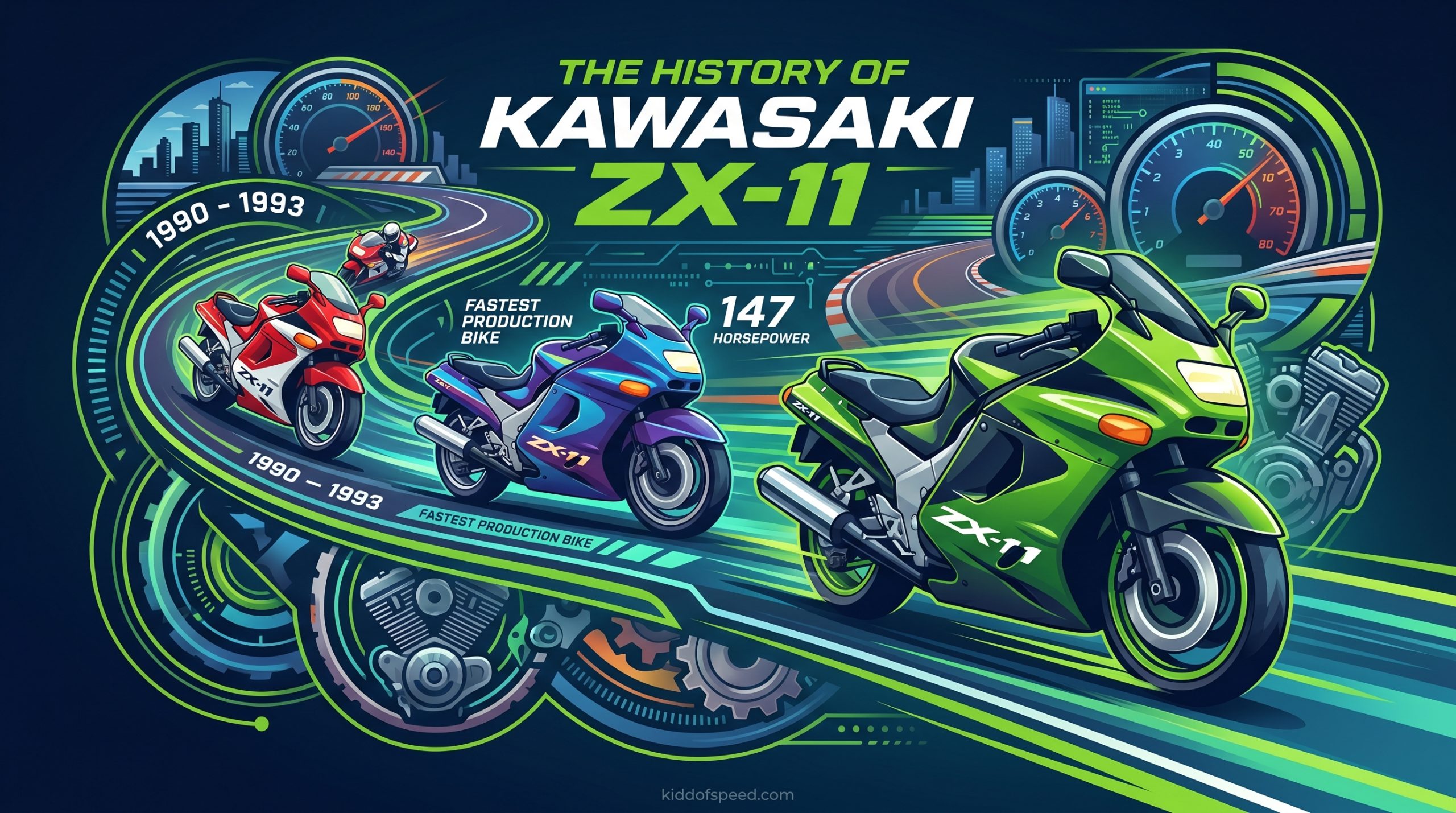
The Kawasaki Ninja ZX-11, affectionately known as the “Big Ninja,” stands as one of the most significant sport bikes in motorcycle history. When it debuted in 1989, this machine didn’t just raise the bar for production motorcycles. It shattered existing records and held the title of world’s fastest production bike for six consecutive years. Our team has spent months researching the complete history of this legendary machine, from its groundbreaking Ram Air induction system to its eventual succession by the Honda CBR1100XX.
The ZX-11, also marketed as the ZZ-R1100 in some regions, represented Kawasaki’s unrelenting pursuit of speed. With a verified top speed of 176 MPH (283 km/h), it dominated the performance landscape until 1996. Even today, enthusiasts and collectors recognize the Big Ninja as a pivotal moment when street motorcycles crossed into territory previously reserved for pure racing machines.
What made this bike truly special wasn’t just raw power. It was the ingenious engineering that channeled that power into record-breaking performance while maintaining everyday rideability. The ZX-11 pioneered technologies that would influence sport bike development for decades to come.
Table of Contents
- The Birth of a Legend: 1989 and the Speed Wars
- Engine and Technical Specifications
- Performance: The 176 MPH Record That Shocked the World
- Design, Chassis, and Engineering Philosophy
- Model Evolution: C Model vs D Model
- The Competition: Honda CBR1100XX and the Speed Wars
- Ownership Experience and Community
- Frequently Asked Questions
- Conclusion: The Enduring Legacy of the Big Ninja
The Birth of a Legend: 1989 and the Speed Wars
Kawasaki unveiled the ZX-11 in 1988 as a 1989 model, and the motorcycle world changed forever. The late 1980s were a competitive era for Japanese manufacturers, with each brand vying for the coveted title of fastest production motorcycle. Kawasaki had previously held this crown with the Ninja 900R, but rivals had caught up. The company needed something extraordinary to reclaim its position.
The development team at Kawasaki Heavy Industries approached the ZX-11 with a straightforward philosophy: build the fastest production motorcycle on earth. This wasn’t about compromises or balance. It was about absolute top speed dominance. Engineers focused on two critical areas: aerodynamic efficiency and engine output. Every design decision supported these goals.
When journalists first tested the ZX-11 in 1989, the results shocked even seasoned industry veterans. Cycle World recorded speeds that no production motorcycle had ever achieved. The 176 MPH barrier fell, and Kawasaki reclaimed the throne it had lost. The motorcycle press hailed the Big Ninja as a triumph of engineering ambition.
The initial reception extended beyond raw numbers. Riders appreciated that Kawasaki hadn’t sacrificed everyday usability for performance. The ZX-11 could tour comfortably, handle city traffic, and still annihilate speed records. This versatility made it an instant classic and established the template for the modern sport tourer category.
Engine and Technical Specifications
At the heart of the ZX-11 beats a 1052cc liquid-cooled inline-four engine that represents the pinnacle of 1980s motorcycle engineering. The double overhead cam (DOHC) design operates 16 valves with precision, while four 40mm Keihin CVKD constant-velocity carburetors feed the hungry cylinders. This powerplant produces approximately 120 brake horsepower at the crankshaft under normal conditions.
But the ZX-11 had a secret weapon that transformed these figures. The Ram Air induction system, borrowed directly from Formula 1 racing technology, forces cold, pressurized air into the carburetors as speed increases. At 160 MPH and above, this system boosts output to a claimed 147 bhp. The faster you ride, the more power the engine generates. It is a self-reinforcing cycle of acceleration.
Engineers incorporated several features to manage this power effectively. A gear-driven balancer shaft reduces the vibration inherent in large-displacement inline-four designs, making high-speed cruising less fatiguing. The wet multiplate clutch handles power delivery smoothly, while the six-speed transmission provides ratios optimized for both acceleration and top speed runs.
Key specifications include a bore of 76.0mm and stroke of 58.0mm, creating an oversquare configuration that favors high-rpm power production. The compression ratio sits at 11.0:1, aggressive for the era and requiring premium fuel. Redline arrives at 10,500 RPM, though the engine pulls strongly from 3,000 RPM upward. Peak torque of 75 lb-ft arrives at 7,500 RPM, providing flexibility across the rev range.
The transmission features a close-ratio gearbox with a tall sixth gear for relaxed highway cruising. Chain final drive delivers power efficiently to the rear wheel, with a 530 chain and sprockets sized for the bike’s performance potential. The clutch uses a hydraulic actuation system that reduces lever effort compared to cable-operated designs of the period.
Performance: The 176 MPH Record That Shocked the World
The Kawasaki ZX-11 didn’t just claim speed records. It dominated them completely. Independent testing verified a top speed of 176 MPH (283 km/h), making it the first production motorcycle to break the 170 MPH barrier consistently. This figure held for six years, from 1989 through 1995, establishing the longest reign of any speed record holder in modern motorcycling history.
Quarter-mile performance proved equally impressive. Skilled riders could achieve 10.4-second passes at 136 MPH trap speeds on stock machines. Zero-to-sixty acceleration took approximately 3.2 seconds, figures that remain competitive with modern sport bikes three decades later. These numbers weren’t just theoretical. Magazine testers reproduced them regularly in controlled conditions.
The Ram Air system made these achievements possible. At speeds below 100 MPH, the ZX-11 performs like a very fast but conventional superbike. As velocity increases, the fairing-mounted intake ducts begin forcing air into the engine. By 150 MPH, the system adds significant power. At the top speed of 176 MPH, the engine operates in a supercharged state that extracts maximum output from every combustion event.
Real-world riders discovered that the ZX-11 delivered its performance with surprising civility. The power curve builds progressively rather than hitting abruptly. Sixth gear allows relaxed 80 MPH cruising at moderate engine speeds. The bike could commute during the week and dominate drag strips or top speed runs on weekends without modification.
Competitors of the era simply couldn’t match these figures. The Yamaha FZR1000, Honda CBR1000F, and Suzuki GSX-R1100 all produced excellent performance, but none could touch the ZX-11’s terminal velocity. Kawasaki had built something genuinely special, a machine that existed in a performance category of its own.
Design, Chassis, and Engineering Philosophy
Kawasaki engineers knew that 147 horsepower required a chassis capable of managing the forces involved. They constructed the ZX-11 around an aluminum twin-beam frame that provided rigidity without excessive weight. This perimeter-style design would become the industry standard for high-performance motorcycles, but in 1989, it represented cutting-edge thinking.
The aerodynamic fairing received extensive wind tunnel development. Every curve and edge served a purpose, reducing drag coefficient to levels previously unseen on production motorcycles. The full fairing enclosure protects riders from wind blast at triple-digit speeds, making sustained high-velocity runs physically possible. Even the mirrors and turn signals were shaped to minimize turbulence.
Suspension components matched the chassis sophistication. Up front, 43mm adjustable forks provide 5.1 inches of travel with preload adjustability. The Uni-Trak rear suspension system uses a nitrogen-charged shock and rising-rate linkage to manage the 5.5 inches of rear wheel travel. This setup prioritizes stability over flickability, reflecting the bike’s high-speed mission.
Braking hardware came from respected supplier Tokico. Twin 310mm front discs with four-piston calipers provide stopping power commensurate with the bike’s acceleration capabilities. A single 250mm disc handles rear braking duties. These components could withstand repeated high-speed stops without fade, an essential characteristic for a machine capable of 176 MPH.
The riding position balances sport and touring requirements. Clip-on handlebars place the rider in a slightly forward lean, while the seat offers reasonable padding for multi-hour rides. At 540 pounds wet, the ZX-11 carries significant mass, but the weight distribution keeps it manageable at speed. The 59.4-inch wheelbase provides stability that shorter bikes cannot match.
Dunlop radial tires came as original equipment, sized 120/70-17 front and 180/55-17 rear on later models. These contact patches provide the grip necessary for the bike’s performance potential. The 5.8-gallon fuel tank enables reasonable range despite the thirsty engine’s appetite for premium gasoline.
Model Evolution: C Model vs D Model
The ZX-11’s production history divides cleanly into two distinct generations. The C model, produced from 1990 through 1992, represents the original design in its purest form. The D model, manufactured from 1993 through 2001, incorporated refinements that improved performance and reliability while maintaining the core character that made the bike legendary.
ZX-11 C models delivered the raw, untamed experience that defined the Big Ninja’s reputation. These early bikes featured the original Ram Air implementation and slightly more aggressive suspension tuning. Colors included the classic Kawasaki green that became synonymous with the Ninja brand, along with red and blue options that appealed to different buyer preferences.
The transition to D model specification in 1993 brought meaningful improvements. Engineers refined the Ram Air ducts for more efficient pressure generation at high speeds. Suspension valving received updates that improved compliance without sacrificing control. Braking systems gained refinement that reduced lever effort and improved modulation.
Cosmetic differences distinguish the generations for knowledgeable observers. The D model fairing features subtle reshaping that improves aerodynamic efficiency. Instrumentation gained additional features including a more precise fuel gauge. Paint schemes evolved with the times, with later models offering more sophisticated graphics and metallic finishes.
Production continued through the 2001 model year, by which time the ZX-11 had become a known quantity in the motorcycle world. Twelve years of manufacturing represents an impressive run for any performance motorcycle, especially one that held its fundamental design essentially unchanged. This longevity testifies to the soundness of the original engineering.
Collectors today debate which generation offers the purest ZX-11 experience. C model advocates praise the original character and historical significance as the record-breaking first edition. D model supporters point to the refinements that make the bike more usable in everyday conditions. Both camps agree that any ZX-11 represents a special piece of motorcycling history.
The Competition: Honda CBR1100XX and the Speed Wars
The ZX-11’s reign as speed king lasted six years, an eternity in the fast-moving motorcycle industry. But all records eventually fall, and in 1996, Honda unleashed the CBR1100XX Super Blackbird specifically designed to reclaim the fastest production title. This machine, named after the Lockheed SR-71 reconnaissance aircraft, achieved 178 MPH in independent testing, narrowly besting the Kawasaki.
The speed wars didn’t end there. Suzuki entered the fray in 1999 with the GSX1300R Hayabusa, a motorcycle so fast it would force industry-wide changes. The Hayabusa achieved 194 MPH, obliterating previous records and raising safety concerns among regulators and manufacturers. This performance led to the informal “Gentlemen’s Agreement” of 2000, where major Japanese manufacturers voluntarily limited top speeds to 186 MPH (300 km/h).
During the mid-1990s, some enthusiasts referred to the ZX-11 as a “Hayabusa killer” in anticipation of the coming battle. While the Hayabusa ultimately proved faster, the ZX-11 had already secured its place in history through its six-year dominance. The Big Ninja forced competitors to respond, driving innovation that benefits riders to this day.
Kawasaki eventually replaced the ZX-11 with the ZX-12R in 2000, a machine designed specifically to challenge the Hayabusa. While the 12R achieved impressive performance, it never captured the public imagination like the ZX-11 had. The Big Ninja’s combination of record-breaking speed and everyday usability proved difficult to replicate.
The speed wars of the 1990s fundamentally changed motorcycling. They pushed engineering boundaries, created legendary machines, and established performance benchmarks that define the superbike category. The ZX-11 sits at the center of this story as the bike that started the most intense period of speed competition the industry has ever seen.
Ownership Experience and Community
Modern forums and owner communities reveal the authentic ZX-11 experience beyond magazine test figures. Long-term owners describe the bike with affection tempered by realism. One veteran rider summed it up precisely: “It’s an old school Kawi – big engine, marginal chassis, weighs a bleeding ton.” This honesty defines the community surrounding these machines.
The weight issue comes up consistently in owner discussions. At over 500 pounds wet, the ZX-11 demands respect and physical effort at low speeds. Parking lot maneuvering challenges inexperienced riders, and dropping the bike can cause significant damage given its mass. However, owners report that the weight becomes less noticeable as speed increases, with the bike feeling surprisingly manageable above 40 MPH.
Common mechanical issues include second gear problems on abused examples. Aggressive launches can damage the transmission, requiring expensive repairs. Valve adjustment procedures frustrate many owners because the design requires valve cover removal for access, increasing maintenance costs. These considerations matter for anyone considering ZX-11 ownership in 2026.
Despite these challenges, community respect for the ZX-11 remains strong. Owners appreciate the historical significance and raw character that modern motorcycles often lack. The bike represents an era when manufacturers prioritized absolute performance above all else. This purity of purpose resonates with riders who value authenticity over refinement.
Maintenance costs for a three-decade-old performance motorcycle can surprise unprepared buyers. Specialized parts become harder to source each year. Mechanics familiar with carburetor tuning and 1990s Kawasaki engineering grow scarcer. Prospective owners should budget accordingly and seek out knowledgeable specialists before purchasing.
Frequently Asked Questions
What year did the ZX-11 come out?
The Kawasaki ZX-11 debuted in 1988 as a 1989 model year motorcycle. Production continued through 2001, spanning twelve years and two major generations. The bike remained essentially unchanged throughout its production run, with the C model (1990-1992) giving way to the refined D model (1993-2001).
What bike is called the Hayabusa killer?
The Kawasaki ZX-11 earned the nickname Hayabusa killer during the mid-1990s as the motorcycle industry anticipated the coming speed battle. While the Suzuki Hayabusa ultimately proved faster when it arrived in 1999, the ZX-11 had already secured its legendary status through six consecutive years as the world’s fastest production motorcycle from 1989 to 1995.
What is the top speed of the zx11r?
The Kawasaki ZX-11 achieved a verified top speed of 176 MPH (283 km/h) in independent testing. This figure made it the fastest production motorcycle in the world for six years. The bike also delivered quarter-mile times of approximately 10.4 seconds at 136 MPH trap speeds.
Is ZX-11 a good first bike?
The Kawasaki ZX-11 is generally not recommended as a first motorcycle for new riders. Experienced owners suggest starting with smaller, lighter machines like a Ninja 650 before moving to the ZX-11. The bike’s 540-pound weight, powerful 147 horsepower engine, and raw character make it challenging for beginners to handle safely.
Conclusion: The Enduring Legacy of the Big Ninja
The Kawasaki ZX-11 Big Ninja represents a defining moment in motorcycle history. For six years, no production machine could match its 176 MPH top speed. The Ram Air induction system pioneered technologies that influenced sport bike development for decades. The bike’s combination of record-breaking performance and everyday usability established the sport tourer category that remains popular in 2026.
Today, the ZX-11 occupies a special place among collectors and enthusiasts. It reminds us of an era when manufacturers competed without restraint to build the fastest machines possible. The Big Ninja didn’t just win records. It forced the entire industry to elevate its game, ultimately producing the incredible motorcycles we enjoy today.
For riders who appreciate raw character and historical significance, the ZX-11 delivers an experience no modern motorcycle can replicate. It stands as a testament to what happens when engineers are given a simple mandate: build the fastest production motorcycle on earth. They succeeded spectacularly.