
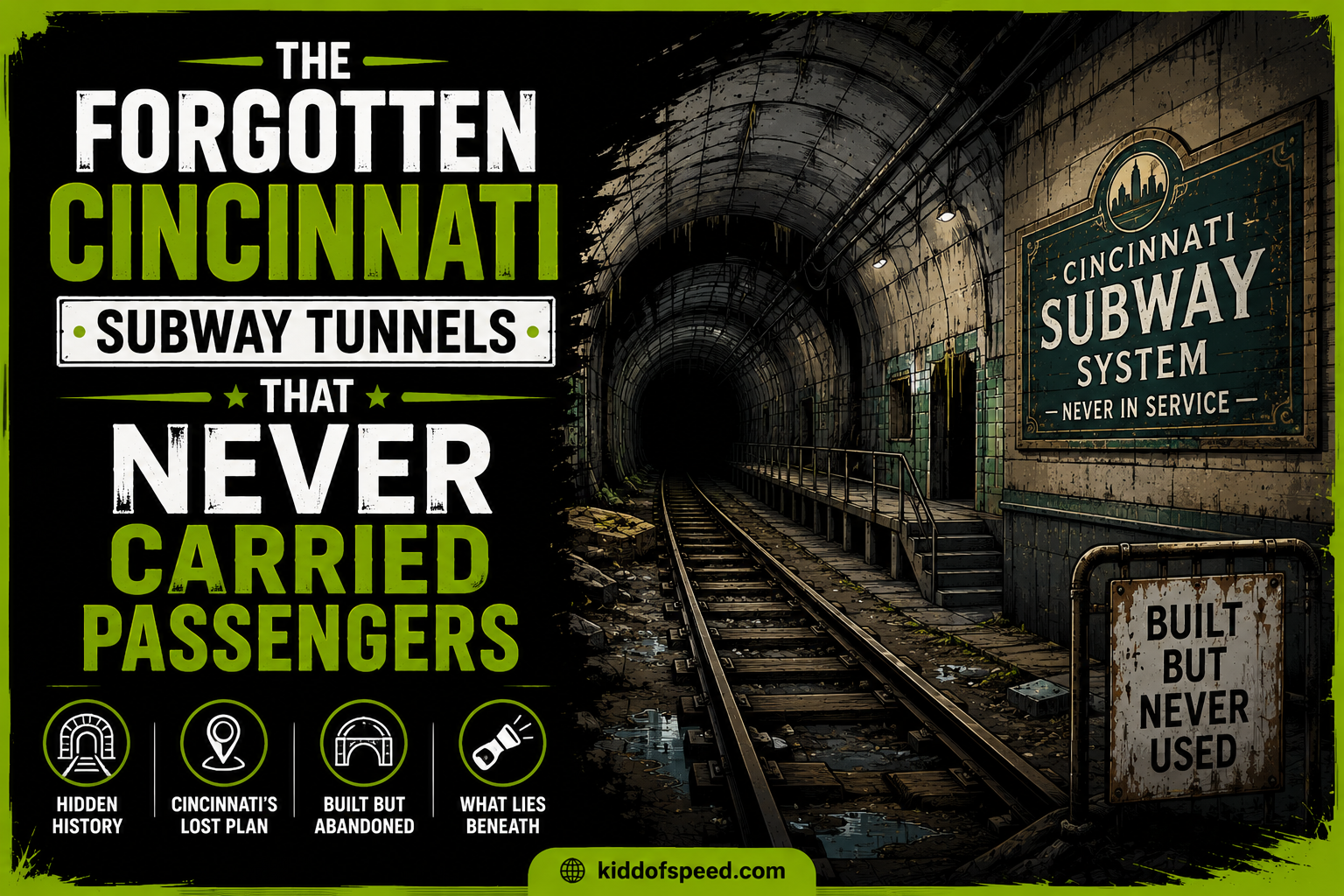
Beneath the bustling streets of Cincinnati lies a secret most residents walk over daily without knowing. Two miles of abandoned subway tunnels sit silent and sealed, representing the largest abandoned subway system in the United States. These tunnels have never carried a single passenger.
In 2026, the city issued a new Request for Proposals seeking ideas to repurpose this century-old infrastructure. After nearly a century of abandonment, could Cincinnati finally find a use for its ghost subway? I spent weeks researching the history, talking to urban explorers who have ventured inside, and examining why this ambitious project became a cautionary tale of American urban planning.
What I discovered was more than failed infrastructure. It is a time capsule frozen in the 1920s, filled with what-ifs and missed opportunities that shaped the city we know today.
Table of Contents
- What Are the Cincinnati Subway Tunnels?
- Historical Context: From Canal to Rapid Transit
- The 1916 Bond Campaign and World War I Delay
- Construction: 1920-1928
- Why the Cincinnati Subway Was Never Completed
- The Stations That Never Served Passengers
- Current Status of the Tunnels
- Failed Revival Attempts Through the Decades
- The 2026 RFP: New Hope for Old Tunnels
- Frequently Asked Questions About Cincinnati’s Abandoned Subway
- What are the abandoned Cincinnati tunnels?
- Why was the Cincinnati Subway never used?
- What is the largest abandoned subway system in the United States?
- What are the abandoned subway tunnels in Cincinnati repurposed for?
- Can you visit Cincinnati subway tunnels?
- Where are the Cincinnati subway entrances located?
- How many stations were built in the Cincinnati Subway?
- What is the temperature inside Cincinnati subway tunnels?
- Conclusion: The Forgotten Cincinnati Subway Tunnels
What Are the Cincinnati Subway Tunnels?
The Cincinnati subway tunnels are 2.2 miles of double-tracked rapid transit infrastructure built beneath Central Parkway in the 1920s. Four underground stations were constructed at Race Street, Liberty Street, Linn Street, and Brighton Place, complete with platforms, staircases, and architectural details.
Construction halted in 1928 when funds ran out. The tunnels were never connected to an operational transit system. Despite multiple revival attempts over the decades, the infrastructure remains unused for its original purpose. The tunnels sit beneath one of Cincinnati’s main thoroughfares, their entrances sealed with concrete and steel.
Some locals call it the “Cincinnati ghost subway” or simply “the tunnels.” Urban explorers who have gained access describe the stations as “flash-frozen in time” with 1920s architecture intact.
Historical Context: From Canal to Rapid Transit
The story begins not with trains, but with water. Before the subway, there was the Miami and Erie Canal.
Completed in 1845, the canal ran through the heart of Cincinnati, connecting the Ohio River to Lake Erie. By the early 1900s, the canal had become an open sewer and traffic obstacle. City leaders decided to drain and cover it, creating a new boulevard above.
Transit planners saw opportunity in the canal bed. The depression created by the waterway offered a ready-made trench for an underground rapid transit system. This alignment would become Central Parkway, with subway tunnels running beneath it.
The plan was ambitious. Cincinnati would build a 16-mile rapid transit loop connecting downtown to neighborhoods and suburbs. The underground portion would run through the old canal route, emerging at either end to connect with elevated and surface lines.
It was visionary urban planning for its time. Most American cities were just beginning to consider subway systems. Cincinnati wanted to join the ranks of Boston, New York, and Philadelphia with modern rapid transit.
The 1916 Bond Campaign and World War I Delay
In 1916, Cincinnati voters approved a $6 million bond issue to build the subway system. The vote passed with 62% support, showing strong public appetite for modern transit.
The city appointed Rapid Transit Commissioners to oversee the project. They hired Bion J. Arnold, a prominent transit engineer, to design the system. Arnold’s plan called for a loop line connecting major population centers and business districts.
Then history intervened. The United States entered World War I in 1917, and construction materials and labor became scarce. The project stalled before breaking ground.
This delay would prove fatal to the subway’s completion. By the time the war ended in 1918, inflation had driven construction costs through the roof. The $6 million that voters approved no longer covered what planners had envisioned.
City officials pressed forward anyway. They broke ground in 1920, optimistic that costs would stabilize and additional funding could be found.
Construction: 1920-1928
Construction crews began digging in January 1920. The work was arduous and dangerous. They excavated the old canal bed by hand and early machinery, creating a massive trench through the city center.
The tunnels were impressive engineering for their era. They featured double-tracked tubes measuring 13 feet wide and 15 feet 6 inches high. The stations included island platforms designed to accommodate multiple rail cars.
By 1927, the tunnels stretched from the Ohio River waterfront to just north of the city center. Four stations were completed or near completion: Race Street, Liberty Street, Linn Street, and Brighton Place.
The stations featured ornate architectural details typical of the era. Arched ceilings, tile work, and decorative lighting fixtures reflected the city beautiful movement’s influence on public infrastructure.
But the money was running out. Construction costs had ballooned to over $13 million, more than double the original bond issue. The city had spent everything voters approved and then some, with only a fraction of the planned 16-mile system complete.
In 1928, construction stopped. The tunnels were sealed. The tracks were never laid. The stations never opened.
Why the Cincinnati Subway Was Never Completed
Multiple factors doomed the Cincinnati subway. Understanding them explains not just this project, but patterns in American infrastructure development.
Cost Overruns and Inflation: The $6 million bond issue proved insufficient. Post-war inflation drove material and labor costs far beyond original estimates. The city spent double the approved amount and still had no operational transit line.
Political Changes: In 1926, Murray Seasongood was elected mayor on a reform platform. His administration viewed the subway as a corrupt boondoggle from the previous political machine. Seasongood opposed spending more money on what he saw as a failed project.
The Great Depression: The stock market crash of 1929 and subsequent economic collapse made any new public spending politically impossible. Cincinnati had other priorities, like feeding the unemployed.
The Automobile Revolution: By the 1930s, personal car ownership was exploding. City leaders began focusing on highways and roads rather than rail transit. The subway seemed increasingly obsolete.
Lack of Federal Support: Unlike highway projects that would later receive massive federal funding, the subway had no Washington backing. Cincinnati was on its own financially.
By the mid-1930s, the subway was officially abandoned. Central Parkway opened as a surface road above the tunnels in 1928, becoming one of Cincinnati’s main east-west arteries.
The Stations That Never Served Passengers
The four completed stations stand as haunting monuments to what might have been. Urban explorers who have documented them describe an eerie beauty.
Race Street Station: Located near the riverfront, this station features the most complete architectural details. The platform remains largely intact, though water damage has taken its toll. The station was designed as a gateway for commuters arriving from Kentucky.
Liberty Street Station: This station sits beneath one of Cincinnati’s main north-south streets. Explorers report finding evidence of later uses, including Cold War-era modifications. Rumors persist of a fallout shelter installed in this station during the 1950s, complete with bunk beds, MREs, and water barrels.
Linn Street Station: The smallest of the four, Linn Street was intended to serve the industrial neighborhoods west of downtown. The platform here is shorter than the others, reflecting the area’s working-class ridership projections.
Brighton Place Station: Located at the northern end of the completed tunnels, this station marks where construction stopped. The tunnel extends slightly beyond here before ending abruptly at a concrete wall.
Inside, the stations feel like time capsules from 1928. The architectural details remain, though covered in decades of grime, graffiti, and water damage. The temperature stays comfortable year-round, around 55-60 degrees, making the tunnels attractive to urban explorers regardless of surface weather.
Urban spelunkers describe the experience as surreal. You descend through sealed entrances or maintenance hatches and emerge into a 1920s transit station that never saw a train. The platforms wait for passengers who will never arrive.
Current Status of the Tunnels
Today, the Cincinnati subway tunnels serve purposes their creators never imagined. The infrastructure has found new life, just not for transportation.
Water Main Infrastructure: The city installed a major water main through portions of the tunnel in the 1950s and 60s. This pipe carries drinking water to thousands of Cincinnati residents. Maintenance crews access the tunnels regularly to check the water lines.
Telecommunications: Fiber optic cables run through sections of the tunnel, providing data infrastructure for the city. The dry, protected environment is ideal for cable housing.
Storage: Various city departments have used portions of the tunnels for storage over the decades. Records, equipment, and supplies have been kept in the unused spaces.
The entrances remain sealed to the public. Concrete walls and steel fences block access at both ends of the completed tunnel sections. Security patrols monitor the sites, though urban explorers still occasionally find ways inside.
The tunnels are structurally sound after nearly a century. Engineers who have inspected them report the concrete and brickwork remain in excellent condition. Cincinnati built the subway to last, even if it never carried a passenger.
Failed Revival Attempts Through the Decades
Cincinnati has never stopped trying to find a use for its ghost subway. Proposals have come regularly for 90 years.
1930s-1940s: Immediate post-abandonment proposals focused on completing the system as originally planned. The Great Depression and World War II made funding impossible.
1950s: Cold War fears sparked interest in converting stations to fallout shelters. Liberty Street station reportedly received some modifications. The plan never fully materialized.
1960s: Urban renewal era proposals suggested underground shopping malls, connecting the tunnels to surface retail. This was the era of similar projects in other cities. Cincinnati’s plan died in committee.
1970s: Transit advocates pushed for completing the subway as originally intended. Rising fuel prices and environmental concerns made rail seem appealing again. City leaders rejected the idea as too expensive.
1980s: Wine storage proposals emerged. The stable 55-degree temperature was perfect for wine cellars. Local developers lobbied to convert stations into private wine vaults. The plan failed.
1990s-2000s: Light rail proposals resurfaced multiple times. Each died at the ballot box or in council chambers. Cincinnati voters rejected a sales tax increase for transit in 2002.
2010s: The city spent $100 million on a streetcar system that opened in 2016. Critics noted the irony: a surface streetcar while the subway tunnels sat unused beneath. The streetcar runs a 3.6-mile loop downtown, completely separate from the subway alignment.
Each revival attempt died for similar reasons: cost, political will, competing priorities. The tunnels remain stubbornly unused for their original purpose.
The 2026 RFP: New Hope for Old Tunnels
In 2026, Cincinnati took a different approach. The city issued a Request for Proposals seeking creative ideas to repurpose the subway tunnels.
The RFP represents acknowledgment that the tunnels are an asset, not just abandoned infrastructure. City officials are open to non-transit uses after a century of failed transportation revivals.
Proposals under consideration reportedly include:
- Underground data centers (the stable temperature is ideal for server cooling)
- Cultural and arts spaces
- Historical tourism attractions
- Recreational facilities
- Research and development labs
The process is ongoing as of 2026. Whatever emerges, it seems unlikely to involve trains. After 100 years, the Cincinnati subway will probably never carry passengers.
But finding any use honors the original construction effort. The engineers and laborers who built these tunnels in the 1920s created something durable enough to outlast their grand plan. Perhaps the next chapter is about to begin.
Frequently Asked Questions About Cincinnati’s Abandoned Subway
What are the abandoned Cincinnati tunnels?
The abandoned Cincinnati tunnels are 2.2 miles of subway infrastructure built in the 1920s beneath Central Parkway. They include four completed stations at Race Street, Liberty Street, Linn Street, and Brighton Place. Construction stopped in 1928 due to cost overruns and was never completed. The tunnels represent the largest abandoned subway system in the United States.
Why was the Cincinnati Subway never used?
The Cincinnati Subway was never used due to a combination of factors: cost overruns that doubled the original $6 million budget, political opposition from reform mayor Murray Seasongood, the Great Depression making public funding impossible, and the rise of automobile culture making rail transit seem obsolete. Construction halted in 1928 and was never resumed.
What is the largest abandoned subway system in the United States?
The Cincinnati Subway is the largest abandoned subway system in the United States. It consists of 2.2 miles of completed tunnels and four underground stations that were never connected to an operational transit network. The infrastructure was built in the 1920s and remains intact beneath Central Parkway.
What are the abandoned subway tunnels in Cincinnati repurposed for?
Today, the Cincinnati subway tunnels house water mains that supply drinking water to city residents and fiber optic cables for telecommunications. The tunnels have also been used for storage and were briefly considered as Cold War fallout shelters. The city issued a 2024 RFP seeking new repurposing ideas.
Can you visit Cincinnati subway tunnels?
The Cincinnati subway tunnels are not open to the public. Entrances are sealed with concrete walls and steel fences, and security patrols monitor the sites. While urban explorers occasionally gain access illegally, official tours are not available. Some station architecture can be viewed from sealed entrance points at street level.
Where are the Cincinnati subway entrances located?
The subway entrances are located along Central Parkway at various points between the Ohio River and Brighton Place. The main access points are sealed with concrete and steel, but visible remnants include ventilation structures and sealed stairwells at Race Street, Liberty Street, Linn Street, and Brighton Place.
How many stations were built in the Cincinnati Subway?
Four stations were built in the Cincinnati Subway: Race Street Station near the riverfront, Liberty Street Station in the downtown core, Linn Street Station in the industrial west side, and Brighton Place Station at the northern end of the completed tunnels. All were completed structurally but never opened for service.
What is the temperature inside Cincinnati subway tunnels?
The Cincinnati subway tunnels maintain a stable temperature of approximately 55-60 degrees Fahrenheit year-round. This consistent temperature, protected from surface weather, has made the tunnels attractive for water main infrastructure and has inspired proposals for wine storage and data centers.
Conclusion: The Forgotten Cincinnati Subway Tunnels
The Cincinnati subway tunnels remain one of America’s most fascinating infrastructure mysteries. Two miles of abandoned subway tunnels that never carried passengers sit beneath a modern city, waiting for a purpose after nearly a century.
They tell a story about ambition and limits, about political will and economic reality. The engineers who built these tunnels created something that has lasted 100 years, even if their transit dream died.
As Cincinnati considers new uses for its ghost subway in 2026, perhaps the tunnels will finally find their purpose. Whether as data centers, cultural spaces, or simply maintained as historical curiosities, they deserve recognition.
The next time you drive down Central Parkway, remember what lies beneath. The largest abandoned subway in America is right there, hidden in plain sight, waiting for the next chapter in its remarkable story.