
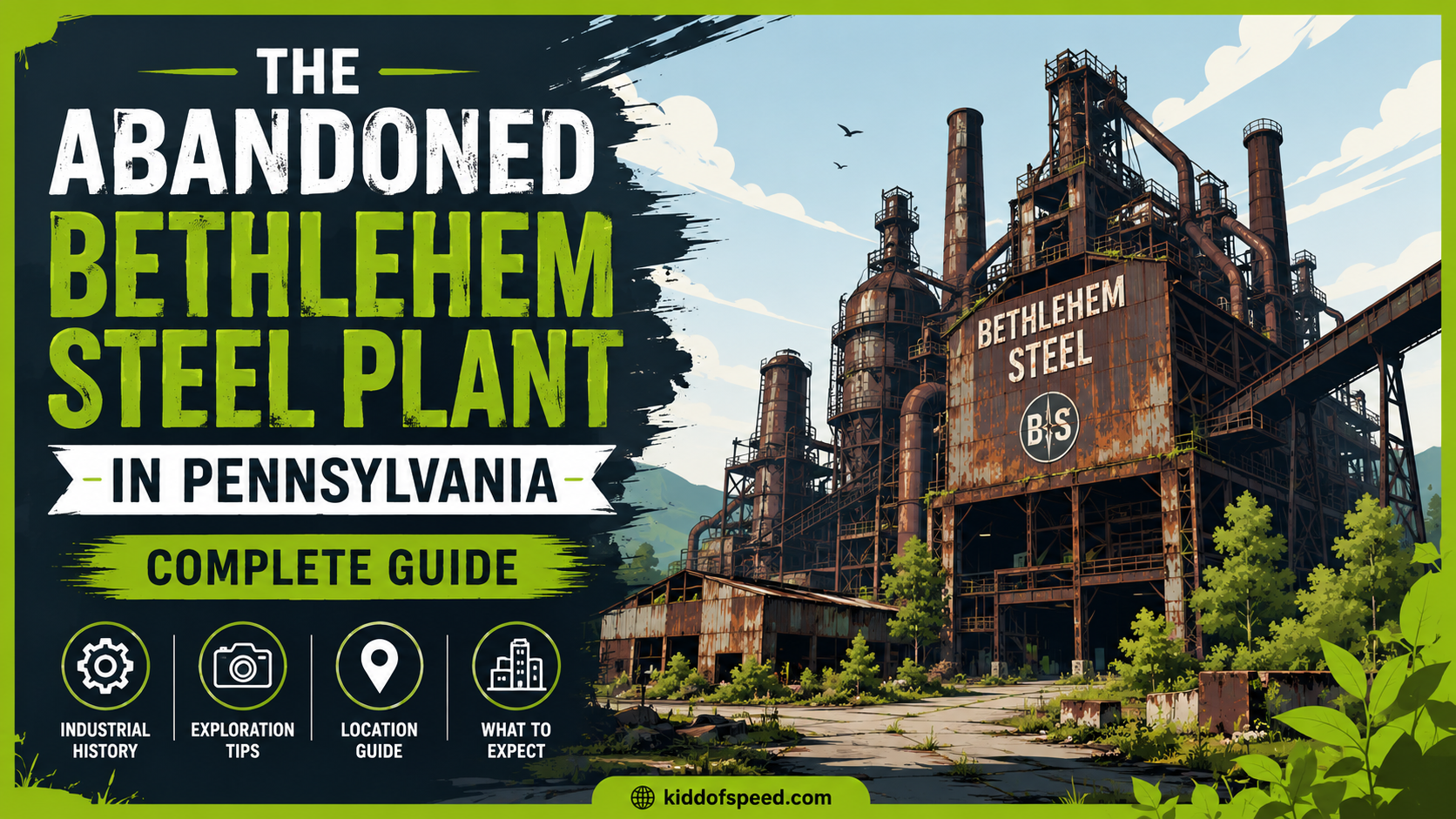
Standing beneath the five massive blast furnaces that tower over Bethlehem, Pennsylvania, you immediately understand why this place earned the nickname “The Cathedral of American Industry.” These rusting giants once roared with the fires of progress, producing the steel that built America’s skyline and armed its military. Today, they stand silent, preserved as monuments to a different era, offering visitors a haunting glimpse into the nation’s industrial past.
The abandoned Bethlehem Steel Plant in Pennsylvania represents one of the most significant industrial archaeological sites in the United States. What began as a modest ironworks in 1857 grew into the flagship production facility of one of the world’s largest steel manufacturers. For nearly 140 years, this plant defined the economic and cultural identity of the Lehigh Valley.
When I first visited the site in 2026, the sheer scale overwhelmed me. The blast furnaces rise 230 feet into the air. The machine shops stretch for what feels like miles. This is not merely an abandoned factory. It is a preserved piece of American history that tells the story of industrial might, economic transformation, and Rust Belt resilience.
In this guide, I will walk you through the complete history of Bethlehem Steel, from its founding through its World War II peak and eventual decline. You will learn what caused the company’s collapse, how the site transformed into SteelStacks, and how you can visit and explore these remarkable ruins today.
Table of Contents
- How Bethlehem Steel Was Founded (1857-1904)
- The Bethlehem Plant Becomes a Flagship Facility
- What Bethlehem Steel Produced During Its Peak
- World War II: The Plant’s Greatest Contribution
- Inside the Gas Blowing Room and Machine Shops
- What Caused the Downfall of Bethlehem Steel?
- The Final Years: Bankruptcy and Closure (1995-2003)
- From Ruins to SteelStacks: The Redevelopment Story
- The National Museum of Industrial History
- Environmental Cleanup and Remediation
- Can You Visit the Bethlehem Steel Ruins?
- The Rise and Fall of Bethlehem Steel Walking Tour
- Photography and Events at the Site
- Frequently Asked Questions
- Conclusion: A Rust Belt Success Story
How Bethlehem Steel Was Founded (1857-1904)
The story begins in 1857 when the Saucona Iron Company was founded on the south bank of the Lehigh River. The location was strategic. The river provided transportation. Nearby limestone deposits offered essential raw materials. Local forests supplied charcoal for early iron production.
In 1861, the company reorganized and adopted a new name: Bethlehem Iron Company. This change reflected broader ambitions. The firm began transitioning from iron to steel production, recognizing that steel represented the future of American construction and manufacturing.
The pivotal moment arrived in 1899 when Charles M. Schwab took control. Schwab was already famous as the president of Carnegie Steel, and he saw something special in the Bethlehem facility. Under his leadership, the company secured crucial patents for the H-beam rolling process. This innovation would revolutionize construction by enabling the building of taller, stronger structures with less material.
In 1904, the Bethlehem Steel Corporation was formally incorporated. The company immediately began an aggressive expansion program. New blast furnaces rose from the Pennsylvania soil. The machine shops grew larger. Employment swelled into the thousands. The Bethlehem plant had become the flagship facility of a company destined to shape the 20th century.
The Bethlehem Plant Becomes a Flagship Facility
By 1910, the Bethlehem plant had evolved into one of the most advanced steel production facilities in the world. The complex covered more than 1,800 acres along the Lehigh River. Five massive blast furnaces dominated the skyline, each capable of producing thousands of tons of pig iron daily.
The plant’s infrastructure was staggering. The gas blowing room housed engines that compressed air to blast the furnaces. Overhead cranes moved materials across the facility. Rail lines connected every corner of the complex. Slag cars and scale cars transported byproducts and waste. The machinery was built to operate at a scale that seems almost impossible by today’s standards.
Employment at the Bethlehem facility peaked during World War II at over 31,000 workers. These were well-paying union jobs that supported entire families. The plant operated continuously, running three shifts around the clock. The economic impact extended far beyond the factory gates. Bethlehem Steel essentially built the middle class of the Lehigh Valley.
What Bethlehem Steel Produced During Its Peak
The Bethlehem plant did not merely produce steel. It produced the materials that defined modern America. The company’s I-beams and structural steel formed the skeletons of countless skyscrapers, bridges, and industrial buildings.
The list of iconic structures built with Bethlehem steel reads like a tour of American landmarks. The Empire State Building. The Chrysler Building. The Golden Gate Bridge. The George Washington Bridge. The Hoover Dam. Rockefeller Center. The list continues for pages.
Beyond construction steel, the Bethlehem facility specialized in shipbuilding components and naval armor. The company developed a particular expertise in producing wide-flange structural sections that engineers specified for their superior strength-to-weight ratios. When architects dreamed big, they specified Bethlehem steel.
World War II: The Plant’s Greatest Contribution
No period in Bethlehem Steel’s history proved more consequential than World War II. The United States military needed ships, and Bethlehem delivered on a scale that seems miraculous today.
The company employed 31,500 people at the Bethlehem plant during the war years. Production lines operated 24 hours a day, 7 days a week. The Bethlehem facility and associated shipyards constructed 1,121 ships between 1940 and 1945. This included naval vessels, cargo ships, and tankers that kept Allied supply lines open across the Atlantic and Pacific.
Beyond shipbuilding, the plant produced vast quantities of armor plating for tanks and warships. Bethlehem Steel manufactured approximately 70 percent of the armor plate used by the U.S. Navy during the war. The quality of this steel literally determined whether sailors lived or died when enemy shells struck their vessels.
The company received the Army-Navy “E” Award for production excellence seven times during the war. These were the peak years of American industrial might, and Bethlehem Steel stood at the center of that achievement.
Inside the Gas Blowing Room and Machine Shops
The technical operations at Bethlehem Steel were fascinating in their complexity. The gas blowing room served as the heart of the blast furnace operation. Massive engines compressed air to 30 pounds per square inch before injecting it into the furnaces. These engines were among the largest ever built.
The Hoover-Mason Trestle, an elevated railroad bed that runs alongside the furnaces, carried raw materials directly to the charging platform. Workers would fill the furnaces with carefully measured layers of iron ore, coke, and limestone. The chemical reactions inside reached temperatures exceeding 3,000 degrees Fahrenheit.
The machine shops contained equipment that could bore holes in steel plates large enough to drive trucks through. Flywheels measured 20 feet in diameter. Overhead cranes lifted loads weighing hundreds of tons. Walking through these spaces today, you can still feel the scale of what human engineering accomplished here.
Visitors on the walking tour can view much of this preserved machinery. The gas blowing engines remain in place, their massive cylinders silent but intact. The scale of these machines helps explain why the plant consumed so much power and employed so many workers.
What Caused the Downfall of Bethlehem Steel?
The collapse of Bethlehem Steel resulted from a combination of external competitive pressures and internal strategic failures. The company that had dominated American steel production for nearly a century gradually lost its market position during the 1970s and 1980s.
Foreign competition represented the first major challenge. Steel producers in Japan, South Korea, and Europe modernized their facilities using basic oxygen furnace technology. These newer plants operated more efficiently than Bethlehem’s aging open-hearth furnaces. Imported steel flooded American markets at prices Bethlehem could not match.
Domestic mini-mills compounded the problem. These smaller operations used electric arc furnaces to recycle scrap steel. They undercut Bethlehem on price for many standard products while avoiding the legacy pension and healthcare obligations that burdened the older company.
Bethlehem Steel’s management made critical errors during this period. They underinvested in modernization, choosing instead to pay dividends to shareholders. The company’s pension obligations grew unsustainable as the workforce aged. By the 1990s, the Bethlehem plant was producing steel at costs far above market prices.
The Final Years: Bankruptcy and Closure (1995-2003)
The end came in stages. In 1995, the company ceased steelmaking operations at the Bethlehem plant. The furnaces went cold after 138 years of continuous production. Approximately 5,000 workers lost their jobs in a single devastating announcement.
Some operations continued. The plant produced coke for other facilities until 1998. Rolling mills operated until 2001. But the core business was finished. The company declared bankruptcy in 2001, then filed for Chapter 11 protection again in 2003 before finally liquidating.
The bankruptcy proved catastrophic for retired workers. Bethlehem Steel’s pension obligations were severely underfunded. The federal Pension Benefit Guaranty Corporation took over the pension plan, but many retirees received reduced benefits. Workers who had dedicated their entire careers to the company saw their retirement security evaporate.
By 2003, the company that had built America’s greatest structures ceased to exist. The Bethlehem plant stood abandoned, its future uncertain, its machinery silent.
From Ruins to SteelStacks: The Redevelopment Story
The transformation of the abandoned Bethlehem Steel Plant into SteelStacks represents one of the most successful industrial heritage preservation projects in the Rust Belt. Rather than demolishing the historic structures, developers and community leaders chose to adapt them for new purposes.
In 2005, the Sands Casino Resort Bethlehem announced plans to develop a portion of the site. This controversial decision actually helped fund preservation efforts. Gaming revenue provided resources that might otherwise have been unavailable. The casino opened in 2009 on property adjacent to the historic blast furnaces.
The nonprofit ArtsQuest led the cultural transformation. They converted former industrial buildings into performance venues, arts spaces, and educational facilities. The SteelStacks campus now hosts concerts, festivals, and community events throughout the year. The Levitt Pavilion, an outdoor amphitheater, presents over 50 free concerts annually.
The five blast furnaces were stabilized and preserved as the centerpiece of the redevelopment. These structures form the backdrop for the annual Musikfest, one of the largest free music festivals in the United States. The juxtaposition of industrial ruins and live performance creates an atmosphere unlike any other venue in America.
The National Museum of Industrial History
The National Museum of Industrial History opened in 2016 as an Smithsonian-affiliated institution. Located in a former Bethlehem Steel building, the museum preserves and interprets the story of American industrial development with particular focus on the steel industry.
The museum’s collection includes machinery, tools, documents, and photographs from the Bethlehem Steel era. Visitors can examine the technical processes that transformed raw materials into finished steel products. Interactive exhibits explain the chemistry of metallurgy and the physics of structural engineering.
Perhaps most importantly, the museum preserves the human stories of Bethlehem Steel workers. Oral history projects have recorded hundreds of interviews with former employees and their families. These personal accounts provide insight into the working conditions, community life, and economic impact of the plant.
The museum operates in partnership with the Smithsonian Institution, which provides expertise in curation and exhibition design. This affiliation signals the national significance of the Bethlehem Steel story.
Environmental Cleanup and Remediation
Decades of heavy industrial use left significant environmental contamination at the Bethlehem site. Soil and groundwater contained elevated levels of heavy metals, polycyclic aromatic hydrocarbons, and other industrial pollutants. Remediation efforts began in the 1990s and continue today.
The Environmental Protection Agency oversaw extensive cleanup operations. Contaminated soil was excavated and treated. Groundwater monitoring wells track pollutant levels. Areas of the site required capping to prevent exposure to remaining contaminants.
The cleanup cost tens of millions of dollars. This expense represented a necessary investment before any redevelopment could proceed. Today, the majority of the SteelStacks campus meets residential standards for environmental safety, though some areas remain restricted.
Can You Visit the Bethlehem Steel Ruins?
Yes, you can visit the abandoned Bethlehem Steel Plant in Pennsylvania, but access is restricted to organized tours and public areas. The site is no longer an open industrial ruin where urban explorers can wander freely. Instead, it has been transformed into a managed heritage destination with specific visiting procedures.
The most comprehensive way to experience the site is through the official “Rise and Fall of Bethlehem Steel” walking tour. This guided experience takes visitors onto the Hoover-Mason Trestle, an elevated walkway that runs alongside the preserved blast furnaces. From this vantage point, you can examine the industrial machinery up close while learning the plant’s history from knowledgeable guides.
The National Museum of Industrial History offers its own plant site tours on Thursdays, Fridays, Saturdays, and Sundays. These tours provide access to areas not available through the standard walking tour. Museum members often receive discounted rates or early access to special tour programs.
Public areas of SteelStacks, including the Levitt Pavilion and ArtsQuest facilities, are open during events and posted hours. These spaces offer excellent views of the blast furnaces even without taking a formal tour. Photography is permitted and encouraged throughout the public portions of the site.
The Rise and Fall of Bethlehem Steel Walking Tour
The signature visitor experience is the Rise and Fall of Bethlehem Steel walking tour operated by Historic Bethlehem Museums and Sites. This guided walk covers approximately one mile along the Hoover-Mason Trestle, providing intimate access to the preserved industrial structures.
The trestle itself is a remarkable feature. Originally built as an elevated rail line to carry raw materials to the blast furnaces, it has been converted into a pedestrian walkway. The path rises 50 feet above the ground, putting visitors at eye level with the massive industrial equipment. Interpretive panels along the route explain the functions of various structures and machinery.
Tours typically last 90 minutes and include detailed historical commentary. Guides explain how the blast furnaces operated, what daily life was like for workers, and how the company’s decline affected the community. Many guides have personal connections to Bethlehem Steel through family members who worked at the plant.
Tickets can be purchased online through the Historic Bethlehem website or at the visitor center. I recommend booking in advance during summer months and festival weekends, as tours often sell out. Comfortable walking shoes are essential, and the trestle is wheelchair accessible.
Photography and Events at the Site
The abandoned Bethlehem Steel Plant has become a premier destination for industrial photography. The contrast of rusting machinery against the Lehigh Valley sky creates compelling compositions. Photographers from across the country visit specifically to capture images of the blast furnaces.
The best photography opportunities occur during the golden hours of early morning and late afternoon. The warm light accentuates the texture of the rusted steel. Night photography can also be spectacular when the furnaces are illuminated by artificial lighting.
Beyond photography, SteelStacks hosts numerous events throughout the year. Musikfest draws over a million visitors annually for eleven days of free music across multiple stages. The Celtic Classic celebrates Scottish and Irish heritage with athletics, music, and food. The PA Bacon Fest combines culinary delights with live entertainment. These events offer unique ways to experience the industrial setting.
Frequently Asked Questions
How many people died at Bethlehem Steel?
Approximately 400 workers died in accidents at the Bethlehem Steel plant over its nearly 140 years of operation. The work was inherently dangerous. Workers faced exposure to molten metal, heavy machinery, toxic fumes, and extreme temperatures. Falls from heights, equipment malfunctions, and industrial explosions claimed lives regularly through the early decades. Safety improved significantly in later years, but the historical death toll reflects the hazardous nature of steel production in that era.
What happened to the Bethlehem Steel Factory?
The Bethlehem Steel plant ceased steelmaking operations in 1995 and completely shut down by 2003. The company declared bankruptcy and liquidated. After closure, the site underwent extensive environmental cleanup and was redeveloped into SteelStacks, a cultural and entertainment complex. The five blast furnaces were preserved as historic landmarks. Today, the site hosts concerts, festivals, and museums while offering tours of the preserved industrial ruins.
Is the Edgar Thomson Works still open?
Yes, the Edgar Thomson Works near Pittsburgh remains operational as part of U.S. Steel. Unlike the Bethlehem plant, which closed completely, Edgar Thomson has continued steel production since 1875. It is now one of the oldest continuously operating steel mills in the United States. The plant has modernized significantly and still produces steel using blast furnace technology, though at much reduced employment levels compared to its peak.
Did Bethlehem Steel employees lose their pension?
Many Bethlehem Steel retirees saw their pensions significantly reduced after the company declared bankruptcy in 2003. The company’s pension fund was underfunded by billions of dollars. The federal Pension Benefit Guaranty Corporation took over the pension plan, but government guarantees have maximum limits. Retirees with pensions above these limits received reduced payments. Healthcare benefits were also drastically cut. The pension crisis became a cautionary tale about corporate bankruptcy and retirement security.
What was the downfall of Bethlehem Steel?
Bethlehem Steel’s downfall resulted from multiple factors: foreign competition from modernized overseas mills, domestic competition from efficient mini-mills, high legacy costs for pensions and retiree healthcare, management’s failure to modernize facilities, and strategic decisions that prioritized dividends over capital investment. The company also struggled with union negotiations and could not match the production costs of competitors. These combined pressures made the Bethlehem plant economically uncompetitive by the 1990s.
Will Bethlehem Steel ever reopen?
No, steel production at the Bethlehem plant will never resume. The blast furnaces have been preserved as historical monuments, not operational equipment. Redevelopment as SteelStacks has permanently converted the site to cultural and entertainment uses. The infrastructure required for steelmaking has been dismantled or repurposed. While other former Bethlehem Steel facilities elsewhere in the country may have been adapted for modern uses, the flagship Pennsylvania plant exists now solely as an industrial heritage site.
Conclusion: A Rust Belt Success Story
The abandoned Bethlehem Steel Plant in Pennsylvania has transformed from symbol of industrial decline into a model of Rust Belt revitalization. What could have become another demolished industrial site instead emerged as SteelStacks, a vibrant cultural destination that honors its past while serving its community’s future.
The five blast furnaces standing sentinel over Bethlehem remind us of the scale of American industrial achievement. They also remind us of the workers who built this country, the communities that depended on manufacturing, and the difficult transitions that economic change requires.
I encourage you to visit this remarkable site. Walk the Hoover-Mason Trestle. Stand beneath the furnaces. Explore the National Museum of Industrial History. The Bethlehem Steel story is the American story, and it deserves to be remembered.