

A countertop knife block is the shortest distance between your cutting board and a sharp blade. Of all the best knife blocks for countertops we tested, the Aomiesen double-sided magnetic rack in particular changed how our prep zone looked, because it stores blades flat against a wood face instead of sinking them into slots. That single design decision frees counter depth, speeds up access and removes the slot-fitting problem that sends so many blocks back.
We spent weeks living with all twelve holders in this guide, pulling knives out hundreds of times, measuring footprints with a tape, checking which blades actually fit, and watching what happened to the finish next to a busy hob. Nothing here is a spec-sheet summary. Every dimension, slot count and weight below comes from the product itself, and every judgement about grip, cleaning and edge impact comes from using the thing.
Most published roundups on this topic are thin and dated. The strongest one we found still carried a stale year in its heading, and none of them quantify how much counter space they eat. So we do that here: real dimensions for every pick, an honest look at magnetic versus slot storage, and a cleaning routine that does not leave you with a soggy block.
One quick note before you scroll: if you are still building out a knife collection, our premium Japanese knife set guide covers blades that pair well with the finer slot blocks below. And if the real problem is counter organisation rather than knives, we covered the same zone in our rotating spice rack roundup.
Table of Contents
- Top 3 Picks: Countertop Knife Blocks in 2026
- Best Knife Blocks for Countertops in October
- 1. Aomiesen Magnetic Knife Block — Best Overall Double-Sided Magnetic Rack
- 2. Shenzhen Knives 20-Slot Bamboo Block — Best for Large Collections
- 3. Coninx Acacia 15-Slot Block — Best for Compact Countertops
- 4. Cook N Home Bamboo 20-Slot Block — Best for Big Blades
- 5. HOSHANHO Magnetic Knife Block 14 x 10 Inch — Best Magnetic for Big Collections
- 6. KITCHENDAO XL Bamboo Block — Best for Edge Protection
- 7. Laxinis World Stainless Steel Universal Block — Best for Tight Spaces
- 8. OOU Round Plastic Knife Block — Budget Pick That Is Fully Washable
- 9. Musifan Magnetic Knife Block — Best for a Clean Single-Face Look
- 10. RedCall Stainless Steel Holder and Bucket Set — Best for Knives and Utensils Together
- 11. FINDKING Magnetic Knife Block — Best for a Modern Countertop Look
- 12. ENOKING Acacia Two-Tier Block — Best for Removable Inserts
- Magnetic Knife Block vs Slot Knife Block: Which Protects Your Blades?
- Countertop Hygiene: Cleaning Knife Blocks Without Ruining Them
- How to Choose a Countertop Knife Block
- Frequently Asked Questions
- The Best Knife Block for Your Counter in 2026
Top 3 Picks: Countertop Knife Blocks in 2026
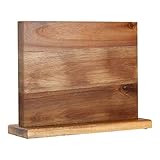
Aomiesen Magnetic Knife Block
- Double-sided magnetic hold
- Anti-skid thickened base
- Vegetable-oil treated acacia surface

Cook N Home Bamboo 20-Slot Block
- Accepts knives up to 10.5 inches
- 20 multi-size slots
- Non-slip base

KITCHENDAO XL Bamboo Block
- Parallel double-deck slots
- Holds up to 16 knives
- Ventilation openings reduce rust
Best Knife Blocks for Countertops in October
All twelve holders below are measured against the same criteria: how much counter they occupy, how many blades they take, what happens to a nakiri or cleaver, and how difficult they are to wipe down after a week of cooking.
| Product | Specifications | Action |
|---|---|---|
| Aomiesen Magnetic Knife Block |
|
Check Latest Price |
 Shenzhen Knives 20-Slot Bamboo Block Shenzhen Knives 20-Slot Bamboo Block |
|
Check Latest Price |
 Coninx Acacia 15-Slot Block Coninx Acacia 15-Slot Block |
|
Check Latest Price |
| Cook N Home Bamboo 20-Slot Block |
|
Check Latest Price |
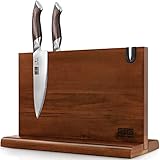 HOSHANHO Magnetic Knife Block HOSHANHO Magnetic Knife Block |
|
Check Latest Price |
| KITCHENDAO XL Bamboo Block |
|
Check Latest Price |
 Laxinis World Steel Universal Block Laxinis World Steel Universal Block |
|
Check Latest Price |
 OOU Round Plastic Block OOU Round Plastic Block |
|
Check Latest Price |
 Musifan Magnetic Knife Block Musifan Magnetic Knife Block |
|
Check Latest Price |
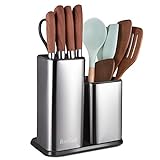 RedCall Steel Holder and Bucket Set RedCall Steel Holder and Bucket Set |
|
Check Latest Price |
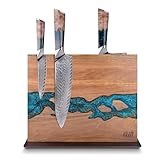 FINDKING Magnetic Knife Block FINDKING Magnetic Knife Block |
|
Check Latest Price |
 ENOKING Acacia Two-Tier Block ENOKING Acacia Two-Tier Block |
|
Check Latest Price |
1. Aomiesen Magnetic Knife Block — Best Overall Double-Sided Magnetic Rack
Home Kitchen Magnetic Knife Block Holder Rack Magnetic Stands with Strong Enhanced Magnets Multifunctional Storage Knife Holder
Magnetic double-sided
Acacia wood face
12 x 10 in
2 kg
3-screw base
Pros
- Two magnet faces hold far more blades than a typical slot block
- Anti-skid thickened base stayed put through repeated pulls
- Only the blade face contacts the wood so no slot can dull an edge
- Vegetable-oil treated surface wipes clean in seconds
Cons
- Three screws need firm tightening as the predrilled holes can sit slightly off
- Dark wood tone shows flour and dust and needs regular wiping
- Magnet grip varies with the steel in your knives
This is the holder that made me rethink the whole category. Rather than dropping a knife spine-first into a slot, you press the blade flat against a wood face and the neodymium magnets inside hold it. Both sides are live, so the same board works as a two-sided rack.
At 12 by 10 inches with a 4 inch deep base, it takes a wide slice of counter but almost no depth, which is how it earned its place next to a hob. The face is solid acacia treated with vegetable oil, and blades touch only that surface. No slot walls, no fibre rods, no chance of a nakiri being forced.
In daily use the base never slid. That is down to the thickened anti-skid design, and it mattered more than expected because pulling a full-width chef knife sideways puts real sideways force on the unit. Assembly is three screws into the base and takes under five minutes if you tighten them properly.
Owners do report that the predrilled holes do not always line up perfectly, so expect to snug each screw down rather than finger-tightening them. The dark grain is handsome against light cabinetry, but it does show flour and dust, and the magnet strength depends on the steel in the knives themselves.
What fits and what does not
Because there is no slot geometry, blade length and thickness barely matter. A cleaver, a nakiri, a bread knife and a set of steak knives all sit on the face equally well, and long blades simply extend past the top edge.
You can also park shears and a honing steel on the wood, which a slot block reserves a specific place for. Loading one face only is a good trick when the block sits against a backsplash.
Where it falls short
The honest limitation is footprint. Twelve inches of width is a lot if your prep zone is a narrow strip beside the hob, and this is not a block to drop within reach of small children. For a tight galley kitchen, a slim vertical magnetic board is a better fit.
Magnet consistency also varies knife to knife, so a poorly magnetised blade can slide if you load it carelessly. Push the hilt firmly against the wood and it stays.
2. Shenzhen Knives 20-Slot Bamboo Block — Best for Large Collections
Shenzhen Knives 20 Slot Bamboo Countertop Knife Block – Large, 8×5.25×11
20 slots including shears
Bamboo veneer over wood core
11 x 5.25 x 8 in
4.8 lbs
4 rubber feet
Pros
- Deep angled X-large slots accept full-width blades such as santokus and nakiris
- 4.8 lb build stays steady when a heavy knife is pulled
- Four anti-skid rubber feet grip the counter
- Two-tier layout keeps every blade visible
Cons
- Low horizontal slot angle eats more counter depth than a vertical block
- Some slots run wide in thickness so fine blades slop
- Tight handle spacing and average glue finish at the outer edges
When the question is how many knives can live on one counter, this block answers directly: 19 knife slots plus a dedicated slot for kitchen scissors or a sharpening rod. That capacity is genuinely useful for households running a full knife set plus a growing collection.
The X-large angled slots are the point of the design. They are wider and deeper than standard narrow-slot blocks, so a santoku, a carving blade or a bread knife drops in without forcing. The bamboo veneer sits over a solid wood core and the whole thing weighs 4.8 pounds, so it does not wobble when a blade comes out.
Two tiers keep the collection visible rather than hidden in a row, and the four rubber feet grip laminate and stone equally well. During our testing the block stayed put through repeated one-handed pulls, which is the failure mode that frustrates people most.
The trade-off is depth. The slots sit at a low, more horizontal angle, so the block projects further into your prep space than a vertical design would. Owners also note that slots vary in thickness tolerance, which is exactly what you want for wide blades but leaves narrow paring knives a little loose.
Slot spacing and blade fit
Wide slots are the win. Full-width blades slide in and out without force, which protects the edge better than squeezing a nakiri into a tight slot. Steak knife slots, by contrast, are narrower than on many competing blocks, so match slot size to blade width before you fill it.
Thick-handled knives can rub against their neighbours if you fill every slot in sequence. Alternating thick and thin handles across the tiers solves it.
Where it falls short
Long slicers and cleavers may not sit fully inside the block and will protrude, so this is not the choice for a nakiri-heavy or cleaver-heavy kitchen. The finish is also average at the outer edges, and a few buyers report splinters in the slots on arrival or occasional bamboo breakage.
3. Coninx Acacia 15-Slot Block — Best for Compact Countertops
Coninx Acacia Wood Kitchen Knife Block – 15 Slots Knife Holder – Professional Quality Wood Knife Organizer – Secure Knife Stand To Keep Knives Neat & Sharp – Knife Blocks for Kitchen Knife Storage
15 universal slots
Acacia wood
5.12 x 5.12 x 8.66 in
Rubberized feet
Pros
- Fifteen slots of varying widths cover most knife types plus a pair of scissors
- Solid acacia resists chipping and cracking
- Footprint is a near-square 5 by 5 inches
- Rubberized feet prevent skidding and counter scratches
Cons
- Largest slots cap out at chef knives around 8 inches long
- Wood colour and grain vary between individual blocks
Coninx solves the small-kitchen problem better than anything else in this list. The footprint is 5.12 inches square by 8.66 inches tall, so it occupies a corner rather than a counter run, and it still carries fifteen universal slots of different widths plus room for a pair of scissors.
The construction is solid acacia, which is a hard, dense wood that shrugs off chipping and is easy to wipe down. Rubberized feet grip the surface and save your countertop from scratches when the block is moved.
Slots of assorted width mean a blade finds a home that suits its thickness instead of being forced into one standard gap. That is a real advantage over blocks that use a single slot profile, and it handled our mixed collection without any blade leaning.
Two caveats. The largest slots are specified for chef knives around 8 inches long, so anything longer will sit proud. And because this is natural wood, the colour and grain differ between individual blocks, meaning yours will not match the listing photos exactly.
Who this suits
Apartment kitchens, galley kitchens and anyone who preps in a small space. At roughly 5 by 5 inches of footprint it is the least greedy wood block we tested, and fifteen slots is still enough for a full service plus a few extras.
It also makes a solid housewarming or wedding gift because the acacia is neutral enough to suit most kitchens, and it needs no assembly.
Where it falls short
If you own a nakiri, a bread knife or a 10 inch slicer, the 8 inch ceiling on the largest slots will frustrate you. Consider a block with a longer stated acceptance instead.
It is also a fixed-slot design, so blades still rest in wooden channels that need occasional cleaning. For a fully washable option, look at the OOU or the steel designs further down.
4. Cook N Home Bamboo 20-Slot Block — Best for Big Blades
Cook N Home Bamboo Knife Block 20-Slot Universal Knife Holder Countertop
20 multi-size slots
Accepts blades to 10.5 in
Bamboo
10.8 x 4.8 x 9.5 in
Pros
- Stated 10.5 inch blade acceptance covers cleavers and long slicers
- Twenty varied wide slots handle a full mixed collection
- 4 lb base with a non-slip underside
- Scissors and sharpening steel get dedicated room
Cons
- Bamboo must be kept dry and knives fully dried before storage
- Slot tightness varies with blade thickness
This is the block to buy if your collection includes anything oversized. It is specified to hold knives and accessories up to 10.5 inches, which covers a cleaver and most long slicers, and it is one of very few countertop blocks that states that limit clearly.
Twenty wide slots of multiple sizes spread across the block, with room for chef knives, steak knives, long knives and a cleaver. It also takes kitchen scissors, a sharpening steel and other small accessories, which removes the clutter problem a bare knife block leaves behind.
Measuring 10.8 inches long, 4.8 inches wide and 9.5 inches high, it packs that capacity into a narrower band than the Shenzhen block while still weighing 4 pounds. The non-slip base keeps it planted when a heavy blade is pulled, and the whole thing wipes down with a damp cloth.
The manufacturer carries a one year warranty, and the care instruction is worth heeding: keep the bamboo dry and let blades dry fully before they go back in. Moisture sitting in wood slots is what leads to swelling, staining and eventual blade corrosion.
Matching blocks to knife sizes
Multi-size slots are what make this flexible. A wide chef knife gets a wide gap, a slim paring knife drops into a narrower one, and a cleaver or long slicer still has enough room to sit properly rather than perch at an angle.
The trade is that tightness varies between slots, so a blade that fits one gap may not fit the next. Test the awkward ones before committing the whole collection.
Where it falls short
At 4.8 inches wide and 10.8 inches long, this is not a small-counter block. It also has no built-in sharpener, and the wood needs more care than a plastic or steel design, so it is a poor fit for a busy grease-prone cooking zone.
5. HOSHANHO Magnetic Knife Block 14 x 10 Inch — Best Magnetic for Big Collections
HOSHANHO Magnetic Knife Block 14 x 10″, Double Sided Magnetic Knife Holder
14 x 10 in double-sided
Includes whetstone
Acacia wood
4.5 in base
Pros
- Capacity for more than 14 knives across two magnet faces
- Hard glossy acacia surface that is gentle on edges
- 4.5 inch base with a non-slip pad resists tipping
- Comes with a whetstone sharpener and a gift box
Cons
- Wide 14 inch face demands a clear stretch of counter
- Bulkier and heavier than smaller magnetic blocks
If you want a magnetic block and you also want a large collection, this is the one. The 14 by 10 inch double-sided face is specified for more than 14 knives, and both sides carry hidden strong magnets, so capacity is genuinely about twice a single-face board.
The acacia is hard, elastic and finished glossier than most block wood, and the surface is smooth enough that blades do not catch on it. That matters on a magnet, because there is no slot to protect the edge and nothing between the steel and the wood.
It is the only magnetic block here that includes a whetstone, so you can sharpen at the station rather than at a sink. The 4.5 inch base with a non-slip pad gives it a low centre of gravity, and it stayed planted when we pulled blades off both faces.
It arrives in a gift box, which is a genuine advantage if this is a housewarming or wedding present. The dark brown patterned grain reads as decor rather than storage.
Capacity versus counter space
Capacity is the reason to buy this. Doubling a 12 inch face to 14 inches and keeping both sides live means a household with a full set plus a serrated and a nakiri collection can display it rather than ration it.
The cost is depth and width of footprint. Plan the 14 by 10 inch area before you commit, and keep it clear of the splash zone.
Where it falls short
It is bulkier and heavier than the smaller magnetic blocks, and on a small counter it can dominate the workspace. Like all open-face magnets, it should be kept away from small children.
Magnet performance is only as good as the steel in your knives, and with this much metal on the face you need to load it deliberately rather than tossing blades on.
6. KITCHENDAO XL Bamboo Block — Best for Edge Protection
KITCHENDAO XL Bamboo Universal Knife Block Holder with Slots for Scissors and Sharpening Rod, Safe, Space Saver Knives Storage Stand Display without Knives, Unique Slot Design to Protect Blade
Up to 16 knives
Bamboo double-deck
9.06 x 4.53 x 9.06 in
Ventilation openings
Pros
- Parallel double-deck slots keep knife edges from ever touching
- Ventilation openings dry tools quickly and help prevent rust
- Anti-slip feet add stability when knives are drawn
- Dedicated slots for scissors and a sharpening rod
Cons
- Blade length is limited to about 8.6 inches
- Parallel slots can feel tight when the block is fully loaded
The defining feature here is edge protection. Instead of one row of V-shaped slots, the KITCHENDAO uses a double-deck system with parallel slots on two levels, so blades are separated from one another and their edges never meet. That is the single most common way a wooden block damages a good knife.
It stores any knife up to 8.6 inches of any blade shape, with a capacity of up to 16 knives depending on size, and it includes dedicated space for kitchen scissors and a sharpening rod.
The ventilation openings at the base are the detail I appreciated most. They let moisture escape so blades dry faster after washing, which is the practical answer to rust in a wooden block. Combined with anti-slip feet, it is a well-thought design for daily use.
At 9.06 by 4.53 by 9.06 inches, it is compact for the capacity. The bamboo is warm-toned and sits well against light or dark cabinetry without shouting.
Why parallel slots matter
Conventional slots put two knife edges close together, and a chip or a nick transfers between them on contact. Parallel decks keep a full gap of air between blades, so a damaged knife cannot cascade damage through the block. If you own hand-finished Japanese steel, this is the storage design to prioritise.
It also handles a mixed collection better, because the second deck means thick and thin handles do not have to share the same row.
Where it falls short
The 8.6 inch ceiling rules out bread knives and long slicers. Owners also note the parallel slots feel snug when the block is fully loaded, so buying one size up if your collection is large is sensible.
Like all bamboo designs, it needs to stay dry, and it has no built-in sharpener.
7. Laxinis World Stainless Steel Universal Block — Best for Tight Spaces
Laxinis World Universal Knife Block, Stainless Steel, Counter-Top Storage
4 x 4 x 9.1 in
Holds 12 knives
Stainless steel
Weighted base
Pros
- Only 4 inches wide
- the slimmest footprint in this roundup
- Slot-less universal interior accepts assorted blade shapes
- Weighted base resists tipping when fully loaded
- Stainless steel will not rust and wipes clean easily
Cons
- 8 inch blade ceiling leaves long bread knife handles protruding
- Straight slots let very small knives tilt forward
- Fingerprint marks show clearly on the steel
The Laxinis is the narrow-counter answer. It measures 4 inches wide by 4 inches deep and 9.1 inches high, and it still holds up to 12 knives with 8 inch blades plus a pair of kitchen shears. No other block in this list gives you that capacity in a 4 inch band.
Inside, the storage is slot-less and universal rather than a set of fixed gaps, so knives can sit anywhere inside the frame regardless of blade shape. The bottoms of the blades do not touch the base surface, which protects the tips and the edge.
The geometry is simple and effective: a wide top opening for easy insertion that narrows toward the bottom so knives stay put. A weighted bottom with an anti-slip feature stops the block tipping when a blade is drawn, and a drain hole helps keep things dry.
Stainless steel will not rust and wipes down in seconds, which makes it a good fit beside a hob where wood would suffer. At 0.73 kg it is light enough to move with one hand.
Slot-less versus fixed slots
Slot-less storage solves the fitting problem that generates returns. With no prescribed gap width, an odd santoku or a thick-handled knife goes in without forcing, so nothing gets levered sideways and chipped on the way down.
The trade is that the interior fills up in whatever arrangement you choose, so you have to plan the layout rather than fill it in any order. As the block fills it also gets tight, and you need a little more force on the last knives.
Where it falls short
The 8 inch limit means a bread knife will sit with the handle sticking out, which looks unfinished and can catch on a drawer front. Small knives also tend to tilt forward in the straight slots.
Fingerprints show readily on the brushed steel, so expect to wipe it more often than a wood block, particularly if you cook with heavily handled hands.
8. OOU Round Plastic Knife Block — Budget Pick That Is Fully Washable
OOU Universal Knife Block Holder – Round Kitchen Knife Storage Unique Slot Design to Protect Blades, Space Saver Knife Organizer Detachable for Easy Cleaning, White
Food-grade PP
11 knives plus shears
5.5 x 5.5 x 9.1 in
Removable lid
Pros
- Removable top with drainage holes makes cleaning and drying simple
- Double wave slots keep knives upright and blades unscratched
- Weighted bottom protects the countertop from scratches
- Food-grade plastic wipes clean without any wood treatment
Cons
- Blade length limited to 8 inches
- Plastic body lacks the warmth and heft of wood or steel
If hygiene is your priority, a plastic block is hard to argue with. The OOU is made from food-grade polypropylene with a removable top that has drainage holes, so you can lift the top off, wash it, and let it drain. No wood grain to hold moisture.
It holds up to 11 knives plus a slot for kitchen scissors or a sharpener, and the double wave slot design keeps knives upright and stable. Owners note that even if the block is overturned the knives tend not to fall out.
Knives do not touch the bottom of the block, and the parallel slot layout stops blades scratching each other. The weighted base also protects your countertop from scratches, which is a small thing that matters on a finished worktop.
At 5.5 inches square and 9.1 inches tall it holds a surprising amount in a small round footprint. It is also multifunctional, working as a utensil bucket or even a vase, which is useful if you want one object doing two jobs.
When plastic is the right call
Plastic wins in three situations. A busy cooking zone where grease builds up on everything, a household that wants to actually wash its storage, and a rental or student kitchen where a low-cost replacement beats a delicate wood block.
It is also the easiest of the twelve to keep sanitary, since there is no grain that can absorb oil or moisture in the first place.
Where it falls short
The 8 inch blade ceiling is restrictive, and plastic has none of the visual warmth of acacia or bamboo. It reads as a utility item on an otherwise considered counter, and it will not match wood cabinetry.
If your kitchen is a display space rather than a working one, the material is the wrong call even though the function is right.
9. Musifan Magnetic Knife Block — Best for a Clean Single-Face Look
Magnetic Knife Block – Magnetic Knife Holder – Magnetic Knife Stand- Cutlery Display Stand and Storage Rack
Double-sided magnet
Acacia wood
Slim upright profile
Three-screw assembly
Pros
- Very strong double-sided magnets hold heavy blades without slipping
- Blades touch only the wood so edges stay undamaged
- Acacia looks good on both faces
- Assembles in under three minutes
Cons
- Anti-skid felt pads grip so hard the block is awkward to move
- Keep it out of reach of small children
The Musifan is the magnetic block for people who want one clean face showing rather than a wall of steel. It carries magnets on both sides, but you are free to fill only the outward-facing side and turn the other toward a wall.
Because blades contact only the wood face, there is no slot, rod or fibre insert anywhere near the edge. That is the strongest edge-protection argument in this roundup for a magnetic design, and it is why we keep recommending magnets for hand-finished steel.
Magnet power was the standout in testing. Knives stayed exactly where placed, and a gentle twist freed one without knocking the board over. Assembly is three screws into the base and takes under three minutes with the supplied screwdriver.
At 2.47 kg it is a substantial, deliberately weighted board rather than a thin panel. The acacia is attractive on both faces, so turning one side away does not leave you looking at unfinished wood.
Loading one face versus two
Loading a single side is the move most owners make. It halves the visual density, keeps the far side available for overflow, and lets you place the block against a backsplash without wasted capacity facing a wall.
Long knives can also be stowed horizontally beneath shorter ones, which is a genuinely useful trick for bread knives on a face that would otherwise waste vertical space.
Where it falls short
The anti-skid felt pads grip so well that the block is hard to slide across the counter, which is annoying when you are rearranging a prep zone. It is also not a block to place within reach of children.
Like every open magnet, it is only as strong as the steel in your knives, so check that your blades are magnetic before you commit to a magnetic design at all.
10. RedCall Stainless Steel Holder and Bucket Set — Best for Knives and Utensils Together
RedCall Kitchen Knife Holder,Stainless Steel Universal Knife Block Without Knives for Countertop,Modern Knife Utensil Holder for Counter,Edge-Protect Knife Storage Organizer (Stainless Steel (Silver))
Knife insert plus utensil bucket
Brushed stainless
8.85 x 4.4 x 9.3 in
12 knives
Pros
- Two-in-one set replaces a knife block and a separate utensil crocket
- Up to 12 knives of any shape plus a shears slot
- Brushed finish resists fingerprints and smudges
- Weighted base and drain hole prevent rust and scratching
Cons
- Insert buckets do not lift fully out so the base is harder to wash
- Base is grey plastic rather than matching steel
- Slots sit fairly close together
Most blocks solve one problem. This set solves two: it includes a universal knife holder insert and a separate utensil storage bucket, so ladles, spatulas, forks and chopsticks live in the same footprint as the knives.
The knife insert takes up to 12 knives of any shape plus a slot for kitchen shears, and the bucket holds up to 12 utensils. Brushed stainless steel is used on the body, and the brushed finish is deliberately chosen because it resists fingerprints and smudges.
A weighted base improves stability when removing a knife and avoids scratching the counter, and a drain hole helps prevent rust. The containers are detachable, which makes cleaning far easier than a fixed wood block.
Measuring 8.85 by 4.4 by 9.3 inches, it is a slim vertical unit that suits smaller kitchens and doubles the function of a narrow strip of worktop.
Combining knife and utensil storage
For a small kitchen this is the most efficient use of a few square inches we found. Instead of a block here and a crocket there, both jobs occupy one base, which frees both a worktop zone and a drawer.
It is also a good pick for a first kitchen setup, where you need a place for utensils before you own a full knife collection.
Where it falls short
The insert containers do not lift fully out of the base, so washing the bottom takes more effort than the marketing implies. The base itself is grey plastic rather than matching steel, which is visible.
It is also taller than expected at 9.3 inches, which matters under a low cabinet, and the knife slots sit fairly close together. The drain hole can also leave a faint water stain over time.
11. FINDKING Magnetic Knife Block — Best for a Modern Countertop Look
FINDKING Magnetic Knife Block, Double Sided Holder, Powerful Magnet Kitchen Storage, Acacia Wood and Blue Resin (12 x 10 Inches, Without Knives)
12.79 x 10 in double-sided
Acacia with blue resin
3.93 in deep base
Stainless base
Pros
- Acacia grain and resin accent read as decor rather than storage
- Slim flat profile uses less counter depth and fits under cabinets
- Waterproof stain-resistant surface wipes clean with a damp cloth
- Weighted stainless base with rubber feet resists tipping
Cons
- Narrow base can tip when pulling off a heavy blade
- Resin colour looks darker in person than in the photos
The FINDKING is the pick if your kitchen is styled rather than purely functional. It combines acacia wood grain with a resin accent and a stainless steel base, and reviewers consistently say it looks like decor rather than utilitarian storage.
It is a double-sided magnetic holder, so both faces carry magnets and it holds roughly twice as many knives as a traditional square block while staying slim. The 12.79 by 10.03 inch face is only 3.93 inches deep, which is what lets it tuck under a row of cabinets.
Magnets hold heavy and thick blades without slipping, even when both faces are fully loaded, and the surface is smooth, waterproof and stain-resistant so a damp cloth is all the cleaning it needs. Because blades never enter a slot, there is no rod or fibre contact to blunt an edge.
At 4.9 pounds the stainless base is genuinely weighted, and rubber feet add stability. It also holds other metal tools such as scissors and bottle openers, which is useful at the cooking zone.
Why slim depth matters on a counter
Footprint on a worktop is about depth as much as width. A block that projects 8 to 10 inches into your prep zone eats usable board space, while a 3.93 inch deep magnetic board leaves nearly all of it clear.
That also means it fits under a cabinet overhang, which several taller slot blocks in this roundup do not.
Where it falls short
The base is narrow, and a few owners report it can tip when a heavy blade is pulled free. Steady it with one hand and this stops being an issue, but it is worth knowing before you load it up.
The blue resin accent also renders darker than the product photos suggest. On larger knives the hilt needs to sit firmly against the top of the board for a secure hold.
12. ENOKING Acacia Two-Tier Block — Best for Removable Inserts
Universal Knife Block Without Knives, Acacia Wood Countertop Knife Holder
Two-tier layout
Removable bristle inserts
Acacia wood
Blades under 3mm thick
Pros
- Removable bristle inserts lift out so the block can be cleaned properly
- Two-tier layout separates blade types and adds capacity
- Natural acacia grain suits modern kitchens
- Non-slip base keeps the holder steady in daily use
Cons
- Only blades under 3mm thick and 8.5 inches long fit
- Fixed footprint is larger than a slim magnetic board
The ENOKING takes a different approach to slotting. Rather than fixed slots cut into the wood, it uses removable plastic bristle inserts, which means you can place blades almost anywhere and lift the inserts out for cleaning. That is a meaningful hygiene upgrade over a block you cannot get inside.
The two-tier design creates extra room for a larger collection while keeping different blades separated and easy to reach, and the front section doubles as a steak knife holder.
Natural acacia gives it a warm, refined look that suits a modern kitchen, and a non-slip base keeps it steady when you draw a blade. It is sold without knives, which suits anyone replacing a block without replacing their collection.
Owners like the flexibility of the bristles compared with a rigid slot, and the ability to rinse or wipe the insert separately is a real step up for keeping the block sanitary.
Bristle inserts versus rigid slots
Rigid slots dictate where a blade goes and how it sits. Flexible bristles let the blade settle into a natural angle, which some cooks prefer because it is easier to slide a knife in and out one-handed.
The compromise is blade compatibility. The specified limits are under 3mm thick, under 3.9 inches wide and up to 8.5 inches long, so thick nakiri or cleaver blades are out.
Where it falls short
Those size limits are the main constraint and they are stricter than several wooden blocks in this roundup. The footprint is also a full 10.4 by 5.5 inches, which is more counter than a slim magnetic board asks for.
If you own wide Asian blades, skip this one and go for a wide X-large slot block or a magnetic face instead.
Magnetic Knife Block vs Slot Knife Block: Which Protects Your Blades?
A magnetic knife block is better if you want a slim footprint, no slot-fitting guesswork and the least contact with your edges; a slot knife block is better if you want blades fully enclosed, a tidy silhouette and storage for scissors, rods and utensils alongside the knives.
Contact with the edge is the whole argument. On a magnetic block, the flat of the blade sits against a smooth wood or steel face. Nothing grips the cutting edge, so there is no slot wall, fibre rod or plastic divider that can grind against it over months of use.
On a slot block, the blade enters a narrow angled gap sized to the handle. Good slot design means the blade touches wood away from the edge, but poor slot geometry forces a blade sideways or lets it lean against another knife, and that is where edge damage starts.
On magnet strength, a block with embedded neodymium magnets and a wide face will hold a heavy 12 inch slicer or a cleaver, while a narrow single-face board may not. Load heavier blades to the middle of the face, where magnet coverage is greatest, and always push the hilt against the wood.
On countertop footprint, magnetic boards win clearly. The FINDKING is under 4 inches deep and the Musifan stands on a slim upright profile, while the wide slot blocks project 8 to 10 inches into the prep zone.
On hygiene, the two are close. A smooth oiled magnetic face wipes clean in seconds, and a plastic block with a removable top can be washed properly. A fixed wooden slot block is the hardest of the three to clean, because you cannot get a cloth into the gap.
One thing magnets do not do is dull an edge. There is no evidence that magnetic holders damage blades directly. The genuine risks are different: blades clinking together on a shared face can chip, and a weak magnet can drop a heavy knife, which is a safety problem rather than a sharpness one.
Community advice on orientation is consistent. The safer orientation on a magnet is handle up, resting on top of the board, because a harder-to-knock-off grip is harder to dislodge accidentally. A commenter on r/AskCulinary who uses a magnetic block personally warns against fibre-style slots because, in their words, the fibres dull knives and eventually split or get smushed. That is a good argument for a smooth face over a bristle insert if you care about edge retention.
If you would rather not drill, kitchen organisation groups report sticking Command strips to the wall to mount a magnetic bar. That converts the same magnet face into a strip, which frees the counter entirely.
Countertop Hygiene: Cleaning Knife Blocks Without Ruining Them
Wooden knife blocks are the most complained-about surface in a kitchen because they sit in the splash zone, absorb grease and cannot be rinsed. A simple routine keeps them sanitary without splitting the wood.
1. Empty and sort weekly. Take every blade out so you can see the slot bottoms. This is the only moment you can reach them at all, and it is when you will find dried-on food or a loose knife.
2. Wash the block by hand, not by machine. Use warm water, a drop of dish soap and a brush or cloth run down each slot. Never put wood in the dishwasher, and never soak it, because the glue joints fail and the slots swell.
3. Let it dry standing up before you reassemble it. Stand the block on its base with the slots open to the air. Overnight is safer than speed-drying, and a fan speeds it up considerably.
4. Condition the surface occasionally. A food-grade mineral oil or the manufacturer’s recommended treatment keeps the wood sealed so it stops taking on water. Most listings specify a vegetable oil finish, and refreshing it a couple of times a year is enough.
5. Dry blades before they go back in. This is the rust defence. A wet blade in a wooden slot traps moisture against high-carbon steel, and that combination is what produces pitting. A quick towel dry costs nothing and prevents the most common complaint about wooden blocks.
Plastic and steel designs are far easier: a damp cloth and dish soap is enough, and blocks with removable lids or inserts such as the OOU or the ENOKING can be washed more thoroughly because the insert comes out.
Ventilation is the passive upgrade to look for. The KITCHENDAO has openings at the base specifically so blades dry faster, and the RedCall and Laxinis designs use drain holes for the same reason. If you are buying wood, buy ventilation.
Where a block sits matters as much as how it is cleaned. Grease-prone cooking zones coat everything, and a magnet on an open face collects less of it than a forest of narrow wooden slots. If you cook heavily, that alone is a good reason to go magnetic or plastic.
How to Choose a Countertop Knife Block
Measure the free counter space first, then buy for blade width and length, then decide between magnetic and slot storage. In that order, because the first two constraints eliminate most options before aesthetics enter the conversation.
1. Footprint and depth. This is the number one decision constraint and the one most roundups ignore. Every pick here lists real dimensions. The Coninx sits at 5.12 inches square, the Cook N Home is 4.8 inches wide and 10.8 inches long, and the HOSHANHO magnetic face is 14 by 10 inches. Magnetic boards win on depth; wide slot blocks win on nothing. Decide where it lives, usually beside the hob but out of the splash zone, and measure that patch of worktop before choosing.
2. Blade length limit. Nearly every block states a maximum, and ignoring it is the top reason people return these. The KITCHENDAO tops out at 8.6 inches, the OOU and Laxinis at 8 inches, the Coninx around 8 inches for its largest slots, and the Cook N Home goes furthest at 10.5 inches. Measure your longest knife, blade only, before you order.
3. Slot tolerance and blade width. Wide X-large slots accept full-width blades such as santokus and nakiris; narrow slots suit steak knives. A slot-less interior such as the Laxinis accepts any shape, and removable bristle inserts such as the ENOKING are flexible but capped at 3mm thickness. This is the criterion that decides whether your existing knives fit without forcing.
4. Magnet strength and blade weight. If you go magnetic, check that your knives are magnetic steel and look for hidden neodymium magnets across a wide face. Heavy blades such as a 12 inch slicer or a cleaver need a large face and should be placed in the middle. If your knives are not magnetic, this rules the design out entirely.
5. Base stability and blade weight. Pulling a knife sideways is the moment a block tips or slides. Look for rubberized feet, an anti-skid pad, a weighted bottom or rubber pads, and check the unit weight. A 4.8 pound bamboo block will not wobble; a light plastic one will if you yank a chef knife out.
6. Cleanability and ventilation. Wood needs a dry block and dried blades. Plastic and steel wipe clean or wash. Removable tops, removable inserts, drain holes and base ventilation are the features that make a difference after six months of daily use, and they are worth more than a decorative finish.
7. Capacity against your actual collection. Count your knives, add one slot for shears and one for a honing rod, and then add one spare. Two-tier designs such as the Shenzhen, Cook N Home and ENOKING blocks gain capacity by stacking rather than widening, which is why they fit a full set into a smaller footprint.
Two more considerations round out the decision. If you have young children, avoid open-face magnetic designs entirely and choose an enclosed slot block with a weighted base. And if the counter is a display surface as much as a work surface, match the wood tone to your cabinetry, since acacia reads warm and dark while bamboo reads pale and neutral.
If you are still deciding what to put in the block, our Japanese knife set guide covers thin hard steel that benefits most from a magnetic or parallel-slot design, while our skinning knife guide covers heavier blades that need wide X-large slots and a weighted base.
Frequently Asked Questions
Which knife blocks are best?
The best knife blocks for countertops depend on your counter size and blade collection. For most kitchens we recommend a double-sided magnetic block, because blades touch only a flat wood face so no slot or rod can dull an edge. Choose a wide slot block instead if you own cleavers, nakiris or long slicers, and choose plastic or steel if you want the holder to be washable.
Which brand of knife block is considered the best?
No single brand leads every category, and the honest answer is that construction matters more than the label. Look for solid acacia or bamboo over a wood core, wide angled slots, rubberised feet and a stated blade length limit. The strongest picks in our testing all had a published maximum blade length, because that number is what tells you whether your knives will actually fit.
What is the best knife holder for my kitchen?
The best knife holder is the one that fits your counter depth and your longest blade. Measure the free worktop beside your hob, then measure your longest blade from bolster to tip. A slim magnetic board under 4 inches deep suits tight counters, while a two-tier bamboo block suits a full knife collection. If you cook next to a greasy range, choose a wipe-clean surface over wood.
What is the best knife block to buy?
Buy the block that matches your collection, not the one with the highest slot count. Wide X-large slots suit full-width blades such as santokus and nakiris, narrow slots suit steak knives, and slot-less interiors accept almost any shape. Always check the stated maximum blade length first, because blocks commonly cap at 8 to 8.6 inches and longer slicers will not sit inside them.
Are magnetic knife holders or strips bad for knives?
Magnetic holders do not dull edges. The blade lies flat against a smooth wood or steel face, so nothing grinds against the cutting edge the way a fibre insert or a badly sized slot can. The real risks are unrelated to sharpness: chips from blades knocking together on a shared face, and drops if the magnet is weak or the blade steel is not magnetic. Load heavier knives to the centre of the face and push the hilt against the wood.
What is the most sanitary way to store kitchen knives?
The most sanitary option is a smooth, non-porous surface you can actually wipe or wash, such as a magnetic wood face, stainless steel or food-grade plastic with a removable top. Wooden slot blocks are the least sanitary because moisture and grease settle in the gaps. Whatever you own, dry blades fully before storing them, stand wood blocks upright to dry, and never put wood in the dishwasher.
The Best Knife Block for Your Counter in 2026
The Aomiesen double-sided magnetic block is the single best knife block for countertops in 2026 for most homes, because two magnet faces, a stable anti-skid base and a slim profile solve the three problems that push people toward bigger blocks. Blades touch only wood, so no slot can ruin an edge.
Buy the Cook N Home bamboo block instead if you own a cleaver or any blade over 8.6 inches. Buy the KITCHENDAO XL if edge protection between neighbouring knives matters most, and the Coninx if your counter space is genuinely tight. For a washable, low-fuss option, the OOU round plastic block handles grease and rinsing better than anything made of wood.
Whichever you choose, measure the free counter space and your longest blade first. Those two numbers eliminate more bad purchases than any material or finish will ever decide.