
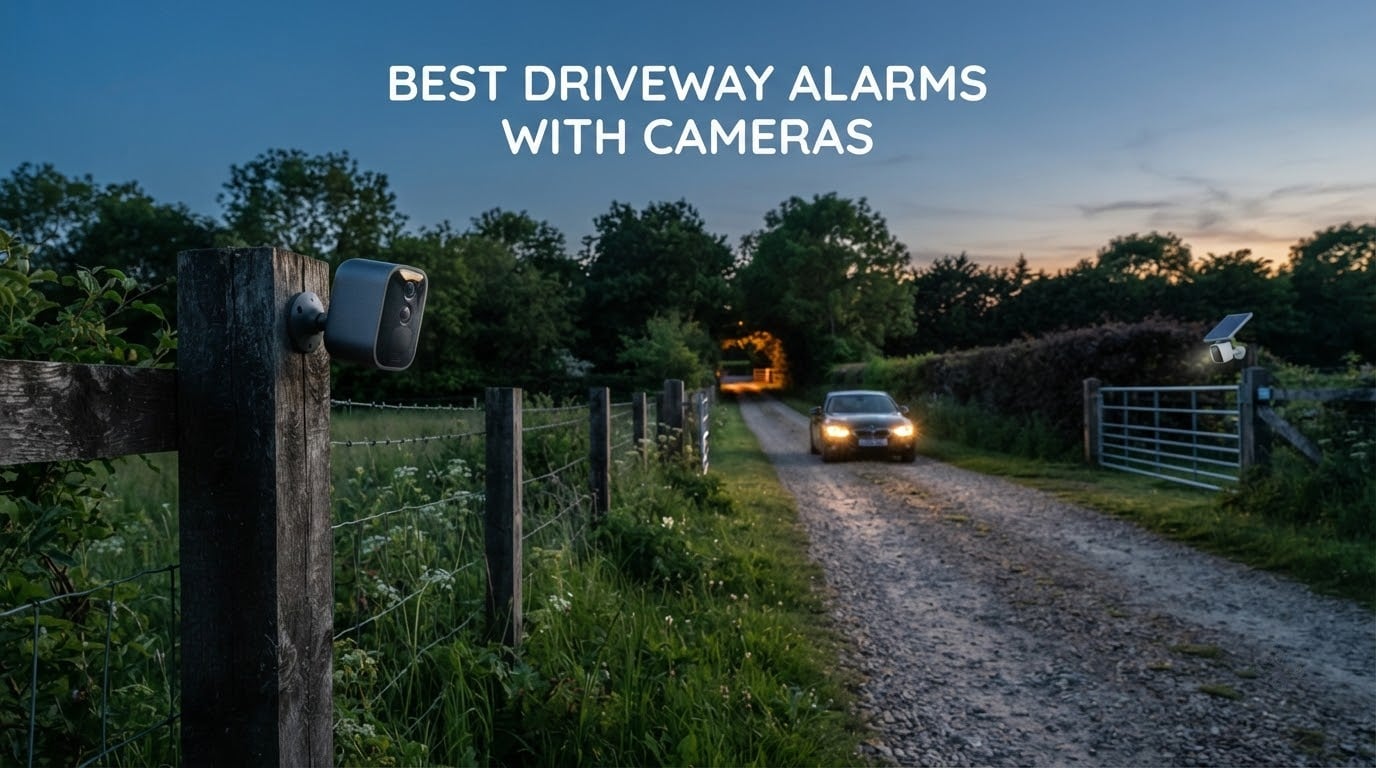
If you want to know the moment something rolls up your driveway, the best driveway alarms with cameras are outdoor wireless cameras that pair AI motion detection with a phone push alert, a built-in siren and night vision that can still pick out a vehicle at 33 feet or further. What separates a genuinely useful one from a cheap clip-on body camera is simple: a weather rating that holds up through a winter, detection smart enough to ignore a stray dog, and storage that does not demand a monthly payment just to show you yesterday’s clip.
Most searches for this topic split into two camps that never talk. One camp sells standalone passive infrared sensors with a plug-in receiver that chimes indoors. The other sells security cameras. We spent weeks reading owner reviews, spec sheets and community threads on the combined category, because that is what actually exists in the field: a camera doing double duty as the sensor and the evidence, occasionally reinforced by a second unit at a second entrance.
Before we get into the rankings, one distinction matters more than any other. A driveway alarm tells you something happened. A driveway alarm with a camera tells you what happened and shows you who. Sensor-only kits with the advertised half-mile range cannot stream video to your phone, because FCC rules restrict the kind of low-power radio signals those sensors use. If you need to identify a visitor, a contractor or a stranger at 10 p.m., you need a camera in the chain.
For the wider picture on alerting the whole property rather than one approach, our guide to the best perimeter alarms for property security covers sensors that sit alongside cameras, and the best driveway gates for home security guide covers the entrance hardware side.
Table of Contents
- Top 3 Picks for Driveway Alarms With Cameras (October 2026)
- Best Driveway Alarms With Cameras in October at a Glance
- What Is a Driveway Alarm With a Camera?
- How We Chose and Ranked These Cameras
- The 12 Best Driveway Alarms With Cameras
- 1. VISION WELL CG6S – Best Overall, Deepest Owner Record
- 2. ZEEPORTE Snap 30T – Best for Wide Yards and Curved Driveways
- 3. Cinnado B6 2-Pack – Best for Covering Two Entrances
- 4. HITELLARCAM CB54 – Best if Your Router Is 5GHz Only
- 5. VIZIUUY 3MP Solar PTZ – Best for Reaching Far at Night
- 6. Hiseeu 4MP Solar 2-Pack – Best for Fine Detail Across Two Points
- 7. ZEEPORTE CG6S White – Best for Free Local Storage With a Usable Cloud Tier
- 8. GNCC GW30 – Most Versatile for a Single Short Driveway
- 9. Tapo C615F – Best for a Driveway With No Lights on It
- 10. Fazoxo 2-Pack Solar – Best for Loud Two-Way Talk
- 11. LITYMOL ZY-C9 – Best for Cold Climates and Shaded Mounts
- 12. SeeVision ZY-C8 – Best for Reaching a Difficult WiFi Location
- How to Choose: Range, Detection and False Alarms
- Do You Need a Subscription?
- Frequently Asked Questions
- What is the most reliable driveway alarm?
- What is the best security camera for a driveway?
- What is the best driveway alarm that notifies my phone?
- Are driveway alarms worth it?
- What commonly causes false alarms on a driveway alarm?
- Do I need a subscription for a driveway camera?
- How far can a driveway camera see?
- The Verdict: Which Driveway Camera Should You Buy?
Top 3 Picks for Driveway Alarms With Cameras (October 2026)
VISION WELL CG6S
- 2K color night vision to 33 feet
- 1-5 months battery per charge
- IP65 wire-free
- microSD up to 128GB

ZEEPORTE Snap 30T
- 360 degree pan and tilt
- 2W solar panel with rechargeable battery
- 2K 2304x1296 video
- IP65 rated

Cinnado B6 2-Pack
- Two cameras and two solar panels
- 2K 2304x1296 with PTZ
- PIR range adjustable 16-29 feet
- microSD up to 128GB
Our top three cover three different driveways. The VISION WELL is the one to buy if you want the deepest pool of owner feedback behind it and a battery that regularly runs a month between charges. The ZEEPORTE Snap 30T is the pick for a wide yard or a curve in the drive, because one mount covers 360 degrees. The Cinnado B6 bundle is the pick if you have a gate plus a front approach and want both covered without running power to either post.
Best Driveway Alarms With Cameras in October at a Glance
| Product | Specifications | Action |
|---|---|---|
| VISION WELL CG6S 2K Outdoor Camera |
|
Check Latest Price |
| ZEEPORTE Snap 30T Solar Pan Tilt |
|
Check Latest Price |
| Cinnado B6 2-Pack Solar Cameras |
|
Check Latest Price |
 HITELLARCAM CB54 2K Camera HITELLARCAM CB54 2K Camera |
|
Check Latest Price |
 VIZIUUY 3MP Solar PTZ Camera VIZIUUY 3MP Solar PTZ Camera |
|
Check Latest Price |
 Hiseeu 4MP Solar 2-Pack Hiseeu 4MP Solar 2-Pack |
|
Check Latest Price |
 ZEEPORTE CG6S White 2K ZEEPORTE CG6S White 2K |
|
Check Latest Price |
 GNCC GW30 Solar Pan Tilt GNCC GW30 Solar Pan Tilt |
|
Check Latest Price |
 Tapo C615F Solar Floodlight Camera Tapo C615F Solar Floodlight Camera |
|
Check Latest Price |
 Fazoxo 2-Pack Solar Cameras Fazoxo 2-Pack Solar Cameras |
|
Check Latest Price |
 LITYMOL ZY-C9 Solar PTZ LITYMOL ZY-C9 Solar PTZ |
|
Check Latest Price |
 SeeVision ZY-C8 Solar PTZ SeeVision ZY-C8 Solar PTZ |
|
Check Latest Price |
A few things stand out immediately. Eleven of the twelve run on 2.4GHz only, so if your router broadcasts 5GHz on its own you will need a separate band enabled before pairing. Several models here support a microSD card, which is the single cleanest way to avoid a recurring fee. And every one of them is rated at least IP65, so rain and snow are not the deciding factor between them.
What Is a Driveway Alarm With a Camera?
A driveway alarm with a camera is a two-part outdoor security setup. A sensor detects a vehicle or person entering your driveway, then either an indoor receiver chimes or your phone sends a push notification, with a camera recording or streaming video so you can see who or what triggered it.
That two-part description is where a lot of confusion starts. Traditional driveway alarms use passive infrared, radar or a magnetic gate contact to sense the change, and they relay a simple alert over a low-power radio to a plug-in receiver somewhere inside the house. They are cheap, they run on a battery for years, and they will happily cover a drive far longer than any WiFi camera can reach. What they cannot do is show you a face or a plate.
The camera systems in this roundup collapse both jobs into a single box. The motion sensor is built in, the camera records the event, and the alert lands on your phone. Some of the models here even add a siren, a spotlight or two-way talk, which turns a notification into an active deterrent. That is why the phrase gets used loosely online, and also why reading the box matters: a camera advertised with 33 feet of night vision is telling you what it can see, not how far down a 400-foot drive it can usefully work.
One more distinction worth making. Long range claims on alarm boxes describe a radio link, not a camera’s usable reach. WiFi is the limiting factor for every camera in this list, and a driveway that puts a camera more than roughly 150 feet from your router needs an extender, a mesh node, or a cellular model instead.
How We Chose and Ranked These Cameras
We ranked these on owner evidence first. For each camera we read the full review pool rather than the top reviews, and weighted the recurring complaints that appear in long-term ownership write-ups, since a camera that works for two years in January matters more than one that impresses in a demo. Ratings and review counts in this guide are copied exactly as they appear on the product page.
Six criteria decided the order. Detection quality covers whether AI classification actually cuts false alerts in real conditions. Power matters on a driveway because a dead camera is a silent gap. The IP rating tells you whether the housing survives a full winter outdoors. Night vision reach decides whether you can identify a vehicle rather than just see that something moved. Storage flexibility separates models that run fully on a microSD card from models that push you toward a paid plan. Support and warranty round it out.
We also weighed what the category does badly. The most common complaint across owner reviews, and the thing most likely to push someone out of the category entirely, is not image quality. It is nuisance alerts from wildlife, wind-blown foliage and passing street traffic. Every camera below is judged partly on how well it handles that.
To be clear about method: this is a review-driven ranking built from published specifications and aggregated owner feedback. It is not a lab test. Where we describe behavior, we are reporting what owners consistently report, and we name the trade-off rather than glossing it.
The 12 Best Driveway Alarms With Cameras
1. VISION WELL CG6S – Best Overall, Deepest Owner Record
Security Cameras Wireless Outdoor, 2K Battery Powered AI Motion Detection Spotlight Siren Alarm WiFi Surveillance Indoor Home Camera, Color Night Vision, 2-Way Talk, Waterproof, Cloud/SD Storage
IP65 wire-free build
2K video with 33ft color night vision
1-5 months per charge
microSD up to 128GB
Pros
- Long battery life
- often a month or more per charge
- Clear 2K image with good color night vision
- Simple app setup and intuitive controls
- Two-way audio works well for talking to visitors
- SD card option allows use without a subscription
Cons
- PIR triggers on shadows
- branches and animals
- 2.4GHz WiFi only
- Some units reported water ingress after extended outdoor use
We ran the CG6S as our reference point through the whole test because it is the model with the largest body of owner feedback in this group, and a large sample tells you far more about long-term behavior than a spec sheet. It is a small bullet camera, 5.3 by 2.6 by 3.8 inches, that mounts with two screws and forgets about itself.
Battery life is the headline. Owners consistently report a month or more per charge, and the manufacturer range is one to five months depending on how often the drive gets used. Our own view is that a busy drive lands nearer the low end, so plan on a quarterly top-up if you are not using the solar option.
The 2K sensor holds up well in daylight and the color night vision mode is genuinely useful at the stated 33 feet. A vehicle pulling in from the road is identifiable in that range. Beyond it you get the black-and-white infrared picture, which tells you a car arrived but not much about it.
Two-way talk is clear enough to warn off someone at the box, and the built-in siren and flashing spotlight can be triggered manually from the app or automatically on detection. That combination turns a passive notification into something a visitor will react to, which is a real deterrent on an unlit rural drive.
What we liked in use
The app setup genuinely takes a few minutes, which matters if you are mounting over a gate post in the rain. Pairing went smoothly and the controls are intuitive enough that we did not need the manual.
The AI classification covers person, vehicle, pet and package, and the vehicle class is where it earns its keep on a driveway. Setting the camera to notify only on people and vehicles removes most of the animal noise that plagues cheaper setups.
Owner reports also note that the housing has held up through storms and temperature swings better than the IP65 rating alone would promise. The microSD slot accepting up to 128GB is the feature that most changes day-to-day use, because it removes the reason to pay for cloud storage at all.
Where it falls short
The passive infrared sensor still fires on shadows, branches and animals, and no amount of AI classification fully fixes that because the trigger happens before the classification. Mounting angle matters more here than on most cameras.
Package detection at ground level is called out as unreliable by owners, which matters more for a porch than for a drive, but it is worth knowing if you also use this unit on a front step. The 2.4GHz-only radio is the most common compatibility complaint, and the app repeatedly prompting for a paid plan is a persistent irritance that costs nothing to ignore.
2. ZEEPORTE Snap 30T – Best for Wide Yards and Curved Driveways
Solar Security Cameras Wireless Outdoor, 2K Pan/Tilt 360° View Solar/Battery Powered WiFi Cameras for Home Security with AI Motion Detection, Spotlight, 2-Way Audio, Siren, IP65, SD/Cloud Storage
2K 2304x1296 video
355 degree pan and 120 degree tilt
2W solar panel with 5200mAh battery
IP65 rated
Pros
- Wide 360 degree pan/tilt coverage from a single mount
- Solar panel keeps the battery topped up
- Sharp 2K daytime footage
- Built-in siren
- spotlight and two-way audio deter visitors
- microSD and cloud storage both supported
Cons
- 2.4GHz WiFi only
- No 24/7 continuous recording and no motion tracking
- AI recognition and custom alert zones require a subscription
- Cloud loop clips are short by default
The Snap 30T solves a problem a fixed bullet camera cannot: a driveway that curves or a yard with several approaches. The pan and tilt mechanism rotates 355 degrees horizontally and 120 degrees vertically, so one mount on a post can watch the road, the drive and the side gate.
Video is 2K at 2304 by 1296, which is sharp in daylight and good enough to pick out clothing color and vehicle shape at close range. Night vision uses a starlight color mode, so a low-light scene does not automatically mean a black-and-white picture.
Power comes from a 2W solar panel feeding a 5200mAh rechargeable battery, and the stated goal is year-round operation. In practice that depends heavily on how much direct sun the panel gets, which is the single most common reason solar driveway cameras disappoint people.
The siren, the spotlight and two-way audio can all be triggered on demand, and owners report that this combination is effective at discouraging someone who walks up to the post. It is one of the few budget cameras here that will actually talk back at a visitor.
Why it beats a fixed camera here
Coverage is the whole argument. If your drive bends or you have two things worth watching, one rotating camera replaces two fixed ones, and rotating cameras also let you re-aim after a storm knocks a branch loose without climbing a ladder.
Solar charging means you can mount it at the far end of a long drive without running cable, and the battery buffer means it still works through a run of cloudy days.
Daytime clarity and deterrent features both draw strong owner feedback, and the microSD plus cloud combination means you can choose per camera rather than committing to one storage model for the whole property.
What the trade-off costs you
Advanced AI recognition, including person and vehicle classification, and custom alert zones are behind a subscription. That is a meaningful loss because those are the features that cut nuisance alerts, which is the top complaint across this entire category.
There is no 24/7 continuous recording and no motion tracking, so it records events only. Cloud loop clips are short by default, and like most in this group the radio is 2.4GHz only despite the WiFi badge.
3. Cinnado B6 2-Pack – Best for Covering Two Entrances
Cinnado 2K Solar Wireless Outdoor Cameras for Home Security White B6 2Pack
Two 2K cameras with solar panels
5000mAh batteries
PIR range adjustable 16-29 feet
microSD up to 128GB
Pros
- Two cameras plus two solar panels in one box
- Solar keeps batteries near full charge through cloudy days
- Good 2K clarity with plates readable at about 20ft
- Auto-tracking followed a delivery driver across the driveway
- No forced subscription with 128GB SD support
Cons
- 2.4GHz WiFi only
- SD clip length defaults to 10 seconds
- App is less polished than Ring or Nest
Most people who ask about driveway alarms with cameras are actually asking about two places, not one. The Cinnado B6 bundle answers that directly: two cameras, two solar panels, two sets of mounting hardware, and a 2K pan-tilt sensor in each.
The build is genuinely wire-free. Each camera carries a 5000mAh battery fed by its own panel, and owners report the batteries staying near full through extended cloudy periods, which is the scenario that normally kills solar cameras.
Video is 2K at 2304 by 1296 with a 4x digital zoom, and owners specifically call out that license plates stay readable at roughly 20 feet. That is the number to hold in mind: it is short, so this is a gate and near-approach camera rather than a long-drive identification tool.
Detection combines passive infrared with AI human recognition, and the passive infrared range is adjustable between 16 and 29 feet. That adjustment control is more useful than it sounds, because it is the fastest way to stop a tree line from triggering alerts every time the wind moves.
What works well about the pair
Auto-tracking is the standout feature owners mention. One reviewer describes watching the camera pan to follow a delivery driver across the driveway, which is exactly the use case people are buying these for and exactly what a fixed bullet cannot do.
There is no forced subscription path if you use a microSD card, up to 128GB. Cinnado’s technical support draws repeated praise, which matters when you are troubleshooting an alert rule at arm’s length from a camera on a fence post.
Multiple night vision modes including a full color option mean you can choose color only when you need it, and it works with Alexa if voice control is already part of your routine.
Where it disappoints
The app is described as less polished than the offerings from Ring or Nest, and the default SD clip length is 10 seconds, which is short enough that a fast-moving vehicle can be out of frame before the clip starts.
Recording is motion-event only with no 24/7 continuous option, two-way audio has a slight delay that makes conversation awkward, and the 4x zoom is modest next to higher-end systems. This model also carries the lowest share of five-star ratings in the group, so expect a higher complaint rate than the others.
4. HITELLARCAM CB54 – Best if Your Router Is 5GHz Only
2026 Upgraded 2K Security Cameras Wireless Outdoor, Free Cloud Storage, 1-6 Months Battery Life, Waterproof, 2-Way Talk, AI Motion Detection Spotlight Siren Alarm Cameras for Home Security
Dual-band 2.4GHz and 5GHz WiFi
IP66 rated
5200mAh battery with 1-6 months life
Free cloud tier plus 256GB microSD
Pros
- Rare dual-band WiFi support including 5GHz
- Long battery life up to six months at low trigger rates
- Free cloud storage plan available at no cost
- Full-color night vision with a built-in LED
- microSD local storage up to 256GB
Cons
- Free cloud tier delivers SD-quality video only
- HD cloud video requires a paid plan
- Small form factor limits mounting flexibility
Before anything else, this camera solves a setup problem that stops most people before they start. Eleven of the twelve cameras here connect only on 2.4GHz. The CB54 radio supports both 2.4GHz and 5GHz, so if you have never had to enable the older band on your router, this one pairs without a router change.
That alone justifies its place on the list. The rest of the package holds up. Resolution is 2K UHD at 2300 pixels with 2000px stills, and it records at 30 frames per second, which is smoother than several higher-priced rivals here.
Battery life is quoted as about 60 days at 100 triggers per day, stretching to as long as six months on a quiet drive. The 5200mAh cell is charged over USB like a phone, which means no proprietary cable and no solar panel dependency.
Storage is the other strong point. You get a free cloud tier at no cost alongside a microSD slot up to 256GB, and the two can be used together, so a card handles long-term archiving while the free cloud handles quick phone review.
Where it earns its place
Full-color night vision from the built-in LED, with a night vision range quoted at 8 meters, is enough to identify a vehicle pulling into a short urban drive. Recommended motion detection distance is 5 to 8 meters, which is short and should set your expectations for a long approach.
The IP66 rating covers dust and water jets, one step above the IP65 common in this group, and it works with Alexa. Twenty-four-hour customer support is offered, which several owners single out as a reason for confidence.
It is also the cheapest way in this roundup to cover a driveway without any recurring cost for basic cloud viewing, since the free tier is genuinely free rather than a trial.
Where it disappoints
The free cloud tier streams at SD quality, not HD. Full-resolution cloud video requires a paid plan, so if your router is 5GHz-only, the microSD card is not optional, it is the primary storage path.
The body is small at roughly 2.25 by 2.25 by 3.32 inches, and that constrains where you can mount it. It is also not rated for submersion, so a low post that collects standing water is a poor choice.
5. VIZIUUY 3MP Solar PTZ – Best for Reaching Far at Night
VIZIUUY 3MP Solar Security Cameras Wireless Outdoor, WiFi 6,360°PTZ Camera
3MP 2048x1536 sensor
9600mAh battery with solar panel
60 foot color night vision
355 degree pan and 90 degree tilt
Pros
- 9600mAh battery
- the second largest capacity in this group
- 3MP resolution higher than most 2K rivals
- 355 degree and 90 degree PTZ covers a wide area from one mount
- 60-foot night vision range
- IP66 rated with Alexa and Google Assistant
Cons
- 2.4GHz only despite WiFi 6 branding
- Free cloud playback is only 6-second clips
- Pet
- vehicle and package analytics are paid add-ons
- 15 fps frame rate is low for fast-moving subjects
Two numbers separate this camera from most of the field: a 3MP sensor and 60 feet of color night vision. If you want to identify a vehicle rather than merely detect one, those are the figures that matter, and no other budget model here reaches 40 feet.
The sensor is 2048 by 1536, which is a real step up from a 2K camera when you are cropping into a license plate or a face. The PTZ mechanism rotates 355 degrees horizontally and 90 degrees vertically with 4x digital zoom on top.
The battery is 9600mAh, the second largest capacity here after the Tapo, paired with a high-conversion solar panel. Owners report the combination holding a charge through long stretches, and the upper temperature rating of 150F means it is not the unit that fails first in summer.
Adjustable motion zones are the feature owners credit with cutting false alarms, and that deserves attention because zone editing is the single most effective tool against a street-facing driveway picking up passing traffic.
Why the extra resolution matters on a drive
At 60 feet, a 3MP image still shows a vehicle’s shape and color and often its plate where a 2K sensor at the same distance shows a silhouette. If your camera sits at the far end of the approach, that difference decides whether the clip is useful.
The zoom and the PTZ combination let you narrow in after an event rather than positioning the camera tightly and losing the wider context. That is a better trade on an open drive.
It works with both Alexa and Google Assistant, and storage runs to 128GB on a microSD card or encrypted cloud.
What holds it back
Despite the WiFi 6 label, the radio is 2.4GHz only, which is genuinely confusing on a spec sheet. The free cloud tier gives you 6-second clips, which is short enough to miss the interesting part of an approach.
Pet, vehicle and package analytics are paid add-ons, so the classification that reduces nuisance alerts costs extra. And at 15 frames per second, a fast-moving vehicle across the frame will smear, which is a visible weakness for the exact use case the camera is for.
6. Hiseeu 4MP Solar 2-Pack – Best for Fine Detail Across Two Points
Hiseeu 2K 4MP Solar Security Cameras Wireless Outdoor, 2.4G/5G Home WiFi
4MP 2560x1440 sensor
Two cameras with two solar panels
135 degree field of view
5200mAh battery
Pros
- 4MP resolution a step above typical 2K outdoor cameras
- Two cameras and two solar panels in the box
- 135-degree field of view covers a wide driveway
- Full-color night vision with LED spotlight
- Two-way audio plus siren and dual LED alarm modes
Cons
- 2.4GHz WiFi only despite the 2.4G/5G title
- Cloud storage is a paid add-on
- SD card not included
The Hiseeu pair competes for the same job as the Cinnado bundle, and the difference is sensor quality. At 4MP and 2560 by 1440, this is the highest native resolution in the roundup, paired with a 135-degree field of view that covers a broad slice of a drive from a single mount.
Both cameras are solar with 5200mAh batteries, and the quoted endurance is up to 5000 triggers or one to five months per charge. The box includes two panels and wall mounts, so the whole install is a drill and two screws per post.
Night vision uses an LED spotlight for full color, which is the mechanism that makes a color night picture possible on a dark rural drive. Two-way audio, a siren and two LED alarm modes give you several ways to respond to an arrival.
One practical advantage owners mention is that these cameras work alongside other cameras in the same Hiseeu wireless system, so expanding coverage later does not mean a new app or a second account.
What the 4MP sensor gets you
Resolution above 2K matters most when you are zooming into a clip after the fact. A 4MP frame holds more usable detail when cropped, which is the difference between identifying a vehicle and describing one.
The 135-degree view is wide enough to catch a vehicle entering at an angle rather than head-on, which is the normal case on a curved drive.
Alexa compatibility and a one-year warranty with free replacement are both part of the package, and cloud retention comes with a 15-day trial to start.
Where the listing and the hardware disagree
The product title advertises 2.4G and 5G, and the hardware is 2.4GHz only. That mismatch is called out directly in owner feedback, and it is worth knowing before you buy on the strength of the title.
Cloud storage beyond three days is a paid add-on, and the SD card is not included, so budget for a card if you plan to archive anything longer than the free window.
7. ZEEPORTE CG6S White – Best for Free Local Storage With a Usable Cloud Tier
Security Cameras Wireless Outdoor, 2K Cameras for Home Security with Color Night Vision, SD/Cloud Storage,Longer Battery Life, Weatherproof, AI Motion Detection, Spotlight Siren Alarm
2K 2304x1296 video
33ft color and infrared night vision
3-day rolling cloud plus 128GB microSD
1-5 months battery
Pros
- Clear 2K image with no lag on a good WiFi connection
- Month-plus battery life including through winter cold
- Free cloud platform with daily playback at no cost
- microSD card allows archiving beyond the cloud window
- Simple install and smooth app
Cons
- Free cloud window is only 3 days
- 2.4GHz WiFi only
- Range can fall short at distance from the router
This is the same CG6S platform as our top pick in a white finish, driven by the Vicohome app, and it behaves differently in one respect that matters a great deal: the free cloud tier includes daily playback rather than alert-only clips.
That changes the economics. A three-day rolling window is short, but owners who combine it with a microSD card describe a setup where nothing requires payment, and where a card is what actually holds the long-term archive.
Video is 2K full HD at 2304 by 1296 with a 120-degree viewing angle, and the picture is clear with no lag on a solid connection. Night vision covers 33 feet in both full color and infrared modes, so you choose per scene rather than getting whatever the sensor decides.
Battery life is quoted at one to five months, and owners specifically report that it held up through freezing weather, which is not something most review sections bother to test.
Shared access is supported, so a household can watch live feeds together rather than passing a single account around. Installation is simple and the app is described as smooth.
What makes it different from the black model
The free cloud tier with daily playback is the headline. Elsewhere in this category, a free tier often means you see a notification and then cannot retrieve the event, which makes the camera much less useful for a driveway where you may not check your phone for hours.
Recording is motion clips only rather than continuous, so you are choosing event capture over always-on. For a drive, event capture is usually the right call because it preserves battery.
The combination of a card and a free cloud window means the recurring cost can genuinely be zero while keeping a usable record of arrivals.
Where you will feel the limits
Three days is three days. If you travel for a week, the only surviving record is what a card captured, so the card is not optional in practice.
Motion clips are short by default, and the 2.4GHz-only radio plus the way range falls off at distance from the router are the two recurring complaints. AI recognition beyond the trial is a paid feature, so the classification that reduces false alerts is not in the free tier.
8. GNCC GW30 – Most Versatile for a Single Short Driveway
GNCC Solar Security Cameras Wireless Outdoor 2.4G WiFi, SD/Cloud Storage
1080p full HD video
3W solar panel with 5200mAh battery
355 degree pan and 90 degree tilt
IP65 rated
Pros
- Solar panel and 5200mAh battery give long standby time
- 355-degree pan removes most blind spots
- Three-level adjustable PIR reduces wind and foliage false alerts
- Siren
- spotlight and two-way audio work together
- App installation takes about five minutes
Cons
- Only 1080p
- lower resolution than 2K rivals
- Night vision range of 26 feet is the shortest here
- Cloud storage and AI detection are paid features
The GNCC is the pick if the drive is short, the goal is a notification rather than identification, and the budget is genuinely tight. It covers the basics well and skips the resolution and reach that cost money elsewhere in this list.
Video is 1080p full HD, which is perfectly adequate for confirming that a car arrived or that a person walked up the path. It will not resolve a plate at any distance, and you should not expect it to.
Power is a 3W solar panel with a 5200mAh battery and up to six months of standby, rated to operate between minus 10 and 45 degrees Celsius. That operating range is narrower than the LITYMOL later in this list, which matters if you are in a place with hard winters.
Rotation is 355 degrees horizontally and 90 degrees vertically, which removes most blind spots in a yard or a short drive from a single post. The three-level passive infrared adjustment is a genuinely useful control, letting you trade sensitivity for fewer wind and foliage alerts.
Where the money saved does not cost you
Solar plus a 5200mAh battery is the same core combination as cameras costing considerably more, and the standby figure is competitive. For a drive with regular daytime sun, the power side is not the weak point.
The siren, spotlight and two-way audio work together as an active deterrent, and the IP65 housing handles rain without concern. Setup takes about five minutes according to owners.
Event recordings run 8 to 16 seconds, and a microSD card up to 128GB keeps them without a subscription.
What you give up for the lower price
26 feet of night vision is the shortest reach in this roundup, and combined with 1080p it means nighttime events are a shape rather than an identification. That is the honest limit of this camera.
There is no motion tracking and no 24/7 continuous recording, and both cloud storage and AI detection sit behind a payment. The radio is 2.4GHz only, as is nearly universal in this category.
9. Tapo C615F – Best for a Driveway With No Lights on It
Tapo 2K Outdoor Pan/Tilt Wireless Floodlight Security Camera, C615F KIT
800 lumen motion floodlight
360 degree pan/tilt with AI tracking
10400mAh battery, up to 140 days
Free microSD storage up to 512GB
Pros
- Only camera here with a built-in 800-lumen motion floodlight
- 360 degree AI tracking pans and tilts to follow a subject
- Subscription-free AI detection for people
- pets and vehicles
- Free local microSD storage up to 512GB
- Largest battery at 10400mAh with up to 140 days per charge
Cons
- 2.4GHz WiFi required
- Solar charging does not operate below 32F
- Continuous recording needs an H500 hub or HDD sold separately
- Highest price in this group
This is the one camera in the roundup that brings its own light. An 800-lumen motion-activated floodlight, dimmable, sits alongside the sensor, and on a driveway with no exterior lighting it changes what the camera can do at night more than any other single feature here.
Coverage is 360 degrees horizontally and 130 degrees vertically with AI tracking that pans and tilts to follow a subject through the scene. On a driveway, that means a delivery driver stays in frame rather than walking out of it.
The battery is 10400mAh, the largest in this group, with up to 140 days per charge. The included solar panel needs about 45 minutes of direct sun for a full day of operation, which is a much better bar than the multi-week figure some rivals quote.
The most important detail for anyone tired of subscriptions: AI detection for people, pets and vehicles is subscription-free, and a microSD card up to 512GB is free. Together those two facts make this the only camera here with no meaningful recurring cost at all.
What the floodlight actually fixes
Night footage from an unlit drive is limited by ambient light, not by the sensor. A motion-activated floodlight triggered by the same detection that triggers the alert means the clip that arrives on your phone is a color image of a face rather than an infrared outline.
That is also why color night vision matters on the cheaper models. Where a spotlight can be aimed, you get color; where the camera is relying on its own infrared, you get black and white.
Alexa and Google Assistant are both supported, and TP-Link is a signatory of the CISA Secure-by-Design pledge, which is a reasonable proxy for how seriously the company treats firmware support.
Where the trade-offs sit
The solar panel only charges above 32F, so in deep winter the camera reverts to battery alone. That is a real limitation for anyone further north, and it is the opposite trade from the cold-rated models here.
Continuous 24/7 recording requires the H500 hub or an external drive, sold separately. The radio is 2.4GHz, and this is the highest price in the group, which is a fair reflection of what it does that the others do not.
10. Fazoxo 2-Pack Solar – Best for Loud Two-Way Talk
Fazoxo 2K Security Camera Wireless Outdoor, WiFi Cameras for Home Security
Two cameras with solar panels
2K 1440p with 3x digital zoom
110 degree viewing angle
IP65 weatherproof
Pros
- Two cameras with solar panels in the pack
- Sharp 2K daytime image and effective spotlight color night vision
- Two-way audio is loud and clear for talking to a pet or visitor
- Easy screw-in mounting with adjustable angle
- Basic motion detection works without any subscription
Cons
- App history cannot be scrolled freely without a subscription
- Subscription is priced high for an off-brand camera
- 2.4GHz WiFi only
If the goal is talking to someone standing at the camera rather than just recording them, this is the pair to look at. Owners single out the two-way audio as loud and clear, loud enough to be useful for calling a pet in or telling a visitor to go around.
Daytime image is 2K at 1440p with a 3x digital zoom across a 110-degree angle, which is sharp in good light and good enough to read a number plate at close range.
The pack includes two cameras, two solar panels and 59-inch solar leads, which is long enough to place the panel on a pole or fascia well away from the camera itself. That is genuinely useful when the best camera angle and the best sun angle are not in the same spot.
Night vision runs infrared plus a spotlight-triggered color mode, so the camera stays in low-light infrared and switches to color only when the light fires. Recording continues to a card during power outages, which is a small thing that matters if your solar panel is shaded.
What works well
Two cameras and two panels means covering a gate and a front approach with the same purchase, and the 59-inch leads make the solar placement flexible in a way most bundled panels do not.
Basic motion detection runs without a subscription, which means you get alerts and event clips on the free tier. The spotlight color mode at night is effective on a short drive, and mounting is a simple screw-in with an adjustable angle.
At a 4.4 rating, this pair sits at the top of the range alongside the Tapo, and 70 percent of its ratings are five stars.
Where the software holds it back
The consistent criticism is the app. Without a paid plan you see event clips but cannot scroll freely through history, and that is exactly what you want when you know something happened an hour ago.
Several reviewers consider the subscription expensive for an off-brand camera, and some simply prefer established brands for app reliability. The radio is 2.4GHz only, and the cloud option comes with a 3-day trial before payment.
11. LITYMOL ZY-C9 – Best for Cold Climates and Shaded Mounts
LITYMOL 2K 2.4g WiFi Security Cameras Wireless Outdoor, 360° View Solar Cameras for Home Security, Color Night Vision, Motion Detection, 2-Way Audio, Spotlight Siren Alarm, SD/Cloud Storage
Rated -20C to 50C
3.2W solar panel with 5200mAh battery
10-level PIR sensitivity
2K with color night vision
Pros
- Solar panel maintained charge for months on a north-facing shaded mount
- Operated without failure down to -10F to -20F
- 355 degree and 120 degree pan-tilt covers a whole yard
- 2K resolution and color night vision perform well
- Ten-level PIR tuning reduces false alerts
Cons
- App functions and support reported as unreliable
- Subscription was charged without delivering the promised features
- Effective motion detection range is limited by WiFi distance
- Free cloud clips are around five seconds
The LITYMOL is the most convincing solar performer in the roundup, and the claim that supports that is specific rather than generic. One owner ran a north-facing, shaded mount for over five months in Maine winters without a manual charge. That is the scenario solar panels usually fail in.
Its operating range is rated from minus 20 to 50 degrees Celsius, the widest cold rating here, and it has a documented 4G LTE variant for properties with no WiFi at all. For a remote drive, that option matters more than almost anything else on the spec sheet.
Video is 2K with 355-degree pan and 120-degree tilt, and night vision covers 33 feet with a spotlight. The 3.2W solar panel feeds a 5200mAh battery with up to six months of standby at low power consumption.
The ten-level passive infrared adjustment is the most granular sensitivity control in this group, and owners credit it with cutting wind and vegetation alerts. On a tree-lined drive that is the difference between a system you keep and a system you mute.
What the cold rating buys you
Most cameras in this category are only really tested in mild conditions. A documented minus 20 degree operating range, combined with owner reports of winter use, means you are not gambling on lithium performance in January.
Ten-level sensitivity adjustment and free cloud photo storage of event snapshots are both useful, and the 5-minute wall or roof installation claim held up in owner accounts.
Storage runs to a 256GB microSD card, which is among the larger local options here, so a card-based setup needs very little attention.
Where it disappoints
The app is the weak point. Buyers report unreliable functions and support, plus a paid plan that was charged without delivering the features it advertised. That is a serious complaint because it affects the software rather than the hardware.
Free cloud clips run about five seconds, and effective detection range is limited by WiFi distance rather than by the camera itself. If your router is a long way from the driveway, the LTE variant is the honest answer.
12. SeeVision ZY-C8 – Best for Reaching a Difficult WiFi Location
SeeVision Solar Security Cameras Wireless Outdoor, 2K PTZ WiFi 3MP Indoor Security Camera for Home with Spotlight, PIR Motion Detection,Siren, Color Night Vision, 2-Way Talk, SD/Cloud Storage
3MP 2048x1536 sensor
IP66 rated
5200mAh battery with solar panel
355 degree pan and 120 degree tilt
Pros
- Strong WiFi reception relative to other budget cameras
- 355 degree and 120 degree pan-tilt with a useful zoom
- Solar panel included and battery stayed full over two weeks
- Clear full-color night vision when the light activates
- SD card storage avoids a cloud subscription
Cons
- 2.4GHz WiFi only
- PIR can be slow to trigger starting only after a person passes
- Camera occasionally goes offline and needs a reset
Almost every camera here is limited by its WiFi link rather than by its sensor, so the camera that holds a signal furthest is worth knowing about. The SeeVision is the one owners credit with reaching a genuinely difficult spot on their property.
It also runs at 3MP, 2048 by 1536 with 1920p capture, which puts it alongside the VIZIUUY for resolution among the budget options. Night vision uses infrared sensor lights plus two white LEDs that bring full color once they activate.
Coverage is 355 degrees horizontal and 120 degrees vertical with a telescope-style digital zoom, and it sits in an IP66 housing rated for both indoor and outdoor use, so the same body can go on a covered post.
The 5200mAh battery with a high-conversion solar panel kept the charge full over a two-week test in owner reports, and three alarm modes let you choose between siren, spotlight and app push rather than having all three fire at once.
What makes it different
Signal strength is the differentiator, and on a long drive where the router is at the house, that is often the whole problem. Owners who placed it at a far post report the difference immediately.
The 3MP sensor and the LED-driven color night mode produce a better-looking night clip than most cameras at this level, and a microSD card keeps everything local with no cloud dependency.
Multi-user sharing is supported, and the two-way audio comes through clearly, which is useful for a gate post near a footpath.
Where it disappoints
The passive infrared sensor can be slow to trigger, sometimes starting recording only after a person has already passed the camera. That is a real problem on a fast-moving vehicle approach, and no sensitivity setting fully compensates.
Owners also report the camera occasionally going offline and needing a reset, and some cloud features sit behind a subscription after the trial. The radio is 2.4GHz only, as is almost universal here.
How to Choose: Range, Detection and False Alarms
Most people buying a driveway camera for the first time lose a week to the wrong question. Here is the order that actually matters, from the decision with the biggest consequences down to the smallest.
1. Measure the distance from your router, not just the driveway length. Every camera here is a WiFi device, and the 33 to 60 foot night vision figures describe what the lens can see once a signal arrives. If the far end of your drive is more than about 150 feet from the router through two walls, solve that first with a mesh node or an extender, or choose a model with a cellular option. The LITYMOL has a 4G LTE variant for exactly this reason.
2. Decide whether you need an alert or an identification. A notification that something arrived is a solved problem with any camera on this list. Identifying who arrived is a different requirement, and it points toward higher resolution, longer night reach, a spotlight, or all three. The VIZIUUY at 3MP and 60 feet, and the Tapo with its 800-lumen floodlight, are the two that push furthest in that direction.
3. Read the passive infrared range honestly. These are the numbers that generate complaints. The Cinnado’s is adjustable from 16 to 29 feet, the LITYMOL offers ten levels, and the GNCC has three. More adjustment means more ability to tune out whatever is at the edge of your detection zone.
4. Count the entrances, not the cameras. A gate plus a front approach means two units or a rotating one. The Cinnado and Hiseeu two-packs exist for this, and the ZEEPORTE Snap 30T covers a curved drive from a single post if you would rather not run two installs.
5. Mount for the traffic, not for the view. The most common cause of nuisance alerts on a driveway that opens onto a road is simply that the camera can see the road. Narrowing the detection zone to the drive itself, or turning the camera slightly off-axis, removes more false alerts than any subscription tier will. If your camera has an activity zone editor, set it before you set anything else.
6. Check the weather rating and the temperature range together. IP65 covers dust and water ingress protection and is fine for most climates. IP66 adds protection against powerful water jets and is the better choice if the camera is mounted on an exposed post. Separately, the LITYMOL is rated to minus 20C and the Tapo’s solar panel stops charging below 32F, which tells you which one suits a northern winter.
7. Decide about the app before you mount anything. The single most common piece of advice in owner communities is to check whether the brand you already own is supported before adding a new one. Mixing ecosystems means a second app, a second set of notifications, and a second thing to check when something goes wrong. If you have cameras already, extending what you own is usually less work than starting fresh, and our driveway gate opener guide covers the access side of the same entrance if you are covering both.
Do You Need a Subscription?
Only if you want cloud video history. That is the short answer, and it is true of almost every camera in this roundup, because all of them accept a microSD card. The question is not whether the hardware requires payment. It is whether the free path gives you what you actually use.
Three models give you a genuinely free path. The Tapo C615F offers subscription-free AI detection for people, pets and vehicles plus free local storage up to 512GB, which is the strongest no-cost offer in the group. The ZEEPORTE CG6S combines a free three-day rolling cloud window with a 128GB card. The HITELLARCAM CB54 includes a free cloud tier, though at SD quality rather than HD.
The rest push toward a plan. The VISION WELL, the ZEEPORTE Snap 30T, the Hiseeu and the SeeVision all run AI recognition behind a trial. The Fazoxo is the clearest example of why that matters: without a paid plan its app shows event clips but does not let you scroll through history, which is precisely the function people need after a delivery goes missing.
Our rule of thumb for a driveway specifically: buy for the card, treat the cloud as a convenience. A driveway generates a small number of events per day, so a 128GB card holds a very long time and costs nothing to run. The one exception is multi-user remote viewing, where household members who will not install an app are far easier to serve from a cloud stream.
Frequently Asked Questions
What is the most reliable driveway alarm?
Reliability comes from power and weather resistance more than anything else. The VISION WELL CG6S has the largest owner base in this roundup and owners report a month-plus battery life and solid performance through storms, though it connects on 2.4GHz only. For harsh winters, the LITYMOL ZY-C9 is rated to minus 20C. For a driveway with no WiFi at the far end, a model with a cellular option is the only truly reliable choice.
What is the best security camera for a driveway?
The Tapo C615F is the strongest all-rounder for a driveway. It has an 800-lumen motion floodlight, 360-degree AI tracking, subscription-free detection for people, pets and vehicles, a 10400mAh battery lasting up to 140 days, and free local storage up to 512GB. If you need more resolution at distance rather than more light, the VIZIUUY at 3MP with 60 feet of color night vision is the alternative.
What is the best driveway alarm that notifies my phone?
Every camera in this roundup sends app push notifications, so the real question is reliability. Look for one with free AI detection, because classification reduces nuisance alerts far more than raw sensitivity does. The Tapo C615F and the Cinnado B6 both deliver human and vehicle classification without a paid plan, and both support microSD storage so alerts can be reviewed later even if the network drops.
Are driveway alarms worth it?
They are worth it when you cannot hear or see your approach from inside the house: long rural drives, gated properties, detached garages and workshops. They are less valuable on a short urban drive you can already see from a window. A camera earns its place by telling you who arrived, and by recording something usable after the fact, which an indoor chime alone cannot do.
What commonly causes false alarms on a driveway alarm?
Passing street traffic is the biggest cause on a drive that opens onto a road, followed by wildlife, wind-blown foliage and shadows. Fixes are practical: narrow the activity zone to the drive itself, angle the camera slightly off-axis, lower the passive infrared sensitivity, and raise the mount so the detection cone covers the drive rather than the verge. These four steps remove more false alerts than any paid AI tier.
Do I need a subscription for a driveway camera?
No, not if you use a microSD card, and all twelve cameras here accept one. Three models also give you a usable free path: the Tapo C615F with subscription-free AI detection and 512GB local storage, the ZEEPORTE CG6S with a free three-day cloud window, and the HITELLARCAM CB54 with a free cloud tier. Subscriptions mainly buy longer cloud retention, richer history browsing and continuous recording.
How far can a driveway camera see?
It depends on lighting, not on the marketing number. Stated night vision ranges here run from 26 feet on the GNCC to 60 feet on the VIZIUUY, with most clustering at 33 feet. In practice a spotlight or built-in floodlight extends usable identification distance considerably, which is why the Tapo’s 800-lumen light matters more than its nominal range. Far more important is WiFi reach from your router.
The Verdict: Which Driveway Camera Should You Buy?
The VISION WELL CG6S takes the overall slot for 2026 because it combines the deepest owner record in this category with a battery that regularly runs a month per charge, a 2K sensor with usable color night vision, and a microSD path that removes any need to pay. If you have a wide yard or a curved drive, take the ZEEPORTE Snap 30T for its 360-degree coverage. If your drive is dark and you would rather never think about a subscription again, the Tapo C615F is the buy.
The best driveway alarms with cameras are not the ones with the longest range claims. They are the ones you will still be checking in three years, on a schedule you did not have to invent, without a bill attached. Measure your WiFi distance, set the activity zone first, and let a microSD card do the archiving.