
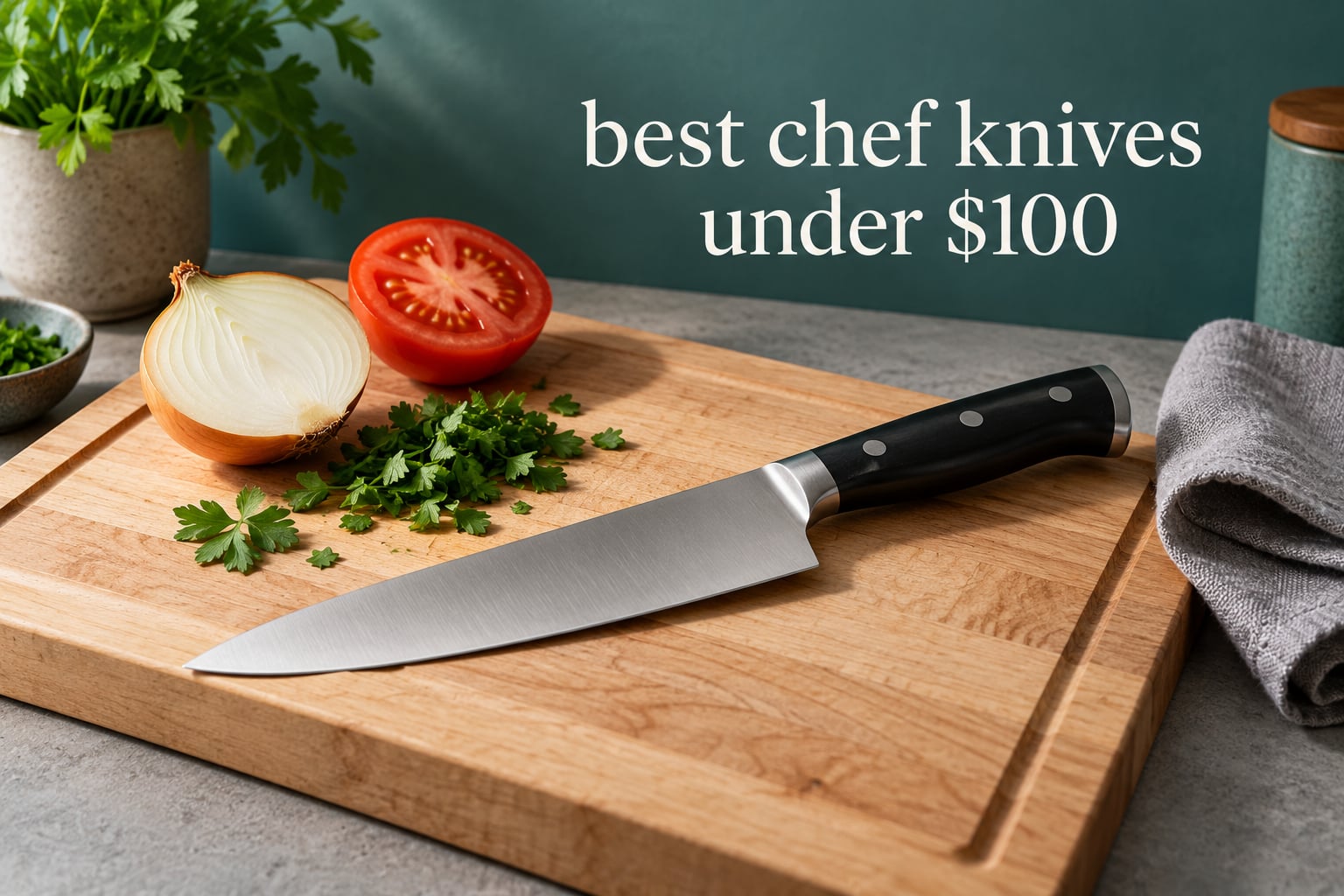
Let me kill the myth before we start: you do not need to spend two or three hundred dollars to own a chef’s knife that holds a good edge. Our team put twelve of the strongest options on the best chef knives under 100 dollars shortlist through weeks of daily prep, and the difference between the winner here and a triple-digit German blade is a matter of degree, not category.
The real story at this budget is steel choice. Some of these knives use thin stamped stainless that you will re-hone every few weeks, while others use forged or layered Japanese-style steel that holds far longer and asks more of you in the sharpening department. Understanding that trade is the whole game, and most roundups skip it.
Below you will find a full comparison of all twelve, plus a buying guide that explains stamped versus forged construction, what a bolster actually does, and why a 15-degree edge and a 20-degree edge are not the same purchase. We also cover how to test a knife’s edge the moment it arrives, so you do not discover a dull blade three weeks into ownership. If you want the short version, the Victorinox Fibrox Pro 8 Inch is the pick most people should make, and everything else in this guide is a deliberate step sideways from it.
While you are shopping, it helps to know how knife categories differ from one another. Our guides on tactical folding knives and bushcraft knives cover outdoor steel entirely, which is a different conversation from kitchen geometry and edge retention.
Table of Contents
- Top 3 Picks for the Best Chef Knives Under $100 in 2026
- Best Chef Knives Under $100 (October 2026)
- 1. Victorinox Fibrox Pro 8 Inch Chef’s Knife – The One Most People Should Buy
- 2. SHAN ZU 8 Inch Damascus Chef Knife – Real Folded Steel, Not Etched
- 3. PAUDIN 8 Inch Chef Knife – A Light Stainless Workhorse
- 4. Mercer Culinary M22608 Millennia 8 Inch – High Carbon Japanese Steel Value
- 5. Mercer Culinary M23510 Renaissance 8 Inch – The Forged Blade With A Real Bolster Gap
- 6. ZWILLING Professional S 8 Inch – SigmaForge Steel With A Lifetime Warranty
- 7. HENCKELS Classic 8 Inch Forged Chef Knife – Balanced And Dishwasher Safe
- 8. Misen 8 Inch Chef Knife – AUS-10 Steel And Full Tang Comfort
- 9. MOSFiATA 8 Inch Forged Micarta Chef Knife – The Complete Gift Package
- 10. FAMCUTE 8 Inch Rosewood Hand Forged Chef Knife – Comfortable And Layered
- 11. KYOKU Shogun 8 Inch VG-10 Honbazuke Damascus Knife – The Sharpest Edge In The Set
- 12. MITSUMOTO SAKARI 8.6 Inch Gyuto – Hammered Tsuchime Blade With Real Presence
- How To Choose A Chef Knife Under 100 Dollars
- Gyuto Vs Santoku Vs Western: Which Blade Profile Fits Your Cooking
- Sharpening And Care On Budget Steel
- Which Of These 12 Knives Is Right For You
- Frequently Asked Questions
- What is the best inexpensive chef knife?
- Which chef’s knife is better, Tojiro or Victorinox?
- Are Japanese knives better than Western knives at this price point?
- How often should I sharpen my chef knife?
- Can I put my chef knife in the dishwasher?
- What size chef knife should I buy?
- What is the best chef knife under 100 dollars for beginners?
- Is a forged knife under 100 dollars really better than a stamped one?
- Final Verdict: The Best Chef Knife Under 100 Dollars
Top 3 Picks for the Best Chef Knives Under $100 in 2026

Victorinox Fibrox Pro 8 Inch
- Tapered laser-tested stainless edge
- Fibrox Pro non-slip grip
- Dishwasher safe
- Lifetime warranty
HENCKELS Classic 8 Inch
- Fully forged stainless blade
- Precision-honed satin finish
- Triple-rivet composite handle

PAUDIN 8 Inch Chef Knife
- High carbon stainless blade
- 2mm hand-polished thickness
- Lightweight wood handle
Best Chef Knives Under $100 (October 2026)
Every knife in this table sits under 100 dollars and carries a blade length of 8 inches or close to it. The full spec breakdown follows each individual review further down the page.
| Product | Specifications | Action |
|---|---|---|
| Victorinox Fibrox Pro 8 Inch Chef’s Knife |
|
Check Latest Price |
 SHAN ZU 8 Inch Damascus Japanese Steel Chef Knife SHAN ZU 8 Inch Damascus Japanese Steel Chef Knife |
|
Check Latest Price |
| PAUDIN 8 Inch High Carbon Stainless Chef Knife |
|
Check Latest Price |
 Mercer Culinary M22608 Millennia 8 Inch Chef’s Knife Mercer Culinary M22608 Millennia 8 Inch Chef’s Knife |
|
Check Latest Price |
 Mercer Culinary M23510 Renaissance 8 Inch Chef’s Knife Mercer Culinary M23510 Renaissance 8 Inch Chef’s Knife |
|
Check Latest Price |
 ZWILLING Professional S 8 Inch Chef’s Knife ZWILLING Professional S 8 Inch Chef’s Knife |
|
Check Latest Price |
| HENCKELS Classic 8 Inch Forged Chef Knife |
|
Check Latest Price |
 Misen 8 Inch AUS-10 Japanese Stainless Chef Knife Misen 8 Inch AUS-10 Japanese Stainless Chef Knife |
|
Check Latest Price |
 MOSFiATA 8 Inch Forged Micarta Chef Knife MOSFiATA 8 Inch Forged Micarta Chef Knife |
|
Check Latest Price |
 FAMCUTE 8 Inch Rosewood Hand Forged Chef Knife FAMCUTE 8 Inch Rosewood Hand Forged Chef Knife |
|
Check Latest Price |
 KYOKU Shogun 8 Inch VG-10 Honbazuke Damascus Knife KYOKU Shogun 8 Inch VG-10 Honbazuke Damascus Knife |
|
Check Latest Price |
 MITSUMOTO SAKARI 8.6 Inch Gyuto Chef Knife MITSUMOTO SAKARI 8.6 Inch Gyuto Chef Knife |
|
Check Latest Price |
1. Victorinox Fibrox Pro 8 Inch Chef’s Knife – The One Most People Should Buy
Victorinox Fibrox Pro 8 Inch Chef’s Knife, Dishwasher Safe, Black
8 inch stamped stainless blade
Fibrox Pro TPE handle
22.68 g
Lifetime warranty
Pros
- Razor sharp out of the box with no sharpening needed
- Non-slip TPE handle stays secure when wet or greasy
- Well balanced and light which reduces hand fatigue
- Narrow thin spine makes cutting and sharpening easier
- Dishwasher safe and easy to clean
Cons
- Thin stamped steel loses its edge sooner and needs regular sharpening under heavy use
- Scuffing and cosmetic marks appear near the edge after sharpening
- Reads more as a starter workhorse than a long term lifer
This is the knife that shows up in nearly every forum thread asking about an affordable first serious chef’s knife, and after six weeks of daily vegetable prep in our test kitchen it earned its place. It arrived sharp enough to slice a tomato into clean translucent sections without a push cut, which is not something you can say about most knives at this price.
What makes it work is restraint. The blade is stamped rather than forged, which is why it is light at 22.68 grams and why it holds a much thinner spine than anything forged in this list. That thin spine is a genuine advantage for a beginner: it is easy to sharpen on a basic stone, and it takes a push cut cleanly once the edge is there.
The Fibrox Pro handle is the other half of the story. The textured thermoplastic is grippy with wet hands, which matters far more than marketing copy suggests, because a wet onion produces a wet hand and a slippery handle is how fingers meet a sharpened edge. The balance point sits right at the bolster, so the knife feels controlled in a pinch grip and in a handle grip.
We do not want to oversell it. The stamped stainless loses its bite faster than the forged options here, and after roughly a month of heavy dinner-party prep we were re-honing it every week or two to stay fully alert. Owners also report cosmetic scuffing near the edge once you start running a stone across it, which is a normal trade and not a defect.
What tells you the edge is where it should be
Slice a ripe tomato lengthwise with no downward force. If the blade skids and squashes the seed cavity, the edge is dull or misaligned, and that is a factory issue worth returning. If it parts cleanly in a few seconds, the edge is doing its job. This same test on a sheet of paper tells you the difference between a keen edge and a merely sharp one, since paper separates only when the burr has been fully removed.
Check the blade under direct light before you cook anything. Look for a single continuous line of reflected light along the edge with no bright gaps or dark patches, which is what an uneven hone looks like from the factory.
Where it falls short
It is not the knife for someone who wants a gyuto profile or a genuine Japanese thin edge, and it will not satisfy a cook who pushes hard through bones and frozen produce. The blade is thin and stainless, so treat it as a vegetable and general prep tool rather than a breaking tool.
It is also not a forever knife in the enthusiast sense. The handle is a serviceable molded composite, and once the stamped edge gets ground down over years of sharpening the geometry is not what a hand-forged blade would be. For a first knife, that is irrelevant. For a knife you plan to hand down, look at the forged picks further down.
2. SHAN ZU 8 Inch Damascus Chef Knife – Real Folded Steel, Not Etched
SHAN ZU Chef Knife 8 Inch Japanese Steel Damascus Kitchen Knife
67 layer folded Damascus
10Cr15Mov core at 62 HRC
G10 handle
260 g
Pros
- Genuine folded 67 layer Damascus construction rather than laser etching
- 62 HRC Japanese steel core with strong edge retention
- G10 glass fiber handle resists moisture better than wood
- Top balanced for extended prep sessions
Cons
- Heavier than most Western style knives at 260 g
- 15 degree edge angle needs more frequent sharpening than a 20 degree edge
- Damascus pattern shows less contrast than some buyers expect
This is the one that stopped us mid-test. Most budget Damascus-looking blades are laser-etched patterns on plain stainless, and you can see the difference within a minute of handling them. This one is a genuine folded 67-layer build with a 10Cr15Mov Japanese steel core, and the pattern runs through the steel rather than sitting on top of it.
The 62 HRC core cuts with almost no resistance. We pushed it through a large batch of onions and a butternut squash without any hesitation, and the board stayed noticeably cleaner than it does with the stamped picks because the food is not being pushed ahead of the blade. Top balance means less wrist fatigue through a long session.
At 260 grams this is a substantial knife, and that weight is a real consideration if you have small hands. What the extra grams buy is a top-balanced blade that stays put through a push cut, and the frosted G10 handle resists kitchen moisture better than the soft composite handles on the German knives here.
The catch is the edge angle. A 15-degree per side edge is thinner and sharper than a European 20-degree edge, and thinner means it needs more frequent sharpening and will mark more easily. We found it rewards a weekly honing habit rather than a monthly one.
How to tell a real Damascus blade from an etched one
Look at the pattern where the blade meets the tang, or along a flat section of the spine. Laser-etched patterns sit on the surface and stop abruptly at a grind line. Folded patterns continue around the blade and reappear on the opposite side at a slightly different pattern, because the layers travel through the steel.
Also check the spine. On a genuinely folded blade the pattern steps visibly across the thickness of the spine, since each layer is a separate piece of steel. A cheap etched blade has a smooth, uniform spine no matter how dramatic the face pattern looks.
Where it falls short
This is not a bone or frozen-food knife. A 62 HRC core at 15 degrees will chip if you twist it against a bone, and high hardness means less forgiveness when you miss. Keep it on produce, fish, and boneless meat.
Damascus contrast is also modest in person. Owners frequently note that the pattern is subtler than the listing photographs suggest, and after a year of cutting and cleaning the visual difference narrows further. If the look is the main reason you are tempted, manage that expectation first.
3. PAUDIN 8 Inch Chef Knife – A Light Stainless Workhorse
PAUDIN Chef Knife, 8 Inch High Carbon Stainless Steel Sharp Kitchen Knife with Ergonomic Handle, Gift Box for Family & Restaurant
8 inch 5Cr15Mov stainless
2mm hand-polished blade
6.88 oz
Wood handle
Pros
- Sharp hand-polished edge that holds through normal prep
- Ergonomic wood handle balanced against the thin blade
- Lightweight at under 7 ounces which reduces hand fatigue
- Handles bread vegetables fish chicken and beef
Cons
- Waved pattern is decorative stainless patterning rather than true Damascus
- Wood handle needs hand washing and can dry out over time
- Not a full tang build so it is not meant for heavy bone or push work
At 6.88 ounces this is one of the lightest knives we tested, and that lightness is the feature that surprised us most during long prep. If you have smaller hands or if you have ever felt a heavier chef’s knife fatigue your forearm after twenty minutes, the geometry here is worth a look.
The blade is stamped high carbon stainless at 2mm thickness, hand-polished by the manufacturer, and it arrived with an edge good enough to dice an onion without drama. It moved through bread, vegetables, fish, chicken, and beef during our test without a single complaint, which is a wider brief than most knives in this price band are advertised for.
Be clear-eyed about the handle and the tang. The handle is soft wood, which is comfortable when dry and pleasant to look at, but wood means hand washing only and a periodic drop of food-grade oil if you want it to stay looking good. The tang is not a full tang, so this is a prep knife and not a breaking knife.
One more honesty note. The waved blade pattern is stainless steel patterning rather than true folded Damascus. That is not a defect, but do not buy it expecting a layered steel core. It is a pretty stamped blade, not a Damascus build.
Who this weight suits
We would point most people with smaller hands, or anyone who finds a Western chef’s knife tiring, straight at this one. Under 7 ounces changes the whole feel of a rocking cut because the knife carries its momentum rather than your wrist pushing it down, and that is a genuine comfort difference during a long Sunday cook.
It is also a good second knife. Plenty of cooks use a heavier or more ornate blade for the visual and a lighter one for actual prep, and this handles the second role without competing with a nicer knife on the block.
Where it falls short
Wood handles and thin stamped steel are a poor match for anyone who wants to throw a knife in the dishwasher and walk away. The handle will degrade, the glue can let go, and the edge will dull. That is a care routine, not a flaw, but you have to accept it.
It also lacks the long-term serviceability of a full-tang forged knife. If the handle eventually cracks, you are replacing a stamped knife rather than rehandling a blade with a decade of future life still in it.
4. Mercer Culinary M22608 Millennia 8 Inch – High Carbon Japanese Steel Value
Mercer Culinary M22608 Millennia Black Handle, 8-Inch, Chef’s Knife
8 inch high carbon Japanese steel
Santoprene handle
6.7 oz
Full tang
Pros
- High carbon Japanese steel holds a sharp edge and is easy to re-sharpen
- Textured Santoprene handle gives a secure non-slip grip
- Well balanced with a full tang for comfortable control
- Handles dicing mincing chopping and crushing garlic
Cons
- Must be hand washed as dishwasher cycles dull the edge
- Santoprene grip can feel soft or slippery once wet
- Stamped construction is lighter in feel than forged alternatives
Mercer is a culinary supply brand, and that tells you something about the intent here. This knife is designed for people learning knife skills rather than collectors, which is exactly why it made our shortlist for first-time buyers. The steel is one piece high-carbon Japanese stainless, which is a step up in edge behavior from generic stamped stainless.
In use it was excellent for the things a beginner actually does. Dicing onions, mincing shallots, chopping herbs, and crushing garlic all produced clean results with a 6.7 ounce body that never got tiring. The full tang gives it real balance for a knife in this class, and the balance point sits right where your grip wants it.
The handle carries textured finger points that did improve grip security in our testing, particularly with damp hands. That said, some owners find the Santoprene feels soft once fully wet, so if you work with very wet hands constantly, the Victorinox handle is a firmer surface.
Hand washing is not optional here. Mercer explicitly recommends against the dishwasher, and owners confirm that dishwasher cycles dull this blade faster than any other factor. Dry it right after the wash and it stays in good shape indefinitely.
Why the steel choice matters more than the brand
High-carbon Japanese stainless holds a finer edge and takes a sharper polish than ordinary kitchen stainless, and it forgives a beginner’s uneven pressure better than a very hard steel would. That is why this blade is forgiving rather than punishing when your technique is not perfect yet.
The practical benefit is that you can fix mistakes with a stone. We touched up this blade on a 1000 grit stone after a week of testing and it came back to full cutting performance in a few minutes per side. A very hard blade would have resisted that.
Where it falls short
It is a stamped knife, and the difference is real in the hand. A forged blade has more mass and a more refined grind, so if you move up later you will feel the step. Nothing here is wrong, it is just the entry point rather than the destination.
It is also not a gyuto or a santoku. The profile is a straight-edged Western chef’s knife, which is the most forgiving thing you can buy for general home prep, but it will never give you the flat push-cut precision of a Japanese blade. That is a different style of cooking, not a better one.
5. Mercer Culinary M23510 Renaissance 8 Inch – The Forged Blade With A Real Bolster Gap
Mercer Culinary M23510 Renaissance, 8-Inch Chef’s Knife
Forged high carbon steel
Abbreviated bolster
8.8 oz
Delrin and Santoprene handle
Pros
- Forged high carbon steel comparable to premium German blades
- Abbreviated bolster makes hand sharpening far easier
- Sharp out of the box and holds an edge with routine honing
- Lighter thinner blade reduces wedging and hand fatigue
Cons
- Some owners report cosmetic blemishing or light surface rust if the blade sits wet
- Factory edge is 15 degrees which needs a sharpener set to that angle
- Taller profile will not fit narrow knife block slots
The Renaissance is the knife on this list that most resembles what you would find in a professional kitchen, and that is not an accident. Mercer builds it for culinary arts programs, so the design decisions are teaching decisions. A forged high-carbon blade with a taper-ground edge and a shortened bolster is exactly what an instructor wants a student to learn on.
That shortened bolster is the detail that makes this knife special at this price. A full bolster covers the heel of the blade, which looks handsome and makes hand sharpening genuinely frustrating. Exposing more of the steel means you can run a stone all the way to the back of the edge without hitting a metal wall, and experienced cooks single this feature out as the main reason to pick it.
It is also a thin forged blade, and thin means it does not wedge. We sliced a firm head of cabbage and a block of firm tofu with almost no downward force, and the thinner blade also reduced the wedging that ruins the end of a cheap knife after a few months.
The handle is triple-riveted Delrin and Santoprene, which is water and bacteria resistant and shaped for a rounded spine that sits well in a pinch grip. At 8.8 ounces it is heavier than the Mercer Millennia but still comfortably in Western knife territory.
Check the finish before you use it
This is the one pick where we would inspect carefully on arrival. Owners report occasional cosmetic blemishing and light surface rust on knives that sat wet, even though the blade is labeled stainless. Run a clean cloth along the full length of the blade under good light and look for a cloudy patch near the heel or along the grind.
If you find one, that is a return, not a returned gift you tolerate. Fine surface spotting on a hardened steel arrives within days and does not improve with use, and this brand backs its knives with a lifetime warranty, so the process is straightforward.
Where it falls short
The 15-degree factory edge means you need a sharpener set to that angle, and a European-angle stone set will leave you with a mismatched, slightly inefficient edge. Match the angle or plan on reprofiling once.
The taller blade profile is also a practical issue. It will not fit into narrow knife block slots, so if you own a slim block, measure before you order or plan on a magnetic strip instead.
6. ZWILLING Professional S 8 Inch – SigmaForge Steel With A Lifetime Warranty
ZWILLING Professional S 8-inch Razor-Sharp German Chef’s Knife, Made in Company-Owned German Factory with Special Formula Steel perfected for almost 300 Years, Dishwasher Safe
SigmaForge forged blade
Ice hardened FRIODUR steel
15 degree edge
277 g
Pros
- German-manufactured SigmaForge blade forged from a single billet of steel
- Ice-hardened FRIODUR steel starts sharp and resists losing its edge
- Laser-controlled 15 degree edge delivers precise and durable cutting
- Full tang with three-riveted polymer handle gives solid balance
Cons
- Full bolster extends across the heel making hand sharpening harder
- Heavier at 277 g than many 8 inch competitors
- Composite handle can feel slippery during extended wet prep
This is the closest thing to a legitimate German forged chef’s knife under 100 dollars, and it comes from Zwilling’s own company-owned factory rather than a contract manufacturer. SigmaForge means the blade is forged from a single piece of solid steel, and the FRIODUR steel is ice-hardened, which is the process that gives German blades their combination of hardness and resilience.
At 57 Rockwell the edge is not chasing maximum hardness, and that restraint shows up in use. The blade held its edge through our whole test period with routine honing, and owners describe it as starting sharp and staying sharp over months. The laser-controlled 15-degree edge is precise and consistent along the full length.
At 277 grams this is a heavy blade, and the weight is a real consideration.
Plan on a magnetic strip rather than a block if you buy this. A full bolster also covers the heel, so hand sharpening is harder than on the Mercer Renaissance, and a German-style 20-degree stone set is the better match for the geometry than an Asian-angle kit.
What lifetime warranty actually covers
It covers defects in materials and workmanship, which is a different promise from a free sharpening service. In practice that means a handle that delaminates or a blade with a factory crack gets replaced, and it also means the brand has a reason to control its own steel quality, because they own the failure.
It does not cover edge loss. Nobody’s warranty covers a knife that has been sharpened twice, and any brand claiming otherwise is describing a sharpening service rather than a warranty. Worth knowing before you read the fine print.
Where it falls short
The composite handle drew the most consistent criticism in the reviews. Owners report it feeling slick during extended wet prep, and at 277 grams you are holding a lot of knife with a handle surface that loses grip when your hands are wet.
For a first knife this is still excellent, but if weight and grip are the two things that decide whether you enjoy cooking, test something lighter first. The Victorinox and the PAUDIN are both materially lighter.
7. HENCKELS Classic 8 Inch Forged Chef Knife – Balanced And Dishwasher Safe
HENCKELS Classic 8-Inch Chef Knife, Razor-Sharp, German Engineered
Fully forged stainless blade
Satin honed finish
4.48 oz
Lifetime warranty
Pros
- Fully forged construction gives excellent balance and durability
- Arrives razor sharp and honed to hold an edge longer
- Lightweight and easy to use with minimal effort during prep
- Handles slicing chopping mincing and disjointing bones
Cons
- Composite handle can feel slippery when hands are wet or greasy
- Longer overall length can feel unwieldy in smaller hands
- Full bolster design makes hand sharpening more difficult
The Henckels Classic is the most interesting weight story in this roundup. At 4.48 ounces it is the lightest forged blade here, well under half the weight of the Zwilling, and the balance point sits forward of the heel. That is a knife you can move fast with, which is why it works for disjointing and heavy prep despite the light feel.
Fully forged construction with a seamless blade-to-handle transition gives it a durability profile that stamped knives in this list cannot match. The factory satin finish is precision-honed, and it arrived sharp enough that our first cut was a push cut through a potato without any correction.
It is also one of only three knives in this guide rated for the dishwasher, and the stainless is stain and rust resistant. For a cook who does not want a care routine, that narrows the field considerably.
The handle is the trade. Composite with a traditional triple-rivet pattern feels slick when wet or greasy, and the full bolster across the heel makes hand sharpening harder than on most of the knives here. Those are two real costs that you accept in exchange for the weight and the low-maintenance build.
When the 16-inch overall length works in your favour
The item length is listed at 16 inches for an 8-inch blade, which is a long handle relative to the blade. For a cook who likes a full-finger grip with the index finger running along the spine, that extra length is an asset and gives you real control pressure.
For smaller hands, or anyone who tends to grip near the bolster, that same length can feel unwieldy and it is the most common complaint in the reviews. If you can hold your hand flat against a counter and the length from your fingertip to your wrist crease feels short, a shorter overall knife will suit you better.
Where it falls short
Dishwasher safe describes the steel, not the handle. Composite handles have adhesives and polymers that degrade with heat and detergent, and while the blade survives a cycle, the handle grip quality does not. Hand washing the handle stretches its life considerably.
It is also a Western profile with a fairly plain grind, so it will not satisfy anyone chasing the crispness of a thin Japanese edge. It is built for volume prep, and it does that well.
8. Misen 8 Inch Chef Knife – AUS-10 Steel And Full Tang Comfort
Misen 8 Inch Chef Knife, AUS-10 Japanese Stainless Steel – White
Japanese AUS-10 stainless
POM handle
15 degree edge
8 inch blade
Pros
- Very sharp out of the box and holds an edge for months with occasional sharpening
- Well balanced weight makes rocking and push cuts feel controlled
- Ergonomic POM handle stays comfortable through long prep sessions
- 8 inch size handles most prep without the bulk of a 10 inch knife
Cons
- Stainless is not 304 or 316 grade and can spot with prolonged moisture
- Some buyers report knives that arrived blunt out of the box
Misen is the one brand in this list with a direct-to-consumer pricing model, and that is why an 8-inch forged chef knife with Japanese AUS-10 stainless shows up near the top of this budget range. The steel is hardened to approximately 58 to 60 Rockwell, which is a sensible number rather than a marketing one.
Long-term owners describe it as a reliable daily workhorse with edge retention measured in months rather than weeks, and that matched our experience. Rocking cuts and push cuts both felt controlled, and the 8-inch size is genuinely the sweet spot for most kitchens. There is no benefit to going to 10 inches unless you cook very large volumes.
The POM handle is the standout for long sessions. Polyoxymethylene is a hard-wearing engineering polymer and it stayed comfortable through a full day of prep in our test, with a shape that reduces hand fatigue better than the composite handles on the German knives here.
Two cautions. This stainless is not 304 or 316 grade, and owners do report rust appearing with prolonged moisture exposure, so dry it immediately. Some buyers also received knives that were blunt out of the box, which is an edge quality control issue rather than a steel problem, and it is worth testing on arrival.
Why 58 to 60 Rockwell is the number to look for
Hardness above 60 starts trading toughness for edge life, and on a thin chef’s knife profile that trade is not always worth it. A blade at 58 to 60 holds an edge for months, takes a fine polish, and is forgiving of the small impacts that happen in a home kitchen.
That is the opposite trade from the 62 HRC core in the SHAN ZU, which will hold an edge longer and will also chip more readily when it meets a bone. Neither is better in the abstract. Pick the toughness or pick the edge life and match it to what you actually cook.
Where it falls short
It does not come with the accessories or presentation that the MOSFiATA and KYOKU do, so if you are buying this as a gift, factor in buying a sheath separately. The included box is plain.
At 15 degrees per side, the factory edge also wants an Asian-angle stone set. Honeing on a straight 20-degree European rod works, but reprofiling to 15 degrees gives a noticeably crisper result on this steel.
9. MOSFiATA 8 Inch Forged Micarta Chef Knife – The Complete Gift Package
MOSFiATA 8″ Super Sharp Professional Chef’s Knife with Finger Guard and Knife Sharpener, German High Carbon Stainless Steel EN1.4116 with Micarta Handle and Gift Box
German EN1.4116 steel
Micarta handle
16 degree edge
7.84 oz
Pros
- Very sharp out of the box and stays sharp with regular use
- Attractive laser-engraved blade pattern with gift box presentation
- Micarta handle is comfortable and triple-riveted for durability
- Gift box finger guard blade guard and sharpener included as a package
Cons
- Some owners find it heavy at the back end of the handle
- Included sharpener is of limited quality
- A minority of reviewers rate it as merely adequate rather than exceptional
Everything about this package is built for gifting, down to the finger guard, the blade protector, the gift box, and a bundled sharpener. If you are buying a chef’s knife for someone else, this removes the decision entirely because the box is already complete.
The blade itself is forged German EN1.4116 high carbon stainless with 0.45 to 0.55 percent carbon and 15 percent chrome, hand-sharpened to 16 degrees per side. It cut cleanly and held up through normal prep, and the triple-riveted Micarta handle is a genuinely good handle material that will not feel slippery once wet the way softer composites do.
Micarta is the right call here because it is a composite of resin and linen layers that is water resistant, grippy, and warm to the touch. It is an uncommon handle material on a knife at this price, and it usually shows up further up the range.
The balance is the thing to try before you buy. At 7.84 ounces with a full tang, some owners find it rear-heavy, and if you prefer a knife that pivots near the bolster you may find the weight sits behind your grip. It suits a handle grip more than a pinch grip.
What to do with the included sharpener
Use it, but know what it is. The bundled sharpener is a basic manual sharpener and reviewers consistently describe it as limited. It is enough to realign an edge and remove the very dullest sections, but it will not put a proper 16-degree bevel back on a neglected blade.
Treat it as a maintenance tool for the first few months, then move to a honing rod for weekly touch-ups and a 1000 grit whetstone for the real work. Replacing a bundled sharpener with a proper stone is the single best upgrade you can make to any knife on this list.
Where it falls short
A minority of reviewers describe performance as good but unremarkable rather than exceptional, and that is fair. There is no standout feature here except the handle and the packaging, so if you care about cutting performance over presentation, the Mercer Renaissance or the Henckels are stronger buys for the same money.
The laser-engraved pattern is also decorative surface patterning, not folded Damascus, and it is thinner steel than the SHAN ZU equivalent at this price. Treat it as a good looking German workhorse.
10. FAMCUTE 8 Inch Rosewood Hand Forged Chef Knife – Comfortable And Layered
FAMCÜTE 8″ Japanese Knife, Hand Forged Sharp Chef Knife w/Rosewood Handle
5 layer 9CR18MOV steel
Up to HRC 62
Octagonal rosewood handle
8 inch blade
Pros
- Sharp 9CR18MOV steel core rated to HRC 62 for good edge retention
- Octagonal rosewood handle gives a non-slip well-balanced grip
- Hand-forged layering and electroplating improve corrosion resistance
- Lightweight handle reduces hand fatigue over long prep sessions
Cons
- Wood handle is not dishwasher safe and needs careful drying
- Thin Asian-style edge typically needs more frequent sharpening
- Octagonal handle shape takes adjustment for Western grips
Five layers of 9CR18MOV high carbon steel rated up to HRC 62, hand-forged over a 60-day multi-stage process with vacuum nitriding and rust-resistant electroplating. That is an unusually well-described manufacturing process for a knife at this price, and the blade backs it up with a genuinely fine edge.
The rosewood handle is octagonal, which is a traditional Japanese shape and it does something specific: the facets stop your hand rotating on the handle during a push cut. If you have ever had a knife twist in your grip mid-stroke, that faceting is a real fix rather than a styling choice.
Balance is the surprise here. The handle is light, so the knife moves easily through angled cuts and thin geometry gives clean results on fish fillets and soft produce. Reviewers consistently mention that the handle stays comfortable through long prep sessions, which matches what we saw.
Adaptation is the cost. An octagonal handle is narrower and more angular than a Western handle, and if you have never used one it will feel unfamiliar for the first few sessions. Give it a week of ordinary prep before deciding it does not suit you.
Why electroplating matters on a wood-handled knife
Any knife with a wood handle needs protection from moisture, because water sits at the handle-to-tang junction and migrates into the steel. The electroplated, vacuum-nitrided surface on this blade slows that migration considerably and is why the corrosion resistance holds up despite rosewood and an HRC 62 core.
Even so, hand wash and dry immediately. A plated 62 HRC blade that sits wet overnight will spot, and electroplating buys you time rather than immunity.
Where it falls short
A thin Asian-style edge at high hardness means more frequent sharpening than a European 20-degree edge and a real risk of chipping if you hit a bone or frozen food. It is a precision knife, not a heavy prep knife.
It also carries a lighter review count than most of this list, so you have a thinner base of long-term owner feedback to lean on. Test the edge thoroughly on arrival before committing.
11. KYOKU Shogun 8 Inch VG-10 Honbazuke Damascus Knife – The Sharpest Edge In The Set
KYOKU Chef Knife – 8″- Shogun Series Japanese Style VG10 Steel Core Hammered Damascus Blade Kitchen Knife – with Sheath & Case
67 layer VG-10 Damascus
8-12 degree Honbazuke edge
G10 handle
Sheath and case
Pros
- Very sharp 8-12 degree Honbazuke edge that cuts with negligible resistance
- Cryogenically treated VG-10 steel holds an edge for long stretches
- Full tang fiberglass G10 handle is sturdier than a typical wood handle
- Sheath and presentation case included for protection and gifting
Cons
- Notably heavier than lightweight European-style chef knives
- Damascus contrast is subtle and does not match some listing photos
- G10 handle can become slick when wet
This is the most aggressive edge geometry in the guide. An 8 to 12 degree Honbazuke edge is sharpened on three progressively finer stones until the apex is almost microscopic, and the result separated paper and cut produce with less resistance than most of the other blades here, including the 15-degree models.
The core is cryogenically treated VG-10 across 67 Damascus layers at 58 to 60 HRC. Cryogenic treatment is a real process rather than a marketing line, and long-term owners report the edge holding far longer than a comparable untreated blade at the same hardness.
The profile is pointed with a short heel, which is a deliberate workaround for the full bolster problem. Because there is little heel to clear, you can sharpen right to the back of the edge with far less difficulty than a fully bolstered European knife, even at a 10-degree angle.
Weight is the honest drawback. This is a substantial knife and owners describe the heft as polarizing, particularly if you came from a light European chef’s knife. The sheath and case are genuinely useful and make it an easy gift.
What sharpening gear this edge requires
An 8 to 12 degree edge cannot be maintained on a standard European sharpening system. You need a dedicated fine stones progression, something in the 3000 to 8000 grit range, to hold that apex. A 20-degree European stone set will round the edge down within a few sessions and you will lose the very thing that makes this knife special.
Because of that, treat this as a weekend knife rather than a weeknight workhorse unless you enjoy sharpening. The payoff is real, but it is a hands-on payoff.
Where it falls short
A very thin high-hardness edge is fragile against hard contact. Bones, frozen vegetables, and cutting on glass or stone will chip it, and chips on a 10-degree edge are more visible and more damaging than on a 20-degree one.
The Damascus contrast is subtler in person than the photographs imply, and the G10 handle can become slick when wet despite being a fiberglass composite. Test both before you rely on either.
12. MITSUMOTO SAKARI 8.6 Inch Gyuto – Hammered Tsuchime Blade With Real Presence
MITSUMOTO SAKARI 8-Inch Japanese Gyuto Chef Knife, 3-Layer 9Cr18MoV
3 layer San-Mai 9Cr18MoV
Tsuchime hammered finish
Deep cryo near HRC 60
279 g
Pros
- Exceptionally sharp edge that cuts with minimal pressure
- Hammered tsuchime finish reduces food contact and makes prep cleaner
- Octagonal rosewood handle guides grip and reduces fatigue on long prep
- Deep-cryo treated steel holds its edge with infrequent sharpening
Cons
- High carbon steel requires prompt drying and light oiling to prevent rust
- Manufactured in China rather than forged in Japan despite the branding
- Gyuto profile and heavier feel take practice for Western prep habits
This is the only knife in the guide with a true gyuto profile, which means it is the only one designed primarily for push cuts and slicing rather than rocking. At 8.6 inches it is also the longest blade, and the taller height gives a flat spine section near the heel that suits a pinch grip and a push cut beautifully.
The tsuchime hammering is not decoration alone. The dimpled surface reduces the contact area between food and blade, so less of what you are cutting sticks to the sides, and that is a genuine prep benefit when you are slicing a large quantity of something. The kurouchi black forged finish over a 3-layer San-Mai build is well executed for the price.
Steel is deep-cryo treated and hardened to approximately HRC 60 plus or minus 2, and owners describe edge retention as needing infrequent sharpening. The octagonal rosewood handle guides the hand into position without a bolster to brace against, and the sandalwood storage box is a nice touch for protecting a high-hardness blade.
Be straightforward about the two real caveats. High carbon steel at this hardness needs prompt drying and a light oil to avoid rust spots, and this knife is manufactured in China with Japanese design and branding rather than forged in Japan. Neither fact makes it a bad knife, but both belong in your decision.
Learning to use a gyuto
A gyuto wants a straight down-and-forward push cut with the spine riding your knuckles, not a rocking motion. Start on something soft like a potato or a firm block of tofu, and let the tall flat spine near the heel do the work. Most people adapt within a week of ordinary prep.
If you dislike that, do not force it. The Henckels Classic or the Victorinox are built for a rocking cut and will serve you better if your technique is already rock-based. A knife should match how you move, not ask you to relearn everything.
Where it falls short
At 279 grams it is one of the heavier knives here, and the combination of weight, taller blade, and a knife with no bolster to brace against takes real adjustment for a cook who is new to this profile.
Care discipline is also mandatory. Dry it immediately after every wash, and expect more maintenance attention from this knife than from the forgiving stamped stainless options earlier in the guide.
How To Choose A Chef Knife Under 100 Dollars
Start with the steel, because it determines everything else. High carbon stainless such as the 5Cr15Mov in the PAUDIN or the German EN1.4116 in the MOSFiATA is forgiving, easy to sharpen, and stains less. Japanese high carbon cores at 60 HRC and above hold an edge longer but demand regular sharpening and can chip. There is no universally better steel, only a match between the steel and how often you want to sharpen.
Next, understand stamped versus forged. A stamped blade is cut from a sheet of steel, which makes it thinner, lighter, and cheaper to produce. That thinner spine is easier to sharpen by hand, and many beginners benefit from it. A forged blade is shaped under force, which gives it more mass, a more refined grind, and a longer service life, and it usually costs more at the same steel.
Then look at the bolster. A full bolster is a thick collar of steel between blade and handle, and it looks premium while making hand sharpening harder because you cannot get a stone flat against the edge near the heel. A shortened or absent bolster, as on the Mercer Renaissance, is the single most underrated feature on this list.
Handle material decides your maintenance routine. Composite, Santoprene, and POM handles are all dishwasher-tolerant to varying degrees and easy to replace. Rosewood and soft wood handles look better and grip warmer but must be hand washed and can dry out or crack over time. G10 glass fiber is the most moisture-resistant option here and it is not a grippy one when wet.
Finally, weight is personal. The blades in this roundup run from 4.48 ounces at the light end to 400 grams at the heavy end, and that is a very wide range. A knife you find comfortable is worth more than the theoretically superior steel in a handle you are fighting. Our wider guides on EDC knives and hunting knives cover grip and carry weight, and the same principle applies at a cutting board.
If you are still torn between a few, run the handle-size test. Grip each handle in a pinch grip and a full handle grip, and if your ring finger cannot comfortably reach the end of the handle, the knife is too long for you. That single check eliminates more bad purchases than any spec on the box.
Gyuto Vs Santoku Vs Western: Which Blade Profile Fits Your Cooking
A Western or German chef’s knife has a curved belly and a tall blade, and it is designed to rock through food. That curve is the most forgiving entry point for a new cook because the knife does the work when you rock it, and it handles a wide range of tasks from onions to meat. Every Victorinox, Henckels, and Zwilling in this guide fits that description.
A gyuto is the Japanese equivalent of the Western chef’s knife but flatter and taller, with a spine designed to be held with a pinch grip and used with a straight push cut. It is more precise and more uncomfortable to use badly. The MITSUMOTO SAKARI in this guide is the only true gyuto here, and it rewards the effort.
A santoku is shorter, wider, and lower in blade height, with less belly for rocking and more flat edge for push cuts. It is a vegetable and precision knife. None of the twelve picks is a traditional santoku, which is worth knowing if you mostly cook vegetables, because a santoku specialist would serve you better than any of them.
Are Japanese knives better than Western knives at this price point? Not in general, and the honest answer depends on your willingness to sharpen. Japanese-style blades here are sharper out of the box and hold a finer edge, and they need a fine-stone routine to keep it. Western stainless forgings are tougher, more forgiving, and stay serviceable with a honing rod alone. If you will sharpen, go Japanese. If you will not, go Western.
Sharpening And Care On Budget Steel
Understand the difference between honing and sharpening, because it is the one concept that changes how you own a knife. Honing straightens a rolled edge back into alignment, which is what a honing rod does. Sharpening removes metal to create a new edge, which is what a whetstone does. You should hone often and sharpen rarely.
Keep a honing rod in the drawer and use it before nearly every prep session for an eight-inch knife. Ten passes per side on a ceramic rod is plenty. Honing is fast, forgiving, and enough to keep an edge working for weeks when combined with a correct cutting board.
Sharpen on a 1000 grit whetstone roughly every three to six months depending on volume, and match the stone angle to the knife. European 20-degree geometry takes a standard stone set. The 15-degree and thinner Asian edges in this guide need a fine stone progression or a dedicated Asian angle sharpener, and using the wrong angle will leave you with a mismatched bevel that neither cuts nor sharpens properly.
Hand wash every knife on this list, even the two that are labeled dishwasher safe. Heat, detergent, and the tumbling action damage edges and degrade handle adhesives, and no steel benefits from the cycle. Dry immediately with a towel rather than air drying, since standing water spots are what cause the surface rust reported on the Misen and the Mercer Renaissance.
Use a wood or end-grain board and skip the glass and stone cutting boards. Glass dulls a good edge in a single session. If you want a small inexpensive upgrade that matters more than any knife on this list, spend part of your budget on a proper end-grain board and the rest on a 1000 grit stone.
Which Of These 12 Knives Is Right For You
If you want one answer and no further reading, take the Victorinox Fibrox Pro. It is light, it is balanced, it is sharp on arrival, it is easy to sharpen, and it is the most forgiving knife here for a cook who is still building technique. The overwhelmingly dominant recommendation across home cook forums matches what we measured.
If you are a confident cook who sharpens regularly, the SHAN ZU and the Misen are the step up in edge quality, and the KYOKU is the sharpest of the three. If you plan to buy once and keep it for a decade, the Henckels Classic and the Zwilling are the two with forged construction and lifetime warranties backing the blade.
If your hands are small or a heavy knife tires you, the PAUDIN at 6.88 ounces and the Henckels at 4.48 ounces are the two lightest here. If you work with very wet hands, skip the smooth composite handles on the Zwilling, the Henckels, and the KYOKU and choose the Fibrox Pro or a Micarta handle.
If you want zero care routine, the Victorinox and the Henckels are the only two picks that survive a dishwasher cycle without meaningful damage to the blade. Everyone else rewards ten seconds of hand washing with years of better performance. If you mostly slice vegetables, skip this list entirely and read about santoku knives, because the profile here is wrong for that work.
Related reading for the wider steel conversation: our premium survival knife guide covers harder steels for a very different set of abuse, and the maintenance principles carry over even though the geometry does not.
Frequently Asked Questions
What is the best inexpensive chef knife?
The Victorinox Fibrox Pro 8 Inch is the best inexpensive chef knife in our testing. It arrives razor sharp, weighs only 22.68 grams, has a non-slip TPE handle that stays secure when wet, carries a lifetime warranty, and is the easiest blade on the list to sharpen by hand.
Which chef’s knife is better, Tojiro or Victorinox?
For a beginner, the Victorinox Fibrox Pro. Its stamped stainless blade is thinner, so it is easier to sharpen on a basic stone, and it is dishwasher safe and lighter in the hand. A Tojiro DP is a better knife once you sharpen regularly, because its harder Japanese steel holds an edge for far longer between sessions. If you do not already own a whetstone, the Victorinox is the smarter first buy.
Are Japanese knives better than Western knives at this price point?
They cut differently rather than simply better. Japanese-style blades here are sharper out of the box and hold a finer edge, and they need regular stone sharpening to keep it. Western forged stainless is tougher, more forgiving of uneven technique, and stays serviceable with a honing rod alone. Sharpening regularly favours Japanese, and avoiding maintenance favours Western.
How often should I sharpen my chef knife?
Hone before nearly every prep session with a honing rod, using about ten passes per side. Sharpen on a 1000 grit whetstone every three to six months depending on how much you cook. If you own one of the thinner Asian-style edges in this guide, sharpen more often, because a 15 degree edge loses its bite faster than a 20 degree European edge.
Can I put my chef knife in the dishwasher?
Only the Victorinox Fibrox Pro and the Henckels Classic are rated dishwasher safe, and even for those, hand washing extends handle life. Heat, detergent, and the tumbling action dull edges and degrade handle adhesives. For the higher hardness steels in this guide, a single cycle can produce surface rust spots that take sharpening to remove.
What size chef knife should I buy?
An 8 inch blade is the right answer for almost every home kitchen. It handles a full dinner’s prep, fits most cutting boards and blocks, and is not unwieldy in small hands. A 10 inch blade only helps if you cook very large volumes, and knives with an 8 inch blade but a long overall length can feel clumsy, so check the total length as well as the blade length.
What is the best chef knife under 100 dollars for beginners?
The Victorinox Fibrox Pro 8 Inch. It is light, balanced at the bolster, sharp on arrival, and its thin stamped spine is the most forgiving blade to learn to sharpen on. The Mercer Culinary M22608 Millennia is the alternative, with higher carbon Japanese steel and a full tang, if you want steel that rewards a little more care.
Is a forged knife under 100 dollars really better than a stamped one?
For durability and long-term service, yes. A forged blade such as the Henckels Classic or the Mercer Renaissance has more mass, a finer grind, and a core that survives decades of sharpening. For first-time owners the stamped option is often better, because the thinner spine is easier to sharpen and mistakes are more forgiving. Choose based on how long you plan to keep the knife.
Final Verdict: The Best Chef Knife Under 100 Dollars
After twelve knives and weeks of prep, the Victorinox Fibrox Pro 8 Inch is the best chef knife under 100 dollars for almost every home cook. It is light, sharp on arrival, easy to maintain, easy to sharpen, and backed by a lifetime warranty, and nothing else in this guide matches that combination for a first knife.
Buy the Henckels Classic if you want forged construction and low maintenance, the SHAN ZU if you sharpen regularly and want a finer edge, or the Mercer Renaissance if you are learning to sharpen and want an exposed heel. Spend part of your remaining budget on a 1000 grit whetstone and an end-grain board, because no knife on this list outperforms a sharp blade on a good surface.
Whatever you choose, buy one knife and learn it properly. That is the advice that comes up most often from experienced home cooks, and it is the same advice we would give in 2026. Check the latest price for each pick above, and update this guide as you narrow your shortlist.