
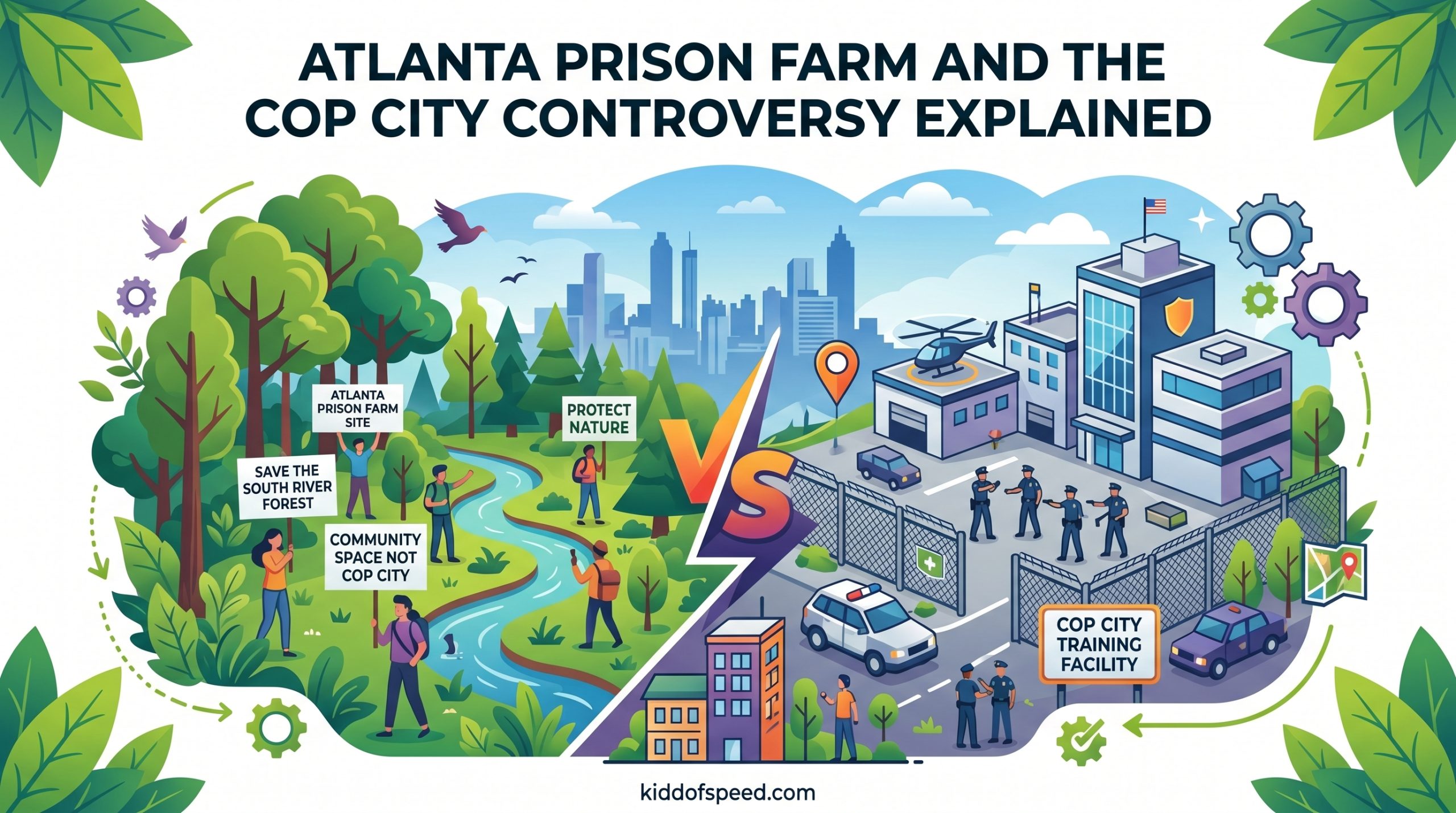
What happens when a city’s plan for public safety collides with its history, environmental concerns, and questions about police militarization? In Atlanta, this collision has sparked one of the most contentious debates in recent memory. The Atlanta Prison Farm and Cop City controversy has drawn national attention, with protesters facing domestic terrorism charges and a tragic death that shocked communities across the country.
I spent weeks digging into court documents, news reports, and firsthand accounts to understand how we got here. This is not a simple story about a training facility. It is a story about land with a painful past, competing visions for public safety, and a community wrestling with its future.
In this guide, you will learn what Cop City actually is, why the Atlanta Prison Farm location matters so much, what both sides are arguing, and where things stand today. Whether you are a local resident, an activist, or simply someone trying to understand what all the headlines mean, this explainer breaks down the Atlanta Prison Farm Cop City controversy into clear, factual terms.
Table of Contents
- What is Cop City?
- History of the Land: From Plantation to Prison Farm
- Why Supporters Want Cop City
- Why Opponents Oppose Cop City
- The Death of Manuel Terán (Tortuguita)
- Domestic Terrorism Charges and Legal Battles
- Current Status and What’s Next
- Frequently Asked Questions
- What is Cop City and why is it controversial?
- Where is the old Atlanta Prison Farm located?
- Why are people protesting Cop City in Atlanta?
- What happened to Manuel Esteban Paez Terán (Tortuguita)?
- How much does Cop City cost and who is paying for it?
- What is the history of the Atlanta Prison Farm land?
- What are the environmental concerns about Cop City?
- Who supports Cop City and why?
- Atlanta Prison Farm Cop City: Understanding the Full Picture
What is Cop City?
Cop City is the unofficial name for the Atlanta Public Safety Training Center, an 85-acre facility planned for construction in DeKalb County’s South River Forest. The project, officially announced in 2021, represents a $90 million investment intended to serve as a state-of-the-art training ground for Atlanta police officers and firefighters.
The Atlanta Police Foundation, a nonprofit organization that supports the Atlanta Police Department, is spearheading the project. They have committed to raising $60 million through private donations, with the remaining $30 million coming from taxpayer funds approved by the Atlanta City Council.
The planned facility includes several specialized training areas. These include multiple shooting ranges, burn buildings for firefighter training, a mock city complete with buildings and streets for scenario-based exercises, emergency vehicle operator courses, and K-9 training facilities. Supporters argue these features will modernize training that currently happens in outdated facilities scattered across the metro area.
However, the scale and scope of the project have alarmed critics. The mock city component, which opponents call “urban warfare training,” has become a particular flashpoint. Environmentalists and police accountability advocates question whether Atlanta needs what they describe as a militarized training compound on forested land with deep historical significance.
History of the Land: From Plantation to Prison Farm
The land where Cop City is proposed carries layers of history that many people do not know about. Understanding this history is essential to understanding why the location itself has become so controversial. The site sits within what is known as the South River Forest, the largest remaining contiguous forest in Atlanta.
Before European colonization, this land was part of the territory of the Muscogee Creek people. Like much of Georgia, it was taken from Indigenous inhabitants through forced removal in the 19th century. The Muscogee Creek Nation has since voiced opposition to the project, citing the desecration of ancestral lands.
Following colonization, the area became part of a plantation economy. The land was worked by enslaved people whose labor generated wealth for plantation owners. This history of forced labor and exploitation would continue in a new form for much of the 20th century.
In 1920, the city of Atlanta established the Atlanta Prison Farm on this land. The facility operated until 1990, using incarcerated labor to produce food and other agricultural products. Prisoners worked the fields under conditions that modern standards would recognize as exploitative. The farm was sometimes called the honor farm, and it produced dairy, vegetables, and other goods using inmate labor.
After the prison farm closed, nature began reclaiming the land. Over three decades, the area became an unofficial forest preserve and an important environmental resource. The South River Forest serves as Atlanta’s lungs, providing critical green space in a rapidly developing metropolitan area. It houses wetlands, wildlife habitat, and the headwaters of the South River, which flows into the Flint River and ultimately contributes to the Gulf of Mexico watershed.
For many opponents, building a police training facility on land with this history represents a continuation of state violence against Black and brown communities. They argue that the same land that once held enslaved people and prisoners would now house facilities for training police in tactics that disproportionately target those same communities.
Why Supporters Want Cop City
Supporters of the Atlanta Public Safety Training Center make their case primarily around public safety and officer preparedness. They argue that Atlanta’s current training facilities are outdated, inadequate, and scattered across multiple locations, making efficient training difficult.
The Atlanta Police Foundation and city officials emphasize several key benefits. They point to officer recruitment and retention challenges, suggesting that modern facilities will help attract qualified candidates to a department that has struggled with staffing. They note that current training spaces lack the integrated environments that would allow for realistic scenario-based training.
Fire department officials have joined in supporting the project, highlighting the need for proper burn buildings and emergency response training facilities. They argue that the joint police-fire training center will improve coordination between departments during actual emergencies.
Mayor Andre Dickens and other supporters have framed the facility as part of a broader public safety strategy. They argue that better-trained officers will serve communities more effectively, particularly in areas like de-escalation and crisis intervention. Some supporters have specifically mentioned that improved training could reduce incidents of excessive force.
The Atlanta City Council approved the funding in 2021 after hearing these arguments. They cited the private funding commitment as evidence that business and community leaders supported the project. Proponents also note that many other major cities have similar training facilities, suggesting Atlanta is simply catching up to national standards.
However, critics question whether these arguments hold up under scrutiny. They point out that the facility’s features seem more suited to military-style training than community policing. The mock city, shooting ranges, and tactical training areas suggest preparation for confrontation rather than community relationship-building.
Why Opponents Oppose Cop City
Opposition to Cop City has coalesced around several interconnected concerns. The Stop Cop City and Defend the Atlanta Forest movements have brought together environmentalists, police accountability activists, prison abolitionists, and local residents who see the project as harmful to their communities.
The first major concern is police militarization. Opponents argue that the facility is designed to train police in military-style tactics rather than community-oriented policing. The mock city, which allows for urban warfare scenarios, suggests preparation for controlling populations rather than serving them. Critics note that militarized policing has been linked to increased violence, particularly in communities of color.
Environmental destruction ranks equally high among concerns. The South River Forest represents one of Atlanta’s last significant green spaces. Clearing 85 acres will destroy wildlife habitat, damage wetlands, and increase flooding risks in surrounding neighborhoods. Environmental groups have filed lawsuits citing violations of the Clean Water Act and other environmental protections.
The funding model has also drawn criticism. While supporters emphasize the private donations, critics note that $30 million in taxpayer money is still substantial, especially when Atlanta faces other pressing needs. Questions have been raised about transparency in the fundraising process and the influence of corporate donors on policing policy.
Location matters deeply to opponents. Building on land with a history of slavery and forced prison labor sends a message that many find unacceptable. The Atlanta Prison Farm history is not incidental, they argue, but symbolic of how the criminal legal system continues to harm the same communities generation after generation.
Racial justice concerns permeate the opposition. Atlanta has a documented history of racial disparities in policing, including higher arrest rates and use of force against Black residents. Critics question whether investing in police training, rather than alternative public safety approaches, will address these disparities or worsen them.
The opposition is not monolithic. It includes local residents worried about property values and noise, environmentalists concerned about the forest, activists focused on police accountability, and historians who understand the site’s significance. What unites them is a belief that Cop City represents a step in the wrong direction for Atlanta.
The Death of Manuel Terán (Tortuguita)
On January 18, 2023, the controversy turned deadly. Georgia State Patrol officers shot and killed Manuel Esteban Paez Terán, a 26-year-old protester known to friends as Tortuguita. The incident occurred during a clearing operation as law enforcement attempted to remove protesters from the forest construction site.
According to the Georgia Bureau of Investigation, officers encountered Terán in a tent and ordered them to leave. When Terán refused, officers used pepper spray. The GBI claims Terán then shot a state trooper, prompting officers to return fire. However, the circumstances remain disputed.
An independent autopsy commissioned by Terán’s family found that they had been shot at least 57 times. The autopsy also suggested Terán may have been sitting cross-legged with their hands raised when shot, contradicting official accounts. The Georgia Bureau of Investigation has not released complete investigative findings, leaving significant questions unanswered.
No body camera footage exists of the shooting. Georgia State Patrol officers were not wearing body cameras during the operation. This lack of documentation has fueled skepticism about the official narrative and demands for independent investigation.
Terán’s death transformed the Stop Cop City movement. What had been primarily a local environmental and police accountability struggle gained national and international attention. Vigils and protests spread across the country. Terán became a martyr figure for activists who saw their death as evidence of the violence inherent in the project they opposed.
The case remains under investigation by the Georgia Bureau of Investigation, though critics have questioned whether an agency aligned with state law enforcement can impartially investigate the killing of a protester by state troopers. Calls for an independent investigation continue.
Domestic Terrorism Charges and Legal Battles
Following Terán’s death, Georgia authorities pursued aggressive legal strategies against protesters. Dozens of activists have been arrested and charged under Georgia’s domestic terrorism statute, a law expanded in 2017 to include certain property crimes. These charges carry potential sentences of up to 35 years in prison.
The use of domestic terrorism charges against protesters has drawn criticism from civil liberties groups. They argue that applying terrorism statutes to non-violent civil disobedience chills protected speech and assembly rights. The charges have been used against people engaged in activities ranging from trespassing to property destruction.
In September 2023, Georgia Attorney General Chris Carr announced RICO charges against 61 activists under the state’s racketeering laws. The indictment alleges a criminal conspiracy to block construction of the training facility. RICO laws, originally designed to prosecute organized crime, carry severe penalties and allow prosecutors to group defendants together.
Legal challenges to the project itself continue. Environmental groups have sued under the Clean Water Act, arguing that construction would damage protected wetlands without proper permits. Other lawsuits challenge the validity of the lease agreement between the city and the Atlanta Police Foundation.
Opponents have also pursued democratic channels. The Stop Cop City coalition gathered signatures for a referendum that would allow Atlanta voters to decide whether to repeal the city’s funding commitment. Legal battles over signature validity and ballot access continue, with supporters hoping to put the question before voters.
The aggressive legal response has, in some ways, strengthened opposition. Protesters and their supporters see the domestic terrorism and RICO charges as overreach intended to intimidate dissent. The cases have drawn attention from national civil liberties organizations and raised questions about whether Georgia’s legal system can fairly handle politically charged prosecutions.
Current Status and What’s Next
As of 2026, construction on the Atlanta Public Safety Training Center is moving forward despite ongoing opposition. Clearing of the forest has begun, though protesters have used various tactics to slow progress. The conflict has settled into a pattern of construction activity, protest actions, arrests, and legal proceedings.
The referendum campaign represents a potential turning point. If organizers succeed in getting the measure on the ballot and voters reject the funding, it could effectively halt the project. However, legal challenges to the petition process and potential political maneuvering could prevent a public vote.
Meanwhile, the criminal cases against protesters continue working through the courts. The domestic terrorism and RICO charges will likely take years to resolve, creating ongoing uncertainty for those accused. The outcome of these cases could set precedents for how Georgia handles protest movements going forward.
Environmental lawsuits also remain pending. If successful, they could force the project to meet stricter environmental standards or potentially halt construction entirely. However, courts have historically been reluctant to stop development projects once they have begun.
The controversy has already affected Atlanta politics. City council members who supported the project face continued pressure from constituents who oppose it. The issue has become a fault line in local elections, with candidates taking clear positions for or against Cop City.
Nationally, the Stop Cop City movement has inspired similar opposition to police training facilities in other cities. Activists have shared tactics and built networks that extend far beyond Atlanta. Whether Cop City is ultimately built or stopped, its impact on the national conversation about policing will likely continue.
Frequently Asked Questions
What is Cop City and why is it controversial?
Cop City is the unofficial name for the Atlanta Public Safety Training Center, an 85-acre police and fire training facility planned for construction in Atlanta’s South River Forest. It is controversial due to concerns about police militarization, environmental destruction of one of Atlanta’s last major forests, its location on historically significant land (former plantation and prison farm), and the violent response to protests including the killing of activist Manuel Terán.
Where is the old Atlanta Prison Farm located?
The old Atlanta Prison Farm was located in DeKalb County within what is now known as the South River Forest. The prison farm operated from approximately 1920 to 1990 on land that had previously been a plantation worked by enslaved people. This same area is now the proposed site for the Atlanta Public Safety Training Center (Cop City).
Why are people protesting Cop City in Atlanta?
People protest Cop City for multiple reasons: concerns about police militarization and urban warfare training; environmental protection of the South River Forest; the historical significance of the land as a former plantation and prison farm; opposition to spending public funds on police infrastructure; and solidarity with the Stop Cop City and Defend the Atlanta Forest movements. The killing of protester Manuel Terán in January 2023 intensified opposition.
What happened to Manuel Esteban Paez Terán (Tortuguita)?
Manuel Esteban Paez Terán, known as Tortuguita, was a 26-year-old protester shot and killed by Georgia State Patrol officers on January 18, 2023, during a clearing operation at the Cop City construction site. According to the Georgia Bureau of Investigation, Terán allegedly shot a state trooper before being killed. However, an independent autopsy commissioned by Terán’s family found they were shot at least 57 times, possibly while sitting with hands raised. The case remains under investigation.
How much does Cop City cost and who is paying for it?
The Atlanta Public Safety Training Center has an estimated cost of $90 million. The Atlanta Police Foundation committed to raising $60 million through private donations from corporate and individual donors. The remaining $30 million comes from taxpayer funds approved by the Atlanta City Council in 2021. This funding model has been criticized for using public money for a project many residents oppose.
What is the history of the Atlanta Prison Farm land?
The land has a layered history. It was originally Muscogee Creek territory before forced removal. It then became a plantation worked by enslaved people. In 1920, Atlanta established the Prison Farm on this land, using incarcerated labor for agricultural production until the facility closed in 1990. After closure, the land reverted to forest. The site is now proposed for the Cop City training facility, which opponents say continues patterns of state violence against marginalized communities.
What are the environmental concerns about Cop City?
Environmental concerns include destruction of 85 acres of the South River Forest, Atlanta’s largest remaining contiguous forest; damage to wetlands and waterways protected under the Clean Water Act; loss of wildlife habitat; increased flooding risk for surrounding neighborhoods; and destruction of trees that help mitigate Atlanta’s heat island effect. Environmental groups have filed lawsuits challenging permits and environmental review processes.
Who supports Cop City and why?
Supporters include the Atlanta Police Foundation, Mayor Andre Dickens, the Atlanta City Council (which approved funding), and some business leaders. They argue the facility will improve police and firefighter training, help with officer recruitment and retention, replace outdated training facilities, and enhance public safety. Fire department officials particularly emphasize the need for modern burn buildings and emergency training facilities. Supporters note that other major cities have similar training centers.
Atlanta Prison Farm Cop City: Understanding the Full Picture
The Atlanta Prison Farm Cop City controversy touches on fundamental questions about how communities balance public safety with other values. It raises issues of historical accountability, environmental stewardship, democratic decision-making, and the role of policing in society.
What makes this case particularly complex is that both sides can make legitimate claims. Supporters genuinely believe that better training facilities will improve public safety. Opponents genuinely believe that the project represents harmful policies and priorities. The tragedy of Manuel Terán’s death has made compromise increasingly difficult.
For those following the story, staying informed means looking beyond headlines to understand the historical context, legal complexities, and competing visions for Atlanta’s future. The outcome will affect not just the South River Forest but potentially set precedents for how cities across the country approach police infrastructure and respond to protest movements.
Whether Cop City is completed or stopped, the questions it raises will continue to matter. How do communities heal from historical injustices? How do cities balance safety with civil liberties? How should public resources be allocated when needs exceed funding? The Atlanta Prison Farm Cop City controversy is ultimately about who gets to decide these questions and whose voices get heard in the process.