
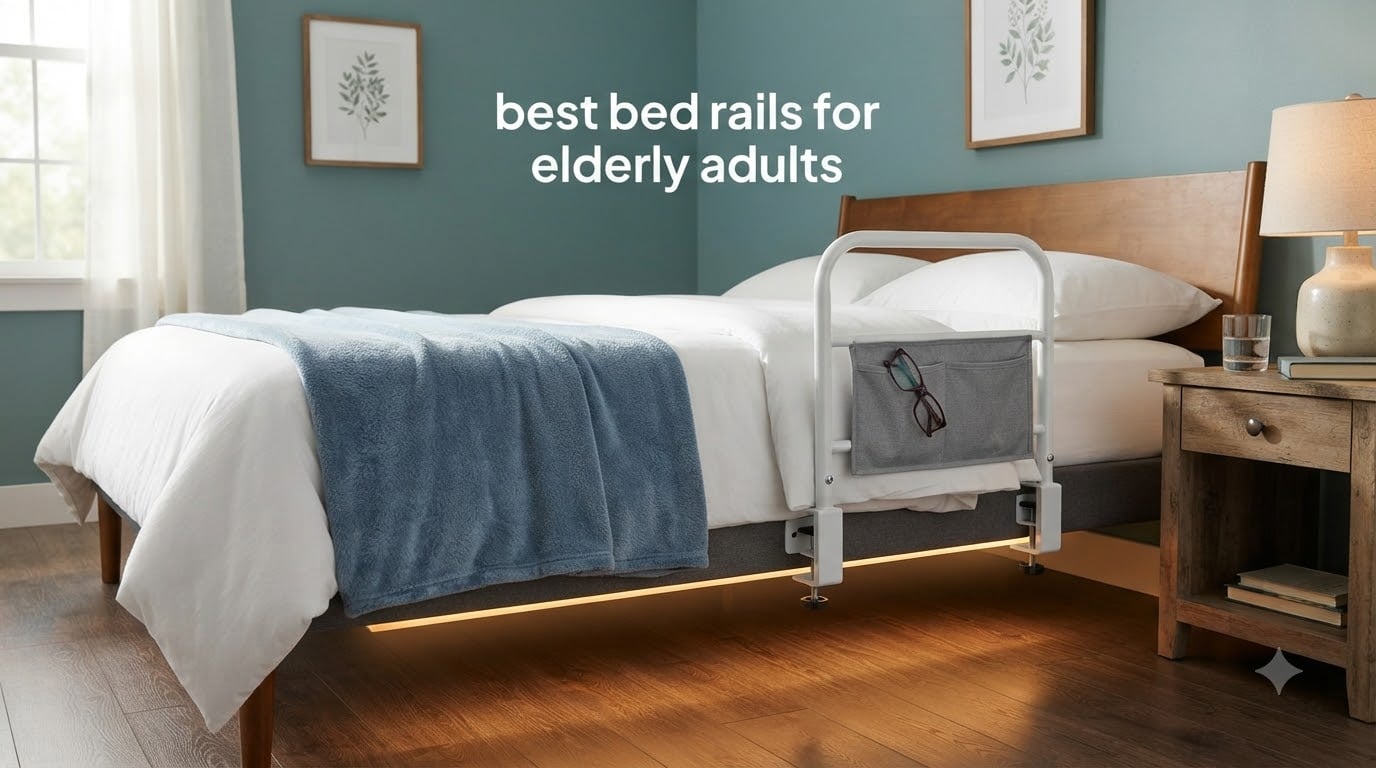
The best bed rails for elderly adults depend on your bed type, your mattress thickness and what you actually want the rail to do. For most people, the rail is a handhold for getting in and out of bed rather than a barrier. The Medline Bed Assist Bar is our top pick because it has the deepest review history of any rail we compared, and the Lunderg rail earns its place for anyone whose falls happen in the dark.
We spent weeks reading specifications, review histories and caregiver forum threads on all eight rails below, and we compared them against the standards that actually matter for this category. Nothing on this list is here for filler.
A few safety points before we get into the list, because no rail is safe when it is fitted badly:
Always use the included safety strap and pull it tight so there is no gap between the rail and the mattress.
Measure your mattress thickness and bed height before ordering, because most returns here are fit problems, not quality problems.
Check that the listing states ASTM F3186-17 certification explicitly. If the standard is missing from the description, assume the rail is not certified.
Never leave someone with moderate or severe dementia alone with a full-length rail. Entrapment is the single most serious documented risk in this category.
Run a hard push, pull and lean test on installation day and once a week after that.
If you want a shortcut, the adjustable bed rail guide we published earlier covers the mechanism in more detail, including bases that move and bend.
Table of Contents
- Top 3 Picks for Elderly Adults Right Now (October 2026)
- Best Bed Rails for Elderly Adults in 2026
- What Is a Bed Rail for Elderly Adults?
- 1. Medline Bed Assist Bar for Seniors – Best Overall
- 2. Stander EZ Adjust Bed Rail – Best Premium Pick
- 3. Able Life Bedside Extend-A-Rail – Best Value
- 4. Lunderg Bed Assist Rail – Best With a Motion Light
- 5. Medical King Bed Rail – Best Budget Pick
- 6. WELLORA Foldable Bed Rail – Best for Discreet Rooms
- 7. WeHwupe Bed Rail – Best for Heavier Users
- 8. TABEKE Bed Rail – Best for Adjustable and Hospital Beds
- How to Choose a Bed Rail: 7 Criteria That Matter
- How to Install a Bed Rail in 4 Steps
- Bed Rail Alternatives and the Entrapment Question
- Frequently Asked Questions
- Will Medicare pay for bed rails for seniors?
- What are the alternatives to bed rails for the elderly?
- What are the best bed rail protectors for elderly people?
- What is the best assistive bed rail for elderly people?
- What is the main cause of death from bed rails?
- Are bed rails safe for elderly adults with dementia?
- Can bed rails be used on an adjustable bed?
- How do I know if a bed rail is ASTM certified?
- Conclusion
Top 3 Picks for Elderly Adults Right Now (October 2026)

Medline Bed Assist Bar
- Tool-free assembly
- Foam-covered handles
- Flat tubing under the mattress
Stander EZ Adjust Bed Rail
- ASTM F3186-17 certified
- Adjusts 20-30 inches
- Folds down with a knob twist

Able Life Extend-A-Rail
- ASTM F3186-17 certified
- Button length adjustment
- Compact 18 inch footprint
Those three cover the widest range of real situations. The other five each win a narrower fight: lighting, budget, discretion, capacity or fit.
Best Bed Rails for Elderly Adults in 2026
| Product | Specifications | Action |
|---|---|---|
| Medline Bed Assist Bar for Seniors |
|
Check Latest Price |
| Stander EZ Adjust Bed Rail |
|
Check Latest Price |
| Able Life Bedside Extend-A-Rail |
|
Check Latest Price |
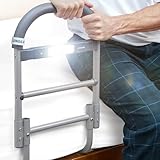 Lunderg Bed Assist Rail with Motion Light Lunderg Bed Assist Rail with Motion Light |
|
Check Latest Price |
 Medical King Bed Rail with Floor Support Medical King Bed Rail with Floor Support |
|
Check Latest Price |
 WELLORA Foldable Bed Rail WELLORA Foldable Bed Rail |
|
Check Latest Price |
 WeHwupe Bed Rail with Storage Pocket WeHwupe Bed Rail with Storage Pocket |
|
Check Latest Price |
 TABEKE Bed Rail with Double Side Pockets TABEKE Bed Rail with Double Side Pockets |
|
Check Latest Price |
One column that is not in this table is certification, and the omission is deliberate. Only the Stander and Able Life rails state ASTM F3186-17 by name in their listings. Where a listing is silent, we treat the rail as uncertified rather than assume the best.
What Is a Bed Rail for Elderly Adults?
A bed rail for elderly adults is a bar that attaches to the side of a bed and gives an older adult something fixed to hold onto when sitting up, standing or lowering themselves back down. On longer models it also helps stop someone rolling out of bed during sleep.
Most of the rails in this roundup work the same mechanical way. A flat steel base slides between the mattress and the box spring or platform, a vertical post rises above the mattress, and a safety strap wraps around the bed frame. That layout matters because it transfers a user’s weight into the bed frame rather than into a soft mattress that just compresses.
There are three distinct archetypes, and buying the wrong one is the most common reason a rail ends up unused on a closet shelf.
A full bed rail runs a long distance along the side of the mattress and is genuinely a containment barrier. It suits someone who rolls out of bed night after night. It is also the archetype that creates entrapment risk, and it is the one most care homes are cautious about.
A bed assist rail is shorter, usually in the region of 17 to 27 inches across, and functions mainly as a grab bar. It suits post-surgery recovery, arthritis in the hands, and anyone whose problem is rising from a seated position rather than nocturnal rolling. Most home buyers want this one.
A bedside grab bar is the smallest option, a single post with a small handle that gives a handhold without blocking the edge of the mattress. It is the least intrusive and the least protective.
For dementia specifically, a shorter rail is generally the safer choice because it leaves the side of the bed open and offers no gap large enough for a confused person to become wedged in. A caregiver forum thread we read asked exactly this question, whether a rail was safe for a parent in her eighties with moderate dementia, and the consensus across the replies was that the honest answer is a conversation with the doctor plus a layered plan rather than a single product.
1. Medline Bed Assist Bar for Seniors – Best Overall
Medline Adjustable Bed Assist Bar for Seniors with Nylon Bag for Storage
6.4 lb total
Foam-covered handles
Tool-free setup
Fits queen and king
Pros
- Largest review history in the group at 15534 ratings
- Tool-free assembly takes about 15 minutes
- Flat tubing passes under the mattress without a lump
- Deep nylon pouch for glasses phone and medication
Cons
- Safety strap is not removable and can bunch under the mattress
- Non-removable safety stickers on the frame look unsightly
- Some units feel wobbly even with the strap tightened
The Medline Bed Assist Bar is the one we recommend to most people, and the reason is not a spec sheet. It has been on the market since 2011 and carries 15534 ratings averaging 4.6, which is by far the deepest review history of anything we compared. When a product has that many owners, its failure modes are well documented rather than theoretical.
What stands out in the reviews is the flat tubing. Most rails use round tube, and round tube creates a visible ridge under the mattress that some users find uncomfortable. Medline’s flat section passes under without a lump, and the foam-covered handles stayed comfortable for people holding on for several minutes at a time.
At 27.5 by 14 by 43.75 inches, it is a fairly tall and long assist bar, which is why it works well for someone who needs to pull themselves forward into a seated position. Buyers repeatedly describe the same outcome: a parent who had been afraid to get out of bed alone started doing it again within a couple of weeks.
The nylon pouch is deeper than most and holds glasses, a phone, a remote and medication together. On an adjustable base the flat profile and low 6.4 pound weight also make it one of the easier rails to reposition as the bed moves.
What to check before you order it
Measure your mattress thickness. The flat base is designed to grip a standard mattress, and a very thick or very thin mattress changes how the rail sits. If your mattress is at the extreme end of normal, look at the Able Life rail instead, which states an 8 to 15 inch range.
Count your clearance. Because the under-mattress section is long, fitting a second rail opposite it on a narrow bed can be awkward. One rail is usually enough for most households.
Where it falls short
The safety strap is fixed. If you want a bar you can release and move daily, for example to help someone with a catheter or to reach them from both sides, this is the wrong choice. It is a permanent anchor by design.
Some owners report residual wobble even after tightening, and the fix in the reviews is an extra fastener into the bed board. Also worth knowing: the safety stickers on the frame cannot be removed, so the rail stays visually marked as medical equipment.
2. Stander EZ Adjust Bed Rail – Best Premium Pick
Stander EZ Adjust Bed Rail, Adjustable Senior Bedrail and Safety Assist Railing for Elderly Adults with Organizer Pouch, ASTM Safety Approved Guard-Rail, Black
Powder coated steel
10 lb
20-30 inch rail
Supports up to 300 lbs
Pros
- States ASTM F3186-17 certification explicitly
- Large multi-pocket organizer
- Knob-twist fold down for bed making and discretion
- Strong powder coated steel frame
Cons
- Included strap clips are hard or impossible to unclip
- Anchoring on an adjustable bed can stop it elevating
- Installation alone with a heavy king mattress is difficult
The Stander EZ Adjust is the only rail in this roundup whose listing names ASTM F3186-17, the US safety standard for adult portable bed rails, and buyers say that single fact is why they chose it. If certification is your hard filter, this is the rail to buy and the other seven are not in the running.
That standard covers structural strength under repeated load, entrapment gap measurement and stability under lateral force, which is exactly the failure mode that matters when someone grabs a rail while already losing balance.
The rail extends from 20 to 30 inches and holds up to 300 pounds. It fits platform beds, box springs and slat beds using the included strap, with a stated mattress range of 10 to 14 inches. The knob-twist fold down is genuinely useful: it lets a caregiver make the bed, and it means the bedroom still looks like a bedroom.
Caregivers of dementia patients and of people with REM sleep behaviour disorder report in the reviews that it reliably prevents night-time roll-outs. The multi-pocket organizer is one of the larger ones we saw and holds a remote, glasses, a phone and medication in a single unit.
How it performs in a real bedroom
At 10 pounds it is the heaviest rail here, and the powder coated steel gives it a planted feel once the strap is tight. The 25 by 26 by 23 inch footprint is compact for a rail that covers up to 30 inches of bed, so it works on smaller rooms than the visual size suggests.
The trade-off is the cover. It reads as a guard rail rather than a grab bar, which some occupants find confining because they cannot see through it to the room.
Two things that catch people out
The strap clips are the top complaint. Multiple reviews describe them as difficult or effectively impossible to unclip, so once it is fitted, this is a semi-permanent installation.
It is not intended for adjustable beds or hospital beds, and on an adjustable base the anchored rail can physically prevent the bed from elevating. If your bed articulates, read the adjustable bed rail guide first and pick a rail that states compatibility.
3. Able Life Bedside Extend-A-Rail – Best Value
Able Life Bedside Extend-A-Rail, Adjustable Senior Bed Safety Railing and Stand Assist Grab Bar, Extendable Guardrail for Seniors and Elderly Adults, ASTM Safety Approved Bedrail
ASTM F3186-17 certified
300 lb support
20-30 inch rail
8-15 inch mattresses
Pros
- Carries ASTM F3186-17 certification at a lower price
- Button length adjustment rather than manual repositioning
- Compact 18 by 20 by 20 inch footprint suits tight rooms
- Fits twin through California King
Cons
- 20 inch rail gives less coverage than a full guard rail
- Excludes adjustable beds and extra soft mattresses
- Mattress range excludes some very thick modern mattresses
The Able Life Extend-A-Rail is the one we point people to when someone wants a certified rail without paying the premium-tier figure. It passes the same ASTM F3186-17 standard as the Stander, supports up to 300 pounds, and sits 4213 ratings at 4.5.
The push-button length adjustment from 20 to 30 inches is the feature that separates it from cheaper fixed-length rails. You size the rail to the person rather than to the bed, which is the difference between a rail that feels solid and one that feels like it is floating.
At 7.15 pounds and 18 by 20 by 20 inches, it is the most compact unit we reviewed. That matters in shared rooms, hospital-style rooms and any bedroom where an adult child needs to get a chair close to the bed to sit with the person.
The stated mattress range of 8 to 15 inches is the widest in this roundup, which makes it the safest bet for thick memory foam or hybrid mattresses. Our general read across this category is that mattress fit causes more failed installations than build quality does.
Where the certification actually shows
Buyers who came from the higher-tier certified rails generally describe this as the practical choice rather than the compromise. The steel does the same job at 300 pounds, the length still adjusts, and the entrapment gaps are within the tested tolerance.
It is also the easier one to install alone, at 7.15 pounds with a lighter folded footprint than the Stander.
Where it does not reach
Twenty inches of coverage is not a full guard rail. If the person is rolling out of bed in their sleep, this is a handhold first and a barrier second. You would need a full-length model for containment.
It is explicitly excluded for adjustable beds and extra soft mattresses, and a rating of 4.5 sits a touch below the two rails above it.
4. Lunderg Bed Assist Rail – Best With a Motion Light
Lunderg Bed Assist Rail for Seniors with Motion Light & Non-Slip Grab Bar
Motion activated LED
300 lb load tested
Four stabilizing bars
2 lb total
Pros
- Highest average rating among the well-reviewed rails at 4.7
- Motion light is repeatedly named as the feature that justifies the price
- Arrives partly pre-assembled and installs tool-free in about 5 minutes
- Short 13 inch variant makes swinging legs over easier
Cons
- Not suitable for adjustable beds
- Mattress compatibility limited to 7-13 inches
- Motion light needs periodic recharging
Nighttime bathroom trips are the single most common reason a rail gets bought, and the Lunderg is the only rail here with lighting built in. The motion-activated rechargeable LED stays on for 60 seconds in auto mode, which is enough to find the floor, the slippers and the bathroom door handle without fumbling for a lamp switch in the dark.
Fumbling for a switch in the dark is named again and again in caregiver threads as the moment just before a fall. Adding light is a cheaper intervention than most people expect.
It carries the highest average rating of the well-reviewed group at 4.7 across 2813 ratings, with 83 percent five-star. Buyers mention buying it repeatedly as a gift, which is usually a good sign that it works for people other than the purchaser.
Four horizontal stabilizing bars across a carbon steel frame is what keeps it wobble-free in practice, and the reviews specifically describe stability even when the under-bed strap is doubled around the frame. The 5-minute tool-free setup with a partly pre-assembled body means it can go in on the same day a hospital discharge happens.
Which version to pick
Two lengths are offered, 17.5 inch and 13 inch. The shorter 13 inch option is worth serious consideration for anyone with hip or knee problems because they can swing their legs over the rail rather than climbing over it. That is a meaningful difference in the first fortnight after surgery.
It fits twin through king on 7 to 13 inch mattresses, on box spring, slat or platform frames, on either side of the bed.
Limits worth knowing
It is not suitable for adjustable beds. The 7 to 13 inch mattress range is the narrowest here, so check thickness before buying.
The light is a feature, not a nightlight. It cannot be set to stay on all night and the battery needs periodic recharging, so it is a motion guide rather than an ambient glow. Attaching the under-bed cord to the far side of the frame is also a two-person job on a wide bed.
5. Medical King Bed Rail – Best Budget Pick
Bed Rails For Elderly Adults Safety Bed Assist Rails For Seniors
Tool-free setup
6 lb
Adjustable height
Fits any mattress thickness
Pros
- Lowest cost in the roundup with close to 10000 ratings
- Adjustable height and installs on either side of the bed
- Non-slip hand bar plus removable storage bag
- Includes security strap and floor support legs
Cons
- Included strap is too short to wrap a queen box spring
- Instructions reference packing washers that are not present
- Some units need partial disassembly before they work
The Medical King rail is the value pick, and its 9549 ratings at 4.4 give it more real-world history than most of the premium options. It also has a feature the higher-tier rails lack: floor support legs, which spread the load to the floor rather than relying entirely on the mattress clamp.
Floor legs are the answer for thick mattresses and for low-profile frames where a slide-under base has very little to grip. If your mattress is unusually thick, this is the rail most likely to work anyway.
Height adjusts tool-free and it fits king, queen and twin beds at any mattress thickness. The non-slip hand bar and the removable storage bag for glasses, remotes and books cover the basics well, and caregivers in assisted living report in the reviews that residents regained confidence with it.
One caveat on the listing itself: it claims to meet US safety requirements, but the ASTM F3186-17 standard is not named in the description. We treat that as uncertified for filtering purposes.
Who should buy this one
A short-term recovery, a hospital discharge at home, or a first purchase where you are not sure a rail will be used long term. At 6 pounds it moves between rooms easily, and the removable bag means you can strip it for laundry without tools.
Support in real-world use is generally reported around 190 to 200 pounds, which is well under the marketing language used elsewhere in this category. For a heavier user, choose one of the rails rated at 300 pounds or above.
The one complaint that comes up constantly
The supplied strap is too short to wrap a queen-size box spring, so the primary safety anchor is compromised on the most common bed size in the country. Many buyers report improvising a longer strap. If you order this, buy a longer tie-down strap at the same time and expect a five-minute job with a screwdriver.
Assembly instructions also reference packing washers that do not exist, and a minority of owners report needing to partially disassemble and reassemble the rail before it functions.
6. WELLORA Foldable Bed Rail – Best for Discreet Rooms
Sturdy Bed Rails for Elderly Adults Safety – Foldable & Adjustable Bed Rail – Supports up to 330lbs – Fit King, Queen, Full, Twin – Bed Guard Rail for Seniors WELLORA
Aluminum frame
3.19 lb
Supports up to 330 lbs
20-23 inch height
Pros
- One-handed folding button lowers the rail without tools
- Lightest rail here at 3.19 lb so it moves between rooms
- Highest stated capacity in the group at 330 lbs
- Soft felt pocket and rail cover reduce arm catching
Cons
- Pop-out locking pins can release under body weight
- Strap buckle is sewn shut on some production runs
- Newer welded build feels cheaper than earlier versions
The WELLORA rail solves a problem most rails in this roundup ignore: it folds down out of sight. One button lowers the handle, and several buyers describe hiding it under the bedspread so the room still looks like a normal bedroom. For a parent who is self-conscious about medical equipment, that is not a small thing.
It is also the most portable unit we reviewed at 3.19 pounds in reinforced recycled aluminum, which means it can move between a bedroom and a sofa bed for someone who naps in different places.
The stated capacity of 330 pounds is the second highest figure in this group, and the height adjusts between 20 and 23 inches, which sits noticeably higher than most competitors and suits a taller person pulling up from a low mattress.
At 16 inch wide with bed-frame safety straps and C-bolts, it works on adjustable beds when positioned a few inches clear of where the mattress bends. That is one of very few rails here where reviewers confirm adjustable-base use, so it is worth reading alongside our dedicated adjustable bed rail guide.
What the fold-down actually does
It removes the rail from the user’s reach without tools, which is the correct behaviour when a caregiver needs to change a sheet, help someone roll, or transfer them out of bed. For a short-term recovery where the rail is not needed permanently, that beats a permanently fixed bar.
The soft felt pocket doubles as arm protection and reduces the chance of an arm catching on the opening as the person moves in their sleep.
Why we placed it sixth
It has 410 ratings, the smallest review base in the roundup, and the lowest average rating at 4.3. Owners report the pop-out locking pins can release if someone leans on the rail with full body weight, and some production runs ship with the strap buckle sewn shut so it cannot be connected as the product video shows.
Reports also indicate newer production is welded rather than solid tube and feels cheaper than earlier versions, and the assembly instructions are minimal. If you buy it, check the returned unit carefully on arrival.
7. WeHwupe Bed Rail – Best for Heavier Users
WeHwupe Bed Rails for Elderly Adults Safety with Bedside Storage Pocket
Alloy steel
Stated 350 lb capacity
4.5 lb
Fits king to twin
Pros
- Second highest stated capacity in the group at 350 pounds
- Foam-padded non-slip grip stays comfortable on longer holds
- Tie-down straps and compact frame install without tools
- Mesh pocket keeps phone and glasses within reach
Cons
- Not suitable for adjustable mattresses or automatic lift beds
- Smallest rail surface at 12.3 inches wide limits roll-over containment
- Firm foam padding can compress and lose grip over time
The WeHwupe rail is the one to look at when the user is a larger adult and the rail has to do real work. Its stated capacity of 350 pounds on an alloy steel frame is the highest in this group, and the 4.6 rating across 1156 reviews holds up better than most of the value tier.
Foam padding along the handrail is the detail that matters most here. A bare steel bar is punishing for arthritic hands over a long hold, and padded grip is what lets someone take their time standing up rather than rushing it.
Assembly is tool-free with the included tie-down straps, and the mesh storage pocket is a sensible size for a phone, glasses and a medication bottle. It fits king, queen, full and twin frames.
The listing states the frame passed ASTM safety testing standards without naming the F3186-17 designation, so we treat it as uncertified even though the capacity figure is generous.
Capacity versus actual coverage
Capacity and coverage are different things, and this rail is a good example. At 12.3 inches wide it is the smallest rail surface in the roundup, so it works well as a push-up handle for standing but does very little to stop someone rolling sideways out of bed.
If the goal is a strong handhold for a heavier user who is unsteady on standing, this fits the bill. If the goal is nocturnal containment, you need a wider rail.
Things to plan around
It is not suitable for adjustable mattresses or automatic lift beds. If your bed articulates, this one is out.
Long-term owners note the firm foam padding compresses over months of daily use and the grip softens, so it needs checking on the same weekly schedule as the stability test. The mesh pocket is also small, which is fine for a phone and less fine for a book.
8. TABEKE Bed Rail – Best for Adjustable and Hospital Beds
TABEKE Bed Rails for Elderly Adults Safety, Adjustable Senior Bed Assist Rail with Non-Slip Handle and Double Side Storage Pocket Fits King, Queen, Full, Twin Bed
1.2mm alloy steel
35 inch base
Supports up to 300 lbs
16-21 inch height
Pros
- Highest average rating in the roundup at 4.8 with 87 percent five-star
- Widest base among the value rails at 35 inches with no reported wobble
- Under-mattress section runs the width of a twin so it stays put
- Owners confirm use on an adjustable frame and twin hospital beds
Cons
- Smallest review count in the group at 399 so durability is less proven
- Mesh pockets are reported as difficult to reach into
- Narrower 16 inch width limits roll-over containment
The TABEKE rail is the highest rated at 4.8 with 87 percent five-star reviews, and its real distinguishing feature is mechanical: the under-mattress section is 35 inches across, the width of a twin bed, which is why owners report no wobble at all under body weight.
A 1.2mm commercial alloy steel tube is thicker than the standard tubing on most rails in this price range, and the foam handle is curved to follow the wrist rather than sitting flat against the steel.
Owners specifically report it working on a premium adjustable frame and on twin hospital beds, and the height adjusts from 16 to 21 inches. Double side nylon pockets hold water, a phone, remotes and medication, which addresses the caregiver pattern of keeping everything within reach of the bed.
There is also 180 day coverage from the brand, which is more reassurance than most rails in this category offer.
Why the wide base changes the result
Rails rock when the under-mattress section is shorter than the mattress and the user shifts weight off-centre. A 35 inch base covers the full width of a twin, so the clamp cannot travel sideways even when someone pushes hard on one side.
That is the single most useful thing about this rail for someone who has already returned a wobblier one, and it is worth reading the stability test below before you decide anything.
The honest drawbacks
It has 399 ratings, the smallest review base in the roundup, so long-term durability is the least proven of the eight. The fixed 16 to 21 inch height range is shorter than some adjustable alternatives, which matters for a tall user.
The mesh pockets are reported as difficult to reach into, which is a real problem for someone with limited shoulder rotation, and at 16 inches wide the rail offers moderate rather than strong roll-over containment.
How to Choose a Bed Rail: 7 Criteria That Matter
1. Certification. Look for the exact string ASTM F3186-17 in the specifications section, not in the product title. That standard covers structural strength under repeated load, entrapment gap measurement and stability under lateral force. If the listing does not name it, assume the rail is not certified.
2. Weight capacity, with a buffer. Do not buy a rail rated at exactly the user’s weight. A rail is loaded sideways and suddenly when someone grabs it while already falling, so rate the rail at least 50 pounds above the person’s actual weight. Anything under 300 pounds is a hard no in our view.
3. Mattress fit, measured not assumed. Measure the mattress thickness with a tape before you order. Rails here range from 7 to 13 inches up to 8 to 15 inches, and a mismatch causes the rocking and sliding that makes a rail worse than useless. Also measure the bed height, which we will come back to.
4. Rail type. Decide whether you need a handhold or a barrier. Most home users need a bed assist rail. A full-length rail is a containment device and brings real entrapment considerations with it.
5. Handle ergonomics. Look for foam or textured padding and a curve that lets the wrist sit under the bar. Arthritic hands and essential tremor both make a bare steel bar a poor choice, and a diameter around 1.5 inches or wider is easier to hold than a thin one.
6. Support mechanics. Slide-under supports grip between the mattress and the box spring and work best on standard-height box springs. Floor-mounted supports spread load to the floor and cope much better with thick or low-profile mattresses. Platform beds with no gap underneath defeat slide-under rails outright, which is the single most common incompatibility in this category.
7. Caregiver access. If someone will be helping the person daily, ask how the rail comes off. A knob-twist fold down or a one-handed folding button is worth a great deal, because a permanently fixed rail blocks bed making and blocks access during a fall.
Rail pads and protectors
Safety rail pads wrap around a rail to soften contact, prevent a limb from striking the frame, and in some designs reduce the opening a person could become wedged in. A firm foam pad that fits the rail without leaving gaps is what you want.
Look for a pad with a wipe-clean surface, quick-release buckles so it can be removed for laundering, and an optional viewing window so a caregiver can see the person through it. Full-length rails should have a pad in place; short assist rails generally do not need one.
Pads are a separate purchase from the rail in almost every case, so factor that into your planning if your person is a dementia risk or has poor skin integrity.
Bed height, the variable nobody mentions
A rail cannot fix a bed that is too high for the person using it. A caregiver writing on a senior forum described having to build a custom platform simply so a parent who was under five feet tall could get down to the floor safely, and the thread has plenty of similar reports.
Before you blame the rail, measure from the floor to the top of the mattress with the person standing beside it. If the mattress top is well above their knee, the risk is the drop, not the absence of a rail. Four practical fixes exist: a low-profile box spring around 5 inches that lowers the whole bed, a raised platform or bed blocks, taking the mattress off the frame and using a lower foundation, or a rail with a longer support leg that bridges a deeper gap.
Platform beds deserve their own note. If the frame is a solid deck with no gap between the deck and the mattress, a slide-under rail has nothing to grip and will not work regardless of how well it is made.
How to Install a Bed Rail in 4 Steps
Step 1: Measure. Measure mattress thickness, mattress width, the gap between mattress and base, and the floor-to-mattress height. If the gap is under 3 inches, a slide-under rail will not work and you need a floor-supported model.
Step 2: Position the base. Slide the flat base fully under the mattress with the post toward the head end of the bed, not the foot. Center it on the side of the bed where the person actually gets in and out.
Step 3: Secure the anchor. Wrap the safety strap around the bed frame and pull it until the rail is tight against the mattress with no gap. Test with your hand: if you can slide a finger between rail and mattress, pull it tighter. This strap is the single most important step for entrapment prevention.
Step 4: Run the stability test. Push the rail sideways hard, pull it toward you, then lean your full body weight onto it. There should be no movement at the base and no gap opening. Repeat this test once a week, and immediately after any bed move, mattress rotation or bedding change.
If the rail moves at all, do not use it. The fix is almost always a longer strap or an extra fastener into the bed board, and both take a few minutes.
Bed Rail Alternatives and the Entrapment Question
Entrapment is the injury mechanism that matters most in this category, so it deserves a direct answer. A person becomes wedged in the gap between the rail and the mattress and cannot free themselves, and the documented outcomes include asphyxiation and strangulation. Adult portable bed rails have been recalled for this reason, including a recall of JOKOSIS rails for entrapment and asphyxiation risk.
The practical mitigations are all mechanical. Use the strap so the gap closes. Choose a short assist rail over a full-length guard rail for anyone with dementia. Use a rail with a cover that limits the opening. Use a pad designed to reduce the gap. And never install a rail and assume it is monitoring the person.
For a person with moderate or severe dementia, talk to the doctor or occupational therapist before installing anything, and consider these alternatives instead:
Low-profile floor fall mats beside the bed, which reduce injury from a fall without creating any entrapment risk at all.
Bed and mattress alarms that notify a caregiver or an alarm unit when someone sits up or leaves the mattress.
Motion-activated under-bed lighting so the path to the bathroom is lit without anyone having to find a switch in the dark.
Lowering the bed with blocks or a low-profile box spring so the drop to the floor is short.
A transfer pole for a floor-to-ceiling grab point that a caregiver can remove instantly.
A bedside commode to remove the midnight walk to the bathroom that causes most of these falls.
Experienced caregivers rarely rely on a rail alone. The pattern that shows up repeatedly in forum threads is a layered system of rail plus bed alarm plus nightstand plus motion detector lights, assembled for the specific person and the specific bedroom. If you are caring for someone from a distance, that layered approach also gives you information a rail cannot.
One more practical point. If you are in the first week after a hospital discharge, buy the rail, the alarm, a nightstand and lighting in the same order, before the person arrives home. Choosing equipment under time pressure is how people end up with a rail that does not fit the mattress.
For families thinking about a rail for a child or a portable setup, our toddler bed rail safety guide covers the very different entrapment picture on that side of life.
Frequently Asked Questions
Will Medicare pay for bed rails for seniors?
Generally no. Original Medicare treats a home bed rail as a convenience item rather than a durable medical equipment necessity, so it is rarely covered. A rail prescribed as part of a hospital or skilled nursing bed rental is a different situation and can be covered. Health savings accounts and flexible spending accounts commonly do cover bed rails as a health or accessibility expense. Check with your supplier before ordering whether they can provide a receipt suitable for an HSA or FSA claim.
What are the alternatives to bed rails for the elderly?
The most common alternatives are low-profile floor fall mats beside the bed, bed and mattress alarms that alert a caregiver, motion-activated under-bed lighting for the path to the bathroom, lowering the bed itself with blocks or a low-profile box spring, a floor-to-ceiling transfer pole that a caregiver can remove instantly, and a bedside commode to remove the midnight trip. For anyone with dementia, these carry no entrapment risk and are usually the safer recommendation.
What are the best bed rail protectors for elderly people?
A firm foam safety rail pad is the standard answer. Look for a wipe-clean surface, quick-release buckles so it can be removed for laundering, and an optional viewing window so a caregiver can see the person through it. Pads also soften the opening a limb could catch in, which reduces entrapment risk on longer rails. Full-length rails should always have a pad fitted; short assist rails generally do not need one. Pads are sold separately from the rail.
What is the best assistive bed rail for elderly people?
For most households the Medline Bed Assist Bar is the best starting point, because it has the longest review history at 15534 ratings and tool-free assembly that takes about 15 minutes. If certification is your hard requirement, the Stander EZ Adjust and the Able Life Extend-A-Rail both state ASTM F3186-17 by name. If falls happen in the dark, the Lunderg with its motion-activated light is the better choice. The right answer depends mainly on your bed type and mattress thickness.
What is the main cause of death from bed rails?
Entrapment. A confused or dementia-diagnosed person becomes wedged in the gap between the rail and the mattress and cannot free themselves, and the documented outcomes include asphyxiation and strangulation. The CPSC and FDA have both documented serious injuries and deaths of this kind, and adult portable bed rails have been recalled for entrapment risk. The mitigation is mechanical: tighten the safety strap until no gap remains, prefer a short assist rail over a full-length guard rail, and use a pad that reduces the opening.
Are bed rails safe for elderly adults with dementia?
Not always, and the honest answer is that they need a conversation with a doctor or occupational therapist rather than a purchase decision. Full-length rails create a gap a confused person can become trapped in, and a documented recall of adult portable bed rails involved entrapment and asphyxiation risk. Where dementia is present, most caregivers do better with a layered approach: a short assist rail with a tightened strap, a bed alarm, under-bed motion lighting, a floor mat and a low bed. Layering gives you monitoring that a rail alone cannot.
Can bed rails be used on an adjustable bed?
Only if the listing states adjustable bed compatibility explicitly. Most rails clamp to a fixed frame or slide between the mattress and a box spring, and on an articulating base the anchored rail can physically prevent the bed from elevating. In this roundup the Stander, Able Life, Lunderg and WeHwupe rails all exclude adjustable beds, while the TABEKE and WELLORA rails are reported by owners to work when positioned a few inches clear of where the mattress bends. Contact the manufacturer before ordering if your bed articulates.
How do I know if a bed rail is ASTM certified?
Look for the exact string ASTM F3186-17 in the product specifications, not in the title. That standard covers structural strength under repeated load, entrapment gap measurement and stability under lateral force for adult portable bed rails. If the listing mentions safety testing without naming the designation, treat the rail as uncertified. In our comparison only the Stander EZ Adjust and the Able Life Extend-A-Rail name the standard explicitly.
Conclusion
The best bed rails for elderly adults in 2026 come down to a short list once you have measured your mattress and checked your bed frame. The Medline Bed Assist Bar is the safest general recommendation for most households. The Stander EZ Adjust and the Able Life Extend-A-Rail are the two that state ASTM F3186-17 certification outright, and the Lunderg is the one to buy if the falls happen in the dark.
Fit beats features in every case. Measure first, strap it tight, test it hard, and check it weekly. If the person has dementia, build a layered system rather than relying on a rail alone. Check the current price and current reviews on each of these before you order, since listings change often and availability shifts from week to week.