
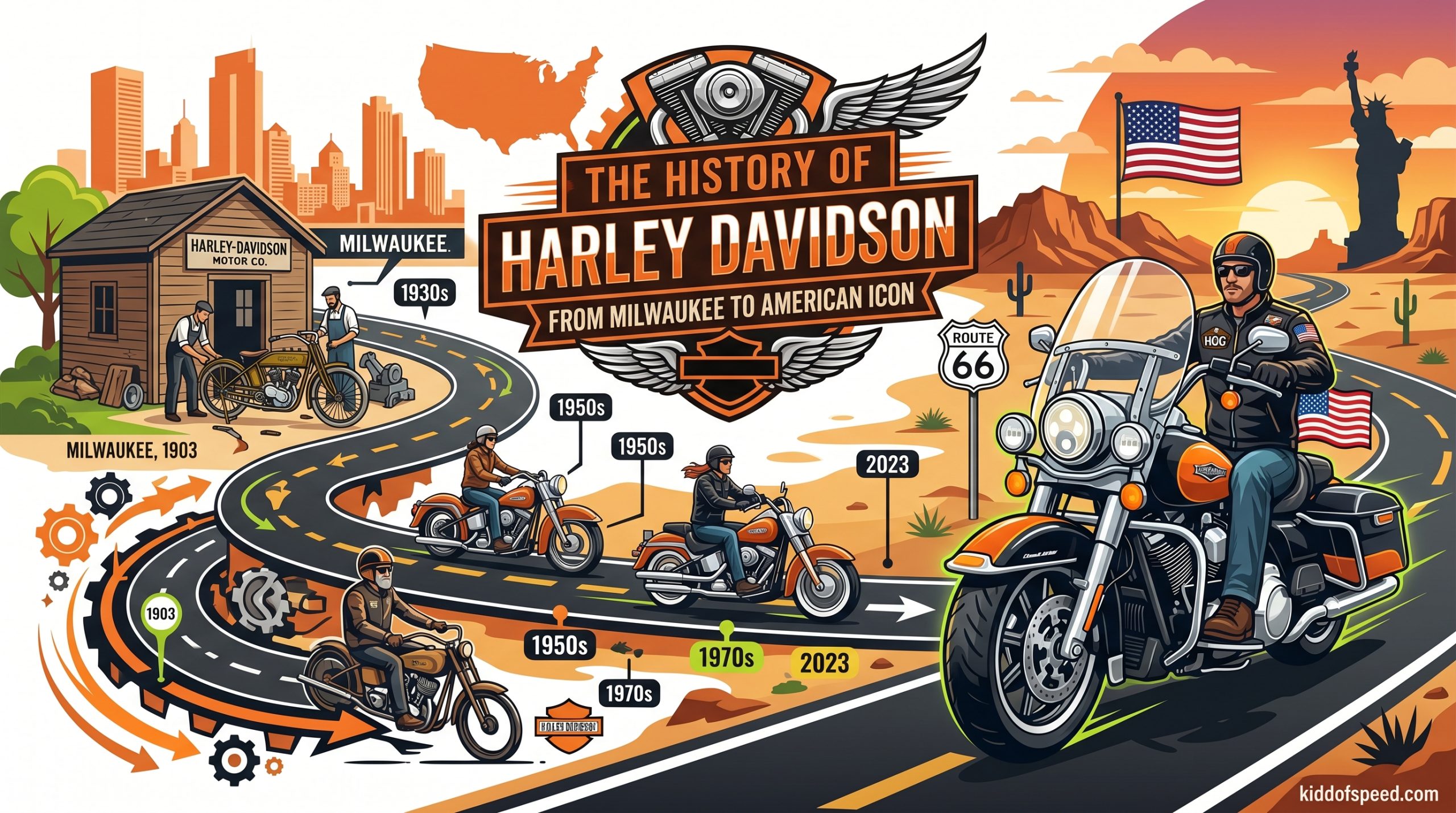
The History of Harley Davidson From Milwaukee to American Icon begins with a simple question: how did a tiny shed in Milwaukee give birth to one of the most recognizable brands in the world? In 1903, four friends with a passion for mechanics built something that would transcend transportation to become a symbol of freedom, rebellion, and American manufacturing excellence. This is the story of resilience, innovation, and cultural impact that spans over 120 years.
Harley-Davidson isn’t just a motorcycle company—it’s an American institution that has survived the Great Depression, two World Wars, and near-bankruptcy in the 1980s to emerge as a cultural icon representing freedom and independence. From those humble beginnings in a 10×15-foot wooden shed to its current status as a global powerhouse, the history of Harley-Davidson reflects the broader story of American industrial innovation and cultural evolution.
In this comprehensive guide, I’ll take you through the complete journey of Harley-Davidson from its Milwaukee origins to becoming an enduring American icon. We’ll explore the founding story, groundbreaking innovations, war-time contributions, cultural revolutions, and the modern challenges that keep this legendary brand relevant in 2026.
Table of Contents
- The History of Harley Davidson From Milwaukee to American Icon Begins with Four Friends
- Innovation and Growth: The V-Twin Engine That Changed Everything
- War Years and Resilience: How Harley-Davidson Survived the Great Depression
- Post-War Evolution: Iconic Engines and Cultural Revolution
- Modern Era: Resurgence, Innovation, and the Electric Future
- Cultural Impact: Why Harley-Davidson Became an American Icon
- The History of Harley Davidson From Milwaukee to American Icon: A Legacy of Resilience
The History of Harley Davidson From Milwaukee to American Icon Begins with Four Friends
The story of Harley-Davidson starts with two childhood friends who shared a dream of building a motorized bicycle. William S. Harley and Arthur Davidson met in Milwaukee, Wisconsin, and bonded over their fascination with the emerging technology of internal combustion engines. Harley, the son of a railroad engineer, worked as a draftsman at a Milwaukee manufacturing company, while Davidson came from a family of carpenters and craftsmen.
In 1901, at just 21 years old, Harley drew up plans for a small engine to be mounted on a standard bicycle frame. For two years, he and Davidson worked tirelessly in a cramped 10×15-foot wooden shed behind the Davidson family home on Chestnut Street in Milwaukee. The shed, no larger than a modern walk-in closet, became the birthplace of an American legend.
The first prototype, completed in 1903, was essentially a bicycle with a small engine attached. It didn’t work well—the engine was too underpowered to climb Milwaukee’s hills without pedal assistance. But Harley and Davidson weren’t discouraged. They saw potential where others saw failure.
Two more Davidson brothers joined the venture: Walter Davidson, a skilled machinist who would become the company’s first president, and William A. Davidson, a toolmaker who handled manufacturing. The four founders—William S. Harley, Arthur Davidson, Walter Davidson, and William A. Davidson—formed a partnership that would shape American motorcycle history for generations.
The breakthrough came in 1903 when they produced their first production-ready motorcycle. This first Harley-Davidson featured a loop-frame design (unlike the diamond frames of competitors), a single-cylinder engine, and a leather belt drive. It could actually climb hills without pedaling. They built three motorcycles that first year, marking the official birth of Harley-Davidson.
The Davidson family played a crucial role in those early years. Their backyard shed served as the first factory, with family members helping with assembly, painting, and even testing the motorcycles. The boys’ father, William C. Davidson, provided initial funding and support, while their uncle, a machinist, helped create engine components.
What started as a weekend project for four friends quickly gained attention in Milwaukee. Local residents were fascinated by these noisy, smoke-belching machines that could travel faster than anything on two wheels had before. By 1904, the first Harley-Davidson dealership opened in Chicago, and the company produced its first catalog.
The early success wasn’t without challenges. The shed was too small for production, so operations moved to a series of increasingly larger facilities around Milwaukee. In 1906, they built their first dedicated factory on Juneau Avenue in Milwaukee—a location that remains Harley-Davidson’s corporate headquarters today. That same year, they produced 50 motorcycles.
By 1907, Harley-Davidson officially incorporated with Walter Davidson as president, Arthur Davidson as secretary and general sales manager, William Harley as chief engineer and treasurer, and William A. Davidson as works manager. The company had grown from a backyard experiment to a legitimate corporation with 18 employees producing 150 motorcycles per year.
Innovation and Growth: The V-Twin Engine That Changed Everything
The first decade of Harley-Davidson was defined by rapid innovation and technical breakthroughs that would establish the company’s reputation for engineering excellence. The most significant of these was the introduction of the V-twin engine in 1909—a design that would become synonymous with the Harley-Davidson brand and create its signature sound.
The V-twin engine configuration featured two cylinders arranged in a V shape, typically at 45 degrees. This design offered several advantages over single-cylinder engines: more power, smoother operation, and better cooling. But perhaps most importantly, it created a distinctive exhaust note that would become Harley-Davidson’s acoustic trademark—a deep, rhythmic potato-potato-potato sound that enthusiasts can recognize from blocks away.
However, the first V-twin wasn’t immediately successful. Early models had reliability issues, and Harley-Davidson continued improving single-cylinder designs while refining the V-twin concept. By 1911, they had perfected the design, and the V-twin engine became the heart of Harley-Davidson motorcycles for the next century.
Innovation extended beyond engines. Harley-Davidson pioneered the loop-frame chassis design, which provided better stability and handling than the diamond frames used by competitors. This design was so superior that it became the industry standard for motorcycles worldwide. The company also introduced improvements like the step-starter (making it easier to start the engine), the first reliable clutch system, and advanced suspension designs for the era.
Racing played a crucial role in Harley-Davidson’s early growth and reputation. The factory racing team, known as the “Wrecking Crew,” dominated motorcycle racing in the 1910s and 1920s. They competed in and won races across the country, proving Harley-Davidson’s reliability, speed, and durability. Racing victories weren’t just about trophies—they provided invaluable feedback that improved production motorcycles and built the brand’s performance credentials.
The Wrecking Crew era produced legendary riders like Ray Weishaar, who became famous for his pig-riding appearances at races (a tradition that continues today with Harley-Davidson’s racing mascot). The team won countless races and set numerous speed records, establishing Harley-Davidson as a serious contender in the emerging world of motorsports.
Production grew rapidly during this period. From 150 motorcycles in 1907, Harley-Davidson produced over 1,000 units by 1910 and more than 3,000 by 1912. The company expanded its factory facilities multiple times to keep up with demand. By 1913, Harley-Davidson was building motorcycles in a state-of-the-art six-story factory on Juneau Avenue, employing hundreds of workers.
The company’s growth wasn’t just domestic. Harley-Davidson began exporting motorcycles internationally, establishing dealerships in Europe, Japan, and South America. The brand’s reputation for quality and reliability made it popular worldwide, laying the groundwork for the global presence it enjoys today.
Technical innovations continued throughout the 1910s. Harley-Davidson introduced the first three-speed transmission in 1915, replacing the older belt-drive systems with more reliable chain drives. They developed improved suspension systems, better braking mechanisms, and more efficient carburetors. Each innovation made Harley-Davidson motorcycles faster, more reliable, and more appealing to a growing market of riders.
By the time America entered World War I in 1917, Harley-Davidson had established itself as one of the premier motorcycle manufacturers in the world. The company was producing nearly 20,000 motorcycles annually and had developed a reputation for building tough, reliable machines that could handle the rough roads of early 20th-century America.
War Years and Resilience: How Harley-Davidson Survived the Great Depression
World War I marked Harley-Davidson’s first major military contract and proved crucial to the company’s growth and reputation. When the United States entered the war in 1917, the military needed motorcycles for messenger duty, reconnaissance, and troop transport. Harley-Davidson answered the call, providing nearly 15,000 motorcycles to the military during the war years.
These military motorcycles, known as the “Liberty Model,” were based on the standard civilian bikes but modified for military service. They featured simplified designs for easier maintenance in the field, enhanced durability for combat conditions, and specialized equipment like rifle scabbards and ammunition boxes. The motorcycles proved invaluable in the trench warfare of World War I, where they could navigate terrain that vehicles and horses couldn’t.
The military contract did more than provide revenue—it established Harley-Davidson’s reputation for reliability and durability under extreme conditions. Soldiers who rode Harley-Davidsons during the war returned home as customers and enthusiasts, spreading the brand’s popularity across America. This veteran connection would become a lasting part of Harley-Davidson’s identity.
The post-World War I period brought rapid expansion and record production. By 1920, Harley-Davidson was the largest motorcycle manufacturer in the world, producing over 28,000 motorcycles annually. The company had more than 2,000 dealers in 67 countries and dominated the American market with a market share exceeding 50%.
However, the 1920s also saw the rise of Indian Motorcycle, Harley-Davidson’s primary American competitor. The rivalry between Harley-Davidson and Indian defined American motorcycling for decades, with both companies constantly innovating and competing for market dominance. This competition pushed both manufacturers to improve their products, benefiting riders with better, more reliable motorcycles.
Then came the Great Depression, which nearly destroyed Harley-Davidson and the entire motorcycle industry. Motorcycle sales plummeted as unemployment soared and disposable income disappeared. Between 1929 and 1933, industry-wide motorcycle sales dropped by over 80%. Many motorcycle manufacturers went out of business entirely.
Harley-Davidson survived through innovative diversification and strategic cost-cutting. The company developed products beyond motorcycles, including the Servi-Car—a three-wheeled utility vehicle used by police departments, delivery services, and small businesses. The Servi-Car, produced from 1932 to 1973, became a staple of American commerce and kept Harley-Davidson afloat during the darkest years of the Depression.
Another survival strategy was focusing on industrial and commercial applications. Harley-Davidson sold engines for industrial equipment, developed snowmobile prototypes, and even built golf carts and golf carts. The company also emphasized motorcycle sales to police departments and government agencies, which had more stable budgets than individual consumers.
The company reduced its workforce dramatically, cut executive salaries, and streamlined production to minimize costs. But they maintained investment in research and development, knowing that innovation would be crucial when the economy recovered. This foresight paid off.
Despite the Depression, Harley-Davidson continued introducing important innovations. In 1936, they launched the EL model, featuring the legendary Knucklehead engine—a 61-cubic-inch V-twin with overhead valves that represented a major leap forward in motorcycle engine technology. The Knucklehead became an instant classic and established the big-twin engine configuration that defines Harley-Davidson motorcycles to this day.
World War II brought another military contract that transformed Harley-Davidson. The company provided over 70,000 motorcycles to the Allied forces during the war, including the WLA model specifically designed for military use. These motorcycles served in every theater of the war, from the deserts of North Africa to the jungles of the Pacific.
World War II motorcycles were more advanced than their World War I predecessors, featuring more powerful engines, better suspension systems, and enhanced reliability for extended military use. Harley-Davidson’s production was so essential to the war effort that the company received the Army-Navy “E” Award for excellence in wartime production.
As with World War I, soldiers who rode Harley-Davidsons during World War II returned home as loyal customers. This created another wave of post-war demand and cemented the connection between Harley-Davidson and American military service that continues to influence the brand’s identity today.
Post-War Evolution: Iconic Engines and Cultural Revolution
The post-World War II period transformed Harley-Davidson from a successful motorcycle manufacturer into a cultural icon. Returning soldiers with motorcycle experience created a huge market for motorcycles, and Harley-Davidson was perfectly positioned to meet this demand. The company introduced several iconic models that would define the brand for generations.
In 1948, Harley-Davidson launched the Panhead engine, which replaced the Knucklehead as the company’s flagship powerplant. The Panhead featured improved cooling, hydraulic lifters, and aluminum cylinder heads—innovations that made it more reliable and easier to maintain. The Panhead would remain in production until 1965 and became one of the most beloved engines in Harley-Davidson history.
The 1950s saw Harley-Davidson introduce the K model (1952), which would evolve into the Sportster in 1957. The Sportster, with its smaller displacement and lighter weight, made Harley-Davidson accessible to a broader range of riders. It became the longest-running model in Harley-Davidson’s history and remains in production today as a bridge between traditional and modern motorcycling.
But the most significant evolution in this era wasn’t mechanical—it was cultural. The 1953 movie “The Wild One,” starring Marlon Brando, featured a Triumph motorcycle but established the image of the motorcycle outlaw that would become forever associated with Harley-Davidson. Brando’s character, Johnny Strabler, embodied rebellion and nonconformity, and his leather jacket, cap, and motorcycle became iconic symbols of American counterculture.
Throughout the 1950s and 1960s, Harley-Davidson motorcycles became symbols of rebellion and freedom. They were adopted by motorcycle clubs, counterculture movements, and individuals who rejected mainstream society. This cultural adoption was both a blessing and a curse—it gave Harley-Davidson incredible cultural cachet but also created an image problem that would haunt the brand for decades.
The 1960s saw the introduction of the Electra Glide in 1965, which featured electric starting and established the touring motorcycle category that Harley-Davidson dominates today. The company also introduced the Shovelhead engine in 1966, replacing the Panhead as the big-twin engine of choice. The Shovelhead featured greater displacement and power, keeping Harley-Davidson competitive in an increasingly performance-oriented market.
However, the late 1960s brought a crisis that threatened Harley-Davidson’s existence. In 1969, the company was acquired by American Machine and Foundry (AMF), a conglomerate that also owned bowling alleys and sporting goods companies. AMF’s ownership would prove disastrous for Harley-Davidson’s reputation.
Under AMF ownership, Harley-Davidson expanded production dramatically to meet growing demand. But quality control suffered as the company prioritized quantity over quality. The motorcycles produced during this period (roughly 1969-1981) became notorious for reliability issues, poor assembly, and frequent breakdowns. This era, known among enthusiasts as the “AMF years,” damaged Harley-Davidson’s reputation so severely that many riders abandoned the brand for Japanese competitors like Honda, Kawasaki, and Suzuki.
The 1970s also brought increased competition from Japanese manufacturers, who offered motorcycles that were cheaper, more reliable, and more technologically advanced. Harley-Davidson’s market share declined steadily throughout the decade as Japanese motorcycles gained popularity. By the late 1970s, Harley-Davidson was on the brink of bankruptcy.
Despite these challenges, the 1970s also saw the birth of one of Harley-Davidson’s most important assets: the Harley Owners Group (HOG). Founded in 1983 but conceived during the company’s darkest days, HOG would become the largest factory-sponsored motorcycle club in the world, with over 1 million members globally. The organization created community among Harley-Davidson riders and helped rebuild brand loyalty during the company’s turnaround.
Modern Era: Resurgence, Innovation, and the Electric Future
The 1980s marked a dramatic turnaround for Harley-Davidson that ranks among the most remarkable business recovery stories in American history. In 1981, a group of 13 Harley-Davidson executives, led by Vaughn Beals and Willie G. Davidson (grandson of co-founder William A. Davidson), executed a leveraged buyout to regain control of the company from AMF.
This management buyout was a gamble of enormous proportions. The executives took on massive debt to purchase a company that was losing money and market share. But they had a vision for returning Harley-Davidson to its roots of quality and craftsmanship. The buyout marked the beginning of Harley-Davidson’s renaissance.
The new management team implemented drastic changes. They reduced production to focus on quality over quantity, implemented rigorous quality control systems, and redesigned manufacturing processes to eliminate defects. They also invested in new technology and equipment to modernize the factories while maintaining traditional craftsmanship values.
The centerpiece of this turnaround was the introduction of the Evolution engine in 1984. The Evolution represented a complete redesign of the traditional Harley-Davidson V-twin, incorporating modern materials, improved cooling, and enhanced reliability while maintaining the classic appearance and sound that defined the brand. The Evolution engine solved many of the reliability problems that had plagued Harley-Davidson during the AMF years and restored confidence in the brand.
The results were dramatic. Harley-Davidson’s quality improved dramatically, customer satisfaction soared, and sales began recovering. The company went public in 1986 with a successful IPO that raised capital for expansion. By the late 1980s, Harley-Davidson was once again profitable and growing, having completed one of the most remarkable business turnarounds in American corporate history.
The 1990s saw continued innovation and growth. Harley-Davidson introduced the Twin Cam 88 engine in 1998, which provided greater power and torque while maintaining the classic Harley-Davidson character. The company expanded its model lineup with new touring bikes, softail models with hidden rear suspensions, and the introduction of the Dyna family, which combined modern performance with traditional styling.
Willie G. Davidson played a crucial role during this period as the company’s design director. As a direct descendant of co-founder William A. Davidson, he embodied the connection between Harley-Davidson’s past and future. His designs respected the brand’s heritage while incorporating modern elements that kept Harley-Davidson relevant to new generations of riders.
The company also expanded its manufacturing facilities during this period. While Harley-Davidson motorcycles remain primarily American-made, the company opened plants in York, Pennsylvania; Kansas City, Missouri; and Menomonee Falls, Wisconsin, to meet growing demand. These facilities employed thousands of American workers and reinforced Harley-Davidson’s commitment to domestic manufacturing.
The 2000s brought continued evolution with the introduction of the Twin Cam 96 engine, electronic fuel injection replacing carburetors, and advanced braking systems. Harley-Davidson also embraced digital technology with the introduction of Harley-Davidson-branded GPS systems, advanced audio packages for touring models, and connectivity features that integrated riders’ smartphones with their motorcycles.
In 2016, Harley-Davidson introduced the Milwaukee-Eight engine, the ninth generation of Big Twin engines in the company’s history. The Milwaukee-Eight featured four-valve cylinder heads (a first for Harley-Davidson Big Twins), improved cooling, and enhanced performance while maintaining the classic appearance and sound that define the brand. The engine represented the perfect balance of tradition and innovation that characterizes modern Harley-Davidson.
But perhaps the most significant development of the modern era has been Harley-Davidson’s entry into the electric motorcycle market with the LiveWire, introduced in 2019. The LiveWire represents a dramatic departure from traditional Harley-Davidson design—a fully electric motorcycle with instant torque, silent operation, and cutting-edge technology. While controversial among traditionalists, the LiveWire demonstrates Harley-Davidson’s commitment to innovation and adaptation to changing markets and environmental concerns.
The electric transition hasn’t been without challenges. The LiveWire’s high price and limited range have slowed adoption, and some traditional Harley-Davidson enthusiasts have been skeptical of the company’s electric direction. But Harley-Davidson has continued investing in electric technology, introducing more affordable electric models and developing battery technology that could make electric motorcycles more practical for mainstream riders.
Today, Harley-Davidson faces new challenges: attracting younger riders, competing with established electric motorcycle manufacturers, and navigating a rapidly changing transportation landscape. The company has responded with initiatives like the Harley-Davidson Riding Academy (training new riders), more affordable entry-level models, and continued investment in electric technology. The brand that began in a Milwaukee shed continues evolving while staying true to its core identity.
Cultural Impact: Why Harley-Davidson Became an American Icon
Harley-Davidson transcends being merely a motorcycle manufacturer to become a genuine American cultural icon. The brand represents freedom, rebellion, individualism, and the open road—values deeply embedded in the American consciousness. This cultural significance is perhaps Harley-Davidson’s greatest asset and explains its enduring appeal across generations.
The connection between Harley-Davidson and freedom isn’t accidental. From the beginning, motorcycles represented liberation from transportation constraints—they could go where cars couldn’t, offered greater connection to the environment, and provided a sense of independence that few other vehicles could match. This association with freedom only intensified as motorcycles were adopted by counterculture movements in the 1950s and 1960s.
The 1969 movie “Easy Rider” cemented Harley-Davidson’s place in American pop culture. Starring Peter Fonda and Dennis Hopper, the film featured customized Harley-Davidson motorcycles and followed two bikers traveling through the American South and Southwest. “Easy Rider” captured the spirit of rebellion and freedom that defined the 1960s counterculture and forever linked Harley-Davidson with the American experience of open roads and personal liberation.
But Harley-Davidson’s cultural impact extends far beyond movies. The brand has been referenced in countless songs, from “Born to Be Wild” to “Bat Out of Hell,” and has been featured in music videos, television shows, and advertisements that have nothing to do with motorcycles. The Harley-Davidson logo has become a shorthand for cool, rebellion, and American authenticity.
The Harley Owners Group (HOG), founded in 1983, created a global community of riders that transcends geography, occupation, and background. HOG chapters organize rides, charity events, and social gatherings that reinforce the sense of community among Harley-Davidson owners. This community aspect is crucial to the brand’s appeal—owning a Harley-Davidson means joining a worldwide brotherhood (and sisterhood) of riders who share a passion for the brand and what it represents.
The Harley-Davidson Museum, opened in Milwaukee in 2008, serves as a shrine to the brand’s history and cultural significance. The museum houses historic motorcycles, memorabilia, and interactive exhibits that tell the Harley-Davidson story. But it’s more than a museum—it’s a pilgrimage destination for enthusiasts from around the world who come to connect with the brand’s heritage and community.
Harley-Davidson’s association with American military service runs deep. From World War I through current conflicts, Harley-Davidson motorcycles have served in every major American military engagement. This military connection creates powerful emotional bonds among veterans and active-duty personnel, many of whom become lifelong Harley-Davidson riders. The company honors this connection through special military editions, veteran support programs, and partnerships with veteran organizations.
The “Made in America” aspect of Harley-Davidson’s identity is crucial to its cultural significance. In an era of globalization and outsourcing, Harley-Davidson’s continued commitment to American manufacturing resonates with consumers who value domestic production. While some components are sourced internationally, the primary manufacturing remains in American facilities employing American workers—a point of pride for the company and its customers.
Harley-Davidson has also become a symbol of American manufacturing resilience. The company’s survival through the Great Depression, two World Wars, quality crises, and near-bankruptcy demonstrates the kind of perseverance that Americans admire. The 1980s turnaround story, in particular, has become a business case study in restoring quality and reclaiming market share through dedication to core values.
The customization culture around Harley-Davidson is another crucial aspect of its cultural impact. Unlike most other motorcycle manufacturers, Harley-Davidson has always embraced customization, offering countless accessories, parts, and options for personalization. This culture of customization allows riders to express their individuality through their motorcycles, reinforcing the brand’s association with personal freedom and self-expression.
Perhaps most importantly, Harley-Davidson has maintained its cultural relevance for over 120 years by balancing tradition with evolution. The brand respects its heritage—the classic V-twin design, the signature sound, the timeless styling—while adapting to changing markets, technologies, and demographics. This ability to evolve without losing its identity is rare in American business and explains Harley-Davidson’s enduring cultural significance.
The History of Harley Davidson From Milwaukee to American Icon: A Legacy of Resilience
The journey from that tiny Milwaukee shed to global icon status represents one of the most remarkable stories in American business history. Harley-Davidson has survived challenges that destroyed countless other companies: economic depressions, world wars, quality crises, ownership changes, and intense foreign competition. Each time, the company has adapted, innovated, and emerged stronger.
What makes this story particularly compelling is the human element. Harley-Davidson wasn’t built by faceless corporations but by real people: four friends with a dream, workers who took pride in their craft, riders who loved their motorcycles, and executives who risked everything to save the company they loved. This human connection is what makes Harley-Davidson more than just a brand—it’s a community, a legacy, and a piece of American identity.
The company’s resilience stems from several factors: a commitment to quality that survived even the darkest periods, a willingness to innovate while respecting tradition, a passionate community of riders and enthusiasts, and a deep connection to American values of freedom and independence. These elements have allowed Harley-Davidson to transcend being merely a motorcycle manufacturer to become a cultural institution.
Looking to the future, Harley-Davidson faces new challenges: attracting younger riders in an era when transportation is changing dramatically, competing with established electric motorcycle manufacturers, and maintaining its cultural relevance while adapting to new technologies and markets. But the company has faced existential threats before and emerged stronger each time.
The History of Harley Davidson From Milwaukee to American Icon is still being written. The company that began in a 10×15-foot shed in Milwaukee now spans the globe, with riders on every continent and a brand recognition that rivals any in the world. Yet the essence of Harley-Davidson remains unchanged: a commitment to freedom, individuality, and the open road that began with four friends building motorcycles in a backyard more than 120 years ago.
That’s the true measure of Harley-Davidson’s success—not just surviving but thriving while staying true to the values that made it an icon. From Milwaukee to the world, the Harley-Davidson story is far from over. The next chapter awaits, written by new generations of riders, engineers, and dreamers who will ensure that the rumble of a V-twin engine continues to symbolize freedom and American independence for decades to come.
FAQ
Did Harley-Davidson start in Milwaukee?
Yes, Harley-Davidson was founded in Milwaukee, Wisconsin in 1903. The company’s first factory was built on Juneau Avenue in Milwaukee in 1906, which remains Harley-Davidson’s corporate headquarters today.
Who are the 4 founders of Harley-Davidson?
The four founders of Harley-Davidson are William S. Harley (chief engineer), Arthur Davidson (secretary and general sales manager), Walter Davidson (first president), and William A. Davidson (works manager). They were childhood friends and brothers who built the first Harley-Davidson motorcycle in a 10×15-foot shed in Milwaukee in 1903.
What year were Harleys bad?
Harley-Davidson experienced significant quality issues during the AMF ownership era from approximately 1969 to 1981. Under AMF management, the company prioritized production quantity over quality control, leading to reliability problems that damaged the brand’s reputation. This period ended when a group of executives bought back the company in 1981 and implemented quality improvements.
Who is Harley’s biggest competitor?
Historically, Harley-Davidson’s biggest competitor was Indian Motorcycle, with the two companies dominating the American motorcycle market for much of the 20th century. Today, Harley-Davidson faces competition from various manufacturers including Indian Motorcycle (revived in 2011), Japanese brands like Honda and Kawasaki, and electric motorcycle manufacturers like Zero and Revzilla.
Who is Harley-Davidson named after?
Harley-Davidson is named after its two founding partners: William S. Harley and Arthur Davidson. The hyphenated name reflects their equal partnership in creating the company, with William Harley providing the engineering expertise and Arthur Davidson contributing business acumen and manufacturing support through his family’s carpentry business.