
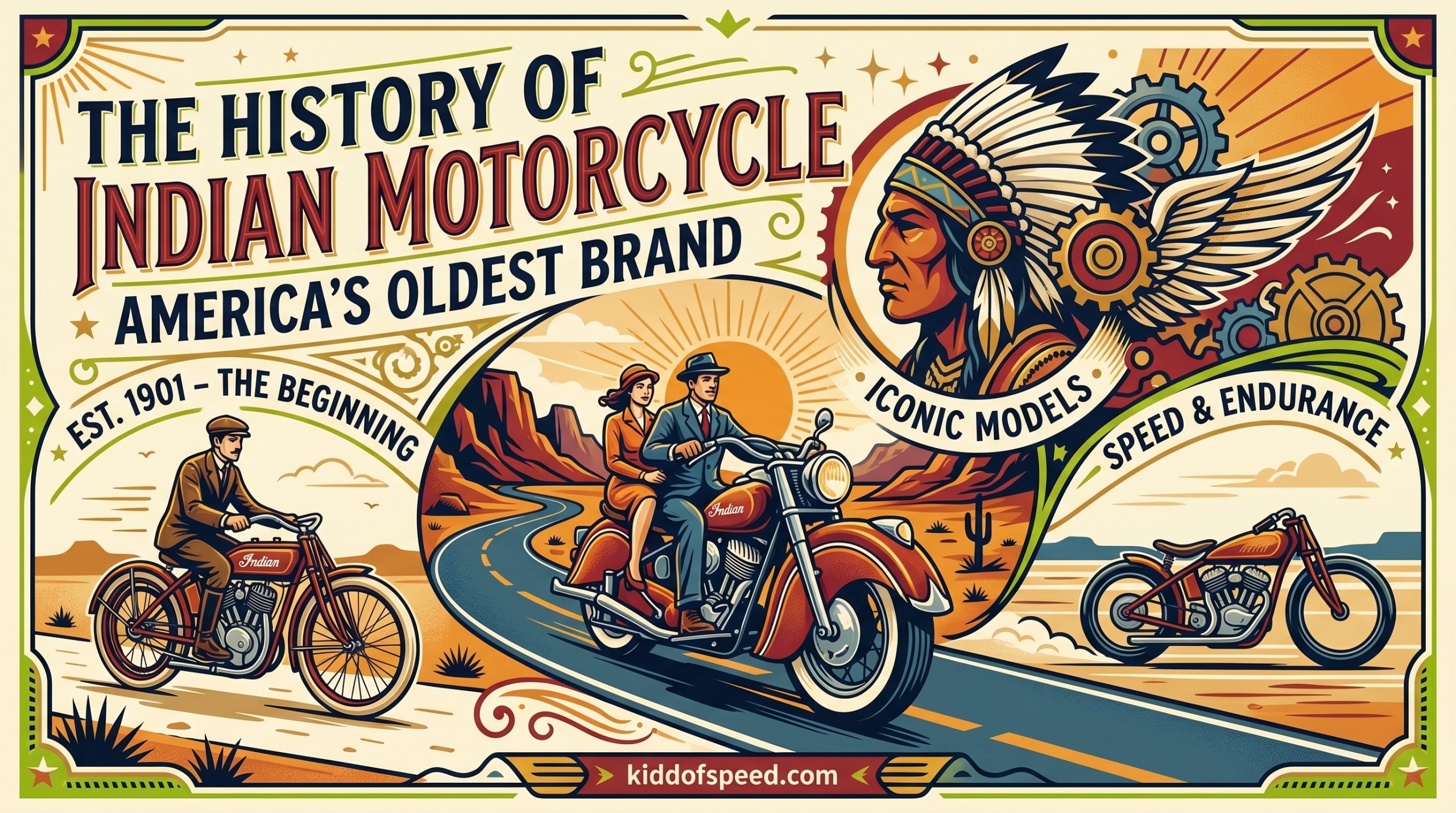
When you think of American motorcycles, one brand stands above all others in terms of heritage and longevity. Indian Motorcycle isn’t just another motorcycle company – it’s America’s oldest motorcycle brand, predating its famous rival by two full years. Founded in 1901, this iconic brand has survived bankruptcy, multiple ownership changes, and decades of dormancy to remain a symbol of American manufacturing pride and innovation.
The story of Indian Motorcycle history spans more than 120 years, filled with racing dominance, technological innovation, and remarkable resilience. From the board tracks of the 1910s to the modern production lines under Polaris ownership, Indian has influenced motorcycle design and culture in ways that still resonate today. Let me take you through the complete history of this legendary American brand.
What makes Indian Motorcycle truly fascinating isn’t just its age – it’s the way the brand has shaped American motorcycling since the very beginning. When George M. Hendee and Oscar Hedstrom built their first motorcycle in Springfield, Massachusetts, they weren’t just creating a product – they were establishing an industry. The innovations, racing victories, and cultural impact that followed would define motorcycling in America for generations.
Table of Contents
- Indian Motorcycle History: America’s First Motorcycle Company
- The Founding: Hendee and Hedstrom’s Vision (1901)
- Corporate Evolution: Name Changes and Ownership
- Golden Age: Racing Dominance and Innovation
- Notable Models: Chief, Scout, and Four
- World War Contributions: Military Service
- Harley-Davidson Rivalry: America’s Two-Wheeled War
- The Decline: What Happened in 1953
- Multiple Revivals: Gilroy, Stellican, and Polaris
- Modern Era: Polaris and the Future
- Legacy and Cultural Significance
- FAQ: Common Questions About Indian Motorcycle History
- What is the oldest motorcycle brand in the US?
- Who is older, Harley or Indian?
- When was Indian Motorcycle founded?
- Why did Indian Motorcycle go out of business?
- Who owns Indian Motorcycle now?
- Where were Indian motorcycles made?
- What does the Indian Motorcycle logo mean?
- What was the best Indian Motorcycle ever made?
- Conclusion: The Enduring Legacy of Indian Motorcycle
Indian Motorcycle History: America’s First Motorcycle Company
Indian Motorcycle history begins at the dawn of American motorized transportation. In an era when automobiles were rare and horses still ruled the roads, two visionaries recognized the potential of motorized two-wheelers. Their partnership would create not just America’s first motorcycle company, but a brand that would define American motorcycling for decades to come.
The significance of Indian Motorcycle in American industrial history cannot be overstated. This was a company that pioneered manufacturing techniques, dominated racing circuits, and created iconic designs that still influence motorcycle styling today. The brand’s survival through multiple bankruptcies and ownership changes testifies to the enduring power of authentic American manufacturing heritage.
The Founding: Hendee and Hedstrom’s Vision (1901)
Every great American manufacturing story begins with two visionaries, and Indian Motorcycle history is no exception. In 1901, George M. Hendee, a former bicycle racing champion, partnered with Oscar Hedstrom, a Swedish-born engineer with exceptional talent for designing engines. Their collaboration in Springfield, Massachusetts would give birth to America’s first motorcycle company.
George M. Hendee brought business acumen and marketing savvy to the partnership. Born in 1866, Hendee had been a champion bicycle racer who understood the American consumer’s desire for speed and reliability. He had been manufacturing bicycles under the “Indian” name since 1897, building a successful business that recognized the emerging potential of motorized transportation.
Oscar Hedstrom provided the technical genius that made Indian motorcycles exceptional. Born in Sweden in 1871, Hedstrom had emigrated to America and established a reputation for creating reliable motorized bicycles. His engineering innovations included improved carburetion systems and more efficient power transfer mechanisms. When Hendee saw Hedstrom’s work, he knew he’d found his partner.
Their first motorcycle, completed in 1901, featured a revolutionary chain drive system that set it apart from the belt-driven motorcycles of the era. This single innovation gave Indian motorcycles superior reliability and performance, establishing a pattern of technical excellence that would continue throughout the company’s history.
The company, originally called the Hendee Manufacturing Company, produced its first production motorcycle in 1902. That year, they built just three motorcycles. By 1903, production had jumped to 143 units. The early Indian motorcycles were immediate successes in racing events, which provided crucial marketing and credibility for the fledgling company.
What made the early Indian motorcycles special? Hedstrom’s engineering innovations included a reliable single-cylinder engine with a horizontal design, improved carburetion, and that chain-drive system that transferred power more efficiently than competitors’ belt drives. The 1.75 horsepower engine could reach speeds of 25 mph – impressive for the era.
These technical advantages, combined with Hendee’s business acumen and racing promotion, created the foundation for what would become America’s dominant motorcycle manufacturer for the first half of the 20th century. The company’s early success established patterns that would define Indian Motorcycle history: technical innovation, racing dominance, and distinctive American styling.
Corporate Evolution: Name Changes and Ownership
Throughout Indian Motorcycle history, the company underwent several significant name changes that reflected its evolution and corporate structure. Understanding these changes helps explain the brand’s complex history and the various incarnations that have carried the Indian name.
Originally founded as the Hendee Manufacturing Company in 1901, the organization kept this name for over two decades. It wasn’t until 1923 that the company officially changed its name to The Indian Motocycle Company – notably spelled without the ‘r’ in ‘motorcycle.’ This unusual spelling was actually intentional, reflecting early 20th century naming conventions and trademark considerations.
The corporate name changes weren’t merely cosmetic – they reflected broader shifts in the company’s identity and market position. The 1923 change from Hendee Manufacturing to Indian Motocycle Company coincided with the brand’s peak market dominance and its establishment as the premier American motorcycle manufacturer.
This corporate naming history matters because it explains why vintage Indian motorcycles and documentation sometimes show different company names. When collectors and historians examine pre-1923 Indians, they’ll find Hendee Manufacturing Company markings. Post-1923 machines bear the Indian Motocycle Company name. These details help authenticate vintage machines and trace their production dates.
Golden Age: Racing Dominance and Innovation
The period from 1910 through the 1940s represents Indian Motorcycle’s golden age – a time when the brand dominated American motorcycling in racing, sales, and technological innovation. This era established Indian as the premier American motorcycle manufacturer and created the legendary models that still define the brand today.
Racing was integral to Indian’s success and identity. In 1911, Indian motorcycles set three speed records at the Brooklyn Velodrome, catching the attention of enthusiasts nationwide. The company’s factory racing team, known as the “Wrecking Crew,” dominated board track racing throughout the 1910s and 1920s.
Board track racing was incredibly dangerous – these wooden oval tracks featured steeply banked turns and speeds that often exceeded 100 mph. Indian riders like Jake DeRosier and Gene Walker became national heroes for their courage and skill. DeRosier in particular established multiple records and became one of the first true motorcycle racing superstars.
The technical innovations that emerged during this golden age were substantial. Indian introduced the first V-twin engine in a production motorcycle in 1907, but it was the 1910 release of the Indian Chief and the 1920 introduction of the Scout that cemented the company’s reputation for building powerful, reliable machines.
The Powerplus engine, introduced in 1916, delivered unprecedented performance and became the benchmark for American motorcycle engines throughout the 1920s. This side-valve V-twin produced 1,000cc of displacement and approximately 18 horsepower – numbers that made Indian the performance leader of its era.
Design elements that became Indian trademarks emerged during this period. The iconic skirted fenders, which covered more of the wheel than any other manufacturer’s design, provided both practical protection from road debris and a distinctive visual identity. These flowing fenders would become perhaps the most recognizable feature of Indian motorcycles.
The war bonnet headdress logo, while controversial by today’s standards, became one of the most recognizable trademarks in American motorcycling. This Native American imagery defined the brand’s identity and marketing for over a century, creating both brand recognition and cultural complexity that continues to this day.
Notable Models: Chief, Scout, and Four
Throughout Indian Motorcycle history, certain models have stood out as defining machines that captured the essence of the brand. Understanding these iconic models helps explain why Indian motorcycles remain so revered among enthusiasts and collectors.
The Indian Chief, introduced in 1922, became the flagship of the Indian line and the model most associated with the brand’s identity. Featuring a 1,200cc V-twin engine, the Chief delivered power and torque that made it ideal for both touring and sidecar use. The Chief’s distinctive styling included those skirted fenders, a streamlined fuel tank, and comfortable riding position that made it popular with police departments and civilian riders alike.
The Indian Scout, introduced in 1920, represented a smaller, more nimble alternative to the Chief. With a 600cc V-twin engine, the Scout offered excellent handling and performance that made it popular for both street riding and racing. The Scout’s reputation for reliability and fun riding experience earned it a devoted following that continues to this day.
The Indian Four, produced from 1928 to 1942, represented the ultimate in luxury and sophistication. This unique motorcycle featured an inline-four cylinder engine arranged in a square configuration – essentially two V-twin engines paired together. The Four produced smooth power and was marketed as a premium touring motorcycle for discerning riders who wanted the best.
These three models – Chief, Scout, and Four – formed the core of Indian’s lineup throughout its golden age. Each served a different segment of the market, from performance enthusiasts to touring riders to luxury buyers. This diverse product line helped Indian maintain market dominance through the 1930s and 1940s.
World War Contributions: Military Service
World War I and World War II both brought significant government contracts to Indian Motorcycle, shaping the company’s production capabilities and establishing its reputation for durability and reliability. Understanding Indian’s military service provides insight into the brand’s role in American history.
During World War I, Indian supplied nearly 50,000 motorcycles to Allied forces between 1917 and 1919. These military motorcycles featured specialized equipment including rifle scabbards, saddlebags, and reinforced frames designed for rugged service. The reliability of Indian motorcycles under combat conditions established the brand’s reputation for building tough, dependable machines.
The military experience influenced Indian’s civilian motorcycle designs. Technologies proven in wartime service – including improved suspension, more reliable electrical systems, and strengthened components – found their way into production motorcycles. This cross-pollination between military and civilian applications benefited consumers and strengthened the brand.
During World War II, the company produced the Model 841, a shaft-driven motorcycle specifically designed for desert warfare in North Africa. The 841 featured a unique V-twin engine with the cylinders arranged 90 degrees apart for better cooling, plus shaft drive instead of chain drive for reduced maintenance in dusty conditions. However, most military motorcycle production during WWII went to Harley-Davidson, as the War Department prioritized simpler designs that could be produced more quickly.
The military contracts provided crucial revenue during difficult economic times and helped Indian maintain production capacity through the Great Depression. However, the company’s dependence on government business also created vulnerability when military orders ended, contributing to the financial challenges that would eventually lead to Indian’s decline.
Harley-Davidson Rivalry: America’s Two-Wheeled War
The rivalry between Indian and Harley-Davidson is one of the most famous competitive relationships in American business history. Harley-Davidson was founded in 1903, two years after Indian, and for the next five decades, these two companies battled for market dominance, racing victories, and the hearts of American riders.
The competition played out on multiple fronts. On the racetrack, Indian and Harley teams traded victories in the most prestigious events of the era, including the Daytona 200 and hill climb competitions. In the showroom, both companies offered similar V-twin-powered machines, but with distinct design philosophies. Indian generally emphasized innovation and performance, while Harley focused on evolution and reliability.
Market share fluctuated over the decades. Indian held the lead through much of the 1910s and 1920s, benefiting from Hendee and Hedstrom’s early start and technical innovations. Harley-Davidson gained ground during the Great Depression when Indian struggled with financial difficulties. By the 1940s, the two companies were roughly equal in market share, each commanding about 50% of the American motorcycle market.
The racing competition was particularly intense. Both companies factory racing teams dominated American board track and dirt track racing throughout the 1910s and 1920s. Indian’s “Wrecking Crew” and Harley’s “Wrecking Crew” (yes, both used similar names) traded victories in spectacular fashion. These racing battles generated enormous publicity and helped establish both brands as serious performance machines.
So why did Harley-Davidson survive while Indian disappeared? The answer lies in post-WWII management decisions. Harley-Davidson focused on meeting the demand of returning veterans with affordable, reliable motorcycles. They continued producing their proven big twin models while gradually introducing improvements and new features. Indian, under new ownership, made expensive investments in lightweight models that failed to capture the market. This strategic divergence ultimately determined which company would survive the challenging postwar years.
The Decline: What Happened in 1953
The decline and fall of the original Indian Motorcycle is a story of missed opportunities, management missteps, and postwar economic challenges. After dominating American motorcycling for decades, Indian’s decline was as dramatic as its rise had been impressive. Understanding what happened in 1953 helps explain one of the great mysteries in American business history.
The trouble began in the years following World War II. Under the ownership of Ralph B. Rogers, who had acquired the company in 1945, Indian made a series of strategic decisions that would prove disastrous. Rogers was a textile manufacturer with limited experience in the motorcycle industry, and his decisions would ultimately doom the original company.
The company invested heavily in developing lightweight motorcycles like the Arrow, Scout, and Warrior – models designed to compete with imported British machines. These bikes featured modern overhead valve engines and unit construction, but they suffered from quality control problems and failed to capture the market. American riders in the postwar period wanted big, powerful V-twins, not small displacement Europeans.
Meanwhile, Indian neglected its proven large V-twin models – the Chief and the Super Chief – that had been the company’s bread and butter. Production of these flagship models became increasingly sporadic as resources were diverted to the unsuccessful lightweight line. Dealers grew frustrated as they couldn’t get the motorcycles their customers actually wanted.
Financial problems mounted through the late 1940s and early 1950s. A strike in 1949 halted production for months, costing the company valuable momentum and market share. The development costs for the lightweight models drained cash reserves without generating corresponding sales. By 1952, Rogers had ceased all motorcycle production, though he continued to sell parts and service existing motorcycles.
The final blow came in 1953 when the Hendee Manufacturing Company, now called the Indian Motocycle Company (notably without the ‘r’ in motorcycle), declared bankruptcy and ceased operations. The assets were purchased by Brockhouse Engineering, a British company, which subsequently sold the Indian name to the Associated Motorcycles Cycles (AMC) in Britain. This marked the end of Indian Motorcycle as an American manufacturer and the beginning of a complicated era of foreign ownership and licensing arrangements that would last for decades.
Multiple Revivals: Gilroy, Stellican, and Polaris
One of the most remarkable aspects of Indian Motorcycle history is the number of times the brand has been revived from the ashes. The original company may have died in 1953, but the Indian name proved too valuable to remain dormant. Three major revival attempts have occurred, each with different approaches and varying degrees of success.
The Gilroy Era (1999-2003)
The Gilroy era represents the first significant attempt to revive Indian Motorcycle in the United States. A group of investors led by Rey Sotille and Fran O’Hagan purchased the Indian trademark and established a new factory in Gilroy, California. They produced motorcycles inspired by the classic Chief design, powered by S&S engines.
The Gilroy Indians featured modern components wrapped in nostalgic styling. The big V-twin engines displaced 100 cubic inches (1,640cc) and produced substantial power. The styling deliberately evoked the classic Chiefs with skirted fenders, valanced tanks, and plenty of chrome. For the first time in nearly 50 years, new Indian motorcycles were rolling out of an American factory.
However, the company struggled with quality issues, financial mismanagement, and production delays. Prices were high – some models exceeded $30,000 – which limited the market. Approximately 1,500 motorcycles were built before the company ceased operations in 2003. While the Gilroy era demonstrated that there was still demand for the Indian brand, it also revealed the challenges of reviving a dormant motorcycle manufacturer.
The Stellican Era (2004-2011)
The Stellican era followed, when British investment company Stellican Limited acquired the Indian assets and moved operations to Kings Mountain, North Carolina. This revival focused on producing limited-production, high-end motorcycles that emphasized traditional Indian styling and craftsmanship.
Unlike the Gilroy era’s focus on volume production, Stellican took a boutique approach. They produced small numbers of carefully assembled motorcycles using traditional methods and premium components. The bikes were well-received by enthusiasts and collectors who appreciated their attention to detail and historical accuracy.
Production volumes remained low and the company struggled to achieve sustainable profitability. Approximately 200 motorcycles were built during this period. While the Stellican era kept the Indian name alive and demonstrated commitment to quality, it couldn’t achieve the scale necessary for long-term success.
The Polaris Era (2011-Present)
The Polaris era began in 2011 and represents the most successful revival to date. Polaris Industries, a major powersports manufacturer known for Victory motorcycles and snowmobiles, acquired Indian Motorcycle and brought significant manufacturing resources, distribution networks, and engineering expertise to the brand.
Polaris invested hundreds of millions in developing new models, including the updated Chief, Scout, and FTR series. They maintained the classic styling cues that define Indian’s identity while incorporating modern engineering and technology. Under Polaris ownership, Indian has returned to being a serious competitor in the American motorcycle market, with annual production reaching approximately 30,000 units by the mid-2010s.
The key to Polaris’s success has been combining Indian’s heritage with modern business practices and manufacturing capabilities. They’ve created a full line of motorcycles that appeal to different segments of the market while maintaining the distinctive Indian identity. The revival of Indian’s racing program, including victories in American Flat Track competition, has reconnected the brand with its competitive roots.
Modern Era: Polaris and the Future
Today’s Indian Motorcycle, under Polaris ownership, represents both a return to the brand’s heritage and an evolution toward modern performance and technology. The current lineup includes motorcycles that honor classic models while incorporating contemporary engineering and features that today’s riders demand.
The modern Indian Chief, with its distinctive skirted fenders and V-twin engine, represents the direct continuation of the model line that made Indian famous. Available in multiple variants including the Chief Dark Horse, Chief Vintage, and Chieftain, the modern Chief offers riders the classic Indian experience with modern reliability and performance. The Thunder Stroke 116 engine produces 116 cubic inches (1,898cc) of displacement, far exceeding the original Chiefs.
The Scout has been reimagined as a smaller, more accessible motorcycle that appeals to a new generation of riders. With a liquid-cooled 1,133cc V-twin engine, the modern Scout offers manageable size and weight without sacrificing performance. The Scout Bobber and Rogue variants provide different styling interpretations while maintaining the Scout’s essential character as a fun, agile motorcycle.
Perhaps most notably, the FTR 1200 represents Indian’s entry into the performance segment with a flat track-inspired design that nods to the company’s racing heritage. With a liquid-cooled 1,203cc V-twin engine producing over 120 horsepower, the FTR 1200 is a thoroughly modern motorcycle that still connects to Indian’s racing roots through its styling and competition success.
Manufacturing takes place in Spirit Lake, Iowa, where Indian motorcycles are assembled alongside Polaris’s other powersports products. While some components are sourced globally, the company emphasizes American design, engineering, and assembly. The factory has created hundreds of jobs and represents a significant investment in American manufacturing.
The brand has also returned to racing, competing in American Flat Track events and achieving significant victories that connect to the company’s racing dominance from a century ago. This racing program provides both marketing exposure and technical development that benefits production motorcycles.
Legacy and Cultural Significance
The history of Indian Motorcycle is more than just a business story – it’s a chapter in American industrial and cultural history. For over 120 years, through multiple incarnations, Indian has represented American ingenuity, racing excellence, and the freedom of the open road.
The brand’s influence on motorcycle design continues to this day. The skirted fenders, valanced fenders, and flowing lines that defined classic Indians can be seen in motorcycles from numerous manufacturers. The emphasis on V-twin power, touring comfort, and distinctive styling that Indian pioneered became the template for the American cruiser segment.
Enthusiast communities dedicated to preserving and restoring vintage Indians remain active and passionate. Pre-1953 Indians, particularly Chiefs and Scouts from the 1940s and early 1950s, are among the most valuable and collectible American motorcycles. A fully restored 1948 Chief in excellent condition can command six figures at auction.
The knowledge and expertise required to maintain these vintage machines keeps the brand’s history alive in workshops and garages across the country. Specialist mechanics, parts suppliers, and restoration shops support a thriving vintage Indian community. This dedication to preservation ensures that the earliest chapters of Indian Motorcycle history remain accessible to future generations.
The survival of the Indian Motorcycle name through multiple bankruptcies and revivals is a testament to the power of brand heritage. Despite decades of dormancy and multiple failed attempts to restart production, the Indian name retained enough value and meaning to attract new investors willing to try again. This resilience suggests that the story of Indian Motorcycle is far from over.
FAQ: Common Questions About Indian Motorcycle History
What is the oldest motorcycle brand in the US?
Indian Motorcycle is the oldest motorcycle brand in the United States, founded in 1901 by George M. Hendee and Oscar Hedstrom in Springfield, Massachusetts. This makes Indian two years older than Harley-Davidson, which was founded in 1903. Indian Motorcycle has operated continuously for over 120 years, through multiple ownership changes and revivals, making it the longest-running American motorcycle brand in history.
Who is older, Harley or Indian?
Indian Motorcycle is older than Harley-Davidson by two years. Indian was founded in 1901, while Harley-Davidson was established in 1903. Both brands are among the oldest American motorcycle manufacturers still in existence today. Indian’s early start gave it a significant market advantage in the early 1900s, though Harley-Davidson eventually surpassed Indian in sales and survived the challenging postwar years that led to Indian’s original bankruptcy in 1953.
When was Indian Motorcycle founded?
Indian Motorcycle was founded in 1901 by George M. Hendee and Oscar Hedstrom. The first motorcycle was produced that same year in Springfield, Massachusetts, with production models following in 1902. The company was originally called the Hendee Manufacturing Company and didn’t change its name to The Indian Motocycle Company until 1923. The first production year, 1902, saw just three motorcycles built, but by 1903 production had increased to 143 units.
Why did Indian Motorcycle go out of business?
The original Indian Motorcycle went out of business in 1953 due to a combination of factors including failed investments in lightweight models, quality control problems, management missteps, financial difficulties, and the loss of market share to Harley-Davidson after World War II. Under owner Ralph B. Rogers, Indian neglected its successful big V-twin models in favor of unprofitable lightweight motorcycles. A 1949 strike halted production for months, and by 1952 all motorcycle production had ceased. The company declared bankruptcy in 1953, ending the original Indian Motorcycle as an American manufacturer.
Who owns Indian Motorcycle now?
Indian Motorcycle is currently owned by Polaris Industries, which acquired the brand in 2011. Polaris is a major powersports manufacturer that also produces Victory motorcycles, snowmobiles, and off-road vehicles. Under Polaris ownership, Indian has returned to being a significant player in the American motorcycle market, with annual production reaching approximately 30,000 units. Polaris has invested hundreds of millions in new models, manufacturing facilities, and racing programs, making this the most successful revival in Indian Motorcycle history.
Where were Indian motorcycles made?
Historically, Indian motorcycles were made in Springfield, Massachusetts from 1901 through the original company’s bankruptcy in 1953. During the Gilroy era revival (1999-2003), motorcycles were produced in Gilroy, California. The Stellican era (2004-2011) saw production in Kings Mountain, North Carolina. Currently, under Polaris ownership, Indian motorcycles are manufactured in Spirit Lake, Iowa. Each manufacturing location represents a different chapter in Indian Motorcycle history, with Springfield being the original and most significant production location.
What does the Indian Motorcycle logo mean?
The Indian Motorcycle logo features a Native American chief in profile wearing a war bonnet headdress. This imagery was chosen by the company’s founders to represent American heritage, strength, and freedom. The logo became one of the most recognizable trademarks in motorcycling. However, the use of Native American imagery has become increasingly controversial in recent years, with debates about cultural appropriation and respect for indigenous cultures. The brand has evolved its marketing approach while maintaining visual continuity with its historical identity.
What was the best Indian Motorcycle ever made?
While opinions vary among enthusiasts, several Indian models are considered the best ever made. The 1946-1948 Indian Chief is widely regarded as the pinnacle of the original company’s production, featuring excellent build quality and classic styling. The 101 Scout (1928-1931) is considered by many to be the best-handling motorcycle of its era. Among modern Indians under Polaris ownership, the FTR 1200 has received critical acclaim for its performance and innovation. The Indian Four (1928-1942) represents the ultimate in luxury and sophistication from the golden age.
Conclusion: The Enduring Legacy of Indian Motorcycle
The history of Indian Motorcycle represents a uniquely American story of innovation, rivalry, decline, and remarkable resilience. From its founding in 1901 by Hendee and Hedstrom, through its golden age of racing dominance and technological innovation, to its dramatic decline in 1953 and multiple revivals, Indian Motorcycle has earned its place as America’s oldest motorcycle brand.
What makes Indian Motorcycle history so compelling is not just the longevity, but the passion the brand continues to inspire. Enthusiasts who have never seen a running original Indian still recognize the name and the distinctive styling that defined the brand for decades. The survival of the Indian name through multiple bankruptcies and ownership changes testifies to the enduring power of authentic American manufacturing heritage.
Today, under Polaris ownership, Indian Motorcycle continues to evolve while honoring its past. The modern Indians connect to the legacy of the Chief, Scout, and Four – models that defined motorcycling for generations of American riders. The brand’s return to racing competition reconnects with the competitive spirit that drove Indian’s original founders and racers.
The complete history of Indian Motorcycle is more than just corporate chronology – it’s the story of American motorcycling itself, written in steel, chrome, and the determination of riders and builders who refused to let a legend die. Whether you’re a historian, an enthusiast, or simply someone who appreciates American manufacturing heritage, Indian Motorcycle remains a symbol of innovation, resilience, and the enduring appeal of the open road.
As Indian Motorcycle moves into its second century, the brand carries with it over 120 years of history, innovation, and the indomitable spirit that has allowed it to survive against all odds. From the board tracks of the 1910s to the modern production lines in Iowa, Indian Motorcycle continues to represent the best of American manufacturing – past, present, and future.