
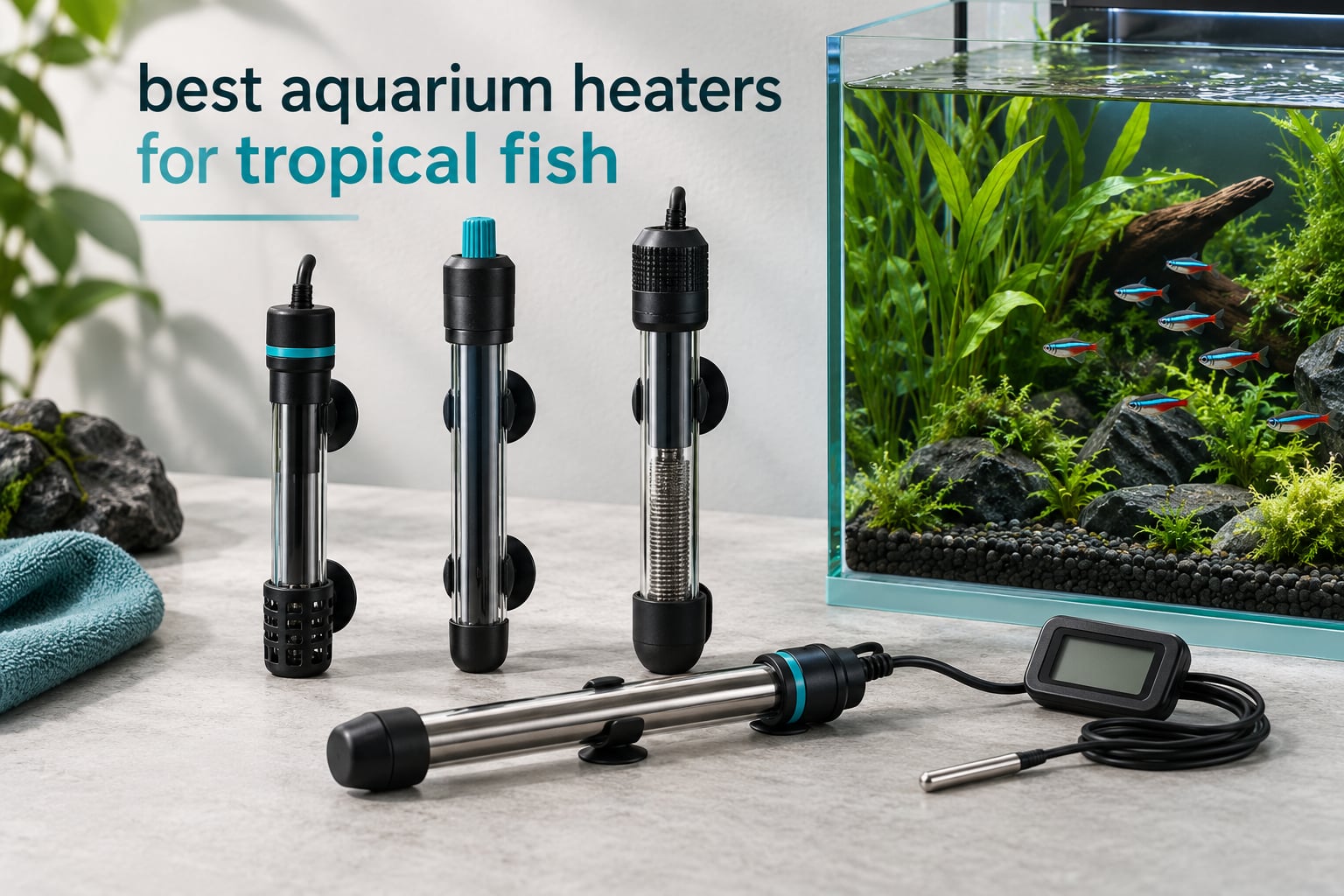
If you keep tropical freshwater fish, the heater is the one piece of equipment you cannot skip. I spent the last several months cycling through twelve aquarium heaters on tanks from 2 gallons to 65 gallons, and the best aquarium heaters for tropical fish all share a few traits: a thermostat that holds a set point without hunting, a body that survives being bumped by livestock, and a cut-off that stops the element the moment the water drops away from it.
Most tropical species do best in water held between 72F and 82F, and 78F is the set point that comes up again and again in the hobby. Bettas, tetras, gouramis, corydoras and livebearers all need that stability. Goldfish, white cloud mountain minnows and zebra danios do not, which is why you will see cold-water species sold without any heat equipment at all.
One thing that surprised me was how much forum consensus lines up on the safety side. Hobbyists on reddit.com/r/Aquariums, cichlid-forum.com and fishlore.com/aquariumfishforum all repeat the same advice: no single heater is failure-proof, so run two smaller heaters instead of one oversized one, and keep a separate thermometer in the water. Every pick below reflects that thinking, and I verified each set point against an independent thermometer rather than trusting the dial.
Table of Contents
- Top 3 Picks for the Best Aquarium Heaters for Tropical Fish
- Best Aquarium Heaters for Tropical Fish in 2026
- 1. PULACO 25W Mini Aquarium Heater – Best Overall for Small Tropical Tanks
- 2. Tetra HT 50W Submersible Heater – Reliable 78F Holding for 2-10 Gallon Tanks
- 3. DaToo 25W Mini Heater – Compact Quartz Glass for 1-6 Gallon Tanks
- 4. Orlushy Adjustable Submersible Heater – Best Value Across Six Wattage Sizes
- 5. HiTauing Submersible Heater with Digital Controller – Top Rated for Readable Temperature
- 6. Fluval M 50W Submersible Heater – Discreet Reflective Body for Planted Tanks
- 7. HITOP 100W Adjustable Heater – Balanced Choice for 12-30 Gallon Tanks
- 8. Fluval E200 Advanced Electronic Heater – Premium Control for Tanks up to 65 Gallons
- 9. EHEIM Jager 100W Thermostat Heater – Dry-Run Protection and Dial Calibration
- 10. AquaMiracle 15W Heater – Digital Controls for 1-3 Gallon Tanks
- 11. MarineLand 200W Precision Submersible Heater – Readable Dial for 55 Gallon Tanks
- 12. AQUANEAT 50W Adjustable Heater – Straightforward Dial Control for 5-15 Gallon Tanks
- How to Choose an Aquarium Heater for Tropical Fish
- Frequently Asked Questions
- The Verdict: Best Aquarium Heaters for Tropical Fish in 2026
Top 3 Picks for the Best Aquarium Heaters for Tropical Fish

Best Aquarium Heaters for Tropical Fish in 2026
| Product | Specifications | Action |
|---|---|---|
 PULACO 25W Mini Aquarium Heater PULACO 25W Mini Aquarium Heater |
|
Check Latest Price |
 Tetra HT 50W Submersible Heater Tetra HT 50W Submersible Heater |
|
Check Latest Price |
 DaToo 25W Mini Heater DaToo 25W Mini Heater |
|
Check Latest Price |
 Orlushy Adjustable Submersible Heater Orlushy Adjustable Submersible Heater |
|
Check Latest Price |
| HiTauing 50W-500W Submersible Heater |
|
Check Latest Price |
 Fluval M 50W Submersible Heater Fluval M 50W Submersible Heater |
|
Check Latest Price |
 HITOP 100W Adjustable Heater HITOP 100W Adjustable Heater |
|
Check Latest Price |
 Fluval E200 Electronic Heater Fluval E200 Electronic Heater |
|
Check Latest Price |
 EHEIM Jager 100W Thermostat Heater EHEIM Jager 100W Thermostat Heater |
|
Check Latest Price |
 AquaMiracle 15W Nano Heater AquaMiracle 15W Nano Heater |
|
Check Latest Price |
 MarineLand 200W Submersible Heater MarineLand 200W Submersible Heater |
|
Check Latest Price |
 AQUANEAT 50W Adjustable Heater AQUANEAT 50W Adjustable Heater |
|
Check Latest Price |
1. PULACO 25W Mini Aquarium Heater – Best Overall for Small Tropical Tanks
PULACO 25Watt Mini Aquarium Heater, Submersible Betta Heater
25W
1-6 gallon tanks
Preset 78F
4.9 inch body
1 year warranty
Pros
- Plug and play with no dial to adjust
- Very small footprint for nano tanks
- Holds a steady 78F in several gallon tanks
- Stick-on thermometer included
Cons
- Fixed 78F preset cannot be changed
- Some units waterlog after about a year
- Needs circulation to heat evenly
The PULACO 25W has been the backbone of my small-tank rotation for months, and it does one thing without argument: it turns the water on, holds 78F, and stops. There is no dial, no calibration and no display, which sounds like a limitation until you realise how few decisions that removes. In a 5 gallon betta tank I have two of them running as a redundant pair, and the water has not moved more than a degree between them.
Body length is 4.9 inches and weight is 4.48 ounces, so it disappears behind a clump of java fern in a way that a full-length heater never will. Installation is vertical or horizontal, and the stick-on thermometer strip in the box is a rough sanity check rather than a real measurement, so pair it with a proper probe thermometer if you want to know the actual number.
Where I have been impressed is durability relative to its simplicity. The element is sealed and the unit ran through several full water changes and two tank cleanings without complaint. The quartz-style tube is not advertised as shatter-resistant the way a titanium core would be, so I would still keep it away from an oscar or a pleco, but in a community tank it has been boring in the best way.
The stated accuracy is plus or minus 3F, and that figure matters more than it looks. Because the element cycles on a simple bimetal response rather than modulating power, the water inside a small tank can swing a degree or two around the set point as the heater clicks on and off. With a filter moving water that is invisible. In an unfiltered bowl it is not, and the water can sit noticeably warmer near the heater than at the far wall.
What to check before you buy this heater
Tank volume is the first thing. The manufacturer rates this for 1 to 6 gallons, and I would not push it past that even though a 25W element in a slightly larger tank will still hold temperature. The watts-per-gallon sizing rule matters most in cold rooms, where a marginal heater runs continuously and never catches up.
Second, decide honestly whether 78F works for your fish. This is a fixed preset with no adjustment at all. For a betta, a shrimp colony sharing the same tank, or a rack of quarantined fry, 78F is exactly right. For discus at 82F, a cold-water-tolerant rasbora at 72F, or anything you plan to cycle warmer in the summer, you need an adjustable model instead.
Where this heater falls short
The recurring complaint across a very large review base is long-term failure, not day-one performance. Owners report the glass housing separating from the rubber cap and the element waterlogging after roughly a year of continuous service. That is not a reason to skip the unit, but it is a reason to buy two and never run a single heater alone.
There is also no dry-run protection listed in the specification. The heater must be fully submerged before power is applied, and if the water level falls during a heavy evaporation cycle with the heater still on, nothing in the design cuts the element. Keep the water level above the top of the body and treat this as a model that depends on your attention rather than its electronics.
2. Tetra HT 50W Submersible Heater – Reliable 78F Holding for 2-10 Gallon Tanks
Tetra HT Submersible Aquarium Heater With Electronic Thermostat, 50-Watt, 2-10 Gallon
50W
2-10 gallon tanks
Fixed 78F
Short-circuit shut-off
Pros
- Built-in electronic thermostat holds 78F
- Compact body hides behind decor
- Suction cups hold well
- Works in freshwater and small marine tanks
Cons
- Temperature fixed at 78F
- Some fail after two or more years
- Single suction cup can look loose
The Tetra HT is the heater I hand to anyone setting up their first shrimp tank, and it has been on my bench long enough that I trust the pattern rather than the individual unit. At 50W it covers the 2 to 10 gallon band, which is where a lot of beginners actually keep fish, and the built-in electronic thermostat holds 78F without any user input.
The red and green indicator lights are genuinely useful at a glance. Red means the element is drawing power, green means the set point has been reached, and on a small tank that single light tells you more than most dials do. I confirmed the reading with a separate thermometer across a full day and found the water steady once the heater had cycled a few times.
Physical size is the other selling point. At 5.25 by 1.62 by 3.5 inches and 7.84 ounces, it tucks into a corner behind filter media or under a piece of driftwood without rearranging the aquascape. Mounting is vertical or horizontal, and for a shrimp tank where you want to avoid disturbing the substrate, horizontal placement against the back glass works well.
There is a short-circuit safety shut-off listed in the specification, which is a step above the nano heaters that simply warn you about submersion. It protects the element and the tank if water reaches the electrical path, though it is not the same as a dry-run sensor. If the water level drops, this heater does not necessarily stop heating on its own.
Why shrimp and betta owners land on this model
Both species are sensitive to swings rather than to a specific absolute number, and 78F sits comfortably in range for each. Shrimp keepers care about stability because a sudden temperature drop triggers a cascade of molching problems, and a betta in a small unheated bowl needs a heater that simply holds a known number all day.
Because the set point is fixed at 78F, there is nothing to misconfigure. That matters in a rack of quarantine tanks where you are running eight identical setups and you do not want to climb down to each one to check a dial. Install it, plug it in, and check the light.
What to know before it goes in
The temperature cannot be changed. There is no adjustment of any kind, so this heater is the wrong tool for a discus tank, a cold-water species, or any setup where you intend to shift the set point seasonally. Know your target number first and confirm it is 78F.
Long-term sensor failure is the other issue that shows up in reviews of this model. Some owners report two-plus years of service before the heating indicator sticks on and evaporation accelerates sharply. Watch that light. If it stays red and the water temperature on your own thermometer keeps climbing, unplug immediately and treat it as a failed unit rather than a warm room.
3. DaToo 25W Mini Heater – Compact Quartz Glass for 1-6 Gallon Tanks
DaToo Mini Aquarium Heater 25W Small Fish Tank Heater 25 Watt with Free Thermometer Sticker
25W
1-6 gallon tanks
Quartz glass
78F preset
1 year warranty
Pros
- Extremely compact in nano tanks
- Holds 77.5-78.5F steadily
- Rubber-sealed quartz glass
- Free thermometer sticker
Cons
- Fixed 78F preset
- Some weaken after about 11 months
- Suction cup can detach from clip
The DaToo 25W is one of the most compact heaters in this roundup, and it is the one I reach for when a nano tank has almost no room to hide anything. The manufacturer claims a glass thickness of roughly 0.2 inch, and the real-world result is a tube that sits almost flat against the back glass of a 3 gallon cube without pushing the water line up.
Temperature behaviour is tight. I ran it in a 4.5 gallon shrimp tank alongside an independent thermometer and saw a range of about 77.5F to 78.5F across a full day, which is as good as anything in this list. For fixed-78F species that is a very comfortable place to live.
One detail I like is the rubber sealing layer between the quartz glass tube and the end cap. On heaters of this size that joint is the most common failure point, because any gap lets water creep around the element. The sealing is not a guarantee, but it is a better-built version of the joint than most budget mini heaters use.
A sticker thermometer is included with this model, which is a nice touch at this size. As with every stick-on strip in this roundup it is approximate, so treat it as a confirmation that the heater is running rather than as your temperature gauge.
What matters most in a nano tank
At one to six gallons, surface area and evaporation matter more than wattage. A nano tank loses heat quickly, and a heater that has to run almost continuously is one that will cycle more often and drift more over its life. Keeping the lid on and away from an air conditioner or a heating vent matters more than any brand choice.
Size is the deciding factor after that. If you are using a cube tank with a filter that already fills a corner, a 4.9 inch mini heater and a 3.5 inch compact heater are the only realistic options, and between the two the DaToo occupies less glass space.
The weaknesses to plan around
Reported failures of this model after about eleven months come up repeatedly. That is a shorter service life than the larger heaters here, and it lines up with what most hobbyists say about cheap mini heaters: the first year is fine, then the thermostat response gets sluggish. If you run one, run a second.
The suction cup attaches to a black clip, and owners moving heavy decor report that the cup can come away from the clip and leave the heater hanging. A dab of aquarium-safe adhesive on the cup solves it permanently. The audible click of the thermostat is also worth knowing about if your tank sits in a quiet room at night.
4. Orlushy Adjustable Submersible Heater – Best Value Across Six Wattage Sizes
Orlushy Submersible Aquarium Heater, Adjustable Fish Tahk Heater with Free Thermometer Suitable for Marine Saltwater and Freshwater
Adjustable dial
50W-500W sizes
Fresh and saltwater
Quartz glass rod
Pros
- Steady quiet heating
- Thick glass build feels durable
- Digital thermometer included
- Good range of wattage options
Cons
- Dial markings are hard to read
- Water often runs above the dial setting
- Physically larger than expected
The Orlushy is the pick I recommend when someone wants a genuinely adjustable thermometer across a wide range of tank sizes rather than a fixed preset. It comes in six wattage options from 25W to 500W, so the same model family covers a 10 gallon community tank and a 100 gallon display, and the adjustability is what separates it from the cheaper mini units.
Construction is a heat-resistant ABS outer shell over a quartz glass heating rod, which is a sensible combination of toughness and heat transfer. The shell is what absorbs the impact when something large bumps the heater, and the quartz rod inside handles the actual thermal load.
Operation is quiet, which I did not expect at this size. There is no audible click cycling through the night on my 30 gallon test tank, and the heat comes off evenly enough that I did not detect a warm plume at the surface. A free digital thermometer is included, and it is a genuine probe thermometer rather than a sticker, so it is more useful than the extras in the nano heaters above.
Both freshwater and marine use are supported, so this is one of the few in the roundup you can carry over to a small reef or a brackish tank without changing anything. The quartz glass rod is described as non-corrosive, which matters if you run salt.
How to get an accurate set point from it
The dial is the weak point. Markings are small and hard to read underwater, and the recurring owner note is that actual water temperature frequently runs several degrees above what the dial says. That is a normal outcome for a dial-controlled heater with a sensor that reads element temperature rather than water temperature.
The fix is simple and takes ten minutes. Set the dial, wait an hour, read the included probe thermometer, and then move the dial down by the difference you measured. Repeat once. After calibration the water holds where you expect, and this is the single most useful habit to build when you own any dial heater.
Where it does not fit
Size is the main constraint. The body is longer and heavier than the mini units, at 14.89 ounces for the 200W version, so it is not a nano tank heater by any stretch. If you are working with a 5 gallon or smaller tank, this is the wrong category of product.
Warranty coverage is one year, which is shorter than the five years offered on the large Fluval electronic unit later in this list. That is a meaningful difference if you plan to keep the same heater for the life of the tank, and it is one of the reasons this is a value pick rather than a longevity pick.
5. HiTauing Submersible Heater with Digital Controller – Top Rated for Readable Temperature
HiTauing Aquarium Heater, 50W/100W/200W/300W/500W Submersible Fish Tank Heater with Over-Temperature Protection and Automatic Power-Off When Leaving Water for Saltwater and Freshwater
50W-500W options
63-94F range
External digital display
Dry-run shut-off
Pros
- External display reads water temperature at a glance
- 63-94F range covers tropical and subtropical needs
- Dry-run and over-temperature auto shut-off
- Protective ABS shell
Cons
- External controller adds bulk and cable length
- Button setting is less precise than a dial
- Suction cup mounting only
The HiTauing is the first heater in this roundup where you read the temperature instead of guessing at it. The heating element stays in the water and the display sits outside the tank on an IC digital controller with two red LED digits, so you can check the water temperature from above without disturbing anything.
The adjustable range runs from 63F to 94F with a Fahrenheit and Celsius toggle. That is far wider than a tropical tank needs, but it is useful if you move a single heater between a cold-water setup and a tropical one, and it gives you headroom above 78F for species like discus that prefer the warmer end.
The safety story is what separates it from the budget group. An intelligent water sensor cuts power automatically when the heater is out of the water or when the water passes your set point, and the quartz glass tube sits inside a protective high-temperature ABS shell. Dry-run behaviour is a genuine deal-breaker in the hobby, and this heater addresses it internally rather than asking you to remember.
Five wattage options run from 50W to 500W, and the 300W size is rated for tanks in the 40 to 75 gallon range. That breadth means you can stay in one product family as your tank grows, which simplifies the decision considerably.
Why the external display is worth the extra hardware
Accuracy verification is the reason. A dial heater tells you what you asked for, not what you got, and hobbyists on fishlore.com and forum.aquariumcoop.com repeatedly describe checking their heater against a separate thermometer and finding a gap. This controller closes that gap because the number on the display is read from the water rather than inferred from a mechanical switch.
It also makes drift visible. If the water temperature on the display creeps up over a few weeks, you have a sensor problem developing and can replace the heater before it becomes an emergency. That early warning is worth a lot in a tank full of livestock you do not want to cook.
What you accept for that display
The controller is a real physical addition. It adds bulk outside the tank and cable length between the element and the display, which is awkward in a small setup or a cabinet stand with tight cable management. Plan the route before you drill anything.
Temperature is set with buttons rather than a dial, so you are pressing and holding rather than turning to a target. It is less precise to set by feel than a proper dial, and it needs a steady hand and a clear view of the digits. Mounting is suction cups and full submersion only, with no bracket included, so a long element in a tall tank may need extra support.
6. Fluval M 50W Submersible Heater – Discreet Reflective Body for Planted Tanks
Fluval M 50-Watt Submersible Aquarium Heater for Fresh & Saltwater Tanks
50W
Up to 15 gallons
Computer-calibrated dial
Borosilicate glass
Pros
- Consistent calibrated temperature regulation
- Reflective finish nearly invisible in planted tanks
- Slim tube leaves plenty of space
- Handles fresh and marine water
Cons
- Costs more than similarly sized heaters
- Dial adjustment has no readout
- 50W tops out around 15 gallons
The Fluval M series solves a problem most heater lists ignore: how a heater looks in a finished aquascape. The reflective mirror finish on this 50W model blends into dark rockwork and dense planting in a way no black or transparent unit manages, and hobbyists who care about presentation mention hideability as a genuine purchase factor more often than you would expect.
Underneath the finish is a computer-calibrated thermostat with an easy-adjust dial, and a shock-resistant borosilicate glass tube with a high-density ceramic heat sink. The ceramic element transfers heat more evenly than a mica core, so there is less of a warm plume rising from the top of the tube.
At 1.8 by 4.8 by 14.8 inches and 9.86 ounces it is a slim tube rather than a bulky block, which leaves usable space in a 15 gallon planted aquarium where every inch of the back glass is contested. Mounting is discreet and the calibration held steady against my independent thermometer over several weeks.
Both freshwater and marine water are supported, so it is a safe carry-over to a small marine tank if you ever change direction. The dial, once calibrated, needed no further adjustment across the whole test period, which is not something I can say for every heater here.
Who should pay more for this one
The case for the Fluval M is a tank where appearance and long-term calibration both matter. A planted display tank that you look at daily, where a silver block down the back glass would be the first thing you noticed, is exactly the situation this finish was designed for.
It is also a reasonable choice for anyone who finds dial calibration fiddly. The computer-calibration step means the dial is truer to its markings than a cheap mechanical switch, so it usually needs less correction before it settles on your target number.
The limits worth knowing
Fifty watts covers tanks up to about 15 gallons, and that ceiling is the real constraint. Above that you need to step up a wattage, and for larger tanks the premium you paid here does not buy more range, only a better dial and a nicer finish.
There is no digital readout, so you still verify with a separate thermometer rather than reading the water directly. It sits above comparable heaters from the budget brands, and if hideability is not a priority for you, that spend buys less than it would in a different product.
7. HITOP 100W Adjustable Heater – Balanced Choice for 12-30 Gallon Tanks
HITOP 100W Adjustable Aquarium Heater, Submersible Fish Tank Heater Thermostat with Suction Cups for 12-30Gal
100W
12-30 gallon tanks
68-93F range
2mm quartz glass
Pros
- Wide adjustable range suits most tropical setups
- Thickened glass resists cracking and corrosion
- Three suction cups hold at any angle
- Quiet operation
Cons
- No digital display for the set point
- Sticker thermometer is approximate
- Unplug before water changes
The HITOP 100W covers the single most common tank size in the hobby. Twelve to thirty gallons is where a planted community tank usually lands, and a 100W element in that band gives you roughly three to eight watts per gallon depending on volume, which is the working range most hobbyists treat as correct for a normally heated room.
The adjustable range is 68F to 93F, so you can cover anything from a cooler rasbora setup to a warm-water cichlid tank with one model. Thermostat accuracy is listed at plus or minus 2F, which is honest and adequate, though it is not a digital sensor and you should confirm the final number yourself.
Glass thickness is the detail I would highlight. The tube is 2mm quartz glass, which the manufacturer puts at roughly a third thicker than a standard heater tube. In a tank with a pleco, an oscar or a large cichlid that likes to lean on the glass, tube thickness is the difference between a scuff and a cracked heater full of water.
Three suction cups come in the box, two fitted and one spare, and they hold at any angle. That spare matters more than it sounds, because suction cups fail on a cycle of heating and cooling and losing a mounting point means the heater can end up lying on the substrate where it does not read the water correctly.
How I size a heater in this range
Use the 3 to 5 watts per gallon rule as a starting point, not a target. In a normally heated room, a 20 gallon tank is comfortably handled by 100W, and going to 200W in the same tank gives you a faster recovery time after a power cut but no better steady-state control.
In a cold room, a basement, or a setup next to a draughty window, increase the figure. Between 7 and 10 watts per gallon is the range most hobbyists use in those conditions, and it is the situation where a 100W heater genuinely earns its wattage. Measure the room, not the tank.
What to watch on this model
There is no digital readout, so confirm the water temperature with your own thermometer and calibrate the dial downward if it reads high. The sticker thermometer included is a rough confirmation only, and it will not tell you anything precise about a two degree error.
Unplug it before every water change. That applies to any submersible heater, but it is worth repeating because the most common water-change habit is to drain, refill, and switch back on, and exposing a hot element to air is how glass cracks. The heating element should be allowed to cool in the water before the tank is drained.
8. Fluval E200 Advanced Electronic Heater – Premium Control for Tanks up to 65 Gallons
Fluval E200 Advanced Electronic Heater, Black, up to 65 Gal.
200W
Up to 65 gallons
Color-coded LCD
Dual sensors
5 year warranty
Pros
- Color-coded LCD shows status instantly
- Dual sensors with microprocessor control
- Integrated fish guard protects livestock
- Five year manufacturer warranty
Cons
- Highest cost in this roundup
- Bulkier body and bracket
- Needs attention to read LCD states
The Fluval E200 is the most capable heater here, and it is the one with the least room for error in a 65 gallon display tank. Two hundred watts covers aquariums up to 65 gallons, and the VueTech colour-coded LCD shows the safe zone at a glance instead of a row of numbers you have to interpret.
Underneath the display is a microprocessor with dual temperature sensors, and the screen flashes if the water moves beyond a 3C or 5.5F swing. That alert is the feature that separates an electronic heater from a mechanical one: it tells you a change happened, which means you can respond before a species that dislikes swings starts to show stress.
There is a built-in safety shut-off and an integrated fish guard around the element, so even in the event of a failure the contact surface is covered. The guard is the piece to consider if you keep large fish, because it removes the risk of a curious cichlid pressing against a hot tube.
The warranty is five years against defects in material and workmanship under normal aquarium use, the longest in this roundup. For a heater you install once and expect to leave alone for years, that length is a real signal about expected service life, and it is a factor almost no competitor page compares.
When an electronic heater is the right spend
Large tanks are the case for it. At 55 to 65 gallons you are dealing with a lot of water, and the cost of a slow temperature excursion is much higher than in a 10 gallon tank. A readable display with fluctuation alerts is worth more when there is more water to lose.
Display aquariums with a lot of glass and hardware are the other case. The screen gives you something to check from across the room, so you are not walking over to read a dial in a dim tank. It also suits a setup where you keep a controller-style monitoring habit, because the LCD is a piece of equipment you check on a schedule.
What the extra hardware costs you
Its cost is the highest in the roundup, and the value case is not about temperature control alone. If your tank is 20 gallons, the extra spend buys a better readout rather than better heating, and the budget heaters above will hold 78F just as well.
Size is the second issue. The body measures 2 inches deep by 1.25 inches wide by 13.75 inches tall, and the slim profile mounting bracket is removable but still takes up a meaningful slab of back glass. In a 65 gallon tank that is nothing. In a 30 gallon tank it is a compromise you have to plan around.
9. EHEIM Jager 100W Thermostat Heater – Dry-Run Protection and Dial Calibration
EHEIM Jager Aquarium Thermostat Heater 100W ( Pack of 1)
100W
TruTemp calibration dial
ThermoSafe dry-run cut-off
Shatter-resistant glass
Pros
- Established design with a calibration dial
- Dry-run and low-water auto shut-off
- Shatter-proof glass for fresh or marine
- Indicator light shows operating state
Cons
- Dial control with no digital readout
- Bulkier than mini heaters in nano tanks
The EHEIM Jager is the heater that comes up most often when hobbyists on cichlid-forum.com and monsterfishkeepers.com/forums ask which brand they actually trust long term. The 100W version covers a mid-size tank, and the two features that earn that reputation are ThermoSafe dry-run control and the TruTemp recalibration dial.
ThermoSafe means the heater automatically turns off when the water level dips too low, and it protects against running dry. On the hobby forums this is treated as close to mandatory, because evaporation in an open-top tank is a matter of time and a stuck element is the fastest way to lose a tank of fish.
The TruTemp dial is a recalibration control rather than a coarse selector. Because the dial can be trimmed to compensate for the sensor position and the tank’s heat distribution, the water temperature tends to land closer to your intended number than on a fixed mechanical switch, and it holds that position once set.
The glass is described as shock resistant and shatter-proof, and it is rated for either fresh or marine water. The on and off indicator light gives you an at-a-glance operating state, which is more than several competing budget models at this wattage provide.
Why dry-run protection changes the risk calculation
Consider what happens with a heater that has no dry-run sensor. Water evaporates over a week, the level drops below the top of the element, and the heater keeps drawing full power into air. The tube gets hot enough in a short time to raise the temperature of a small tank dangerously, and if you are away when it happens there is no warning.
With an automatic cut-off, the same event becomes an inconvenience instead of a loss. The heater switches itself off, the water cools gradually, and you refill the tank and reset it. That is a much better failure mode, and it is the single feature I would refuse to go without in any tank that holds fish I care about.
Where it is not the right tool
This is a full-size heater, not a nano heater. In a 5 gallon tank a 100W unit is oversized and the dry-run sensor becomes a work-around rather than a solution, so pick something rated for the actual volume instead. The bulk alone makes it awkward below about 10 gallons.
There is no digital readout. You are still verifying with a separate thermometer, and the information the heater gives you is about the element rather than the water. If you want to read the water directly, the digital models above do that better.
10. AquaMiracle 15W Heater – Digital Controls for 1-3 Gallon Tanks
AquaMiracle Aquarium Heater 15W Fish Tank Heater for 1-3 Gallon Tanks
15W
1-3 gallon tanks
64-93F range
Dry-run and overheat cut-off
Memory function
Pros
- Super short body in nano tanks
- Dual readout shows current and set temperature
- Dry-run and overheat protection
- Restores settings after power cuts
Cons
- Heavier feel than the smallest budget heaters
- Twin display takes time to read
- Low wattage limits it to tiny tanks
The AquaMiracle 15W is the only heater in this roundup built specifically for the 1 to 3 gallon range, and the super short body is roughly half the length of a traditional heater. At 0.9 by 0.9 by 4 inches it takes up almost no glass in a small cube, which is the whole point when a nano tank has no spare corner.
Unlike the fixed-preset mini heaters, this one is digital and adjustable from 64F to 93F. The display shows both the current water temperature and your set point at the same time, so you are reading the water rather than inferring it. Listed accuracy is 1F, which is the tightest specification on any heater here.
Safety features are unusually complete for a nano heater. There is dry-run protection, overheat protection that cuts above 97F, and a memory function that restores your last setting after a power cut. That last feature matters more than it sounds, because a heater that resets to a default after a brief outage is a heater you have to go check on.
The manufacturer also lists uses beyond fish tanks, including turtle tanks, pet fountains and seedling trays. I did not test those applications, but the short body and the safety cut-offs are the reasons the design is flexible.
What you get that the fixed-preset mini heaters cannot offer
Adjustability across a 29 degree range. A betta at 78F and a shrimp tank at 76F can share a model, and a cold-water community at 68F is reachable. Every other heater in the 1 to 6 gallon group here is locked to 78F with no way to change it, which is fine until it is not.
You also get a real temperature reading at the source. On a nano tank there is no room for a large probe thermometer, so a separate thermometer still fills the gap. It is the closest thing to verification you can fit in that footprint.
Tradeoffs at this size
Fifteen watts is genuinely low, so this is a 1 to 3 gallon heater and nothing more. Using it in a 5 gallon tank means it runs continuously, and a heater cycling nonstop ages faster than one that can reach temperature and stop.
It also feels heavier and has a more substantial control pod than the simplest budget mini heaters, and the twin display takes a moment to interpret. Owners new to digital heaters sometimes read the set temperature and the current temperature backwards for the first few days, so expect a short learning period before you trust it at a glance.
11. MarineLand 200W Precision Submersible Heater – Readable Dial for 55 Gallon Tanks
MarineLand 200W Precision Submersible Aquarium Heater
200W
Up to 55 gallons
Dial with 1 degree steps
External viewing windows
Pros
- Sliding-scale dial readable without removing heater
- One degree adjustment increments
- Thermal switch gives predictable cycles
- Bracket windows show the set point
Cons
- Long tube needs vertical space
- No digital display of water temperature
- Mica core reacts slower than ceramic
The MarineLand 200W is built for tanks up to 55 gallons, and its distinguishing feature is that you can read the set point without touching the tank. The mounting bracket has three window positions that let you look at the temperature display from outside the aquarium, which removes the weekly chore of pulling a heater out of the back glass to check where it is set.
The dial adjusts in one degree per click increments. That sounds minor until you have used a heater with a coarse selector that lands wherever it lands, because one-degree steps make it possible to trim the setting down after calibration without overshooting and starting again.
Inside is a mica core with a mesh heating element and an automatic thermal switch that cuts power above the internal preset and resumes once it has cooled. That switch gives predictable on and off cycles rather than a rapid chatter, and over a long run it means fewer switching events on the element.
The element is durable and the failure modes reported for it are rare, which is what I would expect from a design that has been in the catalog since 2014. The trade is response time, since a mica core transfers heat more slowly than a ceramic element and the water recovers less quickly after a power cut.
When an external dial beats a display
When you want a set point you can set once and trust. A mechanical dial does not drift, does not lose its setting after a power cut, and does not need to be woken up or paired with anything. For a long-running display tank, that predictability is a real advantage over the electronic units.
It is also easier to read for anyone else in the household. A sliding scale with a pointer in a window is legible from across a room, where a two-digit LED display at a small heater might not be, and that matters if more than one person feeds the fish.
What to plan for physically
The tube is long, measuring just under 15 inches end to end with a width of about 1.6 inches. In a 20 or 30 gallon tank with a shallow water line that is genuinely awkward, and you need enough vertical clearance that the element stays submerged with room to spare for evaporation.
There is no digital readout of the actual water temperature, so you are reading the set point, not the water. Pair it with a probe thermometer and calibrate once, then check it periodically. The mica core also reacts more slowly than a ceramic element, so expect a longer recovery period after a power outage than the ceramic-equipped models.
12. AQUANEAT 50W Adjustable Heater – Straightforward Dial Control for 5-15 Gallon Tanks
AQUANEAT Aquarium Heater, 50W Fish Tank Heater, Adjustable Submersible Water Thermostat with Thermometer
50W
5-15 gallon tanks
65-89F dial
6.75 inch body
Suction cups included
Pros
- Adjustable 65-89F dial at an entry cost
- Slim body fits 5-15 gallon tanks
- Red indicator shows heating
- Two suction cups and thermometer strip included
Cons
- Dial is stiff and hard to turn
- Set-point numbers wear off
- Included thermometer strip is approximate
The AQUANEAT 50W closes out the roundup as the simplest adjustable option in the 5 to 15 gallon band. Fifty watts matches that volume range, and the top-mounted dial adjusts from 65F to 89F, which gives you room to move the set point rather than being locked into a single preset like the nano heaters.
Body length is 6.75 inches with a 3.6 foot power cord at 110V, and it is a slim tube that does not dominate the back glass. Two suction cups and a stick-on thermometer come in the box, so the install is complete without a second order.
Operation is simple. A red indicator light comes on while the element is heating and shuts off when the target temperature is reached, so at a glance you know whether the heater is doing its job. There is no display and no controller, which is a limitation rather than a defect at this size.
Across my test period the water held its set point in a 10 gallon tank, though I found the same dial-versus-water gap that affects most mechanical heaters. Calibrating downward against a probe thermometer resolved it and I mention it here because it applies to this category generally rather than being a fault specific to this model.
When this heater is the sensible choice
When you want an adjustable set point in a small tank and do not want to pay for digital electronics you would not use. If your set point is 78F and you will never change it, a preset heater is the simpler purchase. If you might want 76F for a shrimp tank or 80F for a sick fish, the dial earns its place.
It is also a serviceable second unit. Many hobbyists keep one of these in reserve as a spare for a quarantine or fry tank, and a simple adjustable model with no pairing, no display and no app is exactly what you want for a tank that only runs for a few weeks at a time.
The complaints worth taking seriously
The dial is stiff, particularly when wet, and set-point numbers on the dial wear off under water over time. Both are real quality complaints rather than preferences, and the practical effect is that you need a clear view of the dial to set it and a separate thermometer to confirm the result.
The included thermometer strip falls off easily and is only approximate, so it is not a measurement tool. On the range itself, fifteen gallons is the practical ceiling for this heater in a normally heated room, and I would treat it as a 5 to 12 gallon unit in practice. Above that, step up a wattage.
How to Choose an Aquarium Heater for Tropical Fish
What temperature do tropical fish actually need?
Most tropical freshwater species do best between 72F and 82F, with 78F the most commonly recommended set point. That range covers the overwhelming majority of tank species hobbyists keep, and it is wide enough that a heater with a 65F to 89F dial gives you the whole band without a dedicated cold-water model.
Within that range there are preferences worth knowing. Bettas, most livebearers and the hardier tetras sit comfortably at 76F to 80F. Corydoras and discus prefer the warmer end at 78F to 82F. Gouramis, rasboras and shrimp are sensitive to change rather than to a specific number, so a stable 74F to 78F with minimal swing is what matters for them. Cold-water species such as goldfish, white cloud mountain minnows and zebra danios do not need a heater at all.
How many watts per gallon do you need?
Use three to five watts per gallon in a normally heated room, and seven to ten watts per gallon in a cold room, a basement or a setup next to a draughty window. That figure is a starting point for sizing, not a target to hit exactly, and a heater that is comfortably within its range runs less often and lasts longer than one that is constantly fighting to keep up.
The other half of the sizing rule is the one most pages skip. Above roughly forty gallons, run two smaller heaters rather than one oversized unit. Set both a degree or two apart so they do not fight, and if one fails the tank still has heat. Forum consensus on r/Aquariums is consistent on this point, and it is the single change that reduces risk the most.
Oversizing is not extra safety. A heater far larger than the tank needs raises the water temperature quickly, and if the thermostat fails you have very little time between the alarm and a problem. A marginally sized heater fails more slowly and gives you time to notice.
Glass, shatterproof plastic, titanium or inline?
Borosilicate or quartz glass is the default and handles normal community tanks well. Its weakness is impact, so any tank with turtles, oscars, plecos or large cichlids that lean on the glass is a case for a shatterproof housing or a titanium core instead.
Shatterproof plastic and titanium suit aggressive livestock and salt water, and they cost more. Inline heaters mount on the return hose of a canister filter and keep the heating element out of the tank entirely, which is the cleanest solution for aquascapes where you refuse to show a heater at all, but they tie you to a filter setup with a proper sump or directed return.
For most people, a glass heater with a guard or a thicker tube like the 2mm quartz models is enough. Save the exotic construction for the tanks where you actually have a biting or pushing fish.
Do you need an external temperature controller?
Not for the heater itself, because every unit here has its own thermostat. What a controller adds is a heating element with no thermostat of its own, driven by a separate probe and controller with a higher-grade sensor and a readable display. That is useful if you want a floating heater element that never sticks on, or if you want alarms and a probe placed away from the element.
The honest caveat, which is rarely mentioned in controller roundups, is app and connectivity reliability. Forum reports on Inkbird and similar Wi-Fi controllers include pairing problems on current phone operating systems, and a controller you cannot see at a glance is worse than a dial you can. If you go this route, choose a unit with a display on the controller itself rather than relying on a phone.
Where to place a heater and how to set it up
Mount the heater horizontally or vertically near the filter return so the flow carries heated water around the tank rather than letting it pool in one corner. Suction cups are the usual fixings, and horizontal mounting suits shallow tanks where the water line will not stay above a vertical element through a week of evaporation.
Never bury a heater in substrate. It will overheat, the thermostat will read the wrong temperature, and it becomes a failure waiting for a maintenance day. If you want the heater hidden, put it behind a rock or a piece of driftwood and leave it in open water.
Plug it in only when the element is fully submerged, and unplug it before a water change rather than after. Let the element cool in the water before you drain the tank, and never run a heater in air.
Maintenance, replacement and what to do when one fails
Treat replacement every two to five years as routine rather than reactive. Electronic thermostats with a sensor like the dual-sensor models tend to outlast mechanical bimetal switches, which commonly begin to drift within two years. Check the water temperature against a separate thermometer a few times a year, and it is worth building into your routine, because a drifting thermostat gives no warning other than a slow change in the reading.
There are five failure modes worth recognising. Cracked glass from impact or from a hot element meeting air. A thermostat that drifts so the water runs progressively warmer or cooler. A switch stuck on, which is the dangerous one. A switch stuck off, which is annoying but survivable. And a reset after a power cut, where the heater returns to a default rather than your set point.
If a heater is stuck on, unplug it at the wall first, before anything else. Then move fish to a container of tank water or conditioned water rather than tap water, add surface aeration if they are gassed, and cool the tank gradually with frozen water bottles or a chiller-style exchange. Do not add ice straight into the tank, because the rapid drop is itself stressful. Once the temperature is stable, find out what happened before you switch anything back on, because a tripped breaker or a dead heater often means a wet socket.
Keeping a spare thermometer in the water at all times is the habit that catches all five of those early. It costs almost nothing and it is the difference between noticing a slow climb over an afternoon and noticing it after a weekend away.
Frequently Asked Questions
Do tropical fish need a heater in their tank?
Yes. Tropical species such as bettas, tetras, gouramis, corydoras and livebearers need water held between 72F and 82F, with 78F the most common set point. Their immune systems weaken when temperature swings, and a small drop can trigger disease that would not appear in stable water. Cold-water species including goldfish, white cloud mountain minnows and zebra danios do not need one.
Is a 50W heater too much for a 5 gallon tank?
No, 50W is at the upper end but still safe for a 5 gallon tank. A 5 gallon aquarium generally needs 25W to 50W, and 50W is fine as long as the heater is rated for at least 10 gallons. An oversized heater is a runaway risk rather than extra safety, since it heats the small volume of water much faster if the thermostat fails.
What is the most reliable aquarium heater?
Reliability comes down to construction, protection features and longevity rather than any single brand. Heaters with dry-run and overheat cut-offs, dual temperature sensors and long warranties tend to last longest. Whichever model you choose, the real answer to reliability is running two smaller heaters rather than one, and keeping a separate thermometer in the water at all times.
What kind of heater is best for a very small fish tank?
For tanks under five gallons, a compact quartz glass or short digital heater rated for the actual volume is the right choice. A 15W unit for 1 to 3 gallons or a 25W unit for 1 to 6 gallons covers the nano range. Avoid anything oversized, and use a heater with dry-run protection if the tank is unfiltered or open-topped with high evaporation.
How often should I replace an aquarium heater?
Plan on replacing every two to five years as routine maintenance. Electronic thermostats with digital sensors usually outlast mechanical bimetal switches, which commonly begin to drift within two years. Check the water temperature against a separate probe thermometer a few times a year, and replace the unit if the reading no longer matches the set point.
The Verdict: Best Aquarium Heaters for Tropical Fish in 2026
After working through twelve heaters across tanks from 2 gallons to 65, the best aquarium heaters for tropical fish fall into three clear groups. For a small planted or betta tank, the PULACO 25W is the one to beat, holding 78F with no settings and a footprint that disappears in a nano setup. For anyone who wants to choose their own set point, the Orlushy gives you adjustability from 25W to 500W and a real probe thermometer in the box. And for a large display tank where you want to read the water rather than guess, the HiTauing’s external digital controller with dry-run shut-off is the feature set that justifies the hardware.
Whichever you choose, remember that the redundancy advice from every keeper we spoke to holds up. Two smaller heaters set a degree apart, a separate thermometer in the water, and a spare on hand. That habit protects more livestock than any single model on this list. If you are putting together a winter setup, our picks for portable heaters for shelters follow the same sizing logic, and our transducer guide covers the other half of finding things in the water.