
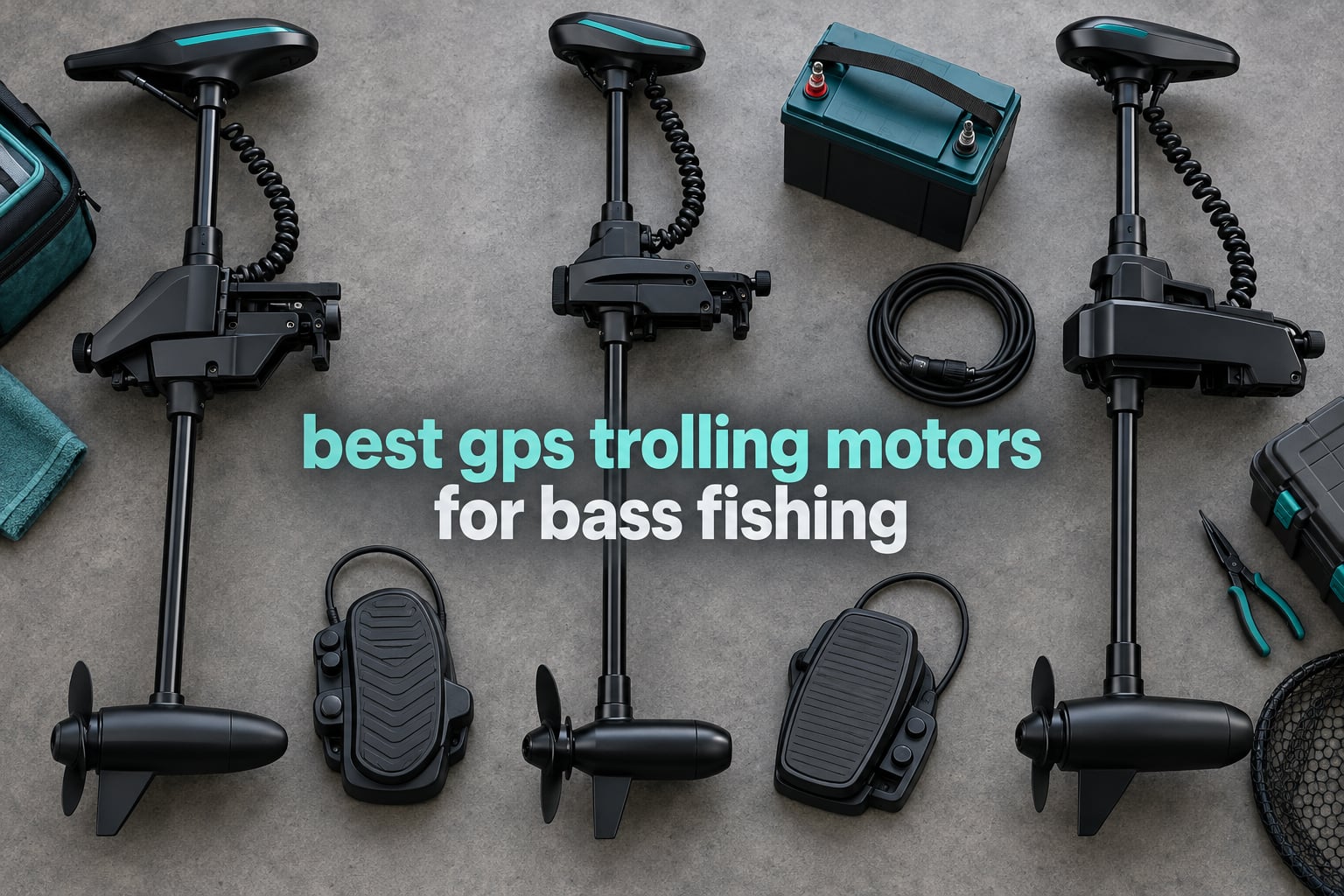
Short answer: the Minn Kota PowerDrive 55 with GPS is the best GPS trolling motor for bass fishing right now, and the Minn Kota Terrova 80 is the one to buy when wind and current decide where you fish. If your boat is under about 16 feet and you want a single battery, the PowerDrive runs on 12 volts. If you are working heavy structure on a 20-foot boat, the Terrova 80 brings 80 pounds of thrust and 24 volts of headroom.
A GPS trolling motor is a bow-mounted electric motor with a GPS receiver and a heading sensor built in. Instead of holding position by hand, you press Spot-Lock and the motor stores your coordinates, then feeds thrust in and out to counter wind, wave and current so the boat stays put. The same hardware records a route, replays it on the way home, and follows depth contours or a heading without you touching the pedal.
That matters on bass water more than on any other species. Holding a brush pile, a rock point or a weed edge while you cast, re-tie and fight a fish is the single most cited benefit anglers report after switching from cable steer. Our team compared seven GPS bow mounts across thrust, voltage, shaft length, control type, sonar integration and known reliability reports, and everything below reflects what the manufacturers publish plus what verified owners say after living with the hardware.
Model lines refresh fast in this category, so treat this as our 2026 snapshot. We earn a commission when you buy through the links on this page, which does not change the picks.
Table of Contents
- Top 3 Picks: GPS Trolling Motors for Bass Fishing (October 2026)
- All 7 Best GPS Trolling Motors Compared in 2026
- 1. Minn Kota PowerDrive 55 GPS – Best Overall GPS Bow Mount
- 2. Minn Kota Terrova 80 with MEGA Down Imaging – Best Thrust for Wind and Current
- 3. Minn Kota Ulterra 80 – Best for Auto Stow, Deploy and Back Strain
- 4. Lowrance Ghost X 47 Inch – Best for a Bundled Sonar Nosecone
- 5. Minn Kota Terrova 55 with i-Pilot Link – Best Single-Battery GPS Setup
- 6. Garmin Force 57 Inch – Best for a Garmin Electronics Setup
- 7. Lowrance Recon 60 Inch – Best for Transom Anglers Who Want a Joystick
- How to Choose a GPS Trolling Motor for Bass Fishing
- How much thrust do you need for a bass boat?
- 12V, 24V or 36V: how many batteries you actually need
- How to measure shaft length before you order
- Match the motor to your fish finder before you buy
- Freshwater only or saltwater capable?
- What are the common problems with spot-lock trolling motors?
- Should you use Spot-Lock or shallow-water anchors?
- Frequently Asked Questions
- Conclusion
Top 3 Picks: GPS Trolling Motors for Bass Fishing (October 2026)

Minn Kota PowerDrive 55 GPS
- 55 lb thrust on 12V
- Spot-Lock with Drift Follow Dodge modes
- Deploy-Assist lever
- Micro remote included

Minn Kota Terrova 80
- 80 lb thrust on 24V
- Built-in MEGA Down Imaging
- Spot-Lock with Jog and Dodge
- Digital Maximizer

Minn Kota Ulterra 80
- 80 lb thrust on 24V
- Auto stow and deploy
- Power trim depth adjustment
- i-Pilot Link with Spot-Lock
All 7 Best GPS Trolling Motors Compared in 2026
| Product | Specifications | Action |
|---|---|---|
| Minn Kota PowerDrive 55 GPS |
|
Check Latest Price |
| Minn Kota Terrova 80 |
|
Check Latest Price |
| Minn Kota Ulterra 80 |
|
Check Latest Price |
 Lowrance Ghost X 47 inch Lowrance Ghost X 47 inch |
|
Check Latest Price |
 Minn Kota Terrova 55 i-Pilot Link Minn Kota Terrova 55 i-Pilot Link |
|
Check Latest Price |
 Garmin Force 57 inch Garmin Force 57 inch |
|
Check Latest Price |
 Lowrance Recon 60 inch Lowrance Recon 60 inch |
|
Check Latest Price |
1. Minn Kota PowerDrive 55 GPS – Best Overall GPS Bow Mount
Minn Kota PowerDrive Bow-Mount Electric Trolling Motor with GPS – 55 Lb. Thrust, 54 In. Shaft, Freshwater
55 lb thrust
12V single battery
54 inch composite shaft
Spot-Lock with Drift Follow Dodge
Pros
- Best value GPS motor with full Spot-Lock
- Single 12V battery keeps the install simple
- Composite shaft will not bend or corrode
- Deploy-Assist lever makes stowing easy
- Strongest review base of any motor here
Cons
- Remote only
- no foot pedal option
- No integrated imaging transducer
- Less thrust than the 80 lb models
The PowerDrive 55 is the motor I put on a 16-foot aluminum bass boat first, and it is the one I recommend to anyone starting out. It puts 55 pounds of thrust on a 12-volt system, which means one deep cycle battery instead of two or three, and the whole install is something you can finish in an afternoon. Owners regularly report running four to five hour trips on a single charge, which lines up with a normal day of moving between brush piles.
What surprises people is how much GPS you get at this level. Spot-Lock stores your position, Jog shifts it in five-foot steps, Drift Mode holds you on a heading while you work the trolling motor to drift bait along a ledge, Follow Mode traces a recorded path, and Dodge Mode nudges the boat to the side when something big shows up on your screen. That is the same feature set the flagship models carry, minus the network integration.
Two practical details make the PowerDrive easier to live with than its spec sheet suggests. The Deploy-Assist lever is a gas-strut-style arm that takes most of the weight of the motor as you raise and lower it, and the shaft is composite rather than aluminum, so a strike on brush or a grounding wipe will not bend it or start galvanic corrosion on your trailer. The push-to-test battery meter on the head tells you bank voltage before you commit to running across the lake rather than after.
With 135 reviews behind it, this is also the motor with the deepest field history in this list. That matters more than it sounds. Reliability claims for a two-year-old product line are marketing; reliability claims for a motor with a large owner base are evidence. If you want the full comparison, our bass boat trolling motor guide breaks down how the PowerDrive stacks up against cable-steer and hand-control options.
Who the PowerDrive 55 suits best
This is the pick for a single-battery angler on a boat up to about 16 feet who fishes close to home and wants GPS without a two-battery install. It is also the safest recommendation for a first-time spot-lock buyer, because a 55 lb motor on a small boat gives the anchor algorithm plenty of reserve to correct with.
It is a strong match for anyone running a Humminbird setup who wants route and contour features later, since the head is a standard platform. The one group I would steer away is anglers who need to cast from the bow all day, because remote-only control means you are steering from the seat rather than the pedal.
Where the PowerDrive falls short
Remote-only control is the honest limitation here. There is no foot pedal in the box, and the micro remote that ships with the motor is small enough to lose between the deck seats. Anglers who spend a full day pitching brush piles usually end up wanting pedal control, and that means buying a different motor rather than adding a pedal later.
There is also no integrated imaging transducer, so if you want the motor to feed a screen directly you will be routing a separate cable or leaving the nosecone off entirely. A small number of owners report occasional GPS dropouts. At 55 pounds of thrust, it is also the wrong motor for a heavy 20-foot boat pushing hard into a current.
2. Minn Kota Terrova 80 with MEGA Down Imaging – Best Thrust for Wind and Current
Minn Kota Terrova Bow-Mount Electric Trolling Motor with GPS, Spot-Lock, MEGA Down Imaging – 80 Lb. Thrust, 60 In. Shaft, Freshwater
80 lb thrust
24V dual battery
60 inch shaft
Spot-Lock Jog Drift Follow Dodge
MEGA Down Imaging
Pros
- Highest rated motor in this guide at 4.6 from 58 reviews
- 80 lb thrust holds a spot in real wind
- Built-in MEGA Down Imaging to 200 ft
- Weedless Wedge 2 prop handles heavy vegetation
- Digital Maximizer stretches runtime up to 5x
Cons
- Corded foot pedal needs a clean cable route
- 24V means two batteries and a fender kit
- 80 lb thrust is overkill on small boats
The Terrova 80 is the motor I trust when the wind is onshore and the ledge you want is 200 feet from a ramp. Eighty pounds of thrust on a 24-volt system gives the anchor enough correction authority to keep a loaded boat from being pushed off a spot when a gust hits from behind, which is exactly when cheaper motors start pitching and correcting constantly. On a 20-foot bass boat with two adults, a console and a full livewell, that reserve is the difference between holding structure and drifting down it.
It ships with a built-in MEGA Down Imaging transducer reading to 200 feet, so the motor head is feeding your MFD without a separate transducer cable running through the boat. Owners like being able to switch between their forward-looking sonar and the motor’s own down imaging at the helm. The Weedless Wedge 2 propeller is another quiet hero on grass and hydrilla, where a standard prop quits early.
Control is a corded electric foot pedal with dual steering, meaning you can steer heel-toe or left-right, plus a wireless remote for the bow. That pedal is a genuine cable-steer feel rather than a joystick approximation, and it is why tournament anglers gravitate here. Digital Maximizer manages the throttle to stretch a pack out, and the included heading sensor feeds the compass-based heading lock and Dodge Mode.
The 80-pound thrust is not free in more ways than the battery bank. This is a two-battery install with a proper fender setup, and on a smaller boat the motor can feel like more than you need. Variants also come in a 112-pound 60-inch and an 80-pound 45-inch shaft, so confirm which configuration you are actually ordering before you commit to a shaft length.
Who the Terrova 80 suits best
This is the right motor for a 18- to 21-foot bass boat, for anglers fishing exposed structure in wind, and for anyone who wants the on-board sonar without running a second transducer. It is also the most straightforward step up for a serious bass angler moving from cable steer to electric steer, because the pedal feel does not change the way a stinger or a joystick does.
If your electronics are Humminbird, the i-Pilot family layers route and contour features over a compatible unit. Our bass boat motor breakdown covers the full line including the shaft options we skipped here.
Where the Terrova 80 falls short
The corded pedal is the main gripe. An 18-foot pedal cable has to be routed to the console, and on an open bass boat the run is visible, can chafe, and needs a connector you can reach from the deck. Anglers with a clean console or a desire to fish with fewer lines will find the wireless options more pleasant, even at the cost of some pedal feel.
Owners also point out that 80 pounds of thrust is excessive on a boat under about 16 feet, where it pushes harder than the hull wants and drains your batteries faster. The Digital Maximizer helps, but more power still means more amps. Plan on a two-battery bank and a charger that handles it.
3. Minn Kota Ulterra 80 – Best for Auto Stow, Deploy and Back Strain
Minn Kota Ulterra Freshwater Bow-Mount Trolling Motor with 60-Inch Shaft, MEGA Down Imaging, and i-Pilot Link GPS (24-Volt, 80-Pound)
80 lb thrust
24V dual battery
Auto stow and deploy
Power trim depth adjustment
45 or 60 inch shaft
Pros
- Deploys and stows itself at the push of a button
- Power trim adjusts motor depth electronically
- Built-in MEGA Down Imaging to 125 ft
- i-Pilot Link contour following for Humminbird
- Quiet under load
Cons
- 24V means two batteries
- Networking cables for Humminbird add cost
- No 360 imaging mount on the shaft
- Smaller review base than the other Minn Kota models here
The Ulterra exists for one reason: to stop you from lifting a heavy motor over the bow at the ramp. Auto stow and deploy raises the shaft and trims it with a button, and power trim lets you change the depth the motor runs at electronically once it is in the water. If you are over 50, you have any back history, or you fish a ramp with a steep slope, that feature alone changes how often you fish.
Underneath the convenience, this is a serious 80-pound, 24-volt bow mount with i-Pilot Link GPS, Spot-Lock and built-in MEGA Down Imaging to 125 feet. Owners report Spot-Lock holding well in waves, and the heading sensor keeps heading lock steady when the boat is working in a seiche. Shaft options run 45 and 60 inches, which covers both a small bay boat transom and a full-size bass boat.
Who the Ulterra 80 suits best
This is the pick for anyone who dreads the physical chore of deploying a heavy bow mount, and for older anglers or anyone recovering from an injury. It is also a strong pick for Humminbird users who want to use contour following rather than just spot-lock, since the integration is the deepest of the Minn Kota options.
Buyers who fish very shallow water get another benefit. Because the motor trims electronically, you can run it high out of the way on a grassy flat and drop it back down when you reach your spot.
Where the Ulterra falls short
The auto stow and deploy mechanism is also the most reported failure point for this motor line. Bass forum threads describe stalling, partial deploys and gear noise that stopped working after a season or two, and that is a real consideration against a long track record in the category. If the mechanism goes, you are lifting 80 pounds of thrust by hand again until it is repaired.
It is also a two-battery install, the Humminbird networking cables add cost on top of the motor, and the shaft will not take a 360 imaging mount. The review base here is thin compared with the other Minn Kota models, so you are trusting the platform more than you are trusting a large body of owner feedback.
4. Lowrance Ghost X 47 Inch – Best for a Bundled Sonar Nosecone
Lowrance Ghost X Freshwater Trolling Motor 47-inch Shaft, Bow Mount, with Active Imaging Nosecone and Configurable Foot Pedal, 000-16475-001
Brushless motor
Active Imaging 3-in-1 nosecone
Spot-Lock anchor
47 inch shaft
3 year motor warranty
Pros
- Brushless motor runs very quietly for stealth approaches
- Active Imaging 3-in-1 nosecone covers CHIRP SideScan and DownScan
- Produces roughly 20 percent more thrust than the original Ghost
- Lifetime shaft warranty
- Foot pedal integrates Power-Pole shallow-water anchors
Cons
- Only 2 reviews so far
- so long-term reliability is unproven
- Premium price point
- Wireless GPS remote is an option rather than standard
The Ghost X is the most complete package in this roundup if your electronics are Lowrance. The Active Imaging 3-in-1 nosecone is in the box, and it covers CHIRP sonar, SideScan and DownScan from the motor head, so a boat with a bare deck can get full sonar coverage without buying a separate transducer or running a cable forward. An adapter cable, an N2K T-Joiner and the nosecone itself all ship in the box.
The motor is brushless, which means it is genuinely quiet on approach, and Lowrance rates it at roughly 20 percent more thrust than the original Ghost for the same power budget. The GPS anchor uses Spot-Lock functionality, and a configurable foot pedal can also trigger Power-Pole shallow-water anchors, which makes it easy to run both systems from one position at the bow.
Who the Ghost X suits best
This is the pick for a Lowrance angler who wants the motor and the sonar in one purchase and values stealth more than pedal feel. The 47-inch shaft suits a smaller bay boat or a boat with a high bow. The 3-year motor warranty and lifetime shaft warranty are among the strongest in the category on paper.
It is also a strong second unit for a boat that already has a Lowrance MFD, because the HDI and NMEA 2000 pieces let the head feed a multi-function display directly. If your boat is not Lowrance, you lose most of that advantage, and our saltwater trolling motor guide covers the corrosion side of the equation.
Where the Ghost X falls short
The honest caveat is the review count. Two reviews is not a reliability record, and nobody has published long-term ownership data on this motor yet. The hardware looks right on paper, but you are an early adopter in practice, and that is worth weighing against a platform with a decade of field reports.
Owners also flag that the wireless GPS remote is an add-on rather than standard, which is a surprise if you were counting on steering from the bow without a cable. And the price sits at the top of the range before you add batteries.
5. Minn Kota Terrova 55 with i-Pilot Link – Best Single-Battery GPS Setup
Minn Kota 1358858 Terrova Freshwater Electric-Steer Bow-Mount Trolling Motor with Universal Sonar 2, i-Pilot Link GPS & Digital Maximizer, 55 lbs Thrust, 54″ Shaft
55 lb thrust
12V single battery
54 inch shaft
i-Pilot Link GPS
Universal Sonar 2
Pros
- Runs on one 12V battery
- Wireless remote included in the box
- i-Pilot Link ties into Humminbird displays
- Universal Sonar 2 keeps transducer wiring concealed
- Digital Maximizer and Weedless Wedge 2 prop
Cons
- Requires a compatible Humminbird N-series unit for i-Pilot Link
- Older model year than the current Terrova
- 2 year warranty rather than 3
- Mixed reports on customer support
If you want spot-lock, i-Pilot Link and a Humminbird link on a single battery, this is the configuration. Fifty-five pounds of thrust on 12 volts covers a boat up to about 16 feet and keeps the electrical side of the install to a single deep cycle battery, a single bank of cable and one charger. For a lot of weekend anglers that is the entire point: less battery weight in the boat and no wiring diagram to argue with.
Universal Sonar 2 routes the transducer wiring through the shaft, so nothing is stapled along the deck, and Digital Maximizer handles the throttle to extend runtime. Bluetooth pairs the head to the included wireless remote, and the Weedless Wedge 2 prop takes vegetation better than a stock prop. Refurbished units of this model show up often and owners report them performing like new.
Who the Terrova 55 suits best
This is the pick for a 12-to-16-foot boat on a single battery who already runs Humminbird and wants path recording, depth contour following and Spot-Lock in one unit. The 54-inch shaft is the most common length in the category and fits most 15- and 16-foot bass boats without a riser.
It is also the value route into the Minn Kota GPS ecosystem, since the i-Pilot feature set matches what the bigger motors offer. If you plan to move up to a 24-volt boat later, everything you learn about the head transfers, and our bass boat guide covers the bigger variants.
Where the Terrova 55 falls short
The big one is compatibility. i-Pilot Link needs a specific Humminbird N-series or Helix-style unit to get the network features. On an older or non-networked display you still get Spot-Lock, but you lose route and contour features, so check your model number before ordering.
This is also an older model year than the current Terrova, and it carries a 2-year warranty where the newer units carry three. At 55 pounds it is underpowered for a heavy boat in a strong current, and owner feedback on customer support is mixed. Software updates on newer production runs fixed some early remote issues that persist on older stock.
6. Garmin Force 57 Inch – Best for a Garmin Electronics Setup
Garmin Force Trolling Motor 57″, 57in, 010-02025-00
57 inch shaft
24V and 36V operation
Wireless foot pedal
GPS autopilot and anchor
Integrated sonar
Pros
- Wireless foot pedal keeps the deck clear
- Deepest network integration for Garmin displays
- Very quiet under load
- Good battery efficiency
- Stainless steel shaft and corrosion-resistant components
Cons
- Some owners report around 20 ft of anchor drift before it corrects
- Heavy at 109 lb to lift by hand
- Power cord may be short for mid-ship battery placement
- Some factory defects needed shaft replacement
The Force is the motor to buy if your boat is a Garmin boat. Routes, waypoints, autopilot and anchor data hand off to a Garmin MFD more smoothly than any other motor in this guide, and the wireless foot pedal means no cable run from the bow to the console. It runs on either 24 or 36 volts, so it covers both a 20-foot bass boat and a heavier multi-species hull without changing brands.
It is also quiet. Owners consistently describe it as one of the quieter motors to approach brush with, and the stainless steel shaft and corrosion-resistant components suit a boat that lives in a wet dock slip. Rated at a 5 HP maximum equivalent with 109 pounds of weight, it is the heaviest motor here, and that is worth thinking about if you deploy it by hand.
Who the Force 57 suits best
This is the pick for an angler running Garmin electronics who wants the tightest possible integration and prefers a wireless pedal to a cable. The 57-inch shaft suits a mid-size bass boat, and the 36-volt capability means you can grow into a bigger hull later without changing motor.
Anglers who dislike cable runs on an open deck will like the clean layout. If your boat is smaller, the kayak trolling motor picks cover the low-thrust end of the range.
Where the Force falls short
Anchor accuracy is the headline complaint. Several owners report the boat drifting on the order of 20 feet before the motor detects it and corrects, and anglers describe the resulting constant re-centering as uncomfortable to fish from. If holding a tight spot without movement is your top priority, this is the motor to test carefully before you commit.
At 109 pounds it is a heavy manual lift, there is no auto stow on this model, and the power cord can be too short when batteries sit mid-ship rather than forward. A small number of buyers also needed a shaft replacement under warranty, though Garmin support is generally praised for resolving those quickly.
7. Lowrance Recon 60 Inch – Best for Transom Anglers Who Want a Joystick
Lowrance Recon Freshwater 60-inch Trolling Motor with FreeSteer Joystick Remote, Wireless Foot Pedal, HDI Nosecone, 000-16174-001
Transom mount
60 inch shaft
FreeSteer joystick remote
Wireless foot pedal
HP HDI nosecone
Pros
- FreeSteer joystick is the most natural steering control here
- Carbon-fiber infused composite shaft carries a lifetime warranty
- Quiet brushless motor
- Wireless foot pedal plus joystick
- Available in 48 54 60 and 72 inch shafts
Cons
- Transom mount only
- not a bow mount
- Only 2 reviews available
- Premium price point
- HDI nosecone needs matching Lowrance hardware to fully use
The Recon takes a different approach to the same job. Instead of a foot pedal alone, it comes with a FreeSteer joystick remote that lets you drive the boat like a slow-speed helm, which is genuinely useful when you are repositioning around a ledge or easing onto a spot at idle speed. The included wireless foot pedal handles the underway steering, and you get both in the box along with a two-blade prop.
It is a transom mount rather than a bow mount, which is the main reason it is not higher in this list for bass anglers. A transom motor works well on a small boat, a pontoon or a jon boat where you want to move the unit between boats without tools. The shaft is carbon-fiber infused composite with a lifetime warranty, and the HDI nosecone supports Active Imaging 3-in-1 and ActiveTarget modules if you add them.
Who the Recon 60 suits best
This is the pick for someone who wants joystick control and does not need a bow mount. Anglers on a pontoon, a multi-species boat or a smaller bass rig that fishes from the back will find the transom format more practical than a bow install. The 60-inch shaft reaches deep enough for a steeper transom, and 48-, 54- and 72-inch options cover the rest.
The brushless motor keeps it quiet on approach, and the wireless pedal means a clean deck. If your boat is a small inflatable instead, our inflatable boat trolling motor guide covers that format.
Where the Recon 60 falls short
The review count is the problem. Two reviews, both perfect scores, tell you early owners are happy and tell you almost nothing about how the gearbox and brushless electronics hold up over five seasons. If you are risk-averse, that is a hard sell no matter how good the feature list looks.
It is also transom only, so there is no option to move it to the bow, and the HDI nosecone is only fully exploited with matching Lowrance sonar hardware. The price sits at the premium end before batteries.
How to Choose a GPS Trolling Motor for Bass Fishing
Most regret in this category comes from ordering the wrong shaft length, an undersized motor, or a head that does not network with the display already in the boat. None of those mistakes show up on a spec sheet, so here is how I size each one before an angler spends anything.
How much thrust do you need for a bass boat?
Use roughly 2 pounds of thrust for every 100 pounds of fully loaded boat weight, where loaded means with passengers, fuel, batteries and tackle. A 20-foot bass boat that weighs 2,300 pounds empty typically comes out near 3,000 pounds rigged, which lands you in the 55-to-80 pound range. A 16-foot aluminum boat at 1,200 pounds rigged is comfortably handled by 55 pounds.
Buy the higher number if you fish in wind or push a heavy current, and buy the lower number if the boat is small and you fish protected water. Over-thrusting is not harmless: an oversized motor draws more amps for the same job and burns batteries faster.
12V, 24V or 36V: how many batteries you actually need
The voltage tells you the battery count. A 12-volt system like the PowerDrive 55 or the Terrova 55 runs on one deep cycle battery. A 24-volt system like the Terrova 80 or the Ulterra needs two batteries in series plus a fender setup and a charger rated for the bank. A 36-volt system needs three, and several motors here accept both 24 and 36 volts so you can scale with the hull.
Lithium iron phosphate batteries are the change most owners notice. A 100Ah lithium pack carries roughly the same usable energy as three Group 31 lead-acid batteries at a fraction of the weight, and owners on forums consistently describe the real win as all-day runtime and a boat that is lighter to load rather than extra top speed. A multi-bank charger is part of the cost either way, and a trolling motor battery guide is worth reading before you size anything.
How to measure shaft length before you order
Kneel at the bow where the motor will mount and measure straight down from the top of the deck to the bottom of the hull, including the hull thickness. Add 6 inches of freeboard so the head clears the deck edge in a wave. Subtract the height of the mount bracket and the transom, and that is your number.
Most 15- to 17-foot boats land on a 54-inch shaft, 18- to 21-foot boats on a 60-inch, and shallow-draft pontoons often need 72 inches. Guessing is the single most common order mistake, and a shaft that is too long will not deploy far enough while too short leaves the head above the water in a chop.
Match the motor to your fish finder before you buy
This is where compatibility anxiety gets solved, and it is worth spending ten minutes on before ordering. Humminbird anglers should look at the Minn Kota i-Pilot Link platform, which covers the Terrova 55 and the Ulterra. Lowrance anglers should look at the Ghost X and the Recon, both of which ship with nosecone hardware and NMEA 2000 pieces. Garmin anglers should look at the Force, which is the tightest Garmin integration of the group.
MotorGuide fits the Simrad and general NMEA 2000 world, and every motor here gives you basic Spot-Lock regardless of what display you own. Network features are the upgrade, not the requirement. One angler in a forum thread put it well: he declined to sync electronics with his motor because integration was not his priority, and that is a perfectly valid position as long as you know before you order.
Freshwater only or saltwater capable?
A freshwater-only motor on a boat that ever touches salt water will corrode at the shaft, the windings and the bearings, and the damage shows up as a motor that gets sluggish and then quits. Bass anglers on inland lakes can generally run freshwater models. If your boat launches at a coastal ramp, an estuary or anything brackish, buy the saltwater-rated version and rinse the head after every trip.
Look for a sacrificial anode on the shaft and a warranty that covers saltwater use, and keep a spare anode in the truck. Our saltwater trolling motor guide goes deeper on the corrosion question.
What are the common problems with spot-lock trolling motors?
Five failure patterns come up repeatedly across these models. First, motorized stow and deploy mechanisms, where the Ulterra is the most exposed, since a stalled deploy gear means hand-lifting the motor again. Second, anchor drift on a windy day, where the Garmin Force draws the most complaints about the boat sliding before it corrects.
Third, cable and connector problems on corded pedals, which show up as intermittent pedal response on the Terrova 80 rather than as a hard failure. Fourth, battery and charging frustration, which is really an install problem: too few batteries, a charger that is too small, or lead-acid banks that were never really sized for the motor. Fifth, electronics compatibility, where an i-Pilot Link motor meets a Humminbird unit that does not support it and the network features simply do not appear.
Brushless motors reduce the gear and winding wear that drives most of the mechanical complaints, and they draw less current for the same thrust. That is the quiet argument for spending up on one of the brushless models here.
Should you use Spot-Lock or shallow-water anchors?
These solve different problems, and plenty of serious bass anglers carry both. Spot-Lock holds you in open water at any depth and lets you reposition to a new spot with a button. Power Poles and Talons hold you in very shallow water where the motor cannot run without grounding, and they give you a rock-solid hold in the last two feet of a creek or a grass edge.
Anglers working shallow structure often prefer the poles because the hold is absolutely still and the boat cannot be pushed off. Anglers working deeper, fishing wind or covering distance prefer spot-lock because it works anywhere on the lake. The Ghost X foot pedal can trigger Power-Pole anchors alongside the motor, which is a nice middle ground.
Frequently Asked Questions
What is the best trolling motor for bass fishing?
The Minn Kota PowerDrive 55 with GPS is the best all-around choice for most bass anglers, because it runs on a single 12V battery and still includes full Spot-Lock, Jog, Drift, Follow and Dodge modes. On a 20-foot boat in wind, step up to the Minn Kota Terrova 80, which brings 80 pounds of thrust on 24 volts plus built-in MEGA Down Imaging.
Who makes the best GPS trolling motor?
Three brands dominate: Minn Kota offers the widest range and the deepest network integration, Lowrance builds the best bundled-sonar packages with the Ghost X and Recon, and Garmin makes the Force, which integrates most tightly with Garmin displays. MotorGuide is a respected builder of trolling motors, though none of its complete GPS models were included in this roundup.
Are Garmin or Minn Kota trolling motors better?
Minn Kota wins on refinement, pedal feel and feature depth, which is why tournament anglers favor it. Garmin wins on integration if your boat already runs Garmin electronics, and the Force ships with a wireless foot pedal that keeps the deck clear. The Garmin anchor is the one to test, because owners report noticeable drift before it re-centers.
Is the Lowrance Ghost a reliable trolling motor?
The original Ghost has a strong reputation among owners for quiet brushless operation and precise anchoring. The newer Ghost X carries a 3-year motor warranty and a lifetime shaft warranty, but with only a couple of reviews on record there is no long-term ownership data yet. Treat it as capable hardware with an unproven service history.
Is spot lock worth the money?
Yes, if you fish structure. Holding a brush pile or rock point without drifting off is the most commonly reported benefit after switching from cable steer, and it saves constant manual repositioning. It matters less on very shallow water where shallow-water anchors give you a stiller hold, and on a small boat you can anchor by hand just as fast.
What are the common problems with spot lock trolling motors?
The recurring complaints are motorized stow and deploy gear that stalls, anchor drift in wind before the motor corrects, corded pedal cables and connectors failing, undersized battery banks, and electronics that do not network with the display you already own. Brushless motors reduce mechanical wear, and checking your fish finder model before ordering avoids the compatibility problem entirely.
Conclusion
The Minn Kota PowerDrive 55 is our pick for the best GPS trolling motors for bass fishing because it puts a complete Spot-Lock system on a single 12-volt battery, backed by the largest owner base of anything in this roundup. The Terrova 80 is the answer when you need thrust reserve in wind, and the Ulterra 80 is worth the step up if deploying a heavy motor is a problem you would rather not have.
Check your fish finder brand before you order, measure your shaft length properly, and budget for the battery bank rather than just the motor. Those three steps prevent nearly every regret we see in this category.