
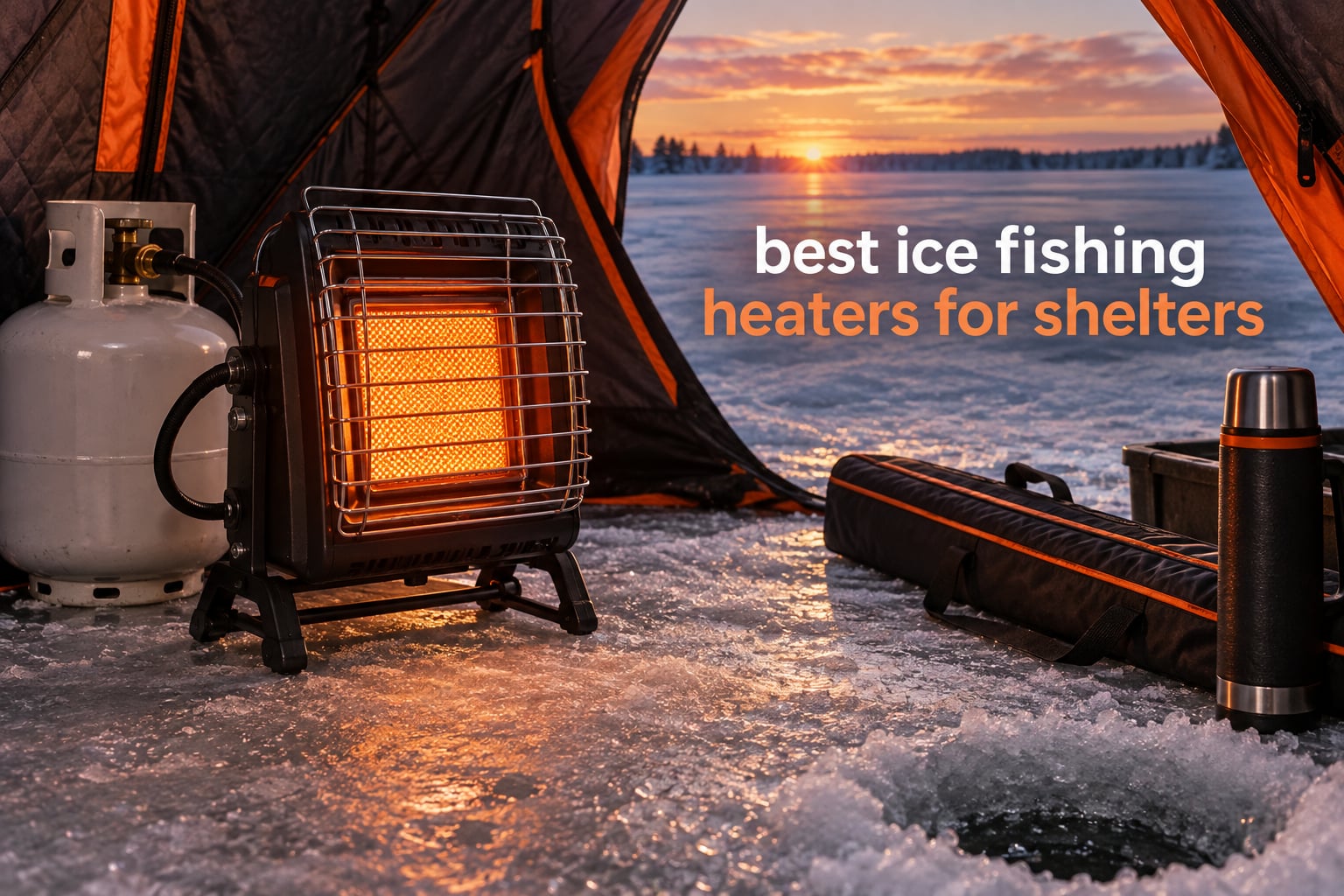
If you spend a full day on frozen water, the heater in your ice fishing shelter matters more than almost any other piece of gear. We have worked through the shelf, read the buyer complaints, and sorted ten propane and off-grid options by output, safety hardware, run time and how much floor space they eat. The short version: the best ice fishing heaters for shelters are the units that are actually indoor-rated, carry an oxygen depletion sensor, and match their BTU output to the square footage you are sitting in.
Our pick for most anglers is the Mr. Heater Buddy at 9,000 BTU. It carries a 4.7 rating across more than 29,000 reviews, runs on a 1 lb propane cylinder, and is approved for indoor use with both a low-oxygen cutoff and a tip-over shutoff. If you fish solo out of a one-man flip-over, drop down to the 3,800 BTU Little Buddy. If you run a hard-sided fish house that fits four people, step up to a 45,000 BTU tank top unit.
This guide covers ten heaters in detail, plus a buyer guide that explains BTU, radiant versus convective heat, run-time planning, condensation and altitude derating. Every unit below carries a badge explaining who it suits, and we list the drawbacks honestly, including the failures reviewers actually report.
Disclosure: We are a participant in the Amazon Services LLC Associates Program, an advertising program designed to provide a means for sites to earn advertising fees by advertising and linking to Amazon.com. We may receive compensation from Amazon when you buy through our links, at no additional cost to you. Our editorial choices are made independently of that relationship.
Table of Contents
- Top 3 Picks for Ice Fishing Heater in 2026
- Five Safety Rules Before You Light Any Shelter Heater
- Best Ice Fishing Heaters for Shelters in 2026: Quick Overview
- 1. Mr. Heater Buddy 9,000 BTU (MH9BX) – Best All-Round Shelter Heater
- 2. Mr. Heater 45,000 BTU Tank Top Radiant Heater – Best for Large Fish Houses
- 3. Mr. Heater Little Buddy 3,800 BTU (MH4B) – Best for Solo Flip-Overs
- 4. CAMPLUX 12,000 BTU Propane Heater – Best Built-In Light for Dawn Sessions
- 5. SISUPASSIE 15,000 BTU Forced-Air Heater – Best Multi-Mode Output
- 6. HEYDUOTON 1.3 lb Cordless Heater – Best for Backcountry Carry
- 7. LOFUKI Compact Propane Heater – Best for One-Push Ignition
- 8. Flame King Catalytic Heater – Best Flameless Heat
- 9. MOZODAWN 2-in-1 Propane Heater and Stove – Best 2-in-1 for Shelter Cooking
- 10. KUNGKA Wood Burning Tent Stove – Best Off-Grid Heat
- Ice Fishing Heater Buying Guide: Match BTU, Fuel and Safety to Your Shelter
- What BTU actually means, and how much you need
- Radiant, convective, catalytic or electric: what kind of heat is it?
- Safety features you should refuse to compromise on
- Run time and fuel planning across a fishing day
- Portability, transport and where your fuel lives
- Altitude, condensation and other real complications
- Beyond Propane: Wood, Electric and Generator Heat Sources
- Frequently Asked Questions
- Is it safe to use a propane heater in an ice fishing shelter?
- Is the Mr. Buddy propane heater safe to use indoors?
- Is it safe to run a buddy heater all night?
- Can you use a propane heater in a tent?
- How long will a 20lb propane tank last on a buddy heater?
- How long does a 1 lb propane cylinder last on a small heater?
- How much heater do I need for my ice fishing shelter?
- Do diesel heaters give off carbon monoxide?
- Is a diesel heater safe to run all night?
- What are people saying about the Mr. Heater Little Buddy?
- Why is my ice shelter fogging up when I use a heater?
- Can deer smell a Buddy heater?
- Who Should Buy Which Ice Fishing Heater
Top 3 Picks for Ice Fishing Heater in 2026
These are the three units we would put in a shelter tomorrow, in the order we would pick them.
Mr. Heater Buddy 9000 BTU
- Indoor and outdoor rated
- 4000 or 9000 BTU radiant
- Low-oxygen and tip-over shut-off
Mr. Heater 45000 BTU Tank Top
- 30000/36000/45000 BTU
- Adjustable burner head
- Mounts to a 20 lb tank

Five Safety Rules Before You Light Any Shelter Heater
Carbon monoxide is the reason this section sits above the product list rather than buried in the guide. A portable shelter is a fabric box with one door flap, and combustion heaters consume oxygen as they burn. Follow these five rules and the risk drops to a manageable level.
Buy an indoor-rated heater with an oxygen depletion sensor. Outdoor-only ratings are not legal in a shelter, and a unit with no low-oxygen cutoff will not shut itself down in a poorly ventilated space.
Carry a battery-operated carbon monoxide detector in the shelter. Keep it near your head height, not on the floor, and change the batteries every season. Treat any alarm as a reason to shut the heater off and step outside, not a nuisance to wait out.
Plan your ventilation before you fish, not after the window fogs. Crack a vent opposite the heater and leave it open. If the unit is too hot to hold a hand near it, your shelter is too tight for that output.
Keep clearance between the heater and shelter fabric. Many shelters have fabric walls, not fire-rated walls. Leave a foot of space from the burner to any wall and never leave a unit running against a seam.
Have a second cylinder ready and know the shut-off reflex. If the flame goes out, the last thing you want is fumbling for a match. Close the cylinder valve, ventilate, and relight outdoors or with a piezo outside the shelter first.
Two further notes. Buddy-style heaters carry an ODS limit of roughly 7,000 ft elevation, so anglers on mountain lakes should read the altitude section of the buying guide before committing. And if you see a unit marketed for fish houses that is rated outdoor only, it belongs outside the shelter walls, not inside them.
Best Ice Fishing Heaters for Shelters in 2026: Quick Overview
Here is every heater in the guide with its defining specs, so you can scan the shelf before reading individual reviews.
| Product | Specifications | Action |
|---|---|---|
| Mr. Heater Buddy 9000 BTU |
|
Check Latest Price |
| Mr. Heater 45000 BTU Tank Top |
|
Check Latest Price |
| Mr. Heater Little Buddy 3800 BTU |
|
Check Latest Price |
 CAMPLUX 12000 BTU CAMPLUX 12000 BTU |
|
Check Latest Price |
 SISUPASSIE 15000 BTU SISUPASSIE 15000 BTU |
|
Check Latest Price |
 HEYDUOTON 1.3 lb Cordless Heater HEYDUOTON 1.3 lb Cordless Heater |
|
Check Latest Price |
 LOFUKI Compact Propane Heater LOFUKI Compact Propane Heater |
|
Check Latest Price |
 Flame King Catalytic Heater Flame King Catalytic Heater |
|
Check Latest Price |
 MOZODAWN 2-in-1 Heater and Stove MOZODAWN 2-in-1 Heater and Stove |
|
Check Latest Price |
 KUNGKA Wood Burning Tent Stove KUNGKA Wood Burning Tent Stove |
|
Check Latest Price |
1. Mr. Heater Buddy 9,000 BTU (MH9BX) – Best All-Round Shelter Heater
Mr. Heater 9,000 BTU Portable Buddy Radiant Propane Heater
4000 or 9000 BTU radiant
Heats about 225 sq ft
Indoor and outdoor rated
5.4 hrs low on a 1 lb cylinder
Pros
- Dual 4000/9000 BTU radiant output
- Indoor and outdoor approved
- Low-oxygen and tip-over shut-off
- Long run time on one 1 lb propane cylinder
- Self-extinguishing materials
Cons
- Radiant heat travels in a line so aim it at the seating area
- Manufacturer rules prohibit unauthorized attachments
This is the unit we keep coming back to. It weighs 7.1 lb, stands 15 inches tall on a 13.4 inch wide pedestal base, and runs on a single 1 lb propane cylinder through a standard regulator. The two-setting design is the reason it fits so many shelters: turn it down to 4,000 BTU in a solo flip-over and turn it up to 9,000 BTU when a second angler and a couple of rods come along.
The ratings history tells the story. At 4.7 across 29,212 reviews, it is the most-reviewed heater in this guide by a wide margin, with 84% of owners handing over five stars. Owners consistently describe compact, dependable radiant heat that runs all day on one small cylinder. Over multiple seasons of comparing shelters, that consistency is the feature we value most, because the failure mode that ruins a fishing day is an igniter that quits in the cold.
What you are getting is radiant infrared heat from a ceramic plate, not a fan-driven warm air stream. That distinction matters in a shelter. A radiant unit throws heat in a line at whatever is in front of the burner, which feels like standing near a campfire, and it does very little to heat the air itself. Sit behind it and you will be cold no matter what the BTU number says.
Run time is 5.4 hours on the low setting and 2.4 hours on high from a 1 lb cylinder, which lines up neatly with a normal day on the ice. Maximum temperature setting is 900 F on the element, not in your shelter, and the unit carries a 1-year limited warranty. The build is a pedestal form factor with floor mount, and Mr. Heater’s rules prohibit unauthorized accessories, so resist the urge to bolt on a custom hose or shield.
Why we picked it for shelter duty
The indoor approval and the low-oxygen cutoff are the whole case. Too many cheap heaters in this category are outdoor-rated only, and a few carry no low-oxygen sensor at all. When a unit is approved for indoor use with an emergency low-oxygen system, you can plan a long session without second-guessing the hardware. At roughly 225 sq ft of rated coverage, it also covers most two-person insulated hub shelters without pushing you into a bigger, hungrier burner.
Where it falls short
The directional nature of radiant heat is the honest drawback. You need to place it where the head aims at your seating position, and if you shift your chair or turn your head, the warmth moves off you. One reviewer of 360-degree designs makes the related point that in a confined shelter, focused heat and minimal fumes matter more than even heat distribution, which is an argument for a straight-line unit like this one over a top-down dish.
2. Mr. Heater 45,000 BTU Tank Top Radiant Heater – Best for Large Fish Houses
Mr. Heater Original 540-Degree 45,000 BTU Tank Top Radiant Propane Heater
30000/36000/45000 BTU radiant
Heats up to 1125 sq ft
Mounts to a 20 lb tank
About 9.5 hrs on high
Pros
- 45000 BTU is the highest output in this group
- Adjustable burner head spreads heat around a shelter
- Three heat settings to cut fuel use
- Mounts directly to a standard 20 lb propane tank
Cons
- Outdoor use only so it cannot run inside a hard-sided shelter
- Requires carrying a 20 lb propane cylinder
- Most radiant output shoots straight up unless the head is tilted
This is the opposite end of the shelf from the Little Buddy, and it exists for one situation: a big shelter that a small heater simply cannot keep up with. At 45,000 BTU on high it has more than twelve times the output of a 3,800 BTU personal unit, and the rated coverage of 1,125 sq ft covers a walk-in or hard-sided fish house used by a group.
The regulator runs high, medium and low at 45,000, 36,000 and 30,000 BTU, and users consistently report that the low setting is the one to use inside a shelter. That advice shows up again and again in owner reviews, alongside the tip to tilt the head downward toward seated people rather than letting the radiant output shoot straight up. Run time is about 9.5 hours on high from a 20 lb tank.
What makes it work in a big shelter
The adjustable 360-degree burner head is the feature that separates it from a fixed-post heater. A head you can turn spreads heat around the shelter perimeter instead of creating one hot spot. At 4.7 across 5,016 reviews with 85% five stars, owners report serious radiant output, with people warming gazebos, pop-up shops and camper decks through sub-freezing weather. It also carries a tip-over protection switch and a noiseless design with no blower to drone through a quiet morning.
Where it falls short
The outdoor-only rating is the deal breaker for many shelters, and we will not soften it. This unit is not approved for indoor use, so it belongs in an open-sided or hard-sided shelter with real ventilation, not inside a fabric hub. It also weighs 5.6 lb on its own and needs a 20 lb cylinder, and reviewers note the hose and control knob orientation is awkward on some tank setups, along with three Phillips-head screws that are tedious to tighten.
3. Mr. Heater Little Buddy 3,800 BTU (MH4B) – Best for Solo Flip-Overs
Mr. Heater 3,800 BTU Little Buddy Portable Radiant Propane Heater
3800 BTU radiant
Heats up to 95 sq ft
One-button ignition
Connects to a 1 lb cylinder
Pros
- Indoor-rated with low-oxygen and tip-over shut-off
- Small round footprint uses little floor space
- One-button ignition and quiet odor-free running
- 3-year limited warranty
Cons
- Single 3800 BTU setting covers only about 95 sq ft
- Needs a separate 1 lb propane cylinder
The Little Buddy is the default answer for a one-man flip-over, and the reasons are practical rather than romantic. It is indoor-rated with an automatic low-oxygen shut-off system and accidental tip-over protection, and at 5.6 lb it is one of the lightest indoor-rated heaters you can carry up a ramp or into a shelter.
It has a single 3,800 BTU setting with no adjustment, which sounds like a limitation and mostly is not. In a shelter of up to 95 sq ft, one setting is all the heat you want, and buyers treat it as the default personal heater for small shanties because it is one of the few units here that is certified for indoor use with a real low-oxygen cutoff. Reviewers also like that it mounts and dismounts from the cylinder quickly.
The footprint is the other quiet win. An 8-inch round stand uses almost no floor space, which matters in a flip-over where your boots, a seat, a rod box and an electronics case are all competing for the same square footage. Operation is one-button ignition, and the stated running character is quiet, clean and odor-free.
On the numbers, it carries a 4.5 rating across 8,796 reviews with 75% five stars, a 3-year limited warranty, and a temperature range listed from 40 F minimum to 900 F maximum. That warranty length is the longest in this group and is worth something when a heater lives in a damp shelter for months at a time. Owners also report using it in deer blinds without trouble, though the same owners flag the fogging issue that comes with any combustion heat in a small fabric space.
Why solo anglers keep buying it
Ask a hundred ice anglers for a heater recommendation and a large share will say a Buddy unit without hesitation, simply because these are the most familiar portable heaters on the market. Brand familiarity matters on the ice because it means parts, cylinders and replacement tips are all understood before you drive to the lake. For a solo flip-over, 95 sq ft of rated coverage is genuinely enough, and the single-setting simplicity means there is no output to second-guess.
Where it falls short
Two limits are worth stating plainly. First, the single 3,800 BTU setting caps it at roughly 95 sq ft, so it is the wrong choice for a two-person insulated hub. Second, it is a radiant burner, so it heats what is in front of it rather than the air, and it needs a 1 lb propane cylinder that you supply separately. It also produces the same fogging and condensation as every other combustion unit in a sealed shelter, and that is a shelter-design problem more than a heater problem.
4. CAMPLUX 12,000 BTU Propane Heater – Best Built-In Light for Dawn Sessions
CAMPLUX Portable Propane Heater Outdoor and Indoor, 12000 BTU LP Gas Buddy Heater for Camping with ODS & Tip-over Protection, 1lb Propane Radiant Heating with LED light, Red
12000 BTU ceramic plate burner
Up to 6 hrs run time
1 lb and 20 lb compatible
9.4 lb body with LED light
Pros
- Handle LED light is useful before dawn
- Rear flap and brace let it run off a 20 lb tank
- No battery needed for ignition
- Low-oxygen and tip-over shut-off with ice fishing listed as a use
Cons
- Heats the floor around it so a riser helps
- Small cylinders empty quickly
- Reports of a broken handle and a dead LED light
Most of the best hours of ice fishing happen before the sun clears the treeline, and that is exactly where this unit separates itself. The easy-grip handle has a built-in LED light, so you can find a rod, a jig or a headlamp without lighting the whole shelter and blinding yourself.
Output is 12,000 BTU from a ceramic plate burner with up to 6 hours of run time, and the manufacturer lists ice fishing among the recommended uses alongside camping, garages, patios and tents. It is indoor and outdoor rated, carries both a low-oxygen safety shutoff and tip-over protection, and reaches heat within about a minute off a single control knob.
The fuel flexibility is the sleeper feature. It runs on both a 1 lb cylinder and a 20 lb tank, and a rear support flap with a removable brace turns the whole heater and tank into one movable assembly. Hose and regulator are not included, so budget for those if you plan to run a 20 lb tank all day. At 9.4 lb it is heavier than the Little Buddy but still a reasonable sled load.
At 4.3 across 272 reviews, with 69% five stars, the review profile is a little more mixed than the Mr. Heater units, and the pattern is consistent enough to plan around. Owners like the LED handle and the ability to strap on a 20 lb tank, and describe very strong radiant output. The complaints center on build consistency: a broken handle, a dead light, plastic near the light reported as melted on one unit, and rapid fuel use when running small cylinders. One early failure was replaced by the seller.
Why the light matters more than it sounds
Propane burners in an enclosed shelter produce a faint pilot glow at best. A handle-mounted LED is the difference between finding your hole chart and digging through a pile. For anyone fishing the pre-dawn window on a sheltered lake, that is a real advantage over an otherwise identical burner, and it is the reason this heater earns its place in a list otherwise stacked with well-known Buddy units.
Where it falls short
Reports note that it heats the floor around it rather than throwing heat upward, so a small riser or stand is a worthwhile add for comfort and for keeping fabric away from the burner. The build consistency complaints are the bigger concern. With a far smaller review pool than the Mr. Heater units, a 4.3 average with 69% five stars leaves more room for an early defect than a 4.7 with 84% five stars does, so inspect the handle and light before you leave the driveway.
5. SISUPASSIE 15,000 BTU Forced-Air Heater – Best Multi-Mode Output
SISUPASSIE 15000BTU Propane Heater, Portable Propane Heater for Outdoor Use with 3 Adjustable Modes and Safety Shut-off Valve for Patio, Camping, Fishing, Garage
Up to 15000 BTU across three modes
Forced air with a 30 degree rotating head
Steel body with mesh guards
Automatic shut-off valve
Pros
- Highest stated output in the budget tier
- Three heat modes plus a rotating head
- Automatic shut-off valve and tip-over switch
- Steel construction with protective guards
Cons
- Rated for outdoor use only
- Hot surfaces need care near fabric shelter walls
This is a forced-air design rather than a straight radiant dish, and the difference is felt within a few minutes of lighting it. A forced-air burner moves heated air across the shelter instead of aiming infrared at one spot, which is a better match for a wide two-person hub where two people sit at different angles.
Output is claimed up to 15,000 BTU across three selectable modes at low, medium and high, and the heater head rotates 30 degrees to spread heat more evenly. The body is steel with mesh guards over the burn area, and it carries an automatic shut-off valve and a tip-over protection switch. Owners highlight strong output for the money, the three modes, and a tilting head that spreads heat around a tent.
What forced air changes in a shelter
Radiant heat warms you. Convective heat warms the shelter, and a warmer shelter means the fabric is less of a cold surface against your back and the fogging problem is reduced. That makes a forced-air unit a reasonable pick for a group shelter where a radiator-style burner would leave half the occupants cold. The 30 degree rotation also matters in a rectangular hub, where a fixed head only ever warms the short end.
Where it falls short
This heater is rated for outdoor use only, so it does not carry an indoor approval, and that is the main reason it sits at number five rather than higher. It is also a tabletop form factor at 12 by 10 by 6 inches, which puts the burner height high enough that you need to be careful with fabric shelter walls, and reviewers note the hot surfaces need care near tent material. At 4.1 across 246 reviews with 66% five stars, the 12% one-star share reflects isolated build and reliability complaints rather than a systemic pattern.
6. HEYDUOTON 1.3 lb Cordless Heater – Best for Backcountry Carry
Portable Propane Heater for Camping, Outdoor Small Space Patio Heater with Control Valve, Radiant Cordless Tent Heaters with Foldable Gas Tank Holder for Hiking Ice Fishing Hunting Backyard
1.3 lb cordless radiant design
Adjustable control valve
Includes a windproof lighter
Foldable base with brass fittings
Pros
- Only 1.3 lb so it is easy to carry and reposition
- Includes a windproof lighter for windy shelters
- Seller covers no-return refunds for quality problems
Cons
- Reflector bends easily if tipped or bumped
- Runs loudly at higher settings
- Not for indoor or enclosed-space use
Weight is the reason this unit exists. At 1.3 lb it is by far the lightest heater here, and if you are walking in past a plowed access point, hauling a sled a quarter mile, or hopping onto a lake with nothing but what fits in a daypack, that difference decides the trip for you.
It is a small radiant design with a listed coverage of about 200 sq ft, an adjustable control valve that runs from gentle warmth to full output, and a foldable base with brass fittings that gives it a stable anti-tip stance. The included windproof lighter is a genuinely thoughtful addition, because matching a flame in a windy shelter with frozen hands is how a lot of cold mornings go wrong.
Owner feedback is consistent about the portability upside. People use it in deer stands, for backup heat, and in small tent spaces, and the praise centers on portability, stability and the included lighter. The drawbacks are equally consistent: a thin reflector that dents, noise at higher settings, and a small group of reviews flagging an open flame at the top of the unit. At 4.2 across 157 reviews with 67% five stars, it holds a solid score for what is a very simple appliance.
One service detail worth knowing: the seller offers no-return refunds or replacements for quality problems, which is a meaningful offset on a lighter-build product with a small review base.
Why backcountry anglers care about this one
Forum regulars point out that a 17 lb heater plus a 20 lb tank is a real burden, and that is a fair description of the heavy end of this category. A 1.3 lb cordless unit changes the logistics of a walk-in session completely, and the windproof lighter removes the single most common failure point on a cold, windy start. For an open-ice warm-up spot with no shelter, it is also far more appropriate than a 45,000 BTU unit.
Where it falls short
It is not appropriate for indoor or enclosed-space use, so this is a warming-unit answer, not a shelter answer, and we will not pretend otherwise. The reflector bends easily if the unit is tipped or bumped, which matters a lot on ice where everything gets knocked. It also burns propane relatively quickly for the heat delivered and runs loudly at higher settings, so low and medium are the sensible settings in a quiet shelter.
7. LOFUKI Compact Propane Heater – Best for One-Push Ignition
Portable Propane Heater for Camping, Outdoor Space Tent Heater
Compact cordless radiant design
One-push electronic ignition
Roughly 8-10 hrs low on 1 lb
Mesh guards and foldable stand
Pros
- One-push ignition avoids matches in freezing hands
- Roughly 8-10 hours on low from a 1 lb cylinder
- Compact and quiet enough to move between spots
Cons
- Modest output works best as a personal heater
- Some owners report no working tip-over sensor
- If run dry it can shut off and release a propane smell
The defining feature here is the one-push electronic ignition. No piezo button, no lighter, no flint. You press a button and it lights, which removes the single most annoying task of a cold morning and the one that most often delays a session.
Run time is the other headline. Owners report roughly 8 to 10 hours on low from a refillable 1 lb bottle, and hunters and winter campers describe it as a lifesaver in sub-zero conditions because of the easy ignition and the long run time on a refillable cylinder. Protective mesh guards, a secure cylinder stand and a leak-resistant connecting pipe round out a sensible build for winter use.
The build is described as thick, rust-resistant material intended for winter outdoor use, and it is a compact cordless design with a foldable stand base and an adjustable knob for fine temperature control. At 4.2 across 166 reviews with 67% five stars, the profile is solid, though the 8% one-star group raises real questions about safety hardware rather than cosmetics.
Why refillable cylinders matter here
A refillable 1 lb bottle beats a disposable cylinder once you are past the first season, because the exchange cost drops and you stop throwing away partially full tanks. Combined with the long low-setting run time, that is why this heater shows up in hunting and ice camping kits rather than only in fishing ones. It is also small enough to move between two spots on the ice, which is handy when the wind shifts and one side of the shelter stops working for you.
Where it falls short
Output is modest, and buyers with uninsulated shelters note the heat falls short of a Mr. Buddy. More seriously, some owners report no working tip-over sensor, and if that is true for your unit it should not go inside a shelter. It also has limited flow control that varies with cylinder pressure, and if run completely dry it can shut off and release a propane smell, so change cylinders rather than pushing one to empty.
8. Flame King Catalytic Heater – Best Flameless Heat
Flame King Portable Propane Gas Outdoor Heater with Piezo Electric Start for Camping, Garage, Ice Fishing, Patio, and Tabletop Green Small
Catalytic element with no open flame
About 7 hrs high or 14 hrs low per 1 lb
Weighs 16 oz
Piezo start plus RV mount bracket
Pros
- Catalytic so there is no open flame in the shelter
- Long run time and nearly odorless on both settings
- Full mesh screen over the heat source
Cons
- No carrying handle and it is awkward to move while hot
- Piezo igniter can fail without warning
- Catalytic pad will not ignite if it gets wet
This is the only flameless unit in the guide. A catalytic element glows without a visible burning flame, which means no open flame inside a fabric shelter and a noticeably drier, cleaner heat profile than an infrared burner produces. Long-term owners value it exactly for that reason, and one reports running it all night in a van on the low setting with no symptoms. It also performs down to about 25F.
Output is listed at 3,000 BTU, and run time is roughly 7 hours on high or 14 hours on low from a 1 lb cylinder, which is the best fuel economy in this roundup by a wide margin. It weighs just 16 ounces, has a 13 by 9 by 9 inch tabletop footprint, and includes an RV or trailer mount bracket if you want it fixed rather than freestanding.
At 4.2 across 169 reviews with 65% five stars, the score is a little lower than the taller units, and the reasons are physical. The recurring negatives are igniter failure and hot, hard-to-grip sheet metal. The full mesh screen over the heat source is a good deterrent for kids and pets, though it is not a substitute for the tip-over shutoff this unit does not appear to carry.
One detail to plan around: the catalytic pad will not ignite if it gets wet. In a damp shelter at the end of a wet snow day, that means a dry-storage spot, and it is one more reason to keep the heater off the shelter floor.
Why flameless heat changes the safety conversation
Most of the anxiety around shelter heaters comes from a visible flame sitting inside a fabric box. A catalytic element removes the flame, and with it most of the burn risk and much of the moisture that drives condensation. For an angler who is nervous about running combustion heat overnight, this is the compromise that keeps a heater in the shelter at all. The 14-hour low run time also means one 1 lb cylinder can cover a very long night without a refuel decision.
Where it falls short
No carrying handle, and owners describe the outer metal ring as hot enough to burn skin, so moving it while lit is a bad idea. The front legs do not lock firmly and there is no back stand for a 20 lb tank, which limits it to 1 lb cylinders. The piezo igniter can fail and gives no feedback that gas is flowing, and the wet-pad issue means it needs a dry home between trips.
9. MOZODAWN 2-in-1 Propane Heater and Stove – Best 2-in-1 for Shelter Cooking
MOZODAWN 2 in 1 Propane Heater & Stove, 13000 BTU Portable Propane Heater with Handle, Outdoor Heater Gas Stove for Patio, Camping, Tent, Ice Fishing, Garage
2-in-1 heater and cooktop
13000 BTU with 360 degree radiant heat
Stainless steel threaded fitting
Includes a 5 ft tank hose
Pros
- Heats and boils water in one unit saving floor space
- Works with 1 lb cylinders or a 20 lb tank on the included hose
- Tip-over and low-oxygen shut-offs
Cons
- Close-range personal heater rather than a room warmer
- Burns propane faster than the delivered warmth suggests
- Control knob and igniter are the weak points
Shelter floor space is the scarcest resource in a flip-over, and a 2-in-1 unit gives back the space a separate cookstove would take. This one heats and boils water in the same body, which is genuinely useful when you want coffee or a hot meal without hauling a second stove into a shelter sized for one person.
Output is claimed at 13,000 BTU with 360-degree radiant heat, and winter tent campers and RV owners report it holding large tents warm through below-freezing nights while appreciating not carrying a separate stove. The stainless steel threaded interface is rust resistant, and the included 5 ft hose means you can hook up to a 20 lb grill tank and run for many hours.
Safety hardware is better than average for the category: owners report testing the tip-over switch and the ODS low-oxygen shutdown and finding both working. At 4.1 across 175 reviews with 60% five stars, it has the lowest five-star share of the propane units here, and the critical reviews are consistent about two specific weaknesses rather than a general quality problem.
The weight listing is worth flagging before you commit: the manufacturer lists 3.92 kg, which is close to 8.6 lb. That is heavier than the Little Buddy by a wide margin, and it is a meaningful load on a walk-in or sled trip. The listed dimensions are not usable, so measure your floor space against the hose and stand clearance in person.
Why 2-in-1 appeals to shelter anglers
The appeal is arithmetic. Every piece of gear you bring to a flip-over has to fit between your boots and your seat for six hours, so combining a burner and a cooktop frees real space, and the flat top handles a pot as well as it handles your knees. The included hose plus 1 lb cylinder or 20 lb tank compatibility also means one connection scheme covers both a quick solo morning and a long group day.
Where it falls short
It is a close-range personal heater rather than a true 13,000 BTU room warmer, so the headline number overstates how much of a two-person shelter it will warm. It burns propane faster than the delivered warmth suggests, and the control knob is described as flimsy, with the cooktop becoming unstable with larger pots in wind. Igniter or pilot failures are reported, including one unit that stopped lighting after a month.
10. KUNGKA Wood Burning Tent Stove – Best Off-Grid Heat
Black Wood Burning Tent Stove, 7 Section & 6 ft height Stainless Steel Chimney with diameter 2.24″, Kungka Portable Hot Tent Stove for Heating & Cooking, Camping, Hunting, Ice Fishing
Wood burning with 2-4 hr burn time
Heats a 200 sq ft tent in about 15 minutes
7-section 6 ft stainless chimney
24 lb with foldable legs
Pros
- No propane cylinder to haul refill or freeze
- Borosilicate glass door shows fire and fuel level
- Everything packs inside the firebox with foldable legs
- Flat top doubles as a cooking surface
Cons
- Small firebox needs tending every 1-2 hours
- First burn outdoors for about 60 minutes to cure the paint
- Too small for shelters much over 144 sq ft
Everything else in this roundup depends on carrying fuel. This one does not. A wood-burning hot tent stove solves the problem anglers on remote lakes actually complain about most, which is that a 20 lb propane cylinder is a dead weight you have to lift over the gunwale and drag back across the ice at the end of the day.
It is tested to -20F and heats a 200 sq ft wall or canvas tent in about 15 minutes, with a 2 to 4 hour burn time per load of hardwood. Owners report tents at 90F inside in 31F weather, and the borosilicate glass door lets you watch the fire and the wood level so you are not opening the door to check either one. The flat top doubles as a cooking surface for cast iron pans, kettles and camp pots.
The packing design is the part we appreciate most. Seven chimney sections, wind ropes, ground nails, a rain cap, a pair of gloves, a screwdriver and firewood hooks all store inside the firebox, and the rack folds into a carry handle. At 4.3 across 166 reviews with 63% five stars, the caution points are consistent: the cure-in smoke on first use, the small firebox needing frequent refills, and owners adding a spark screen and a better damper.
Two practical notes. The listed weight is 24 lb, so it is a two-person carry or a sled item rather than a pack item, and the 6 ft chimney with a 2.24 in diameter will not pass through a standard ice shelter vent sleeve, which means it suits hot tents and larger canvas shelters more than a small insulated hub.
Why wood heat changes the fuel logistics
On a trip where the shelter is already the size of a two-man hot tent, a 2 to 4 hour burn time per load of hardwood is a completely different operating rhythm from fuel cylinders. There is no regulator to freeze, no exchange stop on the drive home, and no cylinder to store in a vehicle over the off-season, which also sidesteps the rodent and insect problem anglers report with fuel heaters left in shelters through the summer. The glass door and flat cooktop make it a genuine two-tool shelter system rather than a single-purpose heater.
Where it falls short
It needs tending every 1 to 2 hours because the firebox is small, and logs must be cut down to fit, so this is not a set-and-forget heat source. The first burn must be done outdoors for about 60 minutes to cure the paint or the tent fills with smoke, which means you do that job in your driveway. Owners also report a door gasket that leaks and backdrafts smoke when the damper is closed too far, a weak supplied damper, and a chimney that runs red hot, so treat it as a hot tent tool rather than a shelter heater.
Ice Fishing Heater Buying Guide: Match BTU, Fuel and Safety to Your Shelter
What BTU actually means, and how much you need
A British Thermal Unit is the amount of energy needed to raise one pound of water by one degree Fahrenheit. Applied to a shelter, it is simply a rating of how much heat the burner can put into the space. One BTU is an abstract number; the useful question is how many you need for the shelter you own, and the answer scales mostly with floor area and insulation.
The working tiers are straightforward. A one-man flip-over or small non-insulated shelter needs roughly 3,000 to 6,000 BTU. A two to four person insulated hub needs about 5,000 to 9,000 BTU. A large hard-sided fish house or walk-in shelter needs 9,000 BTU and up, and the very largest setups need more still. The trap is oversizing, because a burner that is far too powerful for the space does not simply make it warmer, it makes it uncomfortably hot, drives heavy condensation onto the fabric and can scorch material near the burner.
The reverse is also worth avoiding. Too little output and you burn fuel for hours without ever reaching a comfortable temperature, which is the most common complaint we see about undersized units in uninsulated shelters. If your shelter is fabric over ice with no insulation, expect to need the top of whatever range applies to you, and plan on a vent open to the leeward side.
Radiant, convective, catalytic or electric: what kind of heat is it?
Radiant infrared heat behaves like a flashlight pointed at your hand. It travels in a line and warms whatever is in front of the burner, which feels intense and personal but does almost nothing to warm the air. Convective heat moves air instead, warming the whole shelter evenly, which is better for groups and better for reducing condensation on the walls. Catalytic heat is a flameless radiant technology that gives off steady dry heat with no open flame.
The flashlight analogy is the fastest way to decide. If one person sits in a tight space and can aim the heater at their seat, radiant is more efficient and more comfortable. If two or more people sit at different angles in a wider shelter, a unit with airflow or a rotating head is the better choice, because it removes the need to argue about who is in the hot spot. Catalytic is the choice for anyone who wants a heater running overnight without a visible flame in a fabric box.
Safety features you should refuse to compromise on
Four things matter, and a heater missing any one of them is not really a shelter heater. The oxygen depletion sensor shuts the unit down as oxygen drops in an enclosed space, and it is the single most important feature in this category. Tip-over shutoff matters in an ice shelter specifically, because boots, chair legs and a tipping sled are all constantly in the way. Flame failure safety closes the fuel when the flame drops out. And indoor rating is the certification that ties the three together.
On top of those, carry a battery-operated carbon monoxide detector as your second line of defence. Forum discussion on this topic is dominated by carbon monoxide fear, sometimes reasonable, often disproportionate, and the practical response is the same in both cases: indoor-rated hardware, a working low-oxygen cutoff, a permanent vent, and an alarm you can hear from your seat. If you also own a heater you plan to store in a shelter or vehicle over the off-season, rodent-proofing matters, because rodents are reported to get into stored heaters and ruin them.
Run time and fuel planning across a fishing day
Two questions come up more than any others about fuel: how long a 1 lb cylinder lasts, and how long a 20 lb tank lasts. The honest answer is that it depends on which setting you run, and the manufacturer numbers are the useful guide. On the Mr. Heater Buddy, a 1 lb cylinder gives 5.4 hours on the 4,000 BTU low setting and 2.4 hours on the 9,000 BTU high setting. That is why the low setting is the default in a small shelter, and why a second cylinder in your bag is cheap insurance.
Larger tanks change the arithmetic more than most people expect. The 45,000 BTU tank top heater runs about 9.5 hours on high from a 20 lb tank, which is a genuinely different day from the 1 lb units. The catalytic Flame King is the efficiency outlier, giving roughly 7 hours on high or 14 hours on low per 1 lb cylinder. And the LOFUKI compact unit is reported at 8 to 10 hours on low from a refillable 1 lb bottle, which beats most of the radiant burners in this guide on fuel economy alone.
The practical planning rule is simpler than the table. Decide your session length, decide the setting you will actually run, then multiply. A full day of moderate-output radiant heat in a one-man shelter needs one 1 lb cylinder on low and a second in reserve. A full day at high output, or any group shelter session, means a 20 lb tank with a hose and regulator, and that is where transport weight starts to matter.
Portability, transport and where your fuel lives
Weight is the constraint most anglers underestimate. The lightest unit here is 1.3 lb, the Little Buddy and the tank top heater both sit at 5.6 lb, the CAMPLUX is 9.4 lb, and the wood stove is 24 lb before you add fuel. Add a full 20 lb cylinder and the total can exceed what one person wants to drag across a plowed lot. If you are walking in or sledding, that arithmetic decides the purchase more reliably than any spec sheet.
Transport also changes which fuel makes sense. Disposable 1 lb cylinders are convenient and light. Refillable 1 lb bottles are cheaper per season and avoid waste. A 20 lb tank with a hose and regulator is efficient for long sessions but heavy. And wood is the only option here that requires no liquid fuel at all, at the cost of carrying a 24 lb stove and finding dry hardwood in January. If you split your seasons between ice and open water, our picks for saltwater surf fishing reels cover the other half of the calendar.
Altitude, condensation and other real complications
Above roughly 7,000 ft, oxygen depletion sensors on Buddy-style heaters are widely reported to be unreliable, which is a genuine problem for anglers on mountain lakes. A sensor that trips constantly trains you to ignore it, which is the opposite of what you want. If your lake sits at elevation, treat the sensor as unreliable, ventilate more aggressively than you think you need to, and lean on a carbon monoxide detector as your real alarm.
Condensation is the other recurring headache, and it is a design problem as much as a heater problem. Warm moist air meets cold fabric and the moisture lands on the inside of the walls, which then fogs and eventually frosts. A few habits help. Run the lowest setting that keeps you comfortable rather than the highest. Keep the vent cracked so moisture leaves rather than condensing. Wipe or swing the damp panels when the sun comes up. And avoid parking a heater directly under a wall panel where condensation runs down onto the fabric. One angler described using a Little Buddy in a deer blind for years without a problem heating it, while flagging the fogging issue, which is a fair summary of the tradeoff for any combustion unit in a small shelter.
The last common worry is whether a heater melts your ice. It does not, and the reason is simple physics. Ice takes an enormous amount of energy to melt compared with air, which is why a small burner running on a small cylinder for a few hours removes a trivial amount of it. If you are worried about the shelter rather than the ice, the real risk is fabric scorching near a hot burner, which is a clearance problem you solve with a foot of space and a stable stand.
Beyond Propane: Wood, Electric and Generator Heat Sources
Almost every roundup on this topic stops at propane, which leaves out options that experienced winter campers rate highly. Here is the honest summary of the alternatives.
Wood. The KUNGKA stove in this guide is the one wood option we tested against the propane shelf, and for a hot tent or large canvas shelter it is hard to beat. The cost is tending: a 2 to 4 hour burn time, a small firebox, and a 24 lb carry weight.
Diesel. Diesel heaters come up constantly in angler discussion, where experienced winter campers describe them as the way to go for warmth and dryness, and specifically note that their design makes them safe from carbon monoxide poisoning compared with unvented propane units. The tradeoff is size and infrastructure. A diesel unit needs a separate fuel tank, a deep-cycle battery large enough to run it, an exhaust route out of the shelter, and install effort. One poster reports running a diesel heater for about three days nonstop on a deep-cycle battery, though the required battery size is rarely stated and it should be sized to the unit’s draw. If you fish remote lakes for multiple days and already run a battery setup, this is a legitimate path, but it is a project rather than a purchase.
Electric. A 120V heater has one enormous advantage over combustion: no fuel to carry and no carbon monoxide. The disadvantage is power. Electric shelter heaters typically draw 800 to 1,500 W, so a modest generator or a large battery bank is a prerequisite, and you need to plan the electrical load before you buy the heater rather than after. In practice that means a quiet inverter generator sized for the heater plus your fish finder, battery chargers and any other electronics, or a serious solar and battery setup for a multi-day trip. Electric wins in a hub shelter where you are already carrying power for sonar and a battery bank.
Generator plus space heater. This is one of the most common real setups on the ice and one of the least discussed. The failure point is almost always ventilation. A generator must run outside the shelter with its exhaust pointed away from the opening, and the space heater itself must be an indoor-rated electric unit, never an unvented fuel heater on a second fuel source. Done correctly it gives you silent, dry heat with no propane cylinder, which is why more and more large fish houses are moving this way.
The one fuel source we would not recommend is a generic imported diesel unit with no listed safety certification, despite the enthusiasm in some threads. Ask for a documented emissions and safety rating before you put an unknown heater inside a fabric shelter with your family in it.
Frequently Asked Questions
Is it safe to use a propane heater in an ice fishing shelter?
Yes, provided the unit is indoor-rated and carries an oxygen depletion sensor. Most Buddy-style portable heaters are approved for indoor use and will shut themselves off if oxygen levels drop. Keep a vent cracked, leave a foot of clearance from shelter fabric, and carry a battery-operated carbon monoxide detector. Never use an outdoor-only heater inside a shelter.
Is the Mr. Buddy propane heater safe to use indoors?
Yes, when you use the indoor-rated models. The Buddy, Little Buddy and Big Buddy lines are approved for indoor use and include a low-oxygen safety shutoff plus tip-over protection. Check the label on your specific model, keep ventilation open, and run a separate carbon monoxide detector as a backup.
Is it safe to run a buddy heater all night?
It can be, with the right conditions. Use an indoor-rated unit in a ventilated shelter, run it on the lowest setting that keeps you comfortable, keep the detector in the shelter, and shut the cylinder valve at dawn. Many anglers run low settings overnight without issue, but you should never leave a heater running in a sealed shelter.
Can you use a propane heater in a tent?
Only if the heater is indoor-rated. A standard tent is more enclosed than most ice shelters, so ventilation matters more, not less. Outdoor-rated patio heaters are not safe inside a tent. If you need a heater in a small hot tent, a flameless catalytic unit is the least demanding option.
How long will a 20lb propane tank last on a buddy heater?
On the 45,000 BTU tank top heater, about 9.5 hours on high from a 20 lb tank, and considerably longer on the low setting. On smaller Buddy units run off a 1 lb cylinder, the same fuel lasts a few hours instead of a day, which is the practical difference between a walk-in shelter and a solo flip-over.
How long does a 1 lb propane cylinder last on a small heater?
On the 9,000 BTU Buddy it is 5.4 hours on the low setting and 2.4 hours on high. The catalytic Flame King runs roughly 7 hours on high or 14 hours on low, and the LOFUKI compact unit is reported at 8 to 10 hours on low. Plan a second cylinder rather than a single one for a full day.
How much heater do I need for my ice fishing shelter?
A one-man flip-over needs about 3,000 to 6,000 BTU. A two to four person insulated hub needs roughly 5,000 to 9,000 BTU. A large hard-sided fish house needs 9,000 BTU and up. Oversizing causes heavy condensation and uncomfortably warm interiors, so match the output to the space rather than buying the biggest number available.
Do diesel heaters give off carbon monoxide?
Properly installed diesel heaters are rated as low-emission and are widely described by experienced winter campers as safe from carbon monoxide poisoning because of their design. That depends on correct exhaust routing out of the shelter, a properly sized fuel supply, and a deep-cycle battery of adequate size. Buy a unit with documented safety and emissions ratings rather than an uncertified generic model.
Is a diesel heater safe to run all night?
Yes, with correct installation. Diesel heaters are commonly run for long unattended periods because the fuel and exhaust systems are designed for it. The requirements are a proper exhaust exit, adequate fuel, a correctly sized deep-cycle battery, and ventilation. The practical drawback is not safety but the weight and setup effort.
What are people saying about the Mr. Heater Little Buddy?
Owners treat it as the default personal heater for small ice shanties, largely because it is one of the few units certified for indoor use with a real low-oxygen cutoff. It is 4.5 rated across 8,796 reviews, with 75% five stars. Common praise covers its small footprint, one-button ignition and quiet odor-free running; the main limit is its single 3,800 BTU setting.
Why is my ice shelter fogging up when I use a heater?
Warm moist combustion air is meeting cold fabric, and the moisture condenses on the inside of the walls. Run the lowest setting that keeps you comfortable, keep a vent cracked so moisture escapes, avoid parking the heater directly under a wall panel, and swing the damp panels open once the sun is up. A catalytic heater produces the driest heat of any unit in this guide.
Can deer smell a Buddy heater?
Hunters report using small Buddy-style heaters in deer blinds routinely and successfully. As with any scent control, plan your entry route and wind direction, and store the heater between trips so it does not pick up shelter odor. Heat does not eliminate scent on its own, so it is one tool rather than a complete answer.
Who Should Buy Which Ice Fishing Heater
Solo in a one-man flip-over? The Little Buddy, and nothing larger. It is indoor-rated, carries both shutoffs, weighs 5.6 lb and covers the 95 sq ft you are sitting in. Fishing a two-person hub or anything with a partner? The 9,000 BTU Buddy, on the low setting until you need the high setting.
Running a hard-sided fish house for several anglers, or heating an open-sided shelter where ventilation is never in question? The 45,000 BTU tank top heater, kept on its 30,000 BTU setting indoors. Want to stay on your phone and not worry about a cylinder? The CAMPLUX, and accept the smaller review pool in exchange for the light and the flexible fuel connection.
Hunting seasons rather than fishing sessions, or a very small uninsulated shelter? The Flame King catalytic unit for flameless dry heat, and the LOFUKI for one-push ignition and long low-setting run time. Cooking breakfast in a shelter where floor space is the scarcest thing you own? The MOZODAWN 2-in-1, treated as a personal heater rather than the room warmer its BTU number suggests. And if you camp rather than fish, a wood stove removes the fuel-carry problem entirely.
Whatever you choose, the gear around it matters as much as the heater. A good winter coat for ice fishing and a working fish finder only matter if you are comfortable and finding fish, and no heater solves a cold morning at 10 degrees below. This list of the best ice fishing heaters for shelters is current for 2026, and we update it as new models land.