
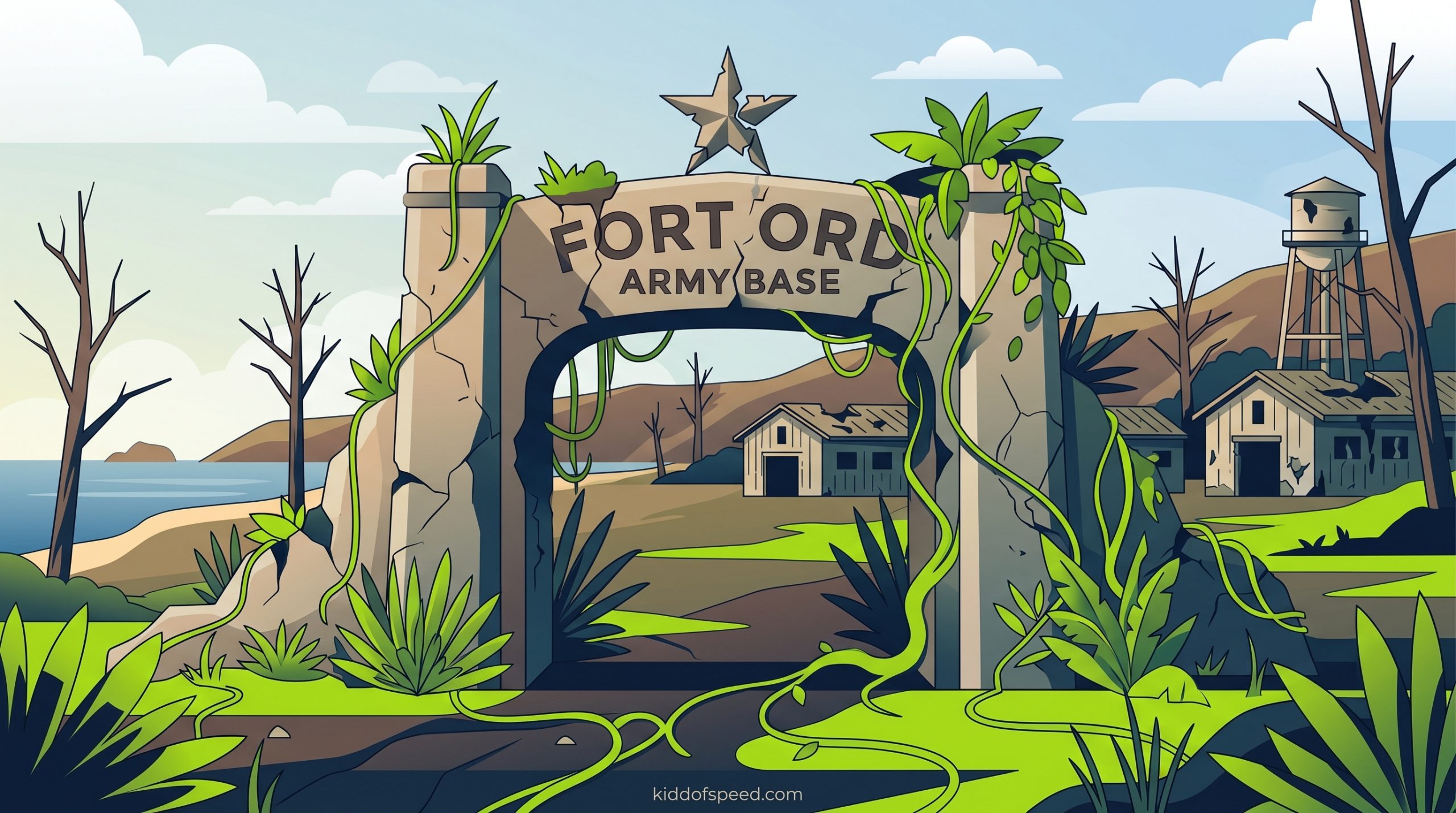
Fort Ord closed in 1994 as part of the Base Realignment and Closure (BRAC) process following the end of the Cold War. The sprawling 28,000-acre installation along California’s Monterey Bay was left to decay because severe environmental contamination, including trichloroethylene (TCE), petroleum spills, and thousands of unexploded ordnance items, required decades of Superfund cleanup before any meaningful redevelopment could occur. Understanding why this major military base was abandoned and left to rot for nearly 30 years requires examining the complex intersection of military downsizing, toxic legacy, and the challenges of converting contaminated land to civilian use.
This comprehensive guide explains the full story of Fort Ord’s closure and prolonged decay. I have researched military records, EPA documents, veteran accounts, and local news archives to give you the complete picture. Whether you are a veteran who served here, a historian researching military base closures, or simply curious about this abandoned California landmark, you will find the answers you need.
Table of Contents
- Fort Ord’s Military Legacy: From Camp Gigling to Infantry Training Center
- Why Did Fort Ord Close? Understanding the BRAC Process
- What Contaminants Were Discovered at Fort Ord
- The Human Cost: Veterans and Community Health
- Why Fort Ord Was Left to Decay for Decades
- What Is Fort Ord Now? Redevelopment and Rebirth
- Frequently Asked Questions About Fort Ord
- Conclusion: Understanding Fort Ord’s Closure and Decay
Fort Ord’s Military Legacy: From Camp Gigling to Infantry Training Center
Fort Ord’s story begins in 1917 when the U.S. Army established Camp Gigling on the Monterey Peninsula. The location offered ideal training conditions: coastal climate, varied terrain, and proximity to the Presidio of Monterey. The base expanded dramatically during World War II, becoming a major light infantry training center for soldiers heading to the Pacific Theater.
The installation was renamed Fort Ord in 1940 and grew to become one of the most important training facilities on the West Coast. At its peak during the 1950s and 1960s, the base covered approximately 28,000 acres and supported a population of over 50,000 military personnel and their families. The 7th Infantry Division called Fort Ord home, and the base served as the primary basic training facility for the entire Western United States.
World War II and the Korean War Era
During World War II, Fort Ord processed thousands of soldiers bound for combat in the Pacific. The base’s light infantry training prepared troops for island-hopping campaigns and jungle warfare. Many of the wooden barracks that would later become symbols of the base’s decay were built during this period.
The Korean War brought renewed activity to Fort Ord in the early 1950s. The base trained and deployed units to the Korean Peninsula, with many soldiers passing through the Monterey Bay installation on their way to combat. This era saw significant infrastructure expansion, including housing, training facilities, and support buildings that would later complicate cleanup efforts.
Vietnam War and Peak Operations
Fort Ord reached its zenith during the Vietnam War era. Between 1965 and 1975, tens of thousands of soldiers completed basic training and advanced infantry training at the base before deployment to Southeast Asia. The 7th Infantry Division prepared for potential deployment, and the base’s firing ranges and training areas saw constant use.
This intensive military activity left a lasting environmental impact. Decades of weapons training, vehicle maintenance, fuel storage, and chemical use contaminated soil and groundwater across thousands of acres. The full extent of this contamination would not become apparent until after the base closed and environmental investigations began.
Economic Impact on the Monterey Bay Region
Fort Ord was the economic engine for the communities of Seaside and Marina, California. The base provided direct employment for thousands of civilian workers and supported countless local businesses. Military families lived in nearby neighborhoods, sent children to local schools, and contributed to the regional economy.
When closure rumors began circulating in the late 1980s, local leaders worried about the devastating economic impact. The base represented approximately 30% of the local economy in the Seaside-Marina area. The prospect of losing this economic anchor drove early discussions about reuse and redevelopment, though the environmental contamination that would be discovered would severely complicate these plans.
Why Did Fort Ord Close? Understanding the BRAC Process
Fort Ord closed because Congress selected it for closure in the 1991 Base Realignment and Closure (BRAC) round, following criteria established by the 1988 BRAC Act signed by President George H.W. Bush. The Army officially closed the base on September 30, 1994, marking the end of 77 years of continuous military operations.
The Base Realignment and Closure Act of 1988
Congress passed the Base Realignment and Closure Act in 1988 to create a fair, politically neutral process for closing excess military installations following the Cold War. The legislation established an independent commission to evaluate bases based on military value, excess capacity, and cost savings potential. This process was designed to remove politics from base closure decisions that had historically been difficult to execute.
The BRAC process considered several key factors when evaluating installations. Military utility and strategic importance ranked highest, but the commission also examined excess capacity, infrastructure condition, surrounding community impact, and estimated closure costs. Fort Ord faced challenges in several of these categories as the Army reduced its size in the post-Cold War era.
Why Fort Ord Made the 1991 BRAC List
The 1991 BRAC Commission selected Fort Ord for several specific reasons. First, the Army had excess training capacity nationwide, with other installations able to absorb Fort Ord’s training mission. Second, maintaining a large coastal installation in high-cost California was expensive compared to alternatives in other states. Third, much of the base’s World War II-era infrastructure required costly modernization.
The commission also considered the base’s proximity to other California installations. With the Presidio of Monterey, Fort Hunter Liggett, and other bases nearby, the military could consolidate functions and reduce redundancy. The decision reflected a strategic shift away from large, fixed installations toward more flexible, deployable force structures.
Timeline from Announcement to Closure
The closure process unfolded over three years following the 1991 BRAC announcement. The Army began relocating the 7th Infantry Division and other tenant units almost immediately. By 1993, most active training operations had ceased, though some administrative functions continued until the formal closure date of September 30, 1994.
During this transition period, the Army conducted preliminary environmental assessments required by federal law. These assessments would reveal the extent of contamination that would ultimately determine the fate of the property and explain why the base could not be quickly transferred to civilian use.
Local Community Response and Early Redevelopment Hopes
Local communities initially approached closure with a mix of concern and optimism. The City of Seaside and Marina stood to lose their primary economic driver, but they also saw opportunity in acquiring valuable coastal real estate for development. Early planning committees formed to discuss reuse options including housing, education, commercial development, and tourism.
These hopes would be dashed by the environmental investigations that followed. What planners envisioned as a quick transition to civilian use would instead become a decades-long cleanup process that left buildings abandoned, infrastructure crumbling, and thousands of acres fenced off from public access.
What Contaminants Were Discovered at Fort Ord
Environmental investigations revealed widespread contamination across Fort Ord’s 28,000 acres, leading to its designation as a federal Superfund site in 1990 before the base even closed. The primary contaminants included trichloroethylene (TCE) in groundwater, petroleum products from fuel spills, and thousands of unexploded ordnance items scattered across former training areas.
Trichloroethylene (TCE) Groundwater Contamination
TCE, a solvent used for degreasing metal parts and dry cleaning, was the most significant contaminant discovered at Fort Ord. The chemical had been used routinely in base maintenance operations for decades, and improper disposal practices allowed it to seep into the soil and contaminate groundwater aquifers.
The TCE plume spread across thousands of acres, affecting drinking water sources for the base and potentially migrating toward civilian wells. TCE is now classified as a known carcinogen linked to kidney cancer, liver cancer, and non-Hodgkin lymphoma. At Fort Ord, concentrations in some areas exceeded safe drinking water standards by factors of hundreds or thousands.
The Army and EPA identified dozens of source areas where TCE had been released. Cleaning these sites required pumping and treating millions of gallons of contaminated groundwater, a process that continues today at many locations. The extent of contamination made rapid redevelopment impossible, as developers could not safely build on or near contaminated areas.
Petroleum and Fuel Spills
Decades of fuel storage, vehicle maintenance, and aircraft operations left petroleum contamination throughout Fort Ord. Underground storage tanks leaked, fuel lines ruptured, and spills during refueling operations contaminated soil and groundwater. The Army identified hundreds of sites requiring cleanup, from small spill areas to large plumes of contaminated groundwater.
Benzene, toluene, and other petroleum compounds created additional health risks beyond the TCE contamination. These chemicals can cause neurological damage, cancer, and other health problems. Cleanup required excavating contaminated soil, treating groundwater, and in some cases, simply fencing off areas too dangerous for human contact.
The Unexploded Ordnance Crisis
Perhaps the most dramatic barrier to redevelopment was the discovery of thousands of unexploded ordnance (UXO) items across Fort Ord. Decades of weapons training, grenade practice, artillery firing, and demolition exercises left dangerous munitions buried in the soil. Some dated back to World War II; others were more recent.
The Army Corps of Engineers launched a massive UXO removal program that continues to this day. Crews systematically survey former training areas using metal detectors and other equipment, carefully excavating and disposing of found munitions. This work is dangerous, slow, and expensive. Areas containing UXO cannot be developed or even opened to public access until cleared.
As of 2026, approximately half of the Fort Ord National Monument remains closed to public access due to ongoing UXO concerns. This ongoing safety hazard continues to limit redevelopment options and explains why so much of the former base remains abandoned decades after closure.
Superfund Site Designation and Cleanup Framework
The Environmental Protection Agency added Fort Ord to the National Priorities List (Superfund) in 1990, making it one of the most contaminated sites in the nation. This designation triggered federal cleanup requirements and established a legal framework for remediation responsibilities. The Army became the lead agency responsible for cleanup, with EPA oversight.
The Superfund process required extensive studies, public input, and remediation planning before any cleanup could begin. These studies took years to complete and revealed contamination far worse than initially anticipated. The complexity of addressing multiple contaminants across thousands of acres made Fort Ord one of the most challenging military base cleanups in the country.
The Human Cost: Veterans and Community Health
Veterans who served at Fort Ord began reporting serious health issues in the years following closure, with many developing rare blood cancers and other conditions linked to chemical exposure. The VA has faced criticism for denying benefits to affected veterans, while research continues into the connection between Fort Ord service and later illness.
Multiple Myeloma and Blood Cancer Clusters
Multiple myeloma, a rare blood cancer affecting plasma cells, has appeared at elevated rates among Fort Ord veterans. This cancer is now associated with TCE exposure, and epidemiological studies have identified higher-than-expected incidence among service members stationed at contaminated bases. Veterans diagnosed with this condition face difficult treatment and often incur significant medical expenses.
Other blood cancers, including non-Hodgkin lymphoma and leukemia, also appear at concerning rates among Fort Ord veterans. These diagnoses often come decades after service, when veterans are in their 50s, 60s, or 70s. The latency period between exposure and illness complicates both research and benefits claims.
Veteran Stories and Forum Insights
Online forums and veteran communities contain numerous accounts from former Fort Ord service members describing health problems they believe relate to their service. One veteran shared on Reddit: “28 years after closing down Ft.Ord, they’ve finally torn down my old WWII era barracks I lived in.” The nostalgia mixed with anger is a common theme among veterans watching their former base decay while they struggle with health issues.
Many veterans express frustration that they were never warned about contamination risks during their service. One veteran noted: “Would have been nice to know. Would have been nice to have like water filtration or bottled water.” This lack of transparency has fueled resentment toward the military and complicated efforts to secure VA benefits.
VA Benefits Struggles
The Department of Veterans Affairs has been slow to recognize health conditions related to Fort Ord service. Unlike Agent Orange exposure for Vietnam veterans or burn pit exposure for Iraq and Afghanistan veterans, Fort Ord contamination lacks a specific presumptive service connection. This means veterans must prove their illness relates to their service, a difficult burden when decades have passed.
Veterans report frustrating claim denials, lengthy appeals processes, and inadequate compensation even when claims are approved. Many give up after initial rejections, leaving them to face serious illness without the support they earned through military service. Advocacy groups continue pushing for broader presumptive coverage for Fort Ord veterans.
Community Health Monitoring
Beyond veterans, the surrounding communities of Seaside and Marina have faced concerns about contaminated groundwater affecting civilian wells. The Army and EPA have monitored drinking water sources and provided alternative water supplies where necessary. However, residents remain concerned about long-term health impacts and property values in proximity to contaminated areas.
Why Fort Ord Was Left to Decay for Decades
The physical decay of Fort Ord’s buildings and infrastructure persisted for nearly 30 years because environmental cleanup had to precede any demolition or redevelopment. The cost and complexity of addressing widespread contamination meant that most structures could not be safely removed until surrounding areas were remediated, creating a paradox where abandoned buildings stood crumbling while cleanup continued slowly around them.
The Cleanup-First Requirement
Federal regulations require that hazardous waste sites be characterized and remediated before disturbing contaminated structures or soil. At Fort Ord, this meant that buildings sitting on or near contaminated ground could not be demolished until the surrounding area was cleaned. With contamination spread across 28,000 acres in a patchwork pattern, many buildings sat in limbo for decades.
The Army could not simply transfer contaminated property to local communities or developers. Federal law required that the land be cleaned to standards safe for intended use before any transfer. This legal framework, while protecting future landowners, created the prolonged decay that became Fort Ord’s defining characteristic.
Economic Factors and Cleanup Costs
The cost of cleaning Fort Ord has run into the hundreds of millions of dollars, with final costs likely to exceed a billion dollars when all work is complete. These costs are borne by the Army and ultimately taxpayers. The slow pace of federal funding has extended the cleanup timeline, as the Army must balance Fort Ord remediation against other environmental obligations at bases nationwide.
Local communities lacked the resources to accelerate cleanup or redevelop contaminated areas themselves. While some portions of the base were clean enough for early transfer, the most desirable coastal parcels often sat atop contaminated groundwater or near UXO areas. The economics of military base cleanup meant that Fort Ord’s decay was essentially a cost-saving measure, however unfortunate its appearance.
Comparison with Successfully Redeveloped Bases
Not all closed military bases experienced Fort Ord’s prolonged decay. Bases like the Presidio of San Francisco transferred to the National Park Service with minimal environmental issues and were redeveloped relatively quickly. Others, like Hunter Army Airfield in Georgia, remained operational and avoided closure entirely.
The difference at Fort Ord was the severity and extent of contamination combined with the base’s massive size. Smaller installations with cleaner environmental histories could transfer more easily. Fort Ord’s 28,000 acres of varied contamination presented challenges unmatched by most other closed bases, explaining why it remained abandoned while other installations found new life.
Regulatory Hurdles and Public Safety
Each phase of Fort Ord cleanup required extensive regulatory review, public comment periods, and approval processes. The EPA, state of California, and local agencies all had oversight roles that added time to every decision. While these safeguards protected public health and ensured thorough cleanup, they also contributed to the slow timeline.
Public safety concerns prevented simply opening the base to exploration or recreation during the cleanup period. The presence of UXO, unstable abandoned buildings, and contaminated areas required fencing, security patrols, and restricted access. The base essentially sat under quarantine while the slow work of remediation proceeded acre by acre.
What Is Fort Ord Now? Redevelopment and Rebirth
After decades of decay and cleanup, Fort Ord is finally experiencing partial redevelopment, though significant areas remain closed. California State University Monterey Bay opened on former base property in 1994, the same year the base closed. In 2012, President Obama designated 14,651 acres as the Fort Ord National Monument, preserving the land for public use while cleanup continues.
Fort Ord National Monument
The Fort Ord National Monument protects a significant portion of the former base as public land managed by the Bureau of Land Management. The monument includes rare maritime chaparral habitat, unique geological features, and historic military structures. Visitors can explore trails, view wildlife, and learn about the area’s military history at the monument.
However, approximately half the monument remains closed due to ongoing UXO cleanup. The BLM opens new areas as the Army Corps of Engineers clears them, but the process is slow. Visitors should check current access restrictions before planning trips, as closed areas are strictly enforced for safety.
California State University Monterey Bay
CSU Monterey Bay represents the most successful redevelopment of Fort Ord property. The university opened in 1994, converting former Army buildings into classrooms, dormitories, and administrative facilities. Today the campus serves over 7,000 students and has become an important part of the regional economy.
The university’s success was possible because it was located on relatively clean portions of the base. This allowed early transfer and development while other areas remained off-limits. CSU Monterey Bay stands as proof that Fort Ord could be productively reused when environmental conditions permitted.
Housing and Commercial Development
As cleanup progresses, portions of Fort Ord have been transferred for housing and commercial development. New neighborhoods have replaced former military housing areas, and commercial developments serve the growing population. The City of Marina and Seaside have slowly incorporated former base land into their jurisdictions.
These developments face strict environmental requirements, including deed restrictions and monitoring systems. Developers must sign agreements acknowledging the land’s military history and accepting liability for any discovered contamination. These requirements add cost and complexity but allow productive use of formerly contaminated property.
Visiting Fort Ord Today
Visitors can explore portions of the former base through the National Monument, though access varies by area. The Fort Ord Dunes State Park offers beach access and coastal trails. BLM-managed areas provide hiking, biking, and horseback riding on cleared trails. Historic markers and interpretive displays explain the area’s military history.
Some abandoned structures remain visible from trails and roads, though visitors should not enter fenced areas or abandoned buildings. The decay that characterized Fort Ord for decades is slowly being remediated, but traces of the base’s abandoned past remain for those who know where to look.
Frequently Asked Questions About Fort Ord
Why did they close Fort Ord, California?
Fort Ord closed in 1994 as part of the Base Realignment and Closure (BRAC) process following the end of the Cold War. The base was selected for closure in 1991 because the Army had excess training capacity, maintaining a large coastal installation in high-cost California was expensive, and much of the World War II-era infrastructure required costly modernization.
Is Fort Ord still contaminated?
Yes, portions of Fort Ord remain contaminated despite decades of cleanup. Trichloroethylene (TCE) contamination in groundwater persists in some areas, and approximately half of the Fort Ord National Monument remains closed due to unexploded ordnance (UXO) concerns. Cleanup efforts continue and are expected to last several more years before all areas are safe for unrestricted use.
What happened to Fort Ord after closure?
After closure in 1994, Fort Ord became a federal Superfund site requiring extensive environmental cleanup. Portions were transferred for redevelopment, including California State University Monterey Bay (opened 1994) and the Fort Ord National Monument (designated 2012). Housing and commercial development has occurred on cleaned portions, while other areas remain fenced off pending remediation.
Did Fort Ord make veterans sick?
Many Fort Ord veterans believe their service caused serious health problems, particularly multiple myeloma and other blood cancers linked to TCE exposure. The VA has been slow to grant presumptive service connection for Fort Ord conditions, leaving veterans to prove individual claims. Research continues into the connection between Fort Ord service and later illness.
Can you visit Fort Ord?
Yes, portions of Fort Ord are open to the public through the Fort Ord National Monument and Fort Ord Dunes State Park. Visitors can hike, bike, and explore trails on cleared portions. However, approximately half the monument remains closed due to unexploded ordnance cleanup. Check current access restrictions before visiting.
What chemicals were found at Fort Ord?
The primary contaminants discovered at Fort Ord included trichloroethylene (TCE) used for degreasing, petroleum products from fuel spills and storage, and various solvents and chemicals from military operations. These contaminants affected groundwater, soil, and in some cases drinking water sources. Unexploded ordnance including grenades, artillery shells, and practice munitions also contaminated former training areas.
How long will Fort Ord cleanup take?
Cleanup at Fort Ord began in the 1990s and continues today, making it one of the longest-running military base cleanups in the United States. Unexploded ordnance removal alone is expected to continue for several more years. Full remediation of all contaminated areas may take until the 2030s or beyond, depending on funding and discovery of new contamination.
Are there other abandoned military bases in California?
California has several former military installations that have been closed or realigned. The Presidio of San Francisco transferred to the National Park Service and has been largely redeveloped. Fort Hunter Liggett remains active. Other closed facilities include portions of the Oakland Army Base and Mare Island Naval Shipyard. Fort Ord is unique in its combination of size, contamination severity, and prolonged decay period.
Conclusion: Understanding Fort Ord’s Closure and Decay
Fort Ord was closed in 1994 due to post-Cold War military downsizing through the Base Realignment and Closure process. The base was left to decay for nearly three decades because severe environmental contamination required extensive Superfund cleanup before any redevelopment could occur.
The toxic legacy of TCE, petroleum spills, and unexploded ordnance created a situation where abandoned buildings stood crumbling while cleanup proceeded acre by acre. Veterans who served at Fort Ord continue to seek recognition and benefits for health conditions they believe resulted from their service. Communities around Monterey Bay have slowly adapted to life without their primary economic engine.
Today, Fort Ord is finally experiencing rebirth. The National Monument preserves portions of the former base for public enjoyment. CSU Monterey Bay thrives on former military land. New housing and commercial development brings life back to once-abandoned areas. Yet the cleanup continues, and the full story of Fort Ord’s environmental impact may not be known for generations.
If you served at Fort Ord and are experiencing health issues, contact the VA to discuss potential benefits. Veterans who served at contaminated bases may be eligible for healthcare and disability compensation, even if claims were previously denied. The fight for recognition continues, and every claim helps build the case for broader presumptive service connection.