
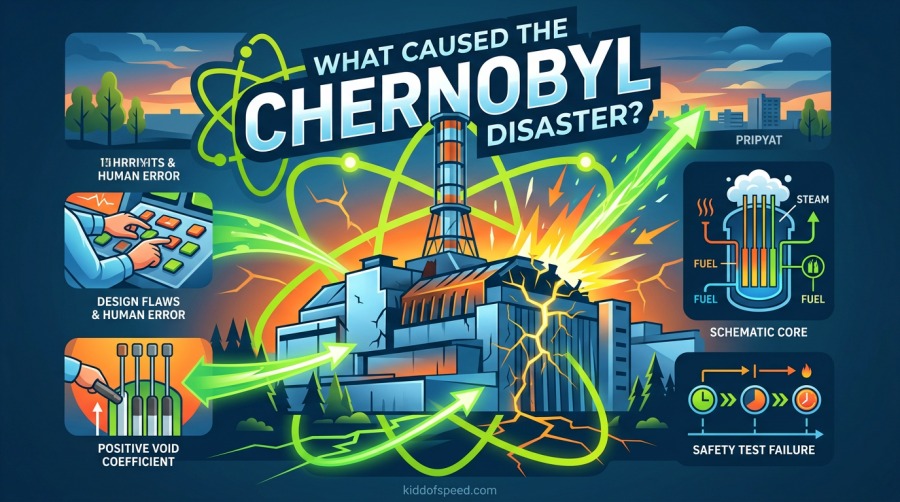
The Chernobyl disaster on April 26, 1986, remains the worst nuclear accident in human history. A catastrophic explosion at Unit 4 of the Chernobyl Nuclear Power Plant released approximately 5% of the reactor core’s radioactive material into the environment. Understanding what caused the Chernobyl disaster helps explain how design flaws, human error, and systemic failures combined to create a tragedy that killed dozens immediately and affected millions across Europe.
The disaster resulted from three primary factors working together:
- Fundamental reactor design flaws in the RBMK-1000 design, particularly the positive void coefficient and graphite-tipped control rods
- Operator errors during a safety test that violated established protocols and disabled critical safety systems
- Soviet bureaucratic culture that prioritized production over safety and suppressed warnings about the reactor’s dangers
This article breaks down exactly what caused the Chernobyl disaster, from the technical reactor physics to the human decisions that turned a routine test into an international catastrophe. I have studied the official reports from the International Atomic Energy Agency, the World Nuclear Association, and declassified Soviet documents to bring you an accurate, comprehensive explanation.
Table of Contents
What Caused the Chernobyl Disaster
The Chernobyl disaster resulted from a fatal combination of reactor design flaws and operator errors during a poorly planned safety test. On the night of April 25-26, 1986, operators at Unit 4 attempted to simulate cooling the reactor during a power outage, but their actions triggered an uncontrolled nuclear chain reaction that caused two explosions and a fire that burned for nine days.
The RBMK reactor design contained inherent safety problems that engineers had identified but never fully addressed. Soviet authorities knew about these flaws since the 1970s, yet they continued operating the reactors because the design was cheap to build and produced weapons-grade plutonium as a byproduct. This prioritization of political and economic goals over safety created the conditions for disaster.
The immediate trigger came when operators, preparing for the test, reduced reactor power too quickly and created a condition called “xenon poisoning.” This phenomenon made the reactor extremely unstable at low power levels. Instead of shutting down safely, the operators removed nearly all control rods and disabled automatic safety systems in violation of their own procedures, creating a situation where any small disturbance could cause a runaway reaction.
When the operators finally pressed the AZ-5 emergency shutdown button, the reactor did not stop. Instead, the control rod design flaw caused a massive power surge within seconds. The fuel rods fragmented, steam pressure built up instantly, and two explosions destroyed the reactor building, sending radioactive material high into the atmosphere.
The RBMK Reactor Design Flaws
The RBMK-1000 reactor that exploded at Chernobyl had a unique design that differed fundamentally from Western nuclear reactors. RBMK stands for Reaktor Bolshoy Moshchnosti Kanalny, which translates to “High Power Channel-type Reactor.” These reactors used graphite as a moderator to slow neutrons and sustain the chain reaction, while water circulated through individual pressure tubes to cool the fuel. This design made the reactors capable of refueling during operation and produced plutonium for Soviet weapons programs, but it also contained dangerous safety vulnerabilities.
The Positive Void Coefficient Explained
The most dangerous design flaw in the RBMK reactor was something called the positive void coefficient. This technical term describes how the reactor responds when water in the cooling channels turns to steam, creating bubbles or “voids” in the coolant flow.
In most Western reactors, if water boils and creates steam bubbles, the nuclear reaction automatically slows down. This is called a negative void coefficient, and it acts as a built-in safety feature. If cooling fails and water boils, the reaction naturally decreases, preventing runaway conditions.
The RBMK reactor behaved in exactly the opposite way. When water turned to steam in an RBMK reactor, the nuclear reaction actually accelerated. Steam absorbs fewer neutrons than liquid water, so more neutrons became available to split uranium atoms. Additionally, the graphite moderator remained in place and continued slowing neutrons effectively. This meant that any loss of cooling water caused the reactor power to increase rapidly, exactly when you needed it to decrease.
This flaw alone did not make the disaster inevitable. RBMK reactors operated for years without major incidents because operators understood they must never allow conditions where steam voids could form in large quantities. However, on the night of April 26, 1986, the operators created exactly those conditions through their decision-making.
The Graphite-Tipped Control Rod Problem
The control rods that regulated the nuclear reaction in the RBMK reactor had a bizarre and dangerous design feature. The lower portion of each control rod consisted of graphite, a material that actually promotes nuclear reactions by slowing neutrons. Only the upper portion contained boron carbide, a material that absorbs neutrons and slows reactions.
When fully withdrawn from the core, the control rod channels filled with water. This water absorbed neutrons and helped regulate the reaction. When operators pressed the AZ-5 emergency shutdown button, the rods began descending into the core. As they entered, the graphite tips displaced the neutron-absorbing water first, while the boron carbide sections remained above the active fuel region.
For approximately 5 to 7 seconds, this design actually increased the reactivity in the lower portion of the core before the boron carbide could take effect. Under normal conditions, this brief surge was manageable. But with the reactor already in an extremely unstable state, this temporary increase in reactivity provided the final trigger for the explosion.
The combination of positive void coefficient and graphite-tipped control rods meant that when operators pressed the emergency stop button expecting the reactor to shut down, they instead triggered an immediate power surge that destroyed the reactor completely.
Why Soviet Authorities Ignored the Warnings
Soviet nuclear engineers had known about these design problems since the 1970s. A partial meltdown at the Leningrad Nuclear Power Plant in 1975 demonstrated that RBMK reactors could behave unpredictably during transients. However, the Soviet system discouraged reporting problems that might reflect poorly on the technology or the state agencies responsible for it.
Engineers who raised concerns about reactor safety faced professional consequences. The RBMK design was cheap, used proven manufacturing techniques, and produced plutonium for the military. Changing the design to fix the positive void coefficient would require expensive modifications and might shut down reactors for extended periods. Soviet authorities chose to continue operating the reactors with the known flaws and simply instructed operators to avoid conditions that could trigger dangerous behavior.
This bureaucratic culture of secrecy and risk tolerance created the foundation for the disaster. The operators on duty at Chernobyl Unit 4 did not fully understand the dangers of the reactor they operated because that information was classified and withheld from them.
The Safety Test That Went Wrong
The immediate trigger for the Chernobyl disaster was a safety test scheduled for April 25, 1986. The test aimed to determine whether the turbine could provide enough power to operate cooling pumps during a station blackout while the emergency diesel generators started up. This was a legitimate safety concern, but the way the test was planned and executed violated multiple safety protocols.
The Purpose of the Test
During a power outage, nuclear reactors need continuous cooling even after shutdown because decay heat continues generating warmth for hours or days. The Chernobyl plant relied on emergency diesel generators to power cooling pumps during blackouts, but these generators took approximately 60 seconds to reach full power after starting.
The test aimed to determine whether the rotational momentum of the turbine, spinning down after steam supply was cut off, could generate enough electricity to bridge this 60-second gap. If successful, this would provide an additional safety margin during power failures. Similar tests had been conducted at other RBMK plants, though never successfully at Chernobyl Unit 4.
How the Test Plan Violated Safety Protocols
Several factors made the April 1986 test particularly dangerous. First, the test was scheduled during a planned reactor shutdown, which meant operators were working under time pressure to complete the test before reducing power for maintenance. Second, the test plan required operators to disable the automatic emergency cooling system because its activation would interfere with the test conditions.
Most critically, the test required running the reactor at very low power levels, around 700-800 megawatts thermal. At these power levels, the reactor became extremely unstable due to xenon poisoning, a phenomenon where accumulated fission product xenon-135 absorbs neutrons and makes the reactor difficult to control. The RBMK reactor’s positive void coefficient made this condition particularly dangerous.
The reactor’s chief engineer approved the test despite these risks. Soviet operating procedures specifically prohibited running the reactor at such low power with the number of control rods that would be required for the test. But production pressures and the desire to finally complete this long-delayed test led to approval of a plan that never should have been authorized.
The Chain of Operator Errors
The disaster unfolded through a series of decisions that made the reactor increasingly unstable. The test was supposed to begin during the day shift on April 25, but a regional power controller requested that the reactor continue supplying electricity to the grid. This delayed the start until the evening shift took over.
At 2:00 PM, operators began reducing power to prepare for the test. By 11:10 PM, power had dropped to 1,600 megawatts thermal, still above the target range but within acceptable limits. However, an operator error caused power to drop rapidly to just 30 megawatts thermal, far below the minimum safe operating level.
This extremely low power created severe xenon poisoning conditions. The reactor became so poisoned with xenon-135 that it threatened to shut down completely. To prevent automatic shutdown, operators disabled the automatic control systems and manually adjusted control rods to maintain some power output.
Over the next hour, operators withdrew almost all control rods from the core, far beyond the minimum safe number required by procedures. They also blocked emergency safety signals that would have triggered automatic shutdown. By 1:00 AM on April 26, the reactor was running at 200 megawatts thermal with only 6 to 8 control rods remaining in the core, while procedures required at least 15 for safe operation.
When the test finally began at 1:23:04 AM, conditions were catastrophically unstable. The reactor was in a state where any small disturbance could cause a massive power surge, and the safety systems designed to prevent this had been manually disabled.
Timeline of the Chernobyl Disaster
The Chernobyl disaster unfolded over approximately 36 hours, from the start of the safety test preparations on April 25 to the evacuation of Pripyat on April 27. Understanding the precise sequence of events helps clarify exactly what went wrong and when.
April 25, 1986: Test Preparation Begins
2:00 PM: Operators begin reducing reactor power from normal operating levels (3,200 megawatts thermal) to prepare for the safety test. The test aims to verify that turbine coast-down can power cooling pumps during a blackout.
3:47 PM: A regional power grid dispatcher requests that the reactor continue supplying electricity to the grid. The test is delayed to accommodate this request, forcing the evening shift to conduct the test instead of the more experienced day shift.
11:10 PM: Power reduction continues. An operator error causes reactor power to plummet to 30 megawatts thermal, far below safe operating levels. Severe xenon poisoning begins, making the reactor extremely unstable.
April 26, 1986: The Explosion
12:05 AM: Operators begin withdrawing control rods to counteract xenon poisoning and raise power. They eventually remove nearly all rods from the core, violating minimum safety requirements.
12:28 AM: Operators disable automatic emergency shutdown systems to prevent them from interfering with the test.
1:00 AM: Reactor power stabilizes at 200 megawatts thermal, still below the intended test range but considered acceptable by the operators. Only 6 to 8 control rods remain in the core, far below the 15-rod minimum required by procedures.
1:05 AM: Additional pumps are activated to increase water flow, causing a slight decrease in steam voids. The reactor becomes even more unstable as water replaces steam in the core.
1:19 AM: Operators block emergency signals that would trigger automatic reactor shutdown. They also disable automatic control rod movement.
1:23:04 AM: The test officially begins. Steam supply to the turbines is shut off to measure their coast-down capability. The reactor continues operating at reduced power.
1:23:40 AM: The turbine coast-down test is complete. The AZ-5 button is pressed to initiate emergency shutdown. Control rods begin descending into the core.
1:23:43 AM: The graphite tips of the control rods displace water in the lower core, causing a rapid increase in reactivity. Power surges to over 30,000 megawatts thermal in seconds.
1:23:45 AM: Steam explosions rupture fuel channels and the reactor vessel. A first explosion occurs, likely caused by steam pressure, followed by a second explosion seconds later from a possible hydrogen or nuclear excursion. The 2,000-ton reactor lid is blown off.
1:24 AM: Fires break out in the reactor building and around the exposed graphite core. Radioactive material begins venting directly to the atmosphere.
1:28 AM: Firefighters from Pripyat arrive. They know nothing about radiation dangers and have no protective equipment. They begin fighting the conventional fires while receiving massive radiation doses.
2:00-3:00 AM: Plant management and local officials debate the severity of the accident. Radiation meters on site max out at 3.6 roentgen per hour, but the actual levels are far higher. Some measurements later indicate radiation levels exceeding 15,000 roentgen per hour near the destroyed reactor.
Immediate Aftermath
April 26, morning: The fire continues burning, releasing radioactive material including iodine-131, caesium-137, and strontium-90. Prevailing winds carry contamination northwest toward Scandinavia.
April 26, evening: A team of plant workers and firefighters, later called “liquidators,” begins the dangerous work of clearing debris from the reactor hall to prevent further fires. Many receive fatal radiation doses.
April 27, 2:00 PM: Authorities finally order evacuation of Pripyat, the city built for plant workers. Over 49,000 people are evacuated within 3 hours, told they will return in a few days. Most never return.
Immediate Consequences and Response
The explosion and subsequent fires released approximately 520 different radionuclides into the environment, with a total radioactivity of about 1,900 petabecquerels. The immediate response was hampered by lack of information, inadequate equipment, and the Soviet system’s initial reluctance to acknowledge the disaster’s severity.
The “3.6 Roentgen” Problem
Perhaps the most infamous aspect of the immediate response was the radiation measurement fiasco. The dosimeters available at the plant were not designed to measure the extreme radiation levels present after the explosion. Most meters maxed out at 3.6 roentgen per hour, leading plant director Viktor Bryukhanov and others to initially underestimate the severity.
The actual radiation levels near the destroyed reactor exceeded 15,000 roentgen per hour. A person standing near the reactor core would receive a fatal dose within minutes. The limited measurement capability delayed proper response and led to firefighters and plant workers receiving massive, often fatal, radiation doses.
Valery Khodemchuk, the reactor operator on duty, was likely killed instantly by the explosion or the debris. His body was never recovered and remains entombed in the reactor ruins. Vladimir Shashenok, an automatic systems operator, died from trauma and burns within hours of the explosion.
The Firefighters and Plant Workers
The first firefighters arrived within minutes of the explosion. They had no knowledge of radiation dangers and no protective equipment. They fought conventional fires while receiving radiation doses that would kill many of them within weeks.
Leonid Telyatnikov, the fire chief, received approximately 4,000 millisieverts and survived, though with long-term health effects. Many of his firefighters received double that amount. Vasily Ignatenko died two weeks after the explosion from acute radiation syndrome. His wife Lyudmilla, pregnant at the time, lost their baby due to radiation exposure.
By the end of 1986, 28 firefighters and plant workers had died from acute radiation syndrome. Nineteen more died by 2004 from various causes including cancer and heart disease potentially linked to radiation exposure. The total death toll remains disputed, with estimates ranging from the United Nations figure of approximately 50 direct deaths to higher estimates from some environmental groups.
Evacuation and Exclusion Zone
The evacuation of Pripyat began approximately 36 hours after the explosion. Authorities initially hoped to contain the situation without evacuation, but rising radiation levels and changing wind patterns made this impossible. Buses arrived in the afternoon of April 27, and residents were told to bring only essential items for a few days away.
The Chernobyl Exclusion Zone was eventually established covering approximately 4,300 square kilometers around the plant. Over 350,000 people were permanently resettled from contaminated areas in Ukraine, Belarus, and Russia. The city of Pripyat remains abandoned to this day, a time capsule of Soviet life frozen in 1986.
Chernobyl Today: Modern Updates and Legacy
Thirty-nine years after the disaster, Chernobyl remains both a memorial to the tragedy and an active site requiring constant maintenance. 2026 marks a period of both progress in securing the site and new challenges from geopolitical events.
The New Safe Confinement
In 2016, engineers completed the New Safe Confinement (NSC), a massive steel and concrete arch that was slid over the original sarcophagus built in 1986. This structure, funded by international donors including the European Union, cost approximately 1.5 billion euros and is designed to last 100 years.
The NSC allows for the safe dismantling of the original sarcophagus and eventually the removal of radioactive material from the destroyed reactor. This process will take decades and cost billions more, but it represents the first permanent solution to containing the radiation threat.
The 2022 Russian Invasion
In February 2022, Russian military forces occupied the Chernobyl site during the invasion of Ukraine. For 35 days, soldiers controlled the facility, creating unprecedented security concerns. Ukrainian staff continued working under occupation to maintain critical safety systems.
The occupation disrupted monitoring equipment and raised radiation levels locally when heavy military vehicles stirred up contaminated dust. The incident highlighted ongoing vulnerabilities at the site and renewed international attention on nuclear security during armed conflicts.
Current Radiation Levels
Most areas of the Chernobyl Exclusion Zone now have radiation levels that are safe for limited human exposure. The most contaminated areas remain closed, but wildlife has flourished in the absence of human activity. Studies have shown that animal populations, including wolves, deer, and wild horses, have increased dramatically since the evacuation.
Some isotopes released in 1986, particularly caesium-137 and strontium-90, will remain hazardous for centuries. However, the most dangerous isotope, iodine-131, decayed within weeks of the accident. Visitors can now take day tours to certain areas of the exclusion zone, though extended stays remain restricted.
Lessons Learned
The Chernobyl disaster fundamentally changed nuclear safety culture worldwide. The International Atomic Energy Agency established new conventions on early notification of nuclear accidents and assistance in emergencies. Western countries reviewed their own reactor designs and emergency procedures.
The disaster demonstrated that nuclear safety requires transparency, international cooperation, and a culture that prioritizes safety over production pressures. While some critics argue that nuclear power remains too dangerous, proponents note that Chernobyl’s specific reactor design flaws do not exist in modern reactors, and the accident led to improvements that make today’s nuclear plants significantly safer.
Frequently Asked Questions
What was the real reason for the Chernobyl disaster?
How long is Chernobyl still radioactive?
Who stopped Chernobyl from exploding?
What animals mutated in Chernobyl?
Conclusion
The Chernobyl disaster was caused by a fatal convergence of reactor design flaws, operator errors, and systemic failures in the Soviet safety culture. The RBMK reactor’s positive void coefficient and graphite-tipped control rods created a machine that could behave unpredictably under certain conditions, while the operators on duty that night created exactly those dangerous conditions through a series of protocol violations.
Understanding what caused the Chernobyl disaster matters not just for historical accuracy but for nuclear safety today. The accident fundamentally changed how the world approaches nuclear power, establishing international cooperation frameworks and safety cultures that prioritize transparency over secrecy. While the site remains radioactive and will require management for centuries to come, the lessons learned from April 26, 1986, have made nuclear power significantly safer worldwide.
The abandoned city of Pripyat, with its decaying Ferris wheel and empty apartment buildings, stands as a memorial to the dangers of complacency. It reminds us that the most advanced technology requires respect, proper training, and a culture that values safety above all other concerns.