
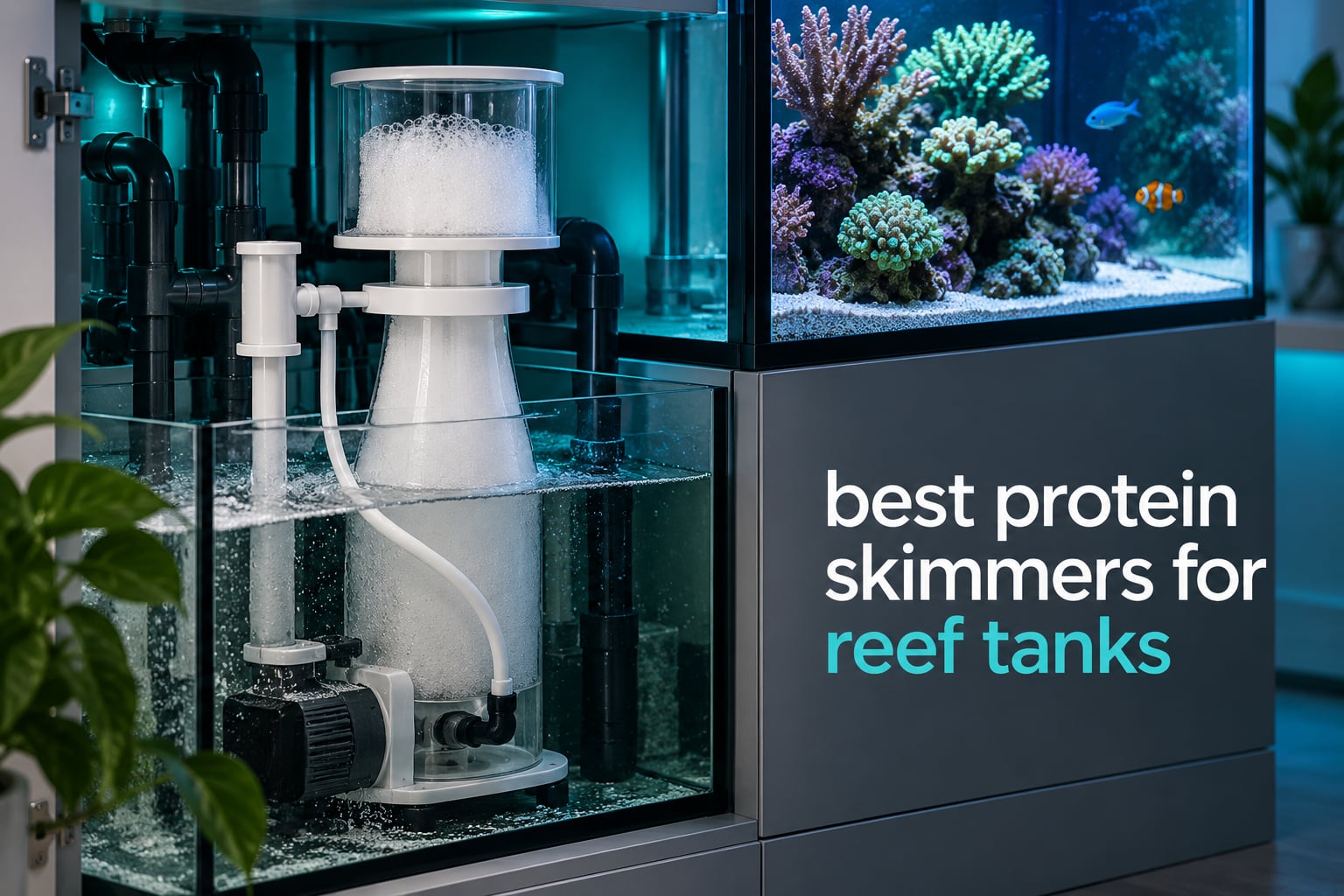
A reef tank has no tides and no water change you can skip forever. Every fish you add produces waste, and that waste turns into dissolved organic compounds that tint the water, absorb the light your corals need, and eventually break down into the nutrients that feed nuisance algae. The cheapest way to strip organics before they get that far is foam fractionation, and the device that does it is a protein skimmer.
This guide covers the best protein skimmers for reef tanks, from a sub-30 gallon all-in-one to a 740 gallon rated display system. I picked each one on reliability history, bubble quality, sump fit, and how real reef keepers describe living with it, not on brochure copy. We earn a commission if you buy through the links on this page, at no extra cost to you.
I should be straight with you about one thing before the list starts. A protein skimmer is not mandatory on every reef, and anyone who tells you otherwise is selling. On a stocked reef with fish in the water it is close to essential, because it removes organics continuously rather than in weekly batches. On a fishless coral-only system with a heavy two-part dosing program, media filtration, and aggressive water changes, you can get by without one. I have covered both cases in the buying guide below.
While you are planning equipment, it is worth sorting out your lighting at the same time. Our guide to the best LED aquarium lights for reef tanks runs through spectrum and PAR decisions that pair well with the skimmer choices here.
Table of Contents
- Top 3 Protein Skimmers for Reef Tanks in 2026
- Quick Overview: All 10 Skimmers Side by Side in 2026
- How We Picked the Best Protein Skimmers
- 1. Reef Octopus Classic 110-INT — Best Overall In-Sump Skimmer
- 2. Coralife Biocube Protein Skimmer — Best Budget Pick for Nano Tanks
- 3. Simplicity 240DC — Best for Tight Sumps and Large Systems
- 4. Tunze Comline DOC 9001 — Best Compact Skimmer for Nano Sums
- 5. Reef Octopus Classic 150INT — Best Value for 100 to 150 Gallon Reefs
- 6. Reef Octopus eSsence S-130 — Best for Heavy Bioload Systems
- 7. Reef Octopus BH90 — Best Hang-On-Back Skimmer for Rimmed Tanks
- 8. Reef Octopus Classic 152-S — Best Compact Body for Mid-Size Systems
- 9. Maxspect Jump SK400 — Best for Quiet Operation
- 10. Red Sea Reefer 900 — Best for Large Display Systems
- How to Choose the Right Protein Skimmer for Your Reef Tank
- How to Dial In, Break In, and Troubleshoot Your Protein Skimmer
- Frequently Asked Questions
- Final Verdict: Which Protein Skimmer Should You Buy?
Top 3 Protein Skimmers for Reef Tanks in 2026
Reef Octopus Classic 110-INT
- 4 inch needle wheel pump
- Rated around 100 gallons
- Quiet DC pump operation

Coralife Biocube Skimmer
- Fits BioCube and tanks to 32 gallons
- Self-priming pump
- Very low power draw
Reef Octopus Classic 150INT
- Aquatrance 2000 pinwheel pump
- Rated to 150 gallons
- Quiet and easy to clean
Quick Overview: All 10 Skimmers Side by Side in 2026
The table below covers every model in the guide, ordered by tank size tier. Ratings and review counts come straight from customer feedback on Amazon listings.
| Product | Specifications | Action |
|---|---|---|
| Reef Octopus Classic 110-INT |
|
Check Latest Price |
| Coralife Biocube Skimmer |
|
Check Latest Price |
 Simplicity 240DC Simplicity 240DC |
|
Check Latest Price |
 Tunze Comline DOC 9001 Tunze Comline DOC 9001 |
|
Check Latest Price |
| Reef Octopus Classic 150INT |
|
Check Latest Price |
 Reef Octopus eSsence S-130 Reef Octopus eSsence S-130 |
|
Check Latest Price |
 Reef Octopus BH90 Reef Octopus BH90 |
|
Check Latest Price |
 Reef Octopus Classic 152-S Reef Octopus Classic 152-S |
|
Check Latest Price |
 Maxspect Jump SK400 Maxspect Jump SK400 |
|
Check Latest Price |
 Red Sea Reefer 900 Red Sea Reefer 900 |
|
Check Latest Price |
How We Picked the Best Protein Skimmers
No competitor in this niche publishes a method, so here is ours. We shortlisted across all four skimmer formats, which means every install style is represented here. Then we scored each model on five things: how long the pump has been proven in service, how the bubble quality holds up under a real bioload, whether the collection cup can be removed without pulling the whole unit apart, how much sump height and clearance the body actually needs, and what long-term owners say about noise and parts availability.
Where customer feedback conflicts with manufacturer claims, we trust the customers. That is why the noise notes below are qualified rather than absolute.
The honest limit: this is a synthesis of manufacturer specifications and thousands of customer reviews plus reef community consensus, not a lab teardown. We have not torn these units down. Every product note reflects reported owner experience in real sumps.
1. Reef Octopus Classic 110-INT — Best Overall In-Sump Skimmer
Reef Octopus Classic 110-INT Needle Wheel Protein Skimmer for Aquarium
In-sump
100 gallon rating
4 inch needle wheel pump
Quiet operation
Pros
- Very quiet needle wheel pump
- Compact footprint suits small sumps
- Produces heavy dark skimmate once tuned
- Cup friction-fits for quick removal
Cons
- One to two week break-in before real output
- Foam position shifts when sump water level drops
- Needs flow and air balancing to perform
This is the one I put at the top of the list, and the reason is simple: it has the deepest review base of any mid-size skimmer here, with a 4.5 average across 292 ratings. Reef keepers describe it as quiet, easy to clean, and capable of pulling genuinely dark skimmate once it is tuned. That combination is hard to find anywhere else in the format.
The pump is a 4 inch needle wheel driven design, which shreds air into fine bubbles rather than slinging water at the surface. Fine bubbles give you more contact time inside the reaction chamber, and contact time is what actually determines how much organic material you lift. Owners repeatedly single out the large bore clear silencer as a detail that pays off over years, because salt creep clogs cheap airline tubing in a matter of months.
The compact footprint is the other reason it lands first for a lot of people. It fits sumps that a 150 rated body physically will not fit into, which is the single most common purchase blocker in reef forums. Measure your sump interior before anything else, because no amount of good spec saves a skimmer that will not go in.
Reviewers do flag a real learning curve. The skimmer needs a one to two week break-in, and the foam column responds visibly to sump water level changes. Balance the water flow and the air intake, then walk away from it for a fortnight before judging the output.
What to check before you buy
Confirm your sump has enough height for the full body plus the cup lift, and that you can actually get a hand and a cloth in there to pull the cup. Cup removal clearance is a requirement that roundups often skip, and it is the difference between a two minute clean and dismantling a skimmer in a cramped cabinet.
Who should skip it
If your system is over about 130 gallons with a heavy bioload, this is undersized and will not keep up. Owners running sps-heavy tanks on a comparable volume should step up a size rather than pushing this one. If you also want a pump you can slow down and back off, this model has no DC speed control and you tune with the air intake alone.
2. Coralife Biocube Protein Skimmer — Best Budget Pick for Nano Tanks
Coralife Biocube Protein Skimmer, Aquarium Skimmer
In-tank
32 gallon rating
Self-priming pump
Suction cup mount
Pros
- Very affordable entry point
- Quiet self-priming pump
- Suction cups hold firmly
- Compact body fits BioCube tanks
Cons
- Tiny collection cup with no drain
- Microbubbles visible early on
- Will not fit BioCube 14 and 16 without modification
With 895 ratings at a 4.0 average, this is the most reviewed skimmer in the guide, and for a first reef on a budget that matters. The self-priming pump is the detail that earns the rating. Set it in the water, press the button, and it primes itself, which removes the single fussiest step in starting a small skimmer.
It is built for BioCube and standard aquariums up to 32 gallons, mounted on suction cups so you can pull the chamber out for cleaning without tools. Power draw is minimal, so it will not warm a small tank, and owners consistently report quiet running at that low output.
Read the cup complaints carefully, because they are the reason this is a budget pick rather than the main recommendation. The collection cup is small and has no drain outlet, so it fills fast and the cap can pop off. For a nano tank that is manageable. On anything larger it becomes an annoyance you would feel daily.
The other recurring note is early microbubbles. A few days of fine bubbles returning to the display tank is normal while the pump primes itself and the bubbles establish, and they settle. If they persist past the break-in, check the airline connection and the pump prime rather than assuming the unit is faulty.
What to check before you buy
Measure your filter chamber. This body does not drop into a BioCube 14 or 16 without pulling the silicone false floor and a side plate. That modification is doable but annoying, and it is the difference between this fitting in ten minutes versus an hour with a screwdriver.
Who should skip it
Skip it for anything over roughly 30 gallons, and skip it if you hate emptying cups. The drainless cup and the modest throughput mean it works harder than the models above for the same result. If your nano is headed for a larger system in a year, buy the small skimmer you will grow out of rather than the one you will replace.
3. Simplicity 240DC — Best for Tight Sumps and Large Systems
Simplicity 240DC Protein Skimmer for Saltwater Aquariums
In-sump
240 gallon rating
Adjustable DC pump
Stainless steel body
Pros
- DC pump speed adjustment
- Compact cone footprint
- Rated for tanks up to 240 gallons
- Drain cap on the collection cup
Cons
- Needs a break-in before steady output
- Sump water level changes shift performance
This is the model that solves the clearance problem. At 8.3 by 7.9 inches and 19.5 inches tall with a stainless steel body, it carries a 240 gallon rating in a footprint that fits sumps where a taller premium body will not go. That rating to size ratio is unusual, and it is why it earns a place this high on a list otherwise full of Reef Octopus units.
The adjustable DC pump is the feature owners mention first. Instead of tuning only with the air intake, you set water flow speed and air independently, which gives you finer control over the foam column than most skimmers at this level. The collection cup has a drain with a cap, so you can drain it without pulling the cup off.
The 4.3 average across 151 ratings reflects a settled product rather than a cult favorite. Owners describe capable skimming, a compact body, and straightforward pump control. Nobody describes it as remarkable, and that is a fair read. It does its job, it fits, and it will not need replacing when you add a hundred gallons.
There is no external redundancy here worth worrying about, but do plan for the break-in. Like the other in-sump models in this list, it needs time to wet its bubble plate and establish before output becomes consistent. Set it and leave it.
What to check before you buy
Measure height more carefully than width. Nineteen and a half inches of body plus the cup plus a hand to lift it is the real number, and it is the number most people get wrong. The cone shape wastes less space at the top than a straight cylinder, which helps in shallow sumps.
Who should skip it
If you want visible on-unit pump speed control beyond a dial, or if you prefer a removable cup over a drain cap, this is not the fit. It is also a two week break-in commitment, so do not judge it on its first week.
4. Tunze Comline DOC 9001 — Best Compact Skimmer for Nano Sums
Tunze Comline DOC Protein Skimmer 9001
DOC skimmer
Compact 4.3 x 2.5 inch body
Magnet mount
Energy efficient
Pros
- Compact and energy efficient
- Magnet mount included
- Long-standing German-engineered design
Cons
- Small capacity limits heavy bioloads
- DOC version still needs break-in and adjustment
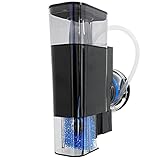
The Tunze Comline DOC 9001 is the model I keep recommending for nano sumps where a full cone body will not fit. At 4.3 by 2.5 inches and just over a pound, it mounts magnetically and disappears into the corner of a small sump. For a 10 to 25 gallon system it does exactly what a nano skimmer needs to do.
DOC here means direct current, so the pump is a small DC unit rather than the AC pumps found in older nano skimmers. That gives you better efficiency and lower power draw, which on a nano tank in a bedroom matters more than people expect. The magnet mount means no suction cups failing at three in the morning.
Owners rate it at 4.2 across 195 ratings. The praise is consistent and narrow: it is compact, it is efficient, and it has a design that has been around long enough that parts and advice are easy to find. Reef forum consensus treats Tunze as a reliable default, and forums.com guidance names it alongside the bigger brands without hesitation.
The limitation is capacity, and it is a hard one. If your bioload grows with a tang, a pair of clowns, and a full reef, this unit simply cannot move enough bubbles to keep up. The DOC pump still needs a break-in period and a tuning pass, so set expectations accordingly.
What to check before you buy
Check the operating depth. A compact unit like this depends more than most on sitting at the right height inside the sump, and running it too shallow or too deep changes everything. Also confirm your magnet surface is flat, since a curved glass panel will not hold it reliably.
Who should skip it
Skip it if your system is already past 30 gallons or if you plan to add a meaningful fish load this year. It is a nano tool. If your tank is coral-heavy and fish-light right now, this is the right size and you can move up later without having overpaid.
5. Reef Octopus Classic 150INT — Best Value for 100 to 150 Gallon Reefs
Reef Octopus Classic 150INT Protein Skimmer
In-sump
150 gallon rating
Aquatrance 2000 pump
12.4 x 8.7 inch footprint
Pros
- Easiest in-sump skimmer to operate
- Very quiet at rated flow
- Cup pops off for zero-disassembly cleaning
- Thick dark skimmate
Cons
- Some units arrive with a failing pump
- Return valve pipe narrower than its elbow
This is the model the wider reef community keeps pointing at for mid-size systems. On r/ReefTank the most common answer to skimmer recommendations is that it is hard to go wrong with the Reef Octopus line, and the 150INT is the version most often named. It carries a 150 gallon rating, which is the sweet spot for the 100 to 130 gallon systems that make up the largest group of reef keepers buying a first serious skimmer.
The Aquatrance 2000 pinwheel pump is the core of the design. It draws a strong airflow with very little moving mass, which is why owners describe it as very quiet even at rated flow. The bubble diffusing chamber and full cone body stabilize the foam column, which translates to less turbulence in the neck and more contact time for organics to rise.
Cleaning is where this unit genuinely beats most competitors. The collection cup pops off with an o-ring, so there is no disassembly to clean the cup. The venturi clips on rather than screws in and resists salt clogging, which saves you the single most common reason skimmer maintenance becomes a hated chore.
The one real negative in the reviews is a minority but worth stating plainly. Some owners received pumps that failed or were failing, and report poor replacement part support when that happens. Test the pump on a fresh install and keep the original packaging so a return is painless.
What to check before you buy
Check the return valve fitting. The valve pipe diameter is smaller than the elbow it mates with, so if your sump plumbing is already assembled you may need a short length of additional pipe. Twenty-two inches of height plus cup clearance is the vertical number to confirm.
Who should skip it
Skip it if you want DC pump speed control, because this one tunes on air alone. And skip it if your sump is under about 13 inches of usable depth, because you will lose the operating range that makes the cone body effective.
6. Reef Octopus eSsence S-130 — Best for Heavy Bioload Systems
Reef Octopus eSsence S-130 Protein Skimmer
In-sump
160 gallon rating
Aquatrance 1800s pump
20.5 inches tall
Pros
- Skimmate output starts quickly
- Handles heavy bioloads
- Easy to tune and disassemble
- Solid construction
Cons
- Included pump can hum noticeably
- Oversized for systems near 65 gallons
The manufacturer rates this one by bioload rather than by gallons, which is the more honest way to size a skimmer. Heavy bioload 75 gallons, medium bioload 120, light bioload 160. That breakdown is why owners on sps-dominated systems with tangs and a full fish load pick this model and report it handles the load without the cup running dry daily.
Owners describe it as a workhorse that starts producing skimmate almost immediately after installation, which is unusual. Most skimmers need a fortnight. The 4.4 average across 69 ratings reflects dependable performance and simple operation rather than any kind of premium refinement.
The pump is an Aquatrance 1800s pinwheel rated to 140 gph, and the recommended sump water height is 7 to 8 inches. Set it inside that range before you touch the air intake, because running the body outside its design water depth is the fastest way to get disappointing skimmate.
The noise complaint is real enough to mention. Some owners report a noticeable low hum from the included pump, and since hums are transmitted through the sump frame, a rubber isolation mat under the skimmer helps. I would not call this a loud skimmer, but it is not the quietest one in this list either.
What to check before you buy
Total height is 20.5 inches with a body diameter of 6 inches and a footprint of 8.3 by 6.9 inches, which is compact for the capacity. Confirm the sump water depth you actually maintain sits in the 7 to 8 inch window before you finalize the install height.
Who should skip it
Skip it on systems around 65 gallons or below unless you intend to stock heavily within a year. This model will simply strip too much and overflow the cup, which is an annoying problem to have on a beautiful new tank. It is also the model with the lowest review count in this group, so treat the consensus as thinner.
7. Reef Octopus BH90 — Best Hang-On-Back Skimmer for Rimmed Tanks
Reef Octopus BH90 Hang on Protein Skimmer
Hang-on-back
Rimmed and euro-braced tanks
Cup accepts a drain line
Pros
- Rugged acrylic body
- Steady skimmate production
- Removable cup with optional drain line
- Proven design with a decade of use
Cons
- Vague assembly instructions
- Limited height adjustment may need shims
- Hard to clean internal channels
Not every reef has a sump, and for rimmed or euro-braced tanks without one, a hang-on-back unit is the realistic option. The BH90 hangs over the back, has a rugged acrylic body, and mounts to the rim bracket. It produces a large volume of microbubbles and steady skimmate, which owners with long tenure describe favorably.
The feature I like most is the collection cup. It removes for cleaning and accepts a drain line, so on a larger HOB install you can plumb continuous export rather than emptying it by hand. The air intake is the single regulation point, which keeps tuning simple to the point of being boring, and that is a virtue.
The 4.1 average across 86 ratings is the lowest among the Reef Octopus models here, and the reviews explain why. Assembly and tuning instructions are vague, the height adjustment on the tank back is limited enough that some people shim it, and the internal channels and tubes are awkward to reach for a proper clean. Owners also report the impeller and needle wheel needing frequent cleaning.
That maintenance note is the honest trade. A HOB skimmer has more surface area exposed to salt spray than an in-sump unit, so corrosion and clogging happen sooner. If you are willing to rinse the pump parts monthly, the design is rugged and long proven.
What to check before you buy
Check your rim bracket and the tank back clearance. The unit needs vertical room above the rim and horizontal room behind the tank, and if your back height adjustment does not reach your water line you will need a shim. Budget five minutes and a foam block before the install, not after.
Who should skip it
Skip it if you hate maintenance or if your tank is rimless with no bracket to hang from. It also makes a poor fit for a large reef, because the pump cannot move enough air for a heavy bioload once the unit grows past the nano and small system range.
8. Reef Octopus Classic 152-S — Best Compact Body for Mid-Size Systems
Reef Octopus Classic 152-S Protein Skimmer
In-sump
158 gallon rating
6 inch body diameter
10.4 x 8.1 inch footprint
Pros
- Compact 6 inch body for a large rating
- AQ1800s pump from the Classic line
- Rated to 158 gallons
Cons
- Limited customer reviews for this model
The 152-S answers a specific problem: how do you get 150 gallon class capacity out of a narrow sump? The body diameter is 6 inches and the footprint is 10.4 by 8.1 inches, at 20.7 inches tall, with a rating up to 158 gallons. That is a genuinely useful ratio when the sump compartment is the limiting dimension rather than the depth.
It uses the AQ1800s pump from the Classic line, which is the same pump family that has built a strong reputation for reliability. The 4.4 average is the second highest in this guide, which tells you owners who received one are happy with it.
What to check before you buy
Confirm your sump compartment is at least 10.4 by 8.1 inches of clear floor with 20.7 inches of vertical space. That vertical number plus the cup plus a hand to lift it is what actually matters, and it is more than the printed height suggests.
Who should skip it
Skip it if you rely on customer photos and reviews to guide a purchase, because there are only 49 ratings here, the thinnest feedback base of the Reef Octopus models in this guide. It is a solid choice on specifications. It is not the choice I would make if I wanted a large body of owner experience behind it.
9. Maxspect Jump SK400 — Best for Quiet Operation
Maxspect Jump SK400 Protein Skimmer
In-sump
Dual needle wheel
DC pump with feeding mode
Bubble trap integrated
Pros
- Very quiet operation
- Short break-in period
- Integrated bubble trap cuts micro-bubble escape
- Feeding mode and overflow protection
Cons
- Metric fittings need adapters for inch pipework
- Small review base for this model
The Jump SK400 is the pick if the skimmer sits in a bedroom or an office and pump noise is your top filter. It rates 4.5 across 16 ratings, and those ratings consistently single out quietness, a short break-in, and simple daily operation. Owners report skimmate sooner than they expected from a new skimmer.
The technical reason for the quiet is the dual intake and dual needle wheel design, which produces very fine bubbles without the aggressive water movement a single large pump needs. The DC pump adds feeding mode, overflow protection, and a 10 second start delay, which are genuinely useful protections on a system where a power blip is not unusual.
What to check before you buy
Buy adapters. The supplied fittings are metric, so if your sump plumbing is inch based you need converters to plumb it in. That is the single most common note in the reviews and it is an avoidable five minute job if you order the fittings in advance.
Who should skip it
Skip it if you want a large body of owner feedback before committing, because 16 ratings is thin. The integrated bubble trap is a genuine advantage in a tight sump where micro-bubbles would otherwise return to the display, but it is also a surface you will clean periodically.
10. Red Sea Reefer 900 — Best for Large Display Systems
Red Sea Reefer 900 Protein Skimmer
In-sump
240 to 740 gallon rating
23 inches tall
Three assembly options
Pros
- Built-in neck cleaner
- Valve-controlled drain tube
- Quiet with vibration absorbing components
- Three pump and valve assembly options
Cons
- Some packages arrive without the pump
- Water line sticker detaches in the sump
- Neck cleaner is stiff to turn
The Reefer 900 is the large system entry, rated from 240 up to 740 gallons depending on bioload. At 23 inches tall with a footprint of 11.4 by 10.6 inches, it is a substantial piece of equipment, and experienced reef keepers rate it among the best large-system skimmers they have run. The ergonomic diffusion chamber spreads the fine bubbles from the PSK pump across the cone without choking air or water flow, which is what keeps output even.
The built-in neck cleaner is the feature I would not give up. It lets you scrub the inside of the neck through the pump inlet without removing the cup, so you can keep the skimmate color consistent without dismantling anything. The valve-controlled drainage tube makes intermittent cup draining simple, and three assembly options for pump inlet and regulation valve give you real flexibility in a large sump.
What to check before you buy
Confirm sump depth first. This is a 23 inch body plus cup plus hand clearance, and large systems sometimes have shallower sumps than expected relative to display volume. You will also want a controller or smart plug if your power is unreliable, since you will otherwise be re-tuning after every outage.
Who should skip it
Skip it on anything under roughly 200 gallons, because the cup will overflow and you will spend your time fighting a machine that is too much skimmer for the system. Also inspect the package on arrival, since a few owners received packages with the pump missing.
How to Choose the Right Protein Skimmer for Your Reef Tank
Size by system volume and bioload, not by tank size alone
Bioload matters more than volume. A 100 gallon reef holding one tang and a pair of clowns is a light-bioload system. A 100 gallon reef holding a full tang, a tang tang, and several hundred dollars of sps is heavy. Use the manufacturer bioload ratings, and if a brand gives you a number, treat it as a starting point rather than a promise.
The old community rule of thumb is one to two hours of contact time per gallon per day. That is a rough framing and manufacturer ratings now do the arithmetic better, but the logic behind it still holds. More contact time means more organics lifted per hour, which means less daily cup volume and less risk of the cup running dry.
You can oversize safely. Oversizing a skimmer strips more than the system needs, so you dial it back with the air intake and end up with a wetter, less intense skim. Undersizing is the real failure mode, because the skimmer cannot keep pace with what the tank produces and you lose the whole point of having one. This is why forum advice keeps saying go bigger, and it is correct advice.
Match the format to your tank
In-tank skimmers sit inside a filter chamber and suit all-in-one tanks and nanos. They are cheap, small, and limited. Hang-on-back skimmers clamp to a rimmed tank and need no sump, which makes them the only option for an older rimmed setup without a sump.
In-sump skimmers are the standard for anything serious. Hidden in the cabinet, protected from spray, and they can be plumbed properly. External skimmers mount outside the sump and are used on very large display systems where the sump is already full. Every one of the mid-size and large models in this guide is an in-sump unit.
Pump technology decides bubble quality and noise
Needle wheel and pinwheel pumps are the current standard. Both shred air into very fine bubbles, which gives longer contact time and quieter running than older venturi designs. Needle wheels concentrate the shear at a fine needle array, pinwheels throw water at the air column with a rotating impeller. Both work well, and the practical difference for a hobbyist is small.
Noise is a function of pump class, not brand marketing. Small DC pumps are quiet, AC pumps hum, and anything with a venturi rattles when it is not seated. Forum opinion on this is genuinely divided, with some keepers reporting one premium line is just as loud as another, so treat any quiet claim from a brand with skepticism and read the current owner comments instead.
Sump clearance is a hard requirement
Measure three things before you buy: the height of the skimmer body plus cup, the floor footprint of the sump compartment, and whether you can get a hand in to remove the cup. Skimmers that will not fit, or that fit but cannot be cleaned, are the most common regretted purchases in this niche, and both reef2reef and forums.com raise fit before anything else.
Do you even need one?
If your reef is stocked with fish, yes. A skimmer removes organics continuously and is the cheapest insurance against nutrient spikes you can buy. If your system is fishless, heavily stocked with corals, running a media reactor and two-part dosing, and you already do weekly water changes, a skimmer is optional and you can put that money into lighting instead.
For those setups, a media reactor with activated carbon plus consistent two-part dosing can hold parameters without a skimmer. The tradeoff is that you are relying entirely on your dosing and water change discipline, with no backup path when something drifts.
How to Dial In, Break In, and Troubleshoot Your Protein Skimmer
Dialing in is a five step process and most of the frustration people report comes from rushing it or changing two things at once.
- Set the correct water level first. Every skimmer is designed around a specific operating depth. The Reef Octopus eSsence S-130 specifies 7 to 8 inches. Get the water level right before adjusting anything else, because foam position shifts with sump level and you will chase a moving target otherwise.
- Balance water flow and air. Open the water valve, then add air slowly until the foam column climbs into the neck and stops. If foam rises past the neck into the cup as liquid, close the air a quarter turn and wait.
- Leave it alone for seven to fourteen days. This is the break-in. The bubble plate needs to wet fully and the bubble column stabilizes during this period. Scrubbing the internals resets the clock, which is why over-cleaning is the most common self-inflicted problem.
- Judge output by cup fill rate, not by color. Color is a weak signal that varies with what you are feeding. A consistent daily or twice-daily fill is the number that tells you whether the skimmer is sized right.
- Adjust by small increments. Quarter turns on the air intake, then wait a day before changing anything else.
If the cup fills with water instead of skimmate
This is the most reported problem in reef communities and it is almost never a failed pump. Owners replace equipment that was working fine. The real causes are a water level that is too high in the sump, a skimmer that is oversized for the system, or too much air.
Lower the water level a quarter inch at a time and give it a day. If that does not help, reduce the air intake in quarter turns. If it still overfoams, the unit is too big for the bioload, and the fix is a smaller skimmer or a lower air setting.
If micro-bubbles return to the sump or display
Check the airline connection first, then check that the pump is fully primed and the intake is submerged. On a brand new install, a few days of fine bubbles is normal while the pump establishes. Persistent haze in the display means you need more contact time inside the reaction chamber, which usually means a taller body and a longer cone rather than more air.
After a power outage
Restart your skimmer and expect to re-tune. Air intake settings drift after a restart, and the water level in the sump may differ from before the outage. Give it a day to settle before judging it, and consider a smart plug with a scheduled restart if outages are frequent in your area.
Frequently Asked Questions
What is the best protein skimmer for a reef tank?
For most reefs, the Reef Octopus Classic 110-INT is the best all-round choice, with a 4.5 average across 292 ratings, a compact footprint, and quiet needle wheel operation. For a nano tank under 32 gallons, the Coralife Biocube skimmer covers the job at a much lower outlay, and for systems between 100 and 150 gallons the Classic 150INT adds capacity without a jump in height.
Are protein skimmers worth it?
Yes on any reef with fish in the water, because a skimmer strips dissolved organics continuously instead of in weekly water changes. On a fishless coral-only system running a media reactor, two-part dosing, and consistent water changes, a skimmer is optional. The honest test is whether your nutrients stay stable when you miss a water change. If they do not, you need export capacity.
Can you have too big of a protein skimmer?
No. Oversizing is safe because you dial the air intake back and accept a wetter, less intense skim. Undersizing is the real failure mode, because the skimmer cannot keep pace with the organics your system produces. Buy the next size up if you expect to add fish within a year, and just expect to run more air intake closed.
Should I leave my protein skimmer on all the time?
Yes. On a stocked reef it should run 24 hours a day, because organics are produced continuously and a skimmer only works while it is powered. Watch for a cup that fills with water rather than skimmate, which points to too much air, a water level that is too high, or an oversized unit rather than to a pump failure.
How do I know if my protein skimmer is working correctly?
Check five things. First, the sump water level is inside the manufacturer’s operating range. Second, after a seven to fourteen day break-in you get stable dark skimmate rather than clear liquid. Third, the cup fills on a consistent daily or twice daily schedule. Fourth, no micro-bubbles return to the sump or display. Fifth, the pump runs at a steady volume without changing pitch. If the cup empties dry every day, your skimmer is oversized.
Why is my skimmer cup filling with water instead of skimmate?
Almost always one of three things rather than a dead pump: the sump water level is too high, the skimmer is oversized for the bioload, or there is too much air. Lower the water level a quarter inch at a time, then reduce the air intake in quarter turns. Owners frequently replace a working pump over this symptom, which is an expensive way to fix a water level problem.
Final Verdict: Which Protein Skimmer Should You Buy?
For the best protein skimmers for reef tanks in 2026, the Reef Octopus Classic 110-INT is the one I would put in a sump without hesitating. It has the deepest review base here, the quietest operation relative to capacity, and a footprint that fits sumps nothing else will.
Buy the Coralife Biocube skimmer if you are on a nano and just starting out. Buy the Classic 150INT for a 100 to 150 gallon reef, and the Simplicity 240DC if sump clearance is your binding constraint. Go bigger rather than smaller, measure your sump twice, and give every skimmer a full two weeks before you judge it.