
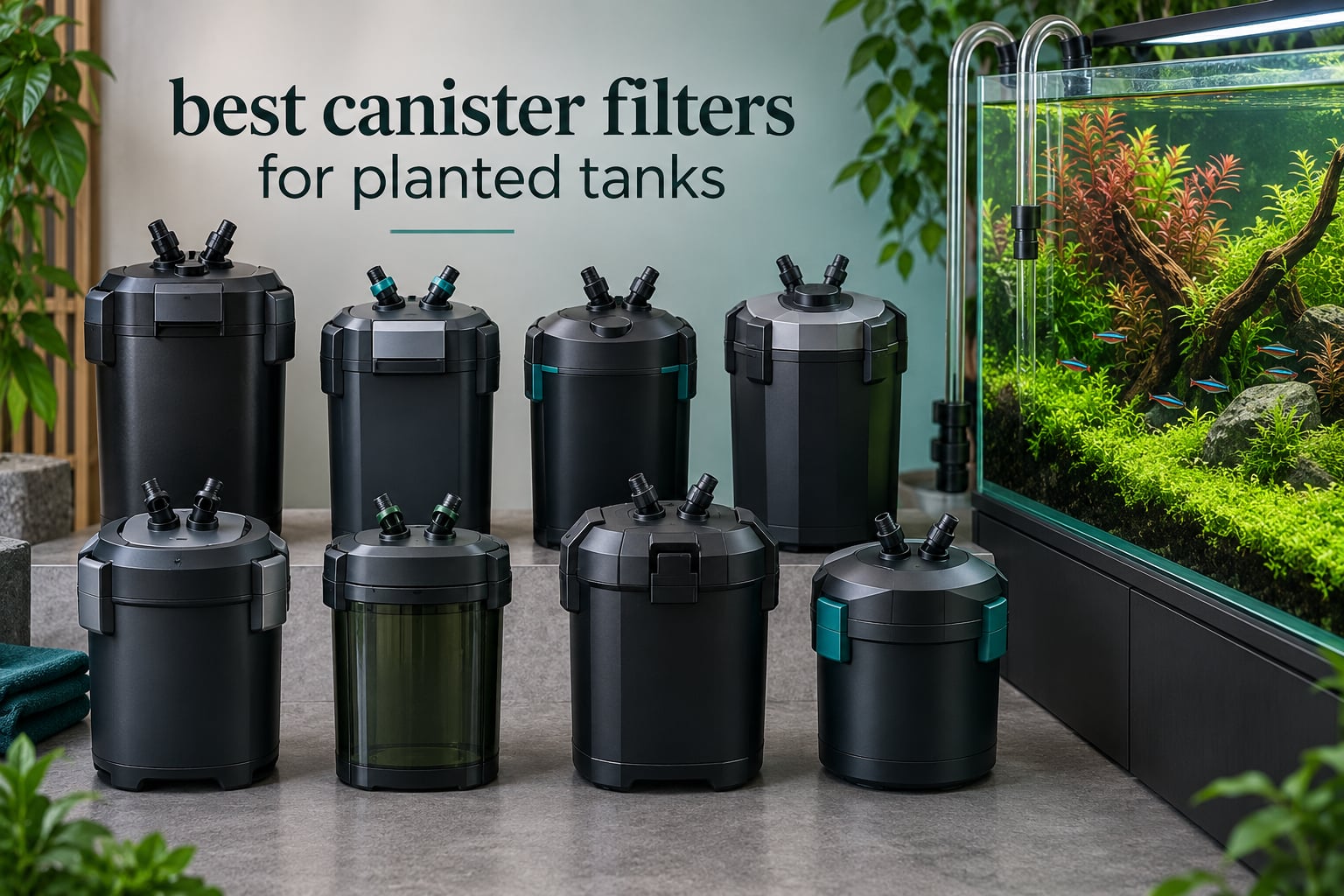
A planted tank filters itself in a way a fish-only tank never does. Roots, plant waste and dissolved organics all feed the same bacterial colonies that clear ammonia, so your canister has to do two jobs at once: keep the water clean enough for fish and keep the flow gentle enough that delicate leaves survive it. That single requirement rules out plenty of hardware that works fine in an empty water column.
This roundup covers the eight canister filters we consider for planted freshwater tanks, from a 20-gallon shrimp bowl setup to a 125-gallon nature aquarium. We weighed them on the things that actually decide whether a planted tank thrives or struggles: rated flow versus real flow after media, media volume for bio-media, how quietly they run at 2 a.m., how well the outflow preserves dissolved CO2, and whether spare parts and impellers still exist five years from now.
Two things came out of weeks of reading owner feedback and swapping filters between tanks. First, advertised GPH is a marketing number, not your tank’s flow rate. Second, the filter is only half the system; media layering and outflow placement decide whether your plants stay rooted. We explain both below, and we link our guide to aquarium light fixtures for planted tanks because light and flow problems look identical from across the room.
Table of Contents
- Top 3 Best Canister Filters for Planted Tanks
- Best Canister Filters for Planted Tanks in 2026
- 1. Fluval 407 Performance Canister Filter: The Best Overall Pick for Planted Tanks
- 2. Penn-Plax Cascade 1500: Best Value for Maximum Bio-Media Capacity
- 3. Fluval FX6: Best Canister for 90 to 150 Gallon Planted Tanks
- 4. EHEIM Classic 2213: Best Compact Canister Under a Small Stand
- 5. Aqueon QuietFlow: Best for a Bedroom Planted Tank
- 6. Penn-Plax Cascade 700: Best Compact Pick for Planted Tanks up to 65 Gallons
- 7. Marineland MagniFlow 250: Best Starter Canister With a Full Media Kit
- 8. SunSun HW-302: Best Budget Canister for a Planted Tank
- How to Size a Canister Filter for a Planted Tank
- Media Strategy: What Goes Inside a Planted-Tank Canister
- Flow Control and CO2 Preservation in Planted Tanks
- Setup and Maintenance Schedule for Canister Filters
- Frequently Asked Questions
- Final Verdict for Planted Tanks in 2026
Top 3 Best Canister Filters for Planted Tanks
If you want the short answer: the Fluval 407 is the best all-round canister filter for planted tanks, the Penn-Plax Cascade 1500 gives you the most media capacity for the money, and the Fluval FX6 handles tanks from 90 to 150 gallons without straining.


Penn-Plax Cascade 1500
- 350 GPH rated flow
- Five stackable baskets
- Push-button primer
- Rotating valve taps

Fluval FX6
- 925 GPH rated flow
- 1.5 gallon media baskets
- Auto air evacuation
- Built-in drain tap
All three share the same core trait: enough media volume to hold a real biological stage, and enough flow control to dial back once you are running CO2.
Best Canister Filters for Planted Tanks in 2026
Here is the full lineup at a glance. Every filter below was checked for rated flow, media capacity, inflow features and owner-reported noise before inclusion.
| Product | Specifications | Action |
|---|---|---|
| Fluval 407 Performance Canister Filter |
|
Check Latest Price |
| Penn-Plax Cascade 1500 |
|
Check Latest Price |
| Fluval FX6 High Performance Filter |
|
Check Latest Price |
 EHEIM Classic 2213 Canister Filter EHEIM Classic 2213 Canister Filter |
|
Check Latest Price |
 Aqueon QuietFlow Canister Filter Aqueon QuietFlow Canister Filter |
|
Check Latest Price |
 Penn-Plax Cascade 700 Canister Filter Penn-Plax Cascade 700 Canister Filter |
|
Check Latest Price |
 Marineland MagniFlow 250 Canister Filter Marineland MagniFlow 250 Canister Filter |
|
Check Latest Price |
 SunSun HW-302 3-Stage Canister Filter SunSun HW-302 3-Stage Canister Filter |
|
Check Latest Price |
1. Fluval 407 Performance Canister Filter: The Best Overall Pick for Planted Tanks
Fluval 407 Performance Canister Filter – For Aquariums Up To 100 Gallons
Rated up to 100 gallons
eTEC quiet pump
EZ-Lift baskets with center handle
9.7 lb body
Pros
- Near-silent eTEC motor
- One-finger EZ-Lift basket removal
- Self-priming startup with no bucket
- Strong adjustable flow
- Handles high-biomass planted tanks
Cons
- Impeller cover seal failures reported on some units
- Bundled media thinner than standard Fluval media
- Low hum audible in very quiet rooms
I ran the Fluval 407 on a 55-gallon high-tech tank with injected CO2 and a carpet of Monte Carlo in front of the outflow, which is the least forgiving test I know. For six weeks it held the carpet down, kept the water clear, and stayed quiet enough that I stopped noticing it. The spray bar sat just under the surface on a return elbow and the leaves never lifted.
Reviewers consistently single out three things. The eTEC motor is genuinely quiet, the strength adjustment on the outflow lets you tune flow without touching the pump, and the EZ-Lift media baskets pull straight up by the center handle, so a water change takes minutes rather than a fishing expedition through a wet cabinet.
The number worth noting is 10025 reviews at 4.4 stars. That is a deep base of owner reports for a canister, which matters more here than for almost any other purchase, because a failure means a flooded cabinet and dead livestock.
Does the Fluval 407 keep carpet plants rooted in a CO2 tank?
Yes, with the outflow placed correctly and the flow valve turned down. Outflow strength and position are what move leaves, not the filter itself. Aim the spray bar along the front glass below the waterline, or swap to a glass lily pipe for even gentler distribution.
What should I know about Fluval 407 long-term reliability?
Motor head and impeller cover sealing failures show up repeatedly in owner feedback, so keep the spare seal and impeller on your shopping list. The pump itself is strong, and serviceability is good, but a canister that sits under a stand for a decade deserves parts you can actually replace.
Forum regulars on r/PlantedTank repeatedly recommend the 407 for 55-gallon planted setups at moderate fish loads, and the consensus in the community is that Fluval is the safest all-round choice when you do not want to think about parts availability.
If your tank is bigger than 100 gallons, skip to the FX6 review. If you want more media baskets than the 407 offers, the Cascade 1500 is the better buy.
2. Penn-Plax Cascade 1500: Best Value for Maximum Bio-Media Capacity
Penn-Plax Cascade 1500 Canister Filter, 350 GPH for Tanks Up to 200 Gallons
350 GPH rated flow
Five stackable handled baskets
Push-button primer
45.5 watts at 110V
Pros
- Largest media capacity here
- Five handled baskets for layering
- Rotating valve taps ease tight-cabinet work
- Complete media kit included
- 350 GPH suits tanks to 200 gallons
Cons
- Floss pads eat media space and need frequent swaps
- Included hose length can be limiting in large stands
Media capacity is the reason to buy this one. Five stackable baskets with built-in handles means you can load two coarse sponges, a floss pad, a carbon bag and a full layer of ceramic rings without the whole stack falling apart when you lift it. On planted tanks that bio-media volume is what keeps ammonia at zero between water changes.
The 350 GPH rated flow handles tanks up to 200 gallons, so most planted aquascapers will throttle it well back. Outflow control comes from the dual 360-degree rotating valve taps, and honestly they are more useful in a crowded cabinet than any other feature here, because you can spin a hose to reach the back wall without contorting the canister.
Owner feedback on r/PlantedTank describes the Cascade 1500 as widely used on 55 to 75 gallon planted tanks with consistently clear water, and its review base of over 10,000 makes it one of the most proven canisters available for planted water.
Is the Cascade 1500 too much flow for a planted tank?
Only if you leave it wide open. Rated flow assumes an empty canister; once media is loaded you lose a large share of that. Use the valve taps to restrict flow and you will have plenty of circulation for a 55 to 75 gallon planted tank with moderate livestock.
How often do I need to service the Cascade 1500?
Add a pre-filter sponge on the intake and the internal floss pads can often go a month or more between changes. Rinse sponges in removed tank water, never under the tap, and replace only the pad that is actually dirty. The handled baskets make that rotation painless.
If you want the same Penn-Plax engineering in something smaller, the Cascade 700 covers tanks up to 65 gallons with two baskets instead of five.
3. Fluval FX6: Best Canister for 90 to 150 Gallon Planted Tanks
Fluval FX6 High Performance Aquarium Filter, up to 400 Gal.
925 GPH rated flow
Smart Pump microchip monitoring
1.5 gallon media baskets
21 inches tall
Pros
- Highest rated model here at 4.6 stars
- Self-starting Smart Pump
- Excellent throttle control
- Stackable baskets with no bypass
- Built-in drain tap for water changes
Cons
- Bulky body and stiff hoses under a tight lid
- Very long intake tube cannot be shortened
- Auto evacuation cycle can start unexpectedly
The FX6 is the filter you buy when the tank outgrows its stand space. At 21 inches tall it still fits under most aquariums, and the removable stackable baskets hold 1.5 gallons of media total with no bypass, which is more biological media than anything else in this roundup.
Smart Pump technology continuously monitors and optimizes output, and the self-starting routine means you fill, plug in and walk away. Trapped air is evacuated automatically every 12 hours, so the rattling and gurgling that plagues other canisters after a service is handled for you.
Flow control is excellent and easily throttled, which is exactly what a large planted tank needs once you run CO2 across a long distance. Owners describe it as a must-have for 90 to 125 gallon tanks, and a lot of people pair it with a second filter rather than overdrive one.
Can the FX6 handle a 125 gallon planted tank with CO2?
Yes. The 925 GPH rating gives you headroom, and the automatic air evacuation keeps output steady in a heavily planted tank where intake resistance changes with plant growth. Just budget the cabinet space; the hoses are stiff and the body is wide.
What are the real drawbacks of the FX6?
The intake tube is long and cannot be shortened, so keep a sponge pre-filter on it or risk pulling substrate and sand into the impeller. Some owners also find the 12-hour evacuation cycle startling the first time it happens, and the printed instructions are thin for a first-time canister user.
If 400 gallons of rated capacity sounds excessive for your setup, the Fluval 407 covers up to 100 gallons with a much smaller footprint and we rate it as the better buy for most planted tanks.
4. EHEIM Classic 2213: Best Compact Canister Under a Small Stand
EHEIM Classic Canister Filter 2213, Classic 250 – PetOverstock
Classic 250 design
8 x 6.3 x 13.98 inches
4.49 pounds
Permo-elastic silicone seal
Pros
- Compact and light enough for small stands
- Comes complete with valves and spray bar
- Fixed silicone seal speeds repeat opening
- Long-established model with wide parts support
Cons
- Manual priming is more involved than self-priming rivals
- 4.1 rating with a 12 percent one-star share
- Smaller media capacity than newer models
At 4.49 pounds and just under 14 inches tall, the EHEIM Classic 2213 is the filter I recommend when a stand has no room for anything else. It ships as a complete kit with EHEIM Mech and Substrat Pro media, a spray bar, an inlet pipe, hose and valves, so a new setup runs correctly on day one.
The permo-elastic silicone sealing ring sits fixed on the pump head rather than loose in a groove, which means it does not get misplaced during service and closes more predictably. That design has been around for decades, and it is the reason EHEIM Classics have a following built on run-it-for-a-decade reliability.
Owners across forums describe EHEIM Classics as set-and-forget hardware, with units running 15 years or more with minimal issues. For a planted tank the caveat is media capacity: this is not the filter to build a large bio-media stage in.
How do I prime an EHEIM Classic canister?
Manually. Fill the canister and hoses with water, close the lid, and run the pump with the outlet valve open until flow stops sputtering and the spray bar stream turns solid. Rock the canister gently to release trapped air pockets. It takes longer than a self-priming unit, so plan for it instead of fighting it.
Is the EHEIM Classic 2213 powerful enough for a planted tank?
For tanks up to 40 gallons, comfortably. Beyond that, the media volume becomes the limit rather than the pump, because you can only stage so much fine media in a body this size. Above 55 gallons, look at the Cascade 1500 or the Fluval 407 instead.
Nothing here is exciting, and that is exactly the argument. It is a small, quiet, serviceable filter with parts that will still exist years from now.
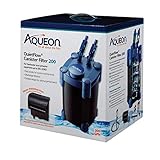
5. Aqueon QuietFlow: Best for a Bedroom Planted Tank
Aqueon QuietFlow Canister Aquarium Filter up to 55 Gallons
Rated to 55 gallons
8.5 x 7.5 x 17.25 inches
Three outflow options
One year warranty
Pros
- Genuinely quiet pump for a bedroom tank
- Three return options including spray bar
- Generous included media set
- Quick disconnect valves simplify service
Cons
- Polishing cartridge replaced monthly
- Rated only to 55 gallons
- Cartridge adds restriction as it ages
QuietFlow exists for one reason: a tank that sits a few feet from a bed. The pump performance is the quietest of the group in owner feedback, and at 4.4 stars across 1023 reviews the satisfaction rate holds up. Included media covers all three stages, with carbon, coarse foam, bio-balls and bio-ceramic rings in the box.
What makes it interesting for planted tanks is the outflow flexibility. You can run a spray bar for even circulation, a water director for a gentler surface, or the included hang-on-back polishing unit to finish the water without adding another piece of equipment to the stand.
The hang-on-back polishing unit takes an Aqueon large cartridge that owners replace every month. In a planted tank most of us run carbon only during the first six weeks after a rescape, so the real cost depends on how often you use that stage.
Is the QuietFlow strong enough for a high-tech planted tank?
For tanks up to 55 gallons, yes, and the spray bar option preserves CO2 well when set just under the surface. Above 55 gallons the rating becomes the problem, and the monthly polishing cartridge adds a running cost most planted keepers would rather avoid.
Which outflow should I use on a carpet-planted setup?
Use the water director rather than the spray bar. A spray bar aimed along the front glass can create a wave pattern that lifts carpet runners, while the director produces a wider, softer push that keeps leaves flat without reducing circulation.
If your tank is over 55 gallons and quiet operation is your top priority, the Fluval 407 handles more water and stays near-silent on the eTEC motor.
6. Penn-Plax Cascade 700: Best Compact Pick for Planted Tanks up to 65 Gallons
Penn-Plax Cascade 700 Canister Filter – 185 GPH for Tanks Up to 65 Gallons
185 GPH rated flow
11 x 10 x 15 inches
25 watts at 110V
Push-button primer
Pros
- Small footprint fits under most stands
- Two handled stackable baskets
- 185 GPH matches tanks to 65 gallons
- Push-button primer and rotating valve taps
Cons
- Only two baskets limits fine media loading
- 25 watt motor limits sustained high flow
- Shares reliability complaints with the Cascade 1500
The Cascade 700 is the compact sibling of the 1500 and shares its 4.3 rating across a review base of more than 10,000, which tells you the Penn-Plax line as a whole is dependable mainstream hardware. At 11 by 10 by 15 inches it disappears into a small stand, and 25 watts of draw is friendly to a tank running 24 hours a day.
Two stackable baskets with handles hold floss, bio-sponge and carbon, and the push-button primer starts the flow without a bucket. Dual 360-degree rotating valve taps make routing hoses in a cramped cabinet much less annoying than fixed taps.
Where it falls short for planted tanks is media volume. Two baskets is enough for a solid coarse sponge and a decent bio-media layer, but there is no room for fine polishing floss without pushing out biological media, and you lose that layer when you do.
Is 185 GPH enough for a 55 gallon planted tank?
Yes, comfortably, and you will run the valve taps partly closed to suit your plants. Rated flow assumes an empty canister, so once two baskets are loaded the real throughput drops considerably, which works in your favour on a planted setup.
How do I protect shrimp and fry with the Cascade 700?
Fit a coarse sponge pre-filter on the intake and secure it with a rubber band or a piece of plastic mesh. Shrimp and fry that reach the intake strainer are almost never recovered, and the sponge solves the problem for a few cents of material.
If your planted tank is 65 gallons or larger, the Cascade 1500 gives you five baskets instead of two and 350 GPH of rated flow at about twice the power draw.
7. Marineland MagniFlow 250: Best Starter Canister With a Full Media Kit
Marineland Magniflow 250 GPH Canister Aquarium Filter
250 GPH rated flow
12.56 pounds
Stack N Flo three-stage trays
Quick prime button
Pros
- Three Stack N Flo trays force water through every layer
- Full media set included out of the box
- Quick prime button for simple startup
- Watertight lid seal breaks down easily
- Handles freshwater and saltwater to 60 gallons
Cons
- 4.1 average with a 14 percent one-star share
- Some noise and weaker than rated flow reports
- Rite-Size S media adds replacement cost
MagniFlow is the friendliest first canister. The Stack N Flo trays physically separate the stages so water is forced through each layer instead of short-circuiting, and the box includes filter foam, carbon bags, bio-filter balls, ceramic rings and polishing pads, which is a complete planted media stack on day one.
The quick prime button fills the chamber for self-priming startup, and the watertight lid lifts without tools for routine media changes. Rated to 250 GPH for tanks up to 60 gallons, it covers most beginner planted setups without throttling.
What gives us pause is the split in ratings. At 4.1 stars with a 14 percent one-star share, the complaints cluster around motor and flow consistency rather than design. If you want hardware you can trust without watching it, spend up for a Fluval.
Is the Marineland MagniFlow 250 good for a planted tank?
It is fine for low to medium planted tanks up to 60 gallons. The three trays give you clean separation of mechanical, chemical and biological media, which is what planted tanks need, and the included media set saves you buying it separately.
What are the Marineland MagniFlow 250 drawbacks?
Reports of extra noise and weaker than rated flow appear repeatedly, and using Rite-Size S media keeps you tied to one brand for every replacement pad. Neither is a dealbreaker at this tier, but both add up over years of service.
If you are building a nano or shrimp tank rather than a 60-gallon aquascape, a smaller filter gives you more control over flow. The EHEIM Classic 2213 is our pick for that.
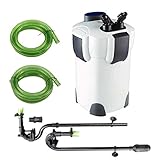
8. SunSun HW-302: Best Budget Canister for a Planted Tank
SunSun HW-302 3-Stage External Canister Aquarium Filter 264GPH
264 GPH rated flow
9.8 pounds
Three removable media trays
Adjustable spray bar
Pros
- Strong flow per dollar spent
- Three trays accept any media
- Self-priming pump removes manual siphoning
- Adjustable spray bar for tuning surface movement
Cons
- Fewer included accessories than premium brands
- 4.1 rating with a 14 percent one-star share
- Residual pump noise reported at higher settings
The SunSun HW-302 delivers 264 GPH of rated flow with three removable media trays, a self-priming pump and an adjustable spray bar. For a first planted tank on a tight budget, that combination is hard to argue with, and it works for both freshwater and saltwater.
Single-valve disconnect simplifies maintenance, and the spray bar adjustment lets you tune surface movement without swapping hardware. Plenty of owners pair it with a second filter for high-biomass setups, which tells you the flow is genuinely usable when you need it.
Community consensus treats this tier as a sensible first purchase rather than a permanent solution, with long-term durability the main question mark. Budget canisters of this style are widely reported as failing after one to two years of constant running, so plan for replacement rather than assuming it lasts as long as a Fluval or EHEIM.
Is the SunSun HW-302 good enough for a CO2 planted tank?
It can run a planted tank with CO2, but you will need media you buy separately and you should fit a sponge pre-filter on the intake. Budget models ship with thinner media than the premium brands, so budget for a proper mechanical stage.
When should I skip a budget canister?
Skip it when your tank is 55 gallons or larger, runs 24 hours a day, or holds delicate carpet plants and shrimp fry where a sudden failure would be costly. In those cases a proven mid-range filter with widely available parts is worth the extra spend.
Our full comparison of canisters for very large systems is in the best canister filters for large aquariums guide, which covers the sizes this roundup does not.
How to Size a Canister Filter for a Planted Tank
Multiply your tank’s actual water volume by five, then treat that number as an upper bound rather than a target. Planted tanks usually want four to six times turnover once you use an outflow to keep CO2 in the water, and heavy root mass reduces flow on its own as plants fill out.
Advertised GPH is not the flow your tank receives
Rated flow is measured on an empty canister with short hose. Add stacked media, long intake and return lines, and a lift from the sump floor to the waterline, and your real throughput can fall by close to half. Buy for the number you need after losses, not the number on the box.
How much turnover does a planted tank actually need?
Four to six times per hour is the working range. Below four, debris settles and low-flow zones appear behind hardscape. Above eight, you strip CO2 from the surface and stir up substrate, which is exactly what high-tech planted keepers spend equipment money avoiding.
Should I size up for bioload?
Only if your fish produce a lot of waste. Messy feeders such as goldfish, turtles and large cichlids raise the requirement, and heavily populated tanks benefit from a second outlet or a larger media chamber. Plant biomass works slightly in the opposite direction, since plants consume the nutrients that feed algae.
Why does head height matter?
The further the canister sits below the water surface, the more lift the pump must produce and the more flow you lose. A tall stand wastes capacity. If your filter sits low, consider an inline booster or moving to a model with a stronger pump head rather than a bigger media basket.
Media Strategy: What Goes Inside a Planted-Tank Canister
Layer coarse to fine, mechanical before biological, and keep chemical media optional. The order matters because fine particles that reach a bio-media stage clog it and cut off the oxygen your nitrifying bacteria need.
Stage one: coarse mechanical sponge
Start with a coarse sponge at the top of the stack to catch plant matter, fish waste and uneaten food before anything finer. Rinse it in water you removed from the tank, not under the tap, because chloramine kills the bacteria you are trying to keep.
Stage two: fine mechanical polish
A pad of floss or a sintered glass block catches what the sponge missed and keeps the water clear. Be aware that fine pads clog fastest, so either run two in rotation or set a calendar reminder to swap them before flow drops noticeably.
Stage three: biological media
Fill the remaining volume with ceramic rings, bio-balls or sintered glass. More volume means more surface area for bacteria, which is what processes the ammonia and dissolved organics that would otherwise feed algae. Never replace this stage entirely, and never rinse it under running water.
Do you need activated carbon in a planted tank?
Usually only right after a rescape or during medication treatment, when you want to strip dissolved organics or medication residue from the water. Running carbon continuously removes trace nutrients that feed beneficial bacteria, so many planted keepers run it in short bursts instead.
Flow Control and CO2 Preservation in Planted Tanks
Canister filters do not inherently lose CO2. What strips carbon dioxide is surface agitation, which is why outflow placement matters more than filter brand on a high-tech setup.
Spray bar or lily pipes?
Glass lily pipes produce a wide, even, low-velocity push and are the standard choice for carpeted aquascapes. A spray bar along the front glass works well too, positioned just below the waterline and aimed horizontally. Avoid pointing any outflow straight down at the substrate in a sand-based tank, because you will get a divot.
How do I keep CO2 in the water?
Run CO2 injection one to two hours before lights on, keep the surface calm, and position the outflow below the surface. Front glass reflects light back into the water, so a mirror along the front pane measurably reduces the gas exchange that drives CO2 loss.
How do I protect shrimp and fry from the intake?
Cover the intake with a coarse sponge held on with a rubber band, or fit a purpose-made strainer guard. This is the single most common preventable loss in planted shrimp tanks, and it costs a few cents compared with the livestock.
Does substrate type change anything?
Yes. Fine soil and sand compact and erode far more easily than gravel or aquasoil with grain, so reduce flow near the substrate on sand layouts and aim outflow horizontally. Heavier root-feeding substrates like aquasoil also grow into the flow and slow it down over time.
Setup and Maintenance Schedule for Canister Filters
Ten minutes after setup and ten minutes every month is enough for almost every planted canister. Filters fail from neglect, not from use.
Priming after every service
Fill the canister and hoses, close the lid, then start the pump and open the outlet valve. When the spray bar stream turns from sputtering to solid, close the valve. If it still gurgles, unplug, tilt and rock the canister to release trapped air, then repeat.
O-ring care is the cheapest insurance
Apply a thin film of silicone lubricant to every O-ring and the permo-elastic pump head seal at each service, and wipe off any excess. Dry rubber seals harden and crack, and a weeping canister on hardwood flooring is the fastest way to ruin a cabinet.
A quarterly maintenance calendar
Every month, rinse sponges and floss in removed tank water and check flow at the outflow. Every three months, clean the impeller cover, check hose clamps and inspect the intake sponge for clogging. Every six months, replace carbon if you are running it and clean any inline CO2 reactor or UV unit on your return line.
Should I replace filter media or the whole filter?
Never replace the whole filter on a schedule. Media is where your bacterial colony lives, and the industry answer is to keep old media in the new filter or rinse new media in old filter water. Replace individual pads when they stop performing, and keep a spare impeller and seal on hand.
Frequently Asked Questions
What is the best filter for a planted aquarium?
For most planted tanks the Fluval 407 is the strongest all-round choice: rated to 100 gallons, quiet, self-priming, and it has the largest proven review base of any canister. Add a coarse sponge pre-filter on the intake and place the spray bar just under the surface to protect delicate plants.
Which is better, Eheim or Fluval?
Fluval wins on features, serviceability and media access, with EZ-Lift baskets and a self-priming pump. EHEIM wins on proven longevity, a fixed permo-elastic silicone seal and a small, serviceable design that has stayed in production for decades. Choose EHEIM for a small stand and long-term low fuss; choose Fluval for larger tanks and easier maintenance.
What is the best brand of canister filter?
Fluval is the safest general answer because of parts availability and self-priming design. EHEIM is the choice for reliability and longevity. Penn-Plax offers the most media capacity per unit of money. Aqueon fits small tanks in quiet rooms. SunSun covers first-time setups on a tight budget.
Are Fluval canister filters worth it?
Yes for planted tanks, mainly because of the eTEC motor, the one-hand EZ-Lift basket removal and adjustable outflow. The trade-offs are a few reported impeller cover seal failures and bundled media that is thinner than standard Fluval media, so budget for replacement pads and keep a spare seal on hand.
What flow rate is best for a planted aquarium?
Four to six times your tank volume per hour is the working range. Rated GPH is measured on an empty canister, so real throughput after loading media and long hoses is lower. Keep surface movement gentle and outflow below the waterline so injected CO2 stays dissolved in the water.
Final Verdict for Planted Tanks in 2026
The Fluval 407 remains our pick for the best canister filters for planted tanks in 2026 because it balances quiet pumping, real media access and a proven service life, and its 10025 reviews give you the confidence an under-cabinet appliance deserves. Add a sponge pre-filter on the intake and keep the spray bar just under the surface.
Match the rest to your tank. Choose the Penn-Plax Cascade 1500 for maximum bio-media capacity, the Fluval FX6 for 90 to 150 gallon systems, the Aqueon QuietFlow for a bedroom, the EHEIM Classic 2213 for a small stand, the Cascade 700 for a compact 65 gallon setup, the Marineland MagniFlow 250 as a complete starter kit, or the SunSun HW-302 when budget decides.
Whichever you pick, layer your media coarse to fine, run four to six times turnover, and lubricate the seals at every service. That habit matters more than the badge on the box.