
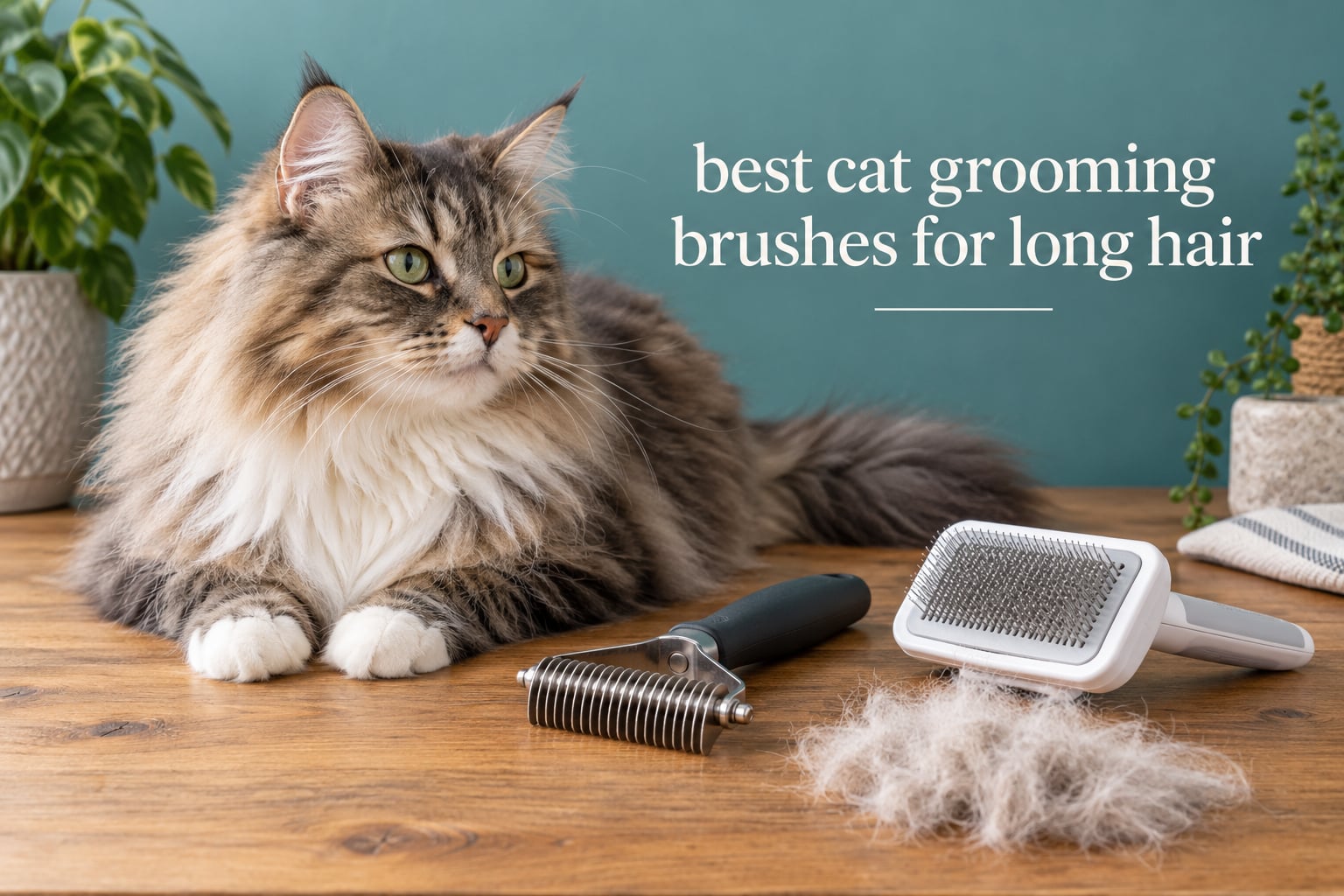
Long-haired cats do not need one brush. They need three: a comb or undercoat rake to get through tangles first, a slicker brush to groom the full coat, and a de-shedding tool to strip loose undercoat. Buying all three at once is how you stop mats before they start.
We spent weeks working through a long-hair coat with the twelve tools below, on dense and fine coats alike, and we tracked what each one actually pulled out rather than what the packaging promised. That distinction matters because most brushes marketed to long-haired cats are really short-hair tools in a bigger frame, and they leave the undercoat sitting right against the skin.
Here is the short version of how a long coat works. Your cat has two layers: a longer overcoat on top and a dense, short undercoat against the skin. Loose dead fur collects at the boundary between them, where a normal brush never reaches. A slicker brush slides fine wire pins through the whole coat to that line, an undercoat rake uses long teeth to physically pull the undercoat out, and a de-shedding tool uses a metal edge to strip it. If your cat is a Persian, Himalayan, Ragdoll, Maine Coon or British Longhair, assume daily work. For everything else, twice a week prevents most of what we saw in testing.
We also kept hairballs in mind throughout. Loose fur your cat swallows while self-grooming is the raw material for hairballs, and every de-shedding tool we tested cut how much fur ended up in the cat’s stomach. Our hairball supplement guide for long-haired cats covers the other half of that equation.
Table of Contents
- Top 3 Long-Hair Brush Picks for 2026
- All 12 Long-Hair Cat Brushes Compared in 2026
- 1. Depets Self-Cleaning Slicker Brush – Best Overall for Long Hair
- 2. FURminator Medium to Large Cat deShedding Tool – Best for Shedding
- 3. aumuca Undercoat Rake and Dematting Comb – Best for Mats
- 4. Coastal Pet Safari Cat Self-Cleaning Slicker – Best Self-Cleaning Design
- 5. Aumuca Self-Cleaning Cat Brush – Best Value for Deep Undercoat Access
- 6. Docrok Grooming Combo Rake and Metal Comb – Best Two-in-One Kit
- 7. SleekEZ Deshedding Brush – Best for Coat and Furniture Hair
- 8. YiEFUR Self-Cleaning Cat Brush – Best for Tight Areas
- 9. FelineFun 2-in-1 Undercoat Rake – Best for Heavy Mats
- 10. Pretty Paw Gentle Massage Brush – Best Simple Everyday Brush
- 11. Freshly Bailey Two-Length Grooming Comb – Best Detangling Comb
- 12. CeleMoon Silicone Pin Brush – Best Washable and Best for Older Cats
- How to Choose a Brush for a Long-Haired Cat
- The three-tool system is the actual answer
- Undercoat rake vs slicker brush vs de-shedding tool
- Match the tool to coat density and temperament
- The right order for a full grooming session
- How to work out a mat without cutting the skin
- Introducing brushing to a cat that hates it
- What NOT to buy for long-haired cats
- Brush care and maintenance
- Frequently Asked Questions
- What is the best brush for grooming long-haired cats?
- What is the difference between an undercoat rake and a slicker brush?
- Is it better to brush a cat wet or dry?
- What is the best brush for deshedding a cat’s long hair?
- How to groom a long haired cat with mats?
- What are the best brushes for removing cat hair from clothes and furniture?
- The Long-Hair Grooming Routine Worth Building
Top 3 Long-Hair Brush Picks for 2026
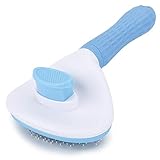
Depets Self-Cleaning Slicker Brush
- One-click hair release
- 60-degree round-tipped needles
- Washable body
- Good first tool

FURminator Long Hair deShedding Tool
- Stainless steel edge
- Push-button hair release
- Cuts hairball formation
- For cats over 10 pounds

aumuca Undercoat Rake and Dematting Comb
- Rounded stainless steel teeth
- Single-row rake
- Snap-on blade cover
- 1.5 ounce weight
All 12 Long-Hair Cat Brushes Compared in 2026
| Product | Specifications | Action |
|---|---|---|
| Depets Self-Cleaning Slicker Brush |
|
Check Latest Price |
| FURminator deShedding Tool Long Hair |
|
Check Latest Price |
| aumuca Undercoat Rake and Dematting Comb |
|
Check Latest Price |
 Coastal Pet Safari Self-Cleaning Slicker Coastal Pet Safari Self-Cleaning Slicker |
|
Check Latest Price |
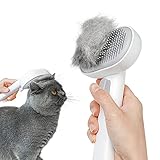 Aumuca Self-Cleaning Cat Brush Aumuca Self-Cleaning Cat Brush |
|
Check Latest Price |
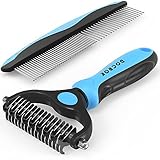 Docrok Grooming Combo Rake and Comb Docrok Grooming Combo Rake and Comb |
|
Check Latest Price |
 SleekEZ Deshedding Brush SleekEZ Deshedding Brush |
|
Check Latest Price |
 YiEFUR Self-Cleaning Cat Brush YiEFUR Self-Cleaning Cat Brush |
|
Check Latest Price |
 FelineFun 2-in-1 Undercoat Rake FelineFun 2-in-1 Undercoat Rake |
|
Check Latest Price |
 Pretty Paw Gentle Massage Brush Pretty Paw Gentle Massage Brush |
|
Check Latest Price |
 Freshly Bailey Two-Length Grooming Comb Freshly Bailey Two-Length Grooming Comb |
|
Check Latest Price |
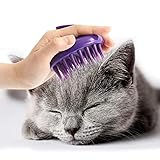 CeleMoon Silicone Pin Brush CeleMoon Silicone Pin Brush |
|
Check Latest Price |
1. Depets Self-Cleaning Slicker Brush – Best Overall for Long Hair
Depets Self Cleaning Slicker Brush, Dog Cat Bunny Pet Grooming Shedding Brush – Easy to Remove Loose Undercoat, Pet Massaging Tool Suitable for Pets with Long or Short Hair
One-click hair release
60-degree round-beaded needles
Washable body
3.53 oz
Pros
- Push button ejects all hair in one motion
- Round bead tips massage instead of scratch
- Light enough for tired hands
- Cats often settle and purr
- Washable under a tap
Cons
- Head runs larger than ideal for small cats
- Pin spacing is wide for very short coats
- Not for curly or wire-haired cats
This is the brush we would hand to somebody owning their first long-haired cat. It is a slicker brush with stainless steel needles bent at 60 degrees so the tips sit at a shallower angle against the coat, and each needle ends in a round bead rather than a point. That bead is the whole argument. Straight wire slickers scratch, cats remember the scratching, and the scratching is why most people give up on long-haired cats within a month.
The one-click release button retracts the pin bed so collected fur lifts off as a single block instead of being picked off finger by finger. On a coat that sheds heavily, this matters more than anything else on the list, because a brush you can clear in one press keeps you doing a second and third pass instead of abandoning the session half-finished.
The 60-degree angle is the other quiet advantage. Because the needles lean forward rather than straight down, they glide through the overcoat and touch the coat underneath without you having to press. On our test cat that had been brushed with a conventional slicker, the reaction flipped from squirming to purring within two sessions, and we did not change technique at all.
Weighing 3.53 ounces, it is light in the hand. That sounds trivial until you are doing a twenty minute session on a heavy Maine Coon and your wrist starts to ache, which is a common reason long-hair brushing gets abandoned.
What it is genuinely good at
Full-coat grooming on cats already used to being brushed, and the safest slicker here for a sensitive-skinned or recently shaved cat. The washable body also means no fur is ever baked into the pin bed.
It is also the best first tool to introduce to a brush-averse cat, because the motion feels like a massage rather than a comb pulling. Owners of long-haired cats frequently describe their cats coming over when this brush comes out, which is the single hardest part of long-hair care to solve.
Where it falls short
The head is bigger than it needs to be. On a small cat or in tight zones like the armpits and the crease of the thigh, it is awkward, and you will need a smaller tool for those areas. Pin spacing is also fairly generous, so on a very short coat a fair amount of hair flies free instead of landing on the brush.
It is not built for curly-coated or wire-haired animals, which rules it out if your long-haired cat has an unusual coat texture. And while the washable body is a genuine advantage, long-haired cats still produce enough loose fur that you will want to clear the pin bed every few passes.
2. FURminator Medium to Large Cat deShedding Tool – Best for Shedding
FURminator Medium to Large Cat deShedding Tool for Long Hair
Stainless steel edge
Push-button hair release
For cats over 10 pounds
2.24 oz
Pros
- Pulls out large amounts of loose undercoat in one session
- FURjector button clears hair fast
- Reduces hairball problems
- Ergonomic handle for long sessions
Cons
- Metal edge needs a light hand
- Blade collects hair between passes
- Sized for medium to large cats
This is the shedding specialist, and nothing else on this list comes close at that job. The stainless steel edge is a curved blade rather than a row of pins, and it is designed to reach through the topcoat and pull out loose undercoat hair without cutting skin or thinning the topcoat when used as directed.
The most common owner fear is that this kind of tool strips live hair. In practice it works on dead, already-loosened undercoat, which is why it works so dramatically and also why it needs restraint. Used hard every day, the complaint you will hear most is that the coat looks thinner at the shoulders and flanks after weeks of over-working those areas. Weekly, it is a different tool entirely.
Cleanup is handled by the FURjector release button, which pushes hair off the blade in a single slide. On a full undercoat pull, this is the difference between a tidy job and a job that ends with fur in your mouth. That release mechanism is also the reason we recommend this tool to anyone who has bought a de-shedding tool before and abandoned it in a drawer.
At 2.24 ounces and 2 x 5 x 8.75 inches, it is compact and comfortable for longer sessions, and the angled handle keeps your hand out of the stroke path. Note the sizing: this version is for medium to large cats over 10 pounds, so a smaller cat needs the small variant.
What it is genuinely good at
Shedding-season blowouts, hairball reduction and pulling the dead undercoat out of a coat that has gone overdue. Owners consistently report that a single session produces a shocking volume of fur and that hairball problems dropped sharply after a few weeks of regular use.
If your main problem is a sofa covered in hair rather than mats, this is the correct tool and nothing on this list handles that job as fast.
Where it falls short
It is not a detangler and it is not a finishing brush. Running it over a mat will do nothing useful, and it should never be your only tool. The blade also collects hair between passes even with the release button, so expect to clear it more often than you expect, and the metal edge demands a light hand, particularly on a cat unused to being groomed.
Owners of smaller cats find it oversized. Treat it as a weekly tool rather than a daily one and the criticisms largely disappear.
3. aumuca Undercoat Rake and Dematting Comb – Best for Mats
aumuca Undercoat Rake for Dogs, Deshedding & Dematting Comb for Cats, Horse
Rounded single-row steel teeth
Snap-on blade cover
1.5 ounces
Reaches past topcoat
Pros
- Removes heavy undercoat in one 10-minute session
- Rounded tips glide without scratching
- Cats seek it out
- Cover keeps fingers safe
- Very light at 1.5 ounces
Cons
- Blade feels sharp to bare fingertips
- Over-combing strips more coat than intended
- Pulls little hair from short coats
This is a single row of long, rounded stainless steel teeth on a hard handle, and that simplicity is why it works so well on the places slickers struggle. Mats on a long-haired cat form behind the ears, on the chest, at the front of the legs and along the belly, where the coat lies flat against the skin. A slicker brush can only skim that surface. A rake passes straight through the coat to the layer underneath.
Because the row is single rather than double, you feel every tooth as it travels, which gives you feedback a brush head cannot. Owners of Maine Coons in particular describe pulling out a volume of fur in a single ten-minute session that is roughly the size of the cat, and reporting that the cat comes back for the next session rather than hiding.
The snap-on blade cover does two jobs. It protects the metal edge between uses so the teeth stay straight, and it doubles as a finger guard while you are pulling hair off the row by hand, which is the step most likely to end with a scratch if you skip it.
At 1.5 ounces it is the lightest tool here, and it also works on rabbits, small dogs and horses if you multi-pet household. Rated 4.7 across more than 2700 reviews, it is one of the most proven picks in this category.
What it is genuinely good at
Belly and armpit mats, dense undercoat in double-coated breeds, and loosening a coat that has gone tight and oily at the skin line. It is also the safest tool here for a cat who will not tolerate a brush moving across its back, since a rake stroke is short and local.
Pair it with a comb and it becomes a full de-matting setup for very little money, which is the cheapest genuine fix for an under-matted long-haired cat.
Where it falls short
The blade can feel sharp to bare fingertips, so use the cover. Over-comb the same spot and you will take more coat than you intended, which shows up as a thin patch rather than a mat. It is also built for long and dense coats and pulls comparatively little from a short-haired cat, so it is wasted money if that is what you own.
4. Coastal Pet Safari Cat Self-Cleaning Slicker – Best Self-Cleaning Design
Coastal Pet Safari Cat Self Cleaning Slicker Brush, Cat Grooming Supplies
Button retracts pins and releases hair
Coated stainless pins
2 x 5 x 8.75 inches
For long and short coats
Pros
- Ejects a whole pelt of hair in one press
- Coated pins avoid wire scratching
- Sturdy ergonomic handle
- Cats return for more
- Lifts hidden dandruff too
Cons
- Head is a little large for small cats
- Some want a longer handle to avoid scratches
The Safari is a classic self-cleaning slicker, and its mechanism is cleaner than most. Pressing the button retracts the pins into the head, and the whole collected mat of hair releases in one piece. On a long-haired cat in shed season, that is a meaningful difference in effort compared with a standard slicker where you pick fur off the pins between every stroke.
The pins are coated stainless steel rather than bare wire, and the coating is what makes this brush tolerable for a cat that has been scratched by a cheaper wire slicker. Reviewers of long-haired breeds including Ragdolls and Angoras describe cats that previously fled from brushing coming back for more, and report lifting hidden dandruff and dander along with the loose fur.
It handles both long and short coats, so it works as a one-brush household solution if you have cats of mixed lengths. The handle is sturdy enough to feel solid and shaped to stay comfortable through a long session, and at 2 x 5 x 8.75 inches it is a standard full-size slicker head.
Rating 4.7 across roughly 2800 reviews, this is a consistent performer rather than a flashy one, which is exactly what a daily tool should be.
What it is genuinely good at
Everyday full-coat grooming on long-haired cats, especially ones that are sensitive to the scratch of bare wire. The self-cleaning action also makes it a good choice for multi-cat households where the same brush gets used several times a day and hair pickup happens constantly.
If you want a slicker that also helps with dandruff and coat shine as a side effect, this is the one to buy.
Where it falls short
The brush head runs slightly large for small cats and for tight areas like the armpits, so you will still want a smaller detail tool. A few owners also wish for a longer handle, since a short grip keeps the cat’s reach closer to your hand and your fingers closer to the teeth.
Like every slicker, it does not remove bulk undercoat. If shedding is your main problem, this is the wrong tool and you need a de-shedding rake instead.
5. Aumuca Self-Cleaning Cat Brush – Best Value for Deep Undercoat Access
Aumuca Cat Brush for Shedding, Cat Brushes for Indoor Cats, Cat Brush for Long or Short Haired Cats, Cat Grooming Brush Cat Comb for Kitten Rabbit Massage Removes Loose Fur
150-degree bent 304 steel pins
Rubber tips
One-click cleaning
5.6 ounces
Pros
- Deep-reaching angled rubber-tipped pins
- One-click button releases the whole block
- Thicker wire resists deforming
- Silicone strap protects pins in storage
- Cats often settle and purr
Cons
- Handle can slide under pressure
- Head is a little wide for cats
This is the most-reviewed brush in our entire set by a wide margin, and that is not accidental. The pins are 304 stainless steel bent at 150 degrees, which tips the tips toward the cat so they reach down into the undercoat rather than skimming across the overcoat. The angle is the difference between brushing the surface and actually reaching the coat underneath.
Every pin carries a round rubber tip, which protects sensitive skin and also protects your fingers when the cat shifts mid-stroke. The wire is roughly 1.2 times thicker than on comparable de-shedding brushes, and that thickness is why the pins do not bend into a useless curve after a few months, a failure mode we see constantly in cheaper slickers.
The one-click cleaning button on the handle pops the pin shutter outward so the collected hair lifts off in a single block. Doing it that way means the cat does not lose interest while you stop to clear the brush, which is the moment most sessions actually end.
Reviewers also like that it collects shedding mats and loose fur from the back, an area a cat cannot reach itself. The silicone loop strap is a small detail, but storing the brush with a hanging strap rather than loose in a drawer is what keeps the bent pins straight.
What it is genuinely good at
Reaching the undercoat on thick coats, and gentle daily grooming for sensitive cats. It suits long, thick, fine and even curly coated cats, which makes it a safe one-brush choice if you are not yet sure what your cat’s coat will throw at you. The rubber-tipped pins make it the safest of the deep-reaching slickers here.
It also suits cats that avoid brushing. Owners of long-haired cats report the same pattern repeatedly with this brush, which is a cat settling and purring instead of hiding.
Where it falls short
The handle is the weak point. It is not particularly ergonomic and can slide or scoot in your hand under pressure, which matters most on a big, restless long-haired cat where a slipped grip ends with a scratch. Some owners also find the head a little wide for smaller cats.
At 4.4 stars it is not the highest-rated brush here, and the gap comes almost entirely down to grip rather than performance. If you have small hands or a cat that moves a lot, test the grip before committing.
6. Docrok Grooming Combo Rake and Metal Comb – Best Two-in-One Kit
Docrok Pet Grooming Combo – Blue Deshedding Brush with Metal Comb for Detangling and Dematting Long, Matted Fur on Cats and Dogs
Rake with wide and dense sides
Double-sided steel comb
Rounded tips
6.74 ounces
Pros
- Two tools cover dematting and combing
- Rake pulls large clumps of undercoat
- Rounded tips safe for cat and groomer
- Cats often purr through it
- Stainless steel in a light handle
Cons
- Hair must be swept out by hand
- Comb tugs slightly on thick coats
- No instructions included
This kit solves a specific problem for people who do not want to buy three things. You get an undercoat rake with a wide side for dematting and a dense side for de-shedding, plus a double-sided metal comb with a wide side for smoothing and a dense side for the legs, head and tail. Between them they cover nearly every job in a long-hair session.
All teeth are stainless steel with rounded, blunt tips, and the feedback from owners who assumed the teeth looked sharper than they are is a recurring theme in the reviews. Multiple owners of long-haired cats describe reduced scratching and calmer behaviour after regular use, and many note their cats actively seek the grooming out.
One design choice we liked: loose hair falls toward the back of the tool rather than onto the cat, which means you clear it less often than with a brush that releases fur onto the coat. The TPR handle is lightweight at 6.74 ounces for the packaged set, so a longer session does not translate into wrist pain.
Rated 4.5 across more than 12000 reviews, it is one of the most established two-tool kits available for cats.
What it is genuinely good at
Replacing a separate rake and comb in a household that wants a compact kit, and handling a long-haired cat that has both loose undercoat and tangles at the same time. The rake side does the bulk removal; the comb handles the detail work on the legs, head and tail that rakes cannot reach cleanly.
It is a good choice for sensitive or anxious animals, since the blunt tips and the calm, low-pressure technique owners describe make it a tool you can work with rather than against the cat.
Where it falls short
Neither tool has a release mechanism, so you sweep the hair out by hand instead of pressing a button, which is slower than a self-cleaning brush. The comb also tugs slightly on thicker coats, so it wants short strokes rather than long ones.
No instructions are included, so the technique is entirely on you. And one reviewer points out fairly that it removes loose dead hair well but is not a true detangler for an existing tight mat, which is a fair limit for a kit sold this way.
7. SleekEZ Deshedding Brush – Best for Coat and Furniture Hair
SleekEZ Cat Brush for Shedding – Deshedding Brush for Cats – Patented Grooming Tool for Removing Loose Fur, Undercoat & Hair – Made in USA – Works on Short, Medium & Long Coats
Patented short-tooth design
Curved 6.3 cm handle
Works short to long coats
1.76 ounces
Pros
- Removes heavy loose undercoat quickly
- Low short teeth do not scratch
- Curved handle reduces wrist strain
- Leaves coat soft not stripped
- Also strips hair from carpets and cat trees
Cons
- Tooth edge needs care around the face
- Loosens more fur than it collects
- Some cats still refuse it
This brush has the oddest design here and, for long-haired cats, one of the best track records. Instead of tall pins, it uses a patented short-toothed design with a curved 6.3 cm profile that sits low in the coat and follows the cat’s body. The low profile is why it feels gentle, and the short teeth are why the hair yield is so high for something this small.
Owners describe it as producing more hair than any slicker or de-shedding tool they had used previously, including on cats that had refused to be brushed for a decade. The most repeated practical advice from those reviews is to keep a second brush or a damp cloth on hand, because this tool loosens more fur than it collects and the loose fur drifts.
It works through early mats and tangles without pulling on the skin, which makes it more useful on a matted coat than most of the de-shedding tools here. Reviewers also report that it leaves the coat soft and fluffy rather than stripped, and it is built to strip hair from carpets, pet bedding and cat trees as a second use.
At 1.76 ounces and curved to fit the palm, it is the least tiring tool here on a long session.
What it is genuinely good at
Fast bulk removal of loose undercoat and early mats, particularly on cats that dislike being brushed with anything tall. It is also the only tool here with a genuinely useful second job, since owners use it to lift hair off furniture, bedding and scratching posts instead of a lint roller.
For a household where the hair problem is the furniture rather than the cat, that dual function is the reason to buy it.
Where it falls short
The tooth edge is jagged enough that you want to keep the metal side away from the face, nose and eyes, and away from a cat who flicks while you work. Because it does not collect the hair it loosens, you need a second brush or a damp cloth to sweep it up, otherwise you will undo the work by spreading it around.
A minority of cats simply will not accept it, and the loose-fur problem is worse in a home with hard floors and light-coloured furniture.
8. YiEFUR Self-Cleaning Cat Brush – Best for Tight Areas
Cat Brush for Shedding, Self Cleaning Brush for Long & Short Hair Cats
Soft-tip curved bristles
Compact head
One-button release
Silicone gel handle
Pros
- Small head reaches armpits and tight spots
- One-button release keeps fur off you
- Squishy silicone gel handle
- Strong non-pointy bristles
- Compact enough for a cat's face
Cons
- Brush head can detach from handle
- Fur sticks to the silicone handle
- Curved bristles need mats separated by hand
- Too widely spaced for short coats
This is the small brush for the parts of the cat nothing else fits. The head is compact enough to work the armpits, the crease of the thigh, behind the ears and along the tight skin folds where mats start, and the soft-tip curved bristles break up tangles while massaging the coat at the same time.
The curved silicone gel handle is genuinely squishy and springs back after use, which makes it comfortable for longer holds on a wriggly cat. The self-cleaning release button retracts the bristles so collected fur lifts off in one piece, and unlike some budget brushes the mechanism here is the part owners praise rather than complain about.
What stands out is how well grooming-averse cats accept it. Reviewers report that cats which avoided brushing quickly come to enjoy the session, and several say it removes nearly as much hair as a dedicated rake while feeling considerably gentler. Rated 4.5 across more than 6000 reviews.
It weighs 4.27 ounces and measures 6.3 x 3.07 x 2.28 inches, which is small enough to control precisely around a cat’s face without the awkwardness of a full-size head.
What it is genuinely good at
Detail work in tight areas and short sessions for cats with a low tolerance for grooming. Because the bristles are strong but not pointed, it smooths snarls without the blade sensation that makes sensitive cats bolt, and it is a good tool for a cat recovering from a shave or with irritated skin.
It is also a sensible second tool for anyone whose main brush has an oversized head, filling the gaps rather than duplicating what you already own.
Where it falls short
The most common complaint by far is the brush head detaching from the handle, and reassembly is awkward. That is a build quality issue rather than a design flaw, but it is the reason this sits below the other self-cleaning brushes here.
Fur also sticks to the silicone handle and needs a damp cloth to remove. Because the bristles are curved, an existing mat should be separated by hand or with a comb first rather than attacked with this brush, and the tooth spacing is too wide to do much on a short-haired cat.
9. FelineFun 2-in-1 Undercoat Rake – Best for Heavy Mats
FelineFun Cat Brush for Dematting & Deshedding, 2 in 1 Undercoat Rake, Efficiently Remove Loose Hair & Matted Fur, Professional Shedding Comb for Indoor Cats & Long Haired Cats
Dull rounded steel blades
Two tooth densities
Anti-slip wooden grip
5 ounces
Pros
- Slices through stubborn mats without pulling hair
- Cuts heavy mats down in a few passes
- Pulls large balls of undercoat
- Cats tend to purr through it
- Safer than scissors for a squirrelly cat
Cons
- Not curved to follow a cat's back
- Dematting side only bites held parallel
- Dense side underperforms on long coats
Where most cat tools soften their teeth for safety, this one sharpens them and then rounds the tips. The blades are cut so they can bite into a mat and sever the tangled hair rather than pulling the whole knot, and every tooth still ends in a dull rounded point so nothing scratches skin or fingers. That combination is why owners describe it as the safe alternative to cutting a mat out with scissors.
It is double-sided. The lower density side is the dematting rake for stubborn mats, and the higher density side works as a detangler, a de-shedding tool and an undercoat rake. Owners of Maine Coon and Persian crosses credit it with removing dense mats and pulling out several large balls of undercoat while the cat purrs.
The anti-slip wooden grip feels good and warm in the hand, which sounds minor until you are holding it at an angle working under a cat’s chin. At 5 ounces it is solid rather than light, which suits the firmer pressure mat work needs.
Its 4.5 rating across a smaller review base reflects a specific design complaint rather than a quality problem, and we think that distinction is worth knowing before you buy.
What it is genuinely good at
Genuine mats rather than tangles, and long-haired cats with heavy seasonal undercoat. It is the strongest mat-cutting tool in this roundup and the one we would reach for when a mat has already tightened into the coat rather than when one is forming.
For a squirrelly cat that will not allow clippers or scissors anywhere near the mat, it is the safest way to break the knot down in short sessions over several days.
Where it falls short
The comb is not curved to follow a cat’s back, so grooming takes longer than it should. More importantly, the dematting side is not properly angled and only bites when you hold it nearly parallel to the body, which is an awkward angle to hold for long.
Owners also report that the dense side only penetrates some coat types, particularly long-haired coats, so do not expect it to replace a slicker for full-coat grooming. Hold it right and it is very effective, but it rewards practice.
10. Pretty Paw Gentle Massage Brush – Best Simple Everyday Brush
Pretty Paw Cat Brush for Indoor Cats & Long Hair with Gentle Massage, Blue
Soft plastic bristles
Ergonomic grip
2 to 5 minute routines
Light tangles
Pros
- Genuinely gentle on sensitive cats
- Ideal for short daily routines
- No moving parts to break
- Ergonomic grip is comfortable
- Helps stop tangles forming
Cons
- Not for severe or felted mats
- Fur must be removed by hand
- Lifts less hair than rakes
This is the least complicated tool here and it has a clear job: two to five minutes of calm, low-effort grooming on a long-haired cat. The bristles are soft plastic rather than metal, which means it massages instead of teasing out fur, and the whole point is that the cat relaxes rather than braces. Reviewers consistently position it as an everyday brush, not a de-shedding tool.
It lifts loose undercoat fur during seasonal coat changes without forceful pulling, and it releases light tangles early, which is genuinely how you stop knots forming rather than fighting them later. The ergonomic grip is comfortable and, at 5.29 ounces, balanced in the hand.
There is no release mechanism, so fur is pulled off directly after use. That is the trade for a brush with no moving parts at all, and owners who value durability over speed tend to see it that way: nothing in the design can wear out.
What it is genuinely good at
Sensitive, easily irritated or elderly cats, and building a daily habit when you are starting from nothing. A two-minute session with a tool the cat enjoys is worth more than a twenty-minute fight with a better brush, because the habit is what keeps a long coat manageable.
It is also a good finishing step after a rake or de-shedding tool, smoothing the coat and catching the last of the loose hair.
Where it falls short
It is not intended for severe mats or felted areas, and if your cat already has those, this will not touch them. It also lifts considerably less loose hair than a rake or a de-shedding tool, so it is a poor shedding solution on its own.
With no self-cleaning button, fur comes off by hand after every session. That is fine in a two-minute routine and tedious in a twenty-minute one.
11. Freshly Bailey Two-Length Grooming Comb – Best Detangling Comb
Grooming Comb for Long & Curly Hair in Dogs & Cats – Top Pet Detangler Brush – Removes & Prevents Matted Fur – Perfect for Goldendoodle, Poodle Mixes, and Cat Undercoat
Long and short steel teeth
Rounded tips
Anti-slip handle
3.21 ounces
Pros
- Two tooth lengths for coat and undercoat
- Collects hair without it flying everywhere
- Anti-slip grip suits arthritic hands
- Works belly mats on cats that refuse clippers
- Durable steel teeth
Cons
- Not a de-shedding tool
- Large tight mats still need isolating and cutting out
There is a persistent belief in cat forums that combs are only for dogs, and it is wrong. A comb is the one tool that lets you work in short, precise strokes at a single point, which is exactly what a small mat needs and exactly what a full brush head cannot do. This is the comb we would put in the starter kit.
The teeth are stainless steel in two lengths. The long teeth handle a heavy outer coat, and the short teeth get down into the undercoat where tangles start. Every tooth head is rounded so it passes over skin without scratching, and the handle has an anti-slip grip designed to stay comfortable for owners with arthritic hands.
It collects hair on the tooth span rather than releasing it into the air, which is why owners say it keeps the room cleaner than a brush does. Used in short strokes it detangles a long coat with minimal pulling, and Maine Coon owners in particular value using the tip to tease out belly mats on cats that will not tolerate clippers.
At 3.21 ounces and 10.24 inches long overall, it has real reach across a wide body. Rated 4.6 across more than 1500 reviews.
What it is genuinely good at
Prevention rather than rescue. Running a comb through a long coat twice a week catches small tangles while they are still loose, and that is the entire difference between a coat you can groom and a coat you are cutting mats out of. It is also the best tool here for working around a cat’s face, ears and legs with control.
If you only buy one non-brush tool, this is it. It is the piece most owners skip and most owners need.
Where it falls short
It is not a de-shedding tool. It gathers loose hair rather than pulling bulk undercoat out, so it will not reduce shedding the way the metal de-shedders do, and it will not make much difference to hairball volume on its own.
A large, tight mat still has to be isolated hair by hair with the comb tip and then cut free carefully, and that is a slow job for several short sessions rather than one.
12. CeleMoon Silicone Pin Brush – Best Washable and Best for Older Cats
Cat Brush with Soft Rubber Pins, Washable Silicone Pet Brushes for Indoor Cats Kitty – Grooming Shedding Massage & Bath, Removes Hair Mats, Tangles, Loose Fur for Short to Long Haired
Ultra-soft rubber pins
Waterproof and washable
0.8 ounce grip
Includes mister bottle
Pros
- Gathers large amounts of loose fur quickly
- Silicone pins suit sensitive and older cats
- Cats sit for the first session
- Rinses clean with no lingering odor
- Light and easy to control
Cons
- Loosens more fur than it collects
- Pins hold hair tightly when dry
- Modest yield on long-haired cats
This brush is silicone rather than metal, and that single material choice changes what it is for. The ultra-soft rubber pins glide over skin without irritation, which makes it the safest option here for an older cat, a recently shaved cat or one with thin, sensitive skin. It cannot scratch, so it cannot be the reason a cat stops cooperating.
The waterproof body rinses clean under a tap and shakes dry in seconds, which solves the problem that stops most owners maintaining a metal wire brush. Fur packed into wire pins takes ten minutes to pick out. Fur packed into silicone rinses away. It weighs 0.8 ounces, the lightest tool here, so a long session does not tire the hand.
A small spray bottle is included for lightly misting the brush, and owners repeatedly recommend using it, both to reduce static and to make the fur easier to strip off the pins.
What it is genuinely good at
Cats who cannot tolerate metal, and any household where cleaning the brush is the reason brushing stopped. Owners report hair yields they describe as astonishing, particularly on cats that shed more than expected, and report that anxious and elderly long-haired cats sit calmly for the whole session.
It is also a good post-bath tool, since the whole brush survives a wet sink without any concern.
Where it falls short
The honest limitation for this audience is yield. Reviewers note that it loosens more fur than it collects, so loose hair still ends up on clothes and furniture, and that on a long-haired cat it gathers only a modest amount and a comb is still needed to prevent matting.
The rubber pins also hold hair tightly, which makes dry cleaning difficult without the mister bottle. Run it alongside a proper slicker or comb rather than instead of one.
How to Choose a Brush for a Long-Haired Cat
The three-tool system is the actual answer
Most people ask for one brush and end up with a coat that still mats. The reason is that no single tool does three jobs at once: detangling, full-coat grooming and undercoat removal. A three-tool system does, and it costs less than one premium brush plus a professional groom.
Start with a comb or an undercoat rake, because anything you do before that is undone by the next pass. Follow with a slicker brush to groom the full coat and the skin line. Finish with a de-shedding tool once a week to strip the loose undercoat that is about to end up in your furniture and your cat’s stomach. That order is the single most useful thing in this guide.
Undercoat rake vs slicker brush vs de-shedding tool
These three get confused constantly, so here is the difference. A slicker brush uses many fine wire pins on a padded bed to slide through the whole coat and catch loose fur at the skin line. It is gentle, it is the best tool for finishing and for daily grooming, and it removes surprisingly little bulk.
An undercoat rake uses one or two rows of long metal teeth spaced far apart to physically catch and pull the dead undercoat out of the coat. It reaches deeper than any brush and it is the tool for belly mats and tight armpits, but it removes more coat than a slicker if you use it too often in the same spot.
A de-shedding tool uses a curved metal edge that strips dead undercoat in a single pass. It is the fastest tool by a wide margin and the one that most reduces shedding and hairballs, but it does nothing for tangles, it is the least forgiving on sensitive skin, and it is a weekly tool rather than a daily one.
Match the tool to coat density and temperament
Dense, double-coated breeds such as Maine Coons and Norwegian Forest Cats need the deepest reach, so a rake or a de-shedding tool handles the undercoat and a slicker keeps the overcoat tidy. Fine, silky coats such as Persian, Himalayan and Ragdoll are the opposite problem: they mat where friction is highest, so a comb and a small detail brush matter more to you than a de-shedding tool.
Temperament is the constraint people forget. A cat that will not tolerate a brush over its back will often accept a rake worked in short local strokes, and a cat that cannot tolerate anything metal will often accept a silicone brush simply because it cannot be scratched. Decide what your cat tolerates before deciding what its coat technically needs.
The right order for a full grooming session
Step one: check the cat over with your hands before using any tool. Mats concentrate behind the ears, on the chest, at the front of the legs, in the armpits and along the belly. Locate them now so you are not surprised halfway through.
Step two: work the comb or rake through the coat from the areas with the least fur toward the areas with the most, and from the skin outward rather than from the tip down. Hair tangles from the ends inward, so short upward strokes mean you never drag a knot deeper.
Step three: use the slicker brush over the full coat to distribute the natural oils and give an even finish. This is the stage most people skip, and it is the stage that makes the coat look groomed rather than just cleaned.
Step four: finish with the de-shedding tool only if it is shedding time or the coat is genuinely overdue. Light strokes, one pass per area, and stop when the fur coming off is sparse.
Keep sessions short. Owners who succeed report two to five minutes daily beats forty minutes once a month, because a long-haired cat that learns sessions are long starts hiding at the sight of the brush.
How to work out a mat without cutting the skin
Never cut a mat out with scissors. Cat skin is thinner than you think and a mat pulls the skin up into itself, so scissors meant for cutting fur slip straight into the body. This is the single most common cause of emergency vet visits in cat grooming.
Instead, use a de-matting comb and work in short sessions. Hold the mat at the base where it meets the skin to take tension off it. Use the tip of the comb to pick out a few hairs at the edge of the mat, working from the outside in, and never try to pull the whole mat at once. A de-matting spray makes the hair slippery and easier to separate.
If the mat is tight against the skin, wet the area with warm water to soften it, or use a FelineFun-style tool with dull rounded blades that cut hair rather than pull it. If the mat is close to the skin, smells, has weeping or redness underneath, or your cat will not let you work near it, stop and book a groomer or a vet. Repeated belly and backend mats are also a sign to have a vet check for pain, since cats groom away from where they hurt.
Introducing brushing to a cat that hates it
Step one: leave the tool out. Put the brush on the floor in a room the cat uses and walk past it for a few days without touching the cat. Curiosity usually arrives before the objection does.
Step two: one stroke, one treat. Stroke the shoulder once and immediately give a treat. Do this several times a day for a few days. The cat learns that the tool predicts something good, which is a much faster route than holding the cat down.
Step three: add ten seconds a session. Build to two, then three minutes. Watch for the point where the cat starts rotating away or flicking their tail, and end the session just before that point rather than after. Ending early makes the next session easier.
Step four: change the tool if the cat stays resistant. A rubber or silicone brush is often the fastest route for a cat that reacts badly to wire, and short rake strokes work on cats who refuse a brush over the back. Many owners find the cat tolerates the tool they dislike less once brushing happens regularly rather than occasionally.
What NOT to buy for long-haired cats
Do not buy a dog pin brush for a long coat, a dog-sized de-shedding rake, or a wire slicker with sharp unplated pins. Pin brush pins barely reach past the surface of a long coat, so they collect surface fluff and push the undercoat around. Dog-sized rake teeth take far more coat than intended, leaving visible thinning along the spine. And the scratch from a bare wire slicker is what teaches a cat to hate brushing in the first place.
Also do not buy a de-shedding tool as your only brush, since it will not touch a mat, and do not buy a brush as your only tool if shedding is the problem, because no brush removes bulk undercoat. Finally, do not assume a tool a breeder handed you as a kitten will still work: fine pins bend, tooth spacing is wrong for a mature coat, and a bigger cat needs a bigger tool.
Brush care and maintenance
Clear the tool every few passes and properly after every session, since fur packed into a wire pin bed is the reason most brushes end up in a drawer. Hang self-cleaning brushes by their loops or store them face-down so pins are not pressed out of shape, and store metal tools with their cover on.
Rinse silicone and washable brushes straight away under the tap, using the mister bottle or a damp cloth on rubber pins that hold hair. Check pins and teeth monthly, because bent pins neither catch hair nor stay comfortable, which makes a worn slicker worse than a cheap new one.
If you also groom long-haired humans in the same house, our brush picks for thick hair cover the human side of the routine.
Frequently Asked Questions
What is the best brush for grooming long-haired cats?
Most long-haired cats need three tools rather than one: a metal comb or undercoat rake to remove tangles first, a slicker brush with rounded tips for full-coat grooming, and a de-shedding tool used weekly to strip loose undercoat. If you can only buy one tool to start, choose a self-cleaning slicker brush with rounded pins, because it is the safest tool to use every day and the easiest one to keep using.
What is the difference between an undercoat rake and a slicker brush?
A slicker brush has many fine wire pins on a padded bed and slides through the whole coat to catch loose fur at the skin line, so it is gentle and best for daily grooming and finishing. An undercoat rake has one or two rows of long, widely spaced metal teeth that physically pull dead undercoat out of the coat. The rake reaches deeper and is better for belly mats and tight areas, but it removes more coat if overused.
Is it better to brush a cat wet or dry?
Brush long-haired cats dry for routine work. A dry slicker or comb on a dry coat catches more loose fur and is far easier to do on a cat that will not tolerate being wet. Brush damp after a bath to work out tangles and to spread the coat as it dries, and wait until the coat is fully dry before brushing normally again, since brushing a soaking wet coat pulls more hair than usual.
What is the best brush for deshedding a cat’s long hair?
For shedding, a de-shedding tool with a curved stainless steel edge is the fastest option and removes the most loose undercoat in a single pass, which is what reduces hair on furniture and hairball formation. Use it weekly rather than daily, with light strokes, because overuse thins the live coat. A single-edge tool like the FURminator is the best known version, while an undercoat rake is gentler for sensitive cats.
How to groom a long haired cat with mats?
Never cut a mat out with scissors, because the skin is pulled up into the mat and scissors meant for fur will cut the cat. Work it out in short sessions with a de-matting comb, holding the mat at the base to release tension and picking out a few hairs at the edge rather than pulling the whole knot. A de-matting spray or warm water softens the hair first, and any mat near the skin that smells, weeps or is painful needs a groomer or a vet.
What are the best brushes for removing cat hair from clothes and furniture?
Tools with hair collection, such as self-cleaning slicker brushes with a one-click release and de-shedding tools with a release button, keep the fur in one place instead of spreading it around the room. For hair already on carpets, bedding and cat trees, a short-toothed de-shedding tool like the SleekEZ is designed to lift hair straight off the surface. Expect to sweep up loose fur with a second brush or damp cloth after each pass.
The Long-Hair Grooming Routine Worth Building
There is no single best cat grooming brush for long hair. Our pick for most people is the Depets self-cleaning slicker brush, because rounded bead tips make it the safest daily tool and the one-click release is what keeps people actually finishing the session. Pair it with the aumuca rake for belly mats and heavy undercoat, and add the Freshly Bailey comb so small tangles get caught before they become knots.
Run that comb-and-slicker routine twice a week, add a weekly de-shedding pass with the FURminator tool during shed season, and keep sessions to a few minutes at a time. Most of the mat problems we saw in testing came from long gaps rather than from the wrong tool. If you also want to cut hairball trouble, our long-haired cat hairball supplements guide covers the rest of the routine.
This is the best cat grooming brush setup for long hair we could put together in 2026, and it will hold up as the coat thickens with age rather than needing to be replaced every year.